
UNIVERSITÀ. — In the sense that is exclusive to the word today, it is the school of the higher order in which, according to current practice, letters and sciences, or at least the disciplines belonging to certain faculties, are publicly taught at an advanced level, and the entire education of the young receives its final completion. In its origins and initial development, it is connected with the doctrinal movement that began to mature in the early Middle Ages (v. SCUOLA, VI).
I. THE ORIGINS
In chronological order, the first university was undoubtedly that of Salerno (v. SCUOLA), made famous by its medical school from as early as the middle of the 11th century and remaining for approximately two centuries the most distinguished European centre of medical science. The abbey of Montecassino certainly played a part in its formation, but nothing is known of its organization until 1231, when Frederick II, who had founded the University of Naples in 1224, decreed that it should be the Kingdom’s only faculty of medicine. It therefore had an origin and life of its own, and very little in common with the great university movement elsewhere in Europe, except insofar as it contributed to the development of medical science when this was introduced into the universities themselves.The emergence of these institutions was prompted, on the one hand, by the thirst for knowledge, which was already becoming more active in the 11th century, generating ever-new energies throughout the Christian West; and, on the other, by the development of social life which, freeing itself increasingly from the constraints of feudalism, led in the cities to the formation of universitates, that is, corporations practically recognized by the public authorities, in which those who felt the need and interest to do so joined together, establishing common regulations for the defense of their rights and the enlargement of their sphere of influence. From as early as the 10th–11th centuries, the clergy too, in the more populous places, took steps to establish their own corporations outside the ecclesiastical institutions of which they were members. It is therefore no surprise that masters and students, wherever they were more numerous, organized themselves to safeguard their class interests through mutual agreements among themselves and in their relations with the seigneurial or communal authorities.
II. THE ORGANIZATION
Studium generale, the name that more properly and officially designates the medieval university as an institution of learning, is to be understood in the sense of “a place of study open to all,” which the public could attend without distinction of class or membership in particular ecclesiastical groups. It was therefore general with regard to persons, not with regard to the disciplines taught there, which could be restricted to a single Faculty. The term universitas, on the other hand, designates rather the corporation (corpus, collegium, societas) and always implied the specification magistrorum, or scholarium, or both together. And just as every craft corporation, in order to defend its members against illicit competition from others, established the rules for entry into the corporation itself and for remaining within it, and granted the right to practice that craft according to sound principles, so the universitas magistrorum, after a suitable examination, granted the licentia o facultas (whence the name faculty for designating the body of a particular field of instruction) ubique docendi, thus guaranteeing the competence of the person who had been promoted.The student was thereby admitted into the class of teachers with the title of doctor or magister and, as such, could teach in the Faculty; in reality, only very few remained to teach in the studium; the majority, having obtained the doctoral degree, did not occupy the chairs of their teachers and did not lead to the establishment of new chairs or new universities, but devoted themselves to teaching in non-university schools, or practiced professions in which teaching was not an integral part. The first universities, on which the others were modeled, did not arise all at once, nor through the specific will of any particular person; they arose gradually, determined by particular needs and with the concurrence of favorable circumstances. The heated controversies that preceded and accompanied the struggle over investitures, besides contributing to re-
III. BOLOGNA
The study of law had never died out in Italy, and practical necessities had preserved it in the schools of Pavia, Ravenna, and Rome; Bologna (v.) that gathered up its tradition through constant work on Justinian’s Digesto, presenting its first and best-known exponent in Irnerio (v.). The concern of those early expositors was to undertake the text correctly, reconcile its contradictions, and bring it into agreement with the law then in force (l'aequitas). Their work took concrete form in the gloss (v.) and continued until the death of Accursius (1263), providing the necessary preparation for a broader development of legal science. Meanwhile, the ecclesiastical laws, which did not yet possess an authentic corpus iuris like the Justinianic one, were gradually being collected according to an attempt at systematic organization, of which the Decretum Norma (v.) was the most widespread example, until at Bologna the monk Graziano completed his Decretum, which was called «Concordantia discordantium canonum», and this expression characterizes the author’s purpose. Bologna’s ingenuity was also exercised upon the Decretum, which soon supplanted every other work of the kind, by glossators and expositors who promptly saw to it that collections of the new laws and papal decisions followed it, until the popes themselves promulgated their authentic collections and took care to send them to the doctors of Bologna, so that they might use them in their teaching. This teaching soon met with great success: students flocked from every part of Italy and Europe, and many among them were advanced in age and held offices and dignities, so that they immediately thought of banding together in associations; consequently, the scholares cives, that is, natives of the cities or the surrounding countryside, protected by the municipal statutes, did not form a corporation; in the early years of the thirteenth century the Italians constituted two societates: Tuscorum, with the scholares de Urbe, Campania et Tuscia, and Lombardorum, with those from Upper Italy; the transalpine students were divided into at least four societates: Francigenae (with the Normans), Provinciales (Provençals with the Spani et Catalani), Anglici, and Germanici. Each societas was headed by a rector scholarium, who was always a forensis and could also be a doctor, but by 1250 custom had established that he should always be a scholaris, assisted by a certain number of consiliarii, and all the scholares obeyed him; in the event of a dispute with the scholares, the doctores too had to submit to his judgments. The associations, initially independent of one another, came together even before 1250 in two great corporations: that of(from G. A. Puri, L'Università di Padova, in L'illustrazione del medico, March 1917, p. 3)
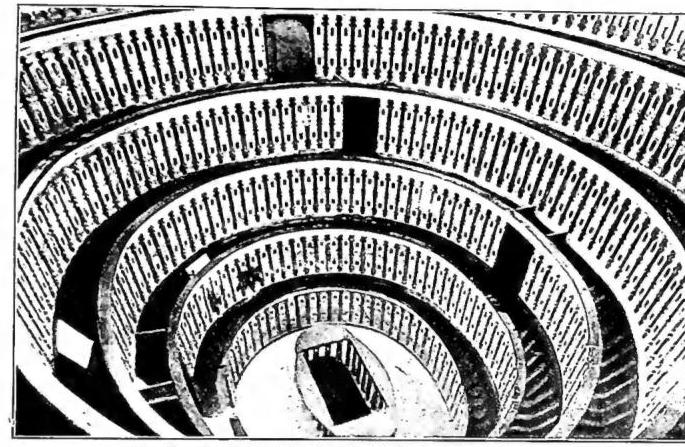
UNIVERSITÀ – Anatomical theatre of the U. of Padua, built in 1594 according to a design by fra Paolo Sarpi.
The masters did indeed have a certain independence in conducting their courses, and it was their responsibility to examine and advance candidates to the degrees, including the rectores themselves; but by order of Honorius III, from 1219 onward they were under the presidency of the archdeacon of Bologna. They formed their own collegia, but outside the school, as individual persons, they were subject to the two rectores in every other respect. In fact, it was the scholares who summoned and paid them by virtue of a specific contract, and also assigned them the portion of the subject they were to treat during the year; and when, for whatever reason, they left Bologna, the masters had to follow them to their new location. All this applied above all to the jurists, because the facultas artium, or facultas medicinae, philosophiae et artium, already active at the end of the 12th century, was constituted as a universitas in the 14th century despite the resistance of the legisti. The art dictandi, a kind of school of rhetoric, and the art notaria, which was subsequently joined to the jurists in the 15th century, were also incorporated into this teaching. The Faculty of Theology was constituted as such at Bologna only on 30 June 1360 by Innocent VI (v. BOLOGNA, VI); before then there were only the studia of religious orders, particularly those of the Dominicans.
IV. PARIS
While the U. of Bologna consisted predominantly of an association of students, PARADISO (v.) on the contrary consisted predominantly of an association of masters. The disputes provoked by the dogmatic deviations observable since the Carolingian period, followed by those of Roscellinus and Berengarius and, later, by the dialectical audacities of Abelard, provided an opportunity in northern France for Catholic masters, such as Ivo of Chartres and Anselm of Aosta, to deepen Catholic speculation (v. SCOLASTICA), and a center of study was formed at Paris to which celebrated masters gravitated. They appropriated the halls of chapters and monasteries as places for teaching, making gifts to the deans and abbots; these gifts later came to be claimed as a right, even when the masters no longer used those premises, so that Alexander III (1180) eventually had to intervene to eliminate every contrary custom, establishing that whenever suitable and literate persons wished to «regere studia literarum», they could do so without any molestation or «exactione» (Decret., V, 5, 3), that is, as the rubric commanded, «nulla si doveva esigere per [concedere] il permesso d'insegnare». In a manner analogous to what took place at Bologna,Holy Scripture with its gloss was the foundation of teaching, to which, in interpretation, was added the tradition of the Fathers, and in particular that of St. John Damascene, until around 1150 one of the doctors of Paris, Peter Lombard (v.), published the Liber sententiarum with the intention of systematizing dogmatic teaching by reconciling the expositions of the Fathers; this work was the subject of numerous commentaries and became a textbook in the schools even when the masters published their Summas (v. SOMME TEOLOGICHE). Toward the end of the 12th century, the masters of theology, canon law, and the arts (medicine and philosophy) who, independently of one another, had taught in various places in Paris spontaneously formed a single body: consortium or universitas magistrorum. The chancellor of the church of Notre-Dame, by virtue of a mandate entrusted to him once and for all by the bishop, granted the masters a license to conduct lectures. Before 1260 these masters, without prejudice to the universitas, formed, in order to promote the interests of study within the individual Faculties, an equal number of particular societies, each presided over by a dean. When the students in turn began to have disputes with the chancellor, Innocent III, around 1210, granted them permission to appoint a procurator who would legally represent them in protecting their interests; thus originated the universitas scholarium, which, before 1249, was divided into the 4 nations: Gallicorum, Picardorum, Normannorum, Anglicanorum (the Germans and the other northern nations belonged with the latter); each nation was headed by a procurator, and all four, for their common interests, assembled in the universitas artistarum, because the artists constituted the majority among the students and also had their own magistri with them. A rector universitatis represented the four nations united together and was the executor of their decisions, until around 1341 he became the true representative of the Studium.
V. PRIVILEGI
In the first period of their existence, the universities were regarded without question as ecclesiastical institutions, and the popes exercised their jurisdiction over them by promulgating or modifying their statutes, supervising orthodoxy, and regarding it as their own exclusive right to establish new Faculties, particularly Faculties of theology, as they did at Bologna (1360) and Padua (1364), or of canon law.The civil authorities soon took a direct interest in the expanding scholastic movement. At the Diet of Roncaglia in 1158, Frederick Barbarossa promulgated the so-called authentic Habita, by which he intended to favor the Italian schools, and Bologna benefited from it especially; the scholars were placed under sovereign protection, so that they could travel without hindrance, remain undisturbed in their studies, and be judged by the bishop’s tribunal or by that of the students themselves. This jurisdiction, initially limited to civil affairs, was later extended to criminal matters as well. In 1200 Philip Augustus exempted the schools of Paris from secular jurisdiction, and the chancellor acquired jurisdiction over teachers and students; thus began those privileges of exemption which sovereigns granted or ratified with great liberality, making the university an autonomous institution, living its own life, with the power to establish its own statutes, to defend its privileges and its members, teachers and students, against outside interference and particularly against local authorities, and to proscribe dangerous doctrines, preventing them from being taught or defended. In addition, an entire network of interested parties formed around the university, consisting of copyists, paper-makers, booksellers, and persons engaged in various services who benefited in different ways from the university’s growth. On 16 November 1219, Honorius III granted that masters and students of theology might enjoy the revenues of ecclesiastical benefices with which they had been provided for five years while they were engaged in study, while retaining the rights of residence (Decret., V, 5, 5); this concession was extended to all universities.
It was then natural that ecclesiastical offices and benefices should be distributed preferentially among university members: during the fourteenth century the University of Paris proposed to the popes the names of those whom it considered worthy of particular consideration in this regard. A degree and license in theology or law constituted a preferential qualification in the appointment of bishops or canons. Fortune, favor, and advantages of various kinds encouraged efforts to increase the number of universities by enlarging their privileges and endowments; they were generously endowed with ecclesiastical revenues and lay income. Eugene IV, for example, assigned to the Studium Urbis the proceeds of the wine tax. The principle prevailed that a Studium generale should be legally established through the intervention of public authority, whether by the Pontiff, the Sovereign, or the Emperor. In many universities both one and the other also took part, at different times; particularly when, as in Italy, free communes or small lordships took the initiative in founding them: it was important, in fact, that the communication of the privileges enjoyed by the older universities should not be lacking.
An important element in the universities (or in the theological Faculties) was constituted by the religious Orders, particularly the mendicants. The Dominicans, in fact, established themselves in Paris in 1217 and at Oxford in 1224. The Franciscans were in Paris in 1230 and at Oxford in 1224. The Carmelites and Augustinians soon had their convents near those schools. The members of these Orders lived in common, and this offered them various advantages: permanent accommodation, even for years; periods for study and books; religious observances; and mutual solidarity. All this favored diligence in study and caused students and teachers to be held in higher esteem. Religious could occupy a chair, but they had no part in the university’s administrative arrangements or offices, being bound as they were by the laws of their institute; and since they had distinguished and highly regarded masters, they aroused jealousy not only among the students but also among the doctors. Thus, in the great controversy which, toward the middle of the thirteenth century, sought to limit the privileges granted by the popes to the mendicant Orders concerning the care of souls, an attempt to exclude them from teaching at the university also played its part; but they had the protection of the pontiffs in safeguarding their rights.
Secular clerics, on the other hand, lived in isolation with private individuals, or in associations of disciples and masters, and were therefore exposed to dissipation. At times they began living together under the direction of a bachelor or a master, who directed the affairs of this freely constituted community. Particular care was taken to provide for poor students through foundations or scholarships. These, too, were established especially at the colleges that arose to facilitate students’ residence under greater discipline and devotion to their studies. There was one in Paris as early as the time of Urban III, with its own chapel, and the popes confirmed its rights in 1210 and 1248. The one founded in 1257 by Roberto Sorbon, chaplain to s. Luigi IX, later became celebrated and gave its name to the entire theological Faculty, the Sorbonne; it was later rivaled in prestige by the one known as Navarra. In 1350 there were nineteen such colleges in Paris, with 375 free places.
Similar measures were adopted at Bologna, Padua, and later also at Rome. These colleges were particularly important at the two great English universities, where by the end of the fifteenth century no one paid board and all students had to take up residence in one of them. The scholastic career, which lasted for several years, concluded with the degree of doctor (a title initially preferred by theologians), obtained after an examination conducted with great solemnity (examinatio publica sive conventus; V. LAUREA); and since this ceremony entailed great expense, the private examinatio was introduced, granting the title of licentiatus or prolyta (v. LICENZA). A lower degree was that of bachelor (v.), who participated (at least in the theological Faculties) in teaching under the direction of the masters.
In the thirteenth century there also appear the magistri and the doctores medicinae or physici, as well as those of grammaticae, logicae, philosophiae et aliarum artium.
VI. THE DISCUSSIONS
Characteristic of the development of knowledge within the university was the frequent use of theological and philosophical disputations held in the school under the direction of the master. They followed precise rules: syllogizing formally, in debate between one participant defending the proposed proposition and an objector, to whom the master himself gave the conclusion (cf. Dante, Parad., XXIV, vv. 66-68). On more solemn occasions, it was the master who proposed one or more theses, declaring himself ready to defend them against anyone. And any doctor could come forward to raise objections, while a jury of doctors, specially constituted for the purpose, directed the discussion and awarded the victory. There were also the quodlibetal questions (v. QUODLIBETI) for the resolution of particularly interesting topics. Discussions constituted a large part of the examinations. The passion for disputation conducted in its syllogistic forms gave rise, besides meticulousness in its execution, to subtlety in argumentation and to a craving for abstruse, unexpected, and even extravagant theses. This, too, was a means of gaining prestige; but it cannot be denied that, at a time when books were few and expensive, it helped deepen knowledge and train minds in readiness and clarity of argument.VII. DIFFUSION
The university movement did not take long to expand. Following the example of Paris, the U. of Toulouse (v.) arose in 1229 with the purpose of combating the Albigensian heresy, and that of Orléans for the study of civil law, which was forbidden in Paris. From Paris also came the students who gave rise in England to the U. Oxford (v.) at the beginning of the 13th century; Cambridge (v.) soon followed, and they remained the only ones in that country. Through a secession from Bologna arose the U. of Padua ([v.] 1222), which the bishop and others consistently supported. Vercelli (v.) soon derived from Padua. In the same 13th century, in Spain, with the king’s support, the U. of Salamanca and Seville arose; toward the end of that century, in Portugal, that of Coimbra arose. In Italy, Naples received a U. by decree of Frederick II in 1224. Rome, at the wish of Boniface VIII, received the Studium Urbis in 1303; but even earlier the Studium Curiae had arisen, a kind of u. for the study of theology and canon law for the benefit of those who were in the Curia, and who therefore had to follow the Curia whenever it moved elsewhere. In the following age, u. arose here and there throughout Italy and France. During the 14th century, they also arose in countries peripheral to the original movement: in Prague in 1347 through the patronage of King Charles IV of Luxembourg; in Vienna in 1365 through the favor of the Habsburgs; in Kraków, Poland, in 1364; in Pécs, Hungary, in 1367; in Germany, at Erfurt in 1379, at Heidelberg in 1385, and at Cologne in 1388.Leipzig separated from Prague in 1409 because of nationalist conflicts. Louvain (v.) arose in 1423 on the initiative of its prince; but during the 15th century, u. also arose in the Scandinavian countries, not without complaints from the ancient u., which saw ever-new competitors emerging. These, however, served more to disseminate knowledge than to deepen the field of learning. Indeed, immediately after the discovery of America, those of Mexico (1553) and Lima (1555) arose there on the model of the U. of Salamanca.
VIII. THE RENAISSANCE
The university system reached the full Renaissance when it had matured as a whole and was by then almost exhausting its vitality of inquiry; it was then that a reactionary movement arose, going so far as contempt in the name of the new currents of knowledge; at the same time, a sense of distrust was developing among university scholars loyal to their traditions. It was especially in the Faculties of arts that new philosophical concepts and methods could enter, such as studying Aristotle from the original texts, allowing a wider scope to mathematics (geometry), astronomy, and medicine, and gradually preparing the age of the great discoveries. The philological-literary field, which was regarded merely as a prerequisite, a necessary initiation into knowledge, remained foreign to the u.; the great humanists for the most part did not teach there. The critical search for new texts, historical and critical investigations, commentary on and imitation of the classics, and political questions would be the task of private investigators or would be entrusted to those schools that were by then multiplying through the initiatives of municipalities or patrons, and that seemed in some way a radical revival of the ancient schools of grammar and rhetoric.At the u., disputations still continued in viam Scoti or in viam Thomae, and, for example, the chair of the Controversiae, so brilliantly held by Bellarmino, was allowed to lapse in Rome, perhaps on the assumption that it was no longer necessary.
Nevertheless, the new problems raised by the new studies did not fail to influence teaching methods and the direction of research in the juridical and philosophical fields, which became more autonomous from the old schemes. In the theological field, the need to oppose the advance of doctrines that completely disrupted traditional teaching led, if not to a complete modernization of methods, at least to bringing them closer to the new requirements. The Jesuit colleges which, in imitation of the Collegio Romano, founded in 1553, arose in Catholic countries and acquired particular importance in Germany as university institutions, played a significant role in this.
The Protestant u., naturally hostile to traditional scholasticism, created a new one, founded on a confessional authoritarianism that was unreasonable and arbitrary and allied itself with, while dominating, the same civil power. They resisted free scientific inquiry vigorously, until they became capable of reacting to the Enlightenment.
The first to become Protestant was the University of Wittenberg, which had been founded in 1507; then one arose at Marburg in 1527 with the property of monasteries and Catholic benefices, followed by several others in that same century. Geneva, through the work of Calvino and Teodora Beza, above any official recognition, was the principal intellectual center of the Reformed throughout Europe. These centers of study, completely removed from the authority of the Church, came under that of the civil authority of each locality. Moreover, absolutism, which began to dominate increasingly in the government of the States from the sixteenth century onward, including in Catholic countries, assumed that progressive interference in the u. by which the corporate system lost its real importance and freedom was restricted in the organization of chairs, the appointment of teachers, and the discipline of students. The interference of the Church, too, gradually diminished, so that the u. came to be regarded simply as an organ of the State.
IX. RECENT TIMES
This evolution was being completed at the end of the 18th century, when the movement for reform was invading every field and the anti-scholastic and anti-medieval spirit was fostering new orientations in studies, while the emperor Giuseppe II was already boldly setting about changing internal regulations and even creating a kind of hierarchy among the universities.The French Revolution, hostile to every privilege, abolished the universities on 15 September 1793; instead, “special schools” were established under the direct control of the State for the training of professionals, especially physicians and lawyers. In 1806 Napoleon created the Université de France, a “body entrusted exclusively with public instruction and education throughout the Empire”; secular by its nature, it embraced all public teaching, from the elementary schoolmaster to the professor of the Sorbonne, with the “Grand Maître” at its head. Dependent upon the University of Paris for higher education in the various localities were the “academies,” each divided into five orders of faculties: theology, law, medicine, sciences, and letters. Thus the universities lost all autonomy and the State monopolized education; in 1850 the Ministry of Public Instruction replaced the Grand Maître, and in 1896 the academies regained the ancient name of universities.
Similar principles concerning the predominance of the State in the field of higher education and the complete secularization of teaching were adopted in the other States of Europe and America. The faculties of theology and canon law were either abolished or, to a greater or lesser extent, removed from the authority of the Church (v. libertà di*); while complete freedom to teach any doctrine was recognized. Apart from the ecclesiastical universities, directed chiefly toward the
doctrinal formation of the clergy, over which the Church claimed exclusive competence, there arose the idea of founding universities in which teaching would be imparted according to the principles and doctrines of the Church in every branch of knowledge. This could not freedom of teaching (v.) were first claimed, together with full authority to confer academic degrees valid for civil purposes, like those granted by State authority. A fully and truly free Catholic university was that of Lovanio, re-established by the bishops of Belgium with the approval of Gregorio XVI in 1833-35. Under this system, universities were in practice limited to being institutions of a national character. For ecclesiastical universities, the new regulations are set forth in the apostolic constitution of Pio XI, Deus Scientiarum Dominum (v.).
Through the initiative of Fr. A. Gemelli and Mons. J. Schrijnen, the Federation of Catholic Universities was established in 1924, with the approval of Pio XI; some twenty universities joined II. Only Catholic universities properly so called could belong to II. Having ceased to exist owing to various circumstances, the Federation was reconstituted by Pio XII on 27 July 1949 (AAS, 42 [1950], pp. 385-87). — See plates LXXXII-LXXXIII.
Iginio Cecchetti - Pio Paschini
UNIVERSITÀ CATTOLICA DEL SACRO CUORE