
MEXICO. - The most southerly and the least extensive (1,964,000 sq. km.) of the three political units into which the territory of North America is divided, bounded by the United States, British Honduras, and Guatemala, and therefore including a small portion of Central America (Yucatán Peninsula and the area to the east of the Isthmus of Tehuantepec).
OUTLINE:
I. Geography
II. Ancient religion of M
III. History
IV. Evangelization
V. Legal status of the Church
VI. School system.I. GEOGRAPHY
The country, which extends over more than 18° of latitude, essentially consists of a vast plateau whose width gradually decreases from north to south, enclosed between two mountain ranges (the Sierra Madre Occidental, 4,335 m., and the Sierra Madre Oriental, which includes Pico de Orizaba, 5,700 m.), running along the two coastlines, the Pacific (7,480 km.) and the Atlantic (2,855 km.), the latter indented in the southeastern corner (Gulf of Campeche) of the Gulf of Mexico. The plateau, which averages between 1,500 and 2,400 m. in elevation, forms in its southern section (Anahuac) the heart of the country, whose population is concentrated in a narrow strip of the central tableland covering barely one-sixth of Mexican territory but containing about two-thirds of the total inhabitants. Climate and vegetation are closely linked to altitude, which moderates or nullifies the effects of the low latitudes characteristic of subtropical or tropical regions. The so-called tierras calientes (below about 1,000 m.), corresponding to the two coastal strips—of which the Pacific side is the wider—have uniformly high temperatures, abundant rainfall, lush vegetation, and are generally unhealthy (yellow fever) and therefore sparsely inhabited. The tierras templadas comprise the mountain slopes between 1,000 and 2,000 m., with milder temperatures (15°–20°) and still ample rainfall; above their upper limit and up to about 3,000 m. extend the so-called tierras frías, with a more temperate, drier, and healthier climate. This is the zone of the interior highlands, where the northern sector—marked by aridity that gives rise to steppe or pre-desert conditions—contrasts with the central and southern sectors, where the most productive cultures and activities are concentrated.The population (24.5 million; 12 per km²) consists of three distinct ethnic groups. The largest is the mestizo group (descendants of intermarriage between Amerindians and Spaniards; 55% of the total), followed by Amerindians (28%); the remainder comprises the white (Spanish) population and immigrant elements, among whom are also Chinese, Japanese, and blacks. The indigenous peoples belong to the two great stocks of the Maya and the Nahua, which include the Aztecs, who dominated the country in pre-Columbian times. Urban centers are relatively numerous, but only about a dozen approach or exceed 100,000 inhabitants (Guadalajara, Monterrey, Puebla de Zaragoza, Mérida, Tampico, Aguascalientes, Torreón, San Luis Potosí, and León).
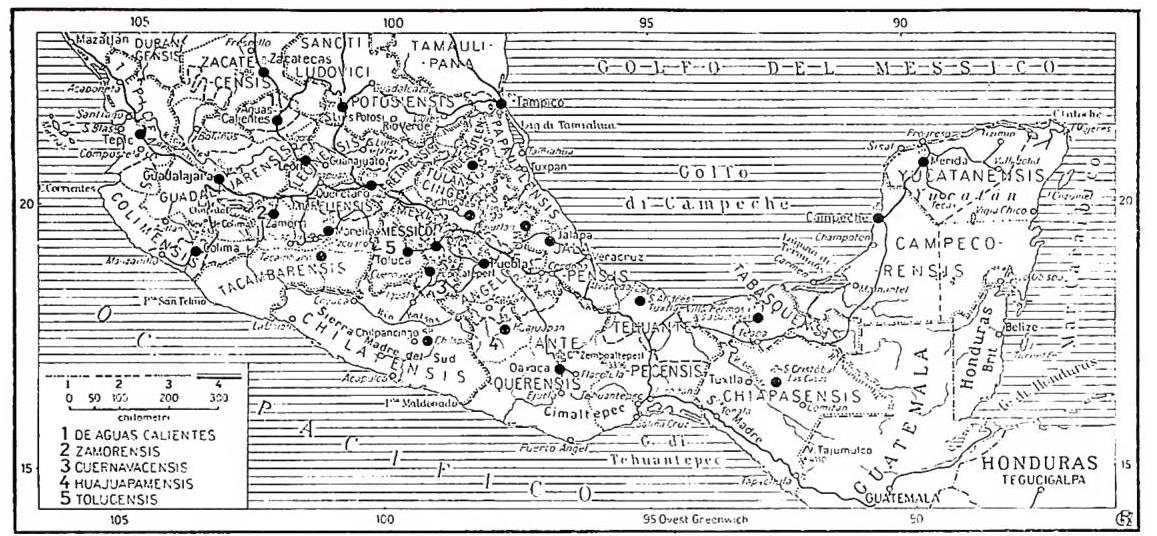
The capital, Mexico City, situated at 2,275 m., today has just under two million inhabitants.
Agriculture is the country’s fundamental activity: alongside cereals (maize first of all; also wheat, barley, and rice) and beans, industrial crops (agave, cotton, peanuts, flax, sugarcane, tobacco, cacao) and tropical fruits (bananas, pineapples) are widely grown, as well as vines and citrus fruits. Livestock raising and forestry remain modest in scale; not so the extractive industries, long renowned as one of Mexico’s principal economic resources. While silver (Mexico supplies about 30% of the world total) and petroleum (8.4 million tons in 1948) clearly predominate, gold, iron, antimony, mercury, coal, natural gas, and others are also extracted in significant quantities. Manufacturing industries (especially iron and steel, and textiles) received a strong boost during the Second World War. Mexico is a federal republic comprising 28 states, one federal district, and three territories, with a president elected every six years and a bicameral legislature elected by universal male suffrage.
Giuseppe Caraci
II. ANCIENT RELIGION OF MEXICO
By the ancient religion of Mexico is meant here the religion of the Aztec people, who at the time of the Spanish conquest politically dominated the country and had their capital at Tenochtitlan, the present-day city of Mexico. This people had reached Mexico only a few centuries before Cortés’s arrival, coming from distant northern seats, and had rapidly assimilated the far superior civilization of the other Nahua peoples already living in the country, using it to emerge and prevail. To the south of the Aztecs, in southern Mexico and Central America, another civilization was widespread, that of the Maya (v. MAYA, RELIGION OF THE).The principal sources for the study of Aztec religion are the writings of those Europeans who, at the time of the conquest or in the immediately following period, gathered information from the living voice of the last Aztecs still practicing the religion of their fathers and witnessed scenes of indigenous life with their own eyes. Among these writers, the Franciscan Bernardino de Sahagún is particularly noteworthy. Other sources are the documents provided by pictographic codices, the interpretations of archaeological remains, as well as data furnished by indigenous groups that survived the destruction of their civilization.
It seems that in a very remote epoch a monotheistic religious conception prevailed in Mexico. Among the upper classes there was faith in a Supreme Being, invisible and incorporeal, not represented by any image. A testimony to this conception may be drawn from the names Teol (= God), Tloque Nahuaque (= He who has all within Himself), Ipalnemoani (= He through whom all things exist). At the time of the Spanish conquest, however, the religion was polytheistic, based on the cult of various deities, clearly defined in their characters and attributes, as is evident from the descriptions that have survived. Polytheism was fostered and accentuated by the fact that the Aztecs incorporated into their pantheon the deities of the peoples they were conquering. It seems, moreover, that the priests strove to reduce the multiplicity of gods by reducing some to different manifestations of the same deity.
At the basis of the generative process of the gods, according to various traditions, were the male and female creative principles, personified respectively in Omecutli (= Lord Two) and Omecubatl (= Lady Two). They were represented with symbols of fertility, for they were considered the origin of generation, and with the ear of grain as masters of life and food. They dwelt in Omeyocan (= the place two); from there also originated the life of men: to this belief refers the invocation that the midwife addressed to the newborn: “O precious stone, O rich feather, O emerald, O sapphire, you were formed in the place where the great god and the great goddess reside, above all the heavens.” The two gods were said to have had four sons: Red Tezcatlipoca, Black Tezcatlipoca, Quetzalcoatl, and Huitzilopochtli, who, among other things, were deities of the cardinal points, perhaps by analogy with the generative couple, representing the zenith and the nadir. These four gods were entrusted with the creation of the other deities, of the world, and of man. Another tradition regarding the origin of the gods was as follows: the goddess Citlalicue, wife of the god Citlatonac, gave birth to a flint stone which her sons threw down from the sky. The stone, as it fell, shattered into 1,600 pieces, from each of which a god was born. These desired servants and worshippers: men were therefore created.
Important deities were Teccatlipoca, Huitzilopochtli, and Quetzalcoatl. The first, god of justice, was represented with a gold mirror in his hand through which he saw everything: he was therefore all-seeing, rewarded the good, and punished the wicked. Since his divine origin is not clearly explained in the oldest myths, it has been supposed that he was a deified warrior and, specifically, the Nahua leader who directed the invasion of Tamoanchan.
The abode of the gods was the sky, divided into thirteen layers, each ruled by some important deity. Men too, after death, ascended to the sky: not all, however, could enjoy immortality or the same privileges there. The attainment of these goods was based, not on moral criteria, but on the causes that brought about death or on the occupations the deceased had practiced in life.
The fact that there was no relation between morality and the afterlife derived from the belief that human actions did not depend on his will and free choice, but on external causes or influences. The priest, during the funeral ceremony, thus excused the deceased before the gods: “He has not sinned freely, for he acted under the influence of the star that presided at his birth.”
The gods, who predetermined the fatal and mechanical course of human life, were honored with public worship—which included collective and solemn prayers, processions, and sometimes even human sacrifices (on certain occasions, a truly staggering number of victims were killed)—and with private worship comprising prayers, mortifications, etc. Many prayers, as Bernardino de Sahagún affirms, were distinguished by a lofty and noble sentiment and refined language. Whoever sinned through adultery or drunkenness (sins punishable by death)
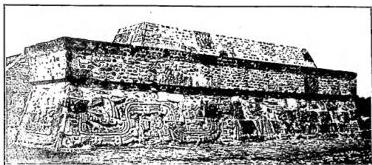
MESSICO - Temple of the god Quetzalcoatl, showing the figure of the "Feathered Serpent" in relief. Recent period of Teotihuacan (ca. 800 A.D.) - Xochicalco.
The sinner could confess his guilt to have it blotted out before the gods and the law. On an auspicious day the sinner presented himself to the priest who, squatting on a mat, exhorted him to reveal every fault because the god Teccatlipoca, knower of every secret, was present even if invisible. After the confession came the penance, which consisted in piercing the sinner’s tongue so that it bled.
The temples were all roofless, except those dedicated to the god Quetzalcoatl, and were shaped like truncated pyramids. The summit was broad enough to hold the sacrificial stone, one or two small shrines, the priests, and the victims. Around the pyramid, stairs and terraces gave access to the summit.
III. HISTORY
In 1517 Francisco Hernández de Córdoba, sent by Diego Velásquez, governor of Cuba, landed on the coasts of Yucatán and present-day Campeche; in 1518 Juan de Grijalva explored the coast of Tabasco; on 21 April 1519 Hernán Cortés landed at the head of about 700 men at the site where the city of Vera Cruz would later arise: Mexico was thus “born” into Western civilisation.Cortés, like the other Spaniards who had landed on the coasts of the Gulf of Mexico, found in the region a population endowed with a notable degree of civilisation and a high degree of political organisation. The Toltecs, who had settled towards the 7th century in the central valley of Mexico (the Anahuac), had been replaced in the 10th century—following their migration towards the regions that would subsequently form part of Guatemala and Nicaragua—by the Aztec tribes, who had likewise arrived from the north: Tenochtitlán, the Aztec capital, was founded c. 1325. Once a hereditary monarchy had been established, the period of greatest splendour for the Aztec people may be said
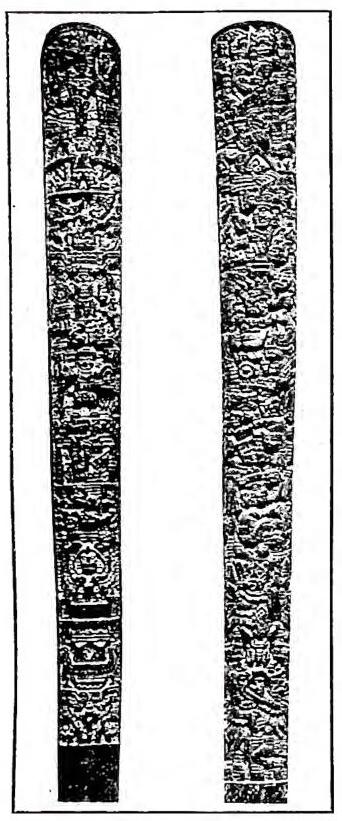
MESSICO - Atlatl (a device for throwing javelins) made of carved and gilded wood. It features depictions of mythological figures. Rome, Museo preistorico etnograffico L. Pigorini.
The Caribbean Sea and the Pacific Ocean have the most dangerous coastlines in the world.
European and American events at the end of the 18th century and the early decades of the 19th, which spread the spirit of independence throughout Latin America, also led to Mexico’s separation from Spain. After a first movement was suppressed, a revolt broke out on 16 September 1810, led by a parish priest, Miguel Hidalgo, in which Indians, mestizos, and Creoles participated. The war was waged ferociously for ten years by guerrillas. Hidalgo, captured by the Spanish, was executed like the other priest-soldier Morelos. But when the Spanish viceroy Félix Calleja del Rey believed he had quelled the revolt, in January 1821 one of his Creole colonels, Iturbide, crossed over to the insurgents and gave them new impetus. On 24 February 1821, through the so-called “Plan de Iguala,” Mexico’s independence was proclaimed; castes were abolished without regard to nationality, and the Catholic religion was recognized as the state religion. The Plan of Iguala was ratified by the Treaty of Córdoba on 24 August 1821, signed on Spain’s behalf by the last viceroy, Juan O’Donojú. The triumphal entry of the liberating army into Mexico City on 17 September 1821 sealed the achieved independence, though it was soon disturbed. Iturbide had himself proclaimed emperor as Agustín I (1822), but he was captured and executed in 1824.
From 1821 to 1857, Mexico experienced six different forms of government, 55 ministries, and 250 uprisings; struggles among leaders, attempts at restoration, and foreign complications ensued (in 1830 the French squadron bombarded Veracruz). Mass expulsions of Spanish citizens occurred. Disputes arose with neighboring United States over the secession of Texas, encouraged and favored by slaveholders in both countries who were harmed by the law abolishing slavery in Mexico. In September 1847, North American troops occupied the capital of the Republic and left only after Mexico ceded to the United States Texas, New Mexico, New California, and part of Coahuila, losing nearly half its territory—about 1,400,000 km²—in exchange for an indemnity of 18.5 million dollars, as stipulated in the Treaty of 2 February 1848. In 1853, the United States acquired an additional 116,000 km² of Mexican territory for another payment of 10 million dollars.
But Juárez, well supplied with funds from the United States, began a series of military operations. Through a continuation of guerrilla warfare that flared up everywhere, forcing imperial troops into constant marches and grueling movements, he took Matamoros in June 1866, while Maximilian had to abandon the capital and take refuge in Querétaro. Besieged in that locality by Porfirio Díaz, one of Juárez’s generals, Maximilian was compelled to surrender, tried by a court-martial, sentenced to execution—which could not be prevented despite the most desperate efforts by the unfortunate Empress Carlota—and shot on 16 June 1867.
Deeply and intimately nationalist, convinced of the still embryonic strength of his people—Mexican and American to the core—Juárez did not shy away from any action he deemed beneficial to his country: from all manner of exactions imposed on his fellow citizens to loans contracted with foreign states, from subsidies obtained from the United States to indiscriminate confiscations of ecclesiastical property, from the most obtuse anticlericalism and fratricidal strife to systematic, fanatical opposition to Maximilian both as emperor and as a European. Juárez ordered his execution out of resentment against old colonialism and against whites; all this was done in the dream of making Mexico a first-rate nation on the American continent, a worthy successor to the deeds of the Aztecs and the peons.
With Maximilian eliminated, Juárez implemented liberal reforms, granted amnesties, enacted press laws, formed alliances with foreign powers, and secured recognition of his regime. Some dissident generals were fomenting a new revolt when an apoplectic stroke struck Juárez down in 1872 at the age of 66. Through continuous turmoil, the Republic reached 1876, when Porfirio Díaz, a mestizo, assumed the presidency of Mexico and held it until 1910. Under his government, Mexico experienced a period of great
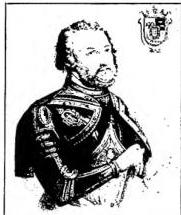
MESSICO — Portrait of Fernando Cortés. Engraving.
The Republic, after continuous upheavals, reached 1876, when Porfirio Díaz, a mestizo, assumed the presidency of Mexico and held it until 1910. Under his government, Mexico experienced a period of great economic flourishing, but there were also stirrings of revolt, forcing Díaz to take refuge in Europe in May 1911.
Francisco Madero, who succeeded Díaz, was assassinated in 1913 for his agrarian reform plans; his main enemy, Huerta, who was implicated in the killing, succeeded him but was soon deposed and exiled. He was replaced by Venustiano Carranza, who was killed in 1920; Álvaro Obregón and Elías Calles subsequently held the presidential office amid incessant revolts and pronunciamientos, religious agitation, and international complications with England over the massacre of British subjects and the confiscation of English properties. Relations with the United States were also extremely tense, culminating on 30 June 1926 in the ultimatum from the American minister Kellogg to amend the Constitution in a manner acceptable to the United States. Meanwhile, Obregón, reelected in 1928, had been assassinated by a fanatic; he was succeeded by Portes Gil, who deserves credit for calming political and religious dissent. These tensions resumed with renewed vigor under the presidencies of Pascual Ortiz Rubio and Abelardo Rodríguez.
The new president, Miguel Alemán, elected on 7 July 1946, has worked extensively to restore both internal and external tranquility.
IV. EVANGELIZATION
In 1519, together with the conqueror of the Aztec Kingdom in Mexico, Hernán Cortés, some missionaries also arrived in the country. Proper missions, however, did not begin until 1522, with the arrival of the Franciscans, and even more so in 1524, when the “Twelve” (“Los Doce”) under the leadership of the Franciscan Martín de Valencia systematically set about converting the Indians. In 1526 the Dominicans arrived, and the Augustinians in 1533. The apparition of Our Lady of Guadalupe to the Indian Juan Diego in 1531 contributed greatly to the conversion of his countrymen.The mission succeeded in developing despite immense obstacles, such as pagan religions with their superstitious rites and human sacrifices, and, on the part of the Spanish colonial government, the oppression of the Indians through encomiendas and forced labor. The main means employed by the missionaries was adaptation to the Indian mentality: the building of magnificent churches, festive processions and celebrations with dances and songs; the introduction of a patriarchal social system. The church and the convent at the heart of the Indian village formed the center of religious life; the missionary was both father and protector of the people, even against the abuses of the Spanish colonial masters. Schools and hospitals were established, trades and arts were introduced. Efforts were also made to train an indigenous clergy, chiefly through the founding of a Franciscan college at Tlatelolco; this initiative, however, failed, first because of its rather negative outcome and then due to the stubborn resistance of the Spanish monks. The ecclesiastical hierarchy was established with the founding of the dioceses of Tlaxcala in 1526, of Mexico in 1530, of Oaxaca in 1534, of Michoacán in 1536, of Chiapa in 1538, of Jalisco in 1548 (transferred in 1560 to Guadalajara), and of Yucatán in 1526 (originally erected in 1518 as Carolensis before the conquest). In 1545 the diocese of
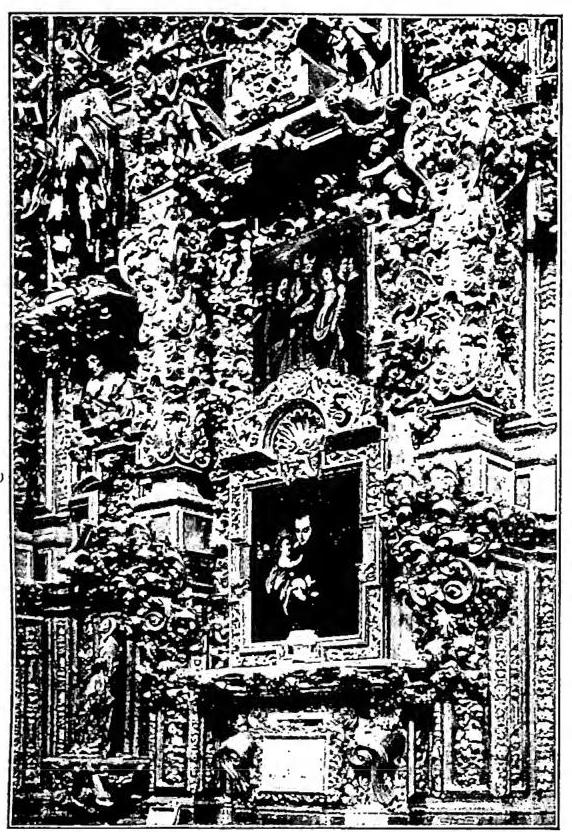
MESSICO - Altarpiece in gilded wood, a typical example of a Mexican Churrigueresque altarpiece - Tepozotlán.
M. was elevated to an archdiocese. The first pastor was Juan de Zumárraga, Observant Franciscan (1468-1548), who gave a very strong impetus to the mission among the Indians, promoting Christian instruction and fostering the cultural and social advancement of the indigenous peoples, and, with the help of Viceroy Antonio de Mendoza, established the first printing press. Under his leadership, three synods (Juntas) were held. His successor, the Dominican Alonso Montufar (1548-89), convened two provincial councils in 1555 and 1565 that were of great importance for the further development of the Mexican Church. During his tenure, the University was also founded in 1553. After fifty years of intense work, the central and southern parts of M. were brought to the faith and enriched with churches and convents of Franciscans, Dominicans, and Augustinians with their flourishing provinces.
Towards the end of the 14th century, the evangelization of the northern provinces began, continuing until the 19th century, penetrating deeply into the southern states of the present-day United States—Texas, New Mexico, Arizona, and California. The pioneers of these missions were first the Jesuits and the Franciscans. The Jesuits, from 1572 onward, opened schools and colleges in M.; in 1591 they founded the first mission in Sinaloa; in the 17th century they worked among the Indians of Durango, Sinaloa, Sonora, and Chihuahua, extending their activity by the end of the 17th and during the 18th centuries to Pimeria and California. The Franciscans, during the 17th century, established missions and reductions in the provinces of Nuevo León and Coahuila.
The colleges of the missions founded by them towards the end of the 17th century—the first in 1682 at Querétaro, then in Zacatecas, M., and Pachuca—were their centers of diffusion during the 18th century.
When the Jesuits were expelled in 1767, the missions passed partly to the secular clergy and partly were continued by the Franciscans, who took charge of the most advanced posts in Pimeria and California, extending their work also to Upper California.
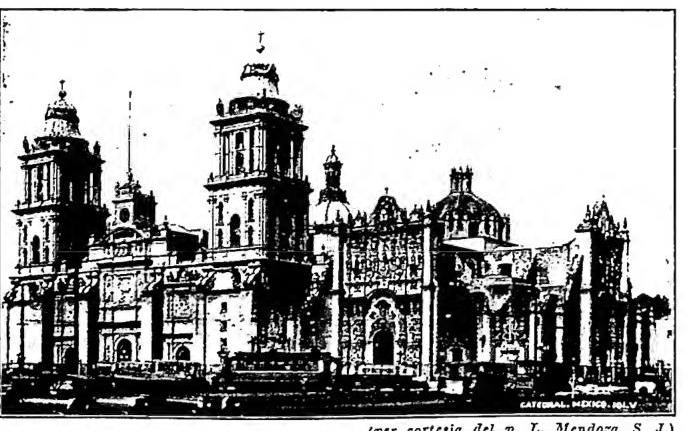
At present, in M., the Catholic hierarchy comprises the metropolitan sees of Puebla de los Angeles, with suffragans Huejutla, Huajuapan de León, Papantla; of Antiquera, with suffragans Chiapas and Tehuantepec; of Durango, with suffragans Chihuahua, Sinaloa, Sonora; of Guadalajara, with suffragans Aguascalientes, Colima, Tepic, Zacatecas; of Mexico, with suffragans Chilapa, Cuernavaca, Tulancingo, Veracruz; of Monterrey, with suffragans León, Querétaro, Tacámbaro, Zamora; of Yucatán, with suffragans Campeche, Tabasco. The Apostolic Vicariate of Lower California has also been established, with its seat at La Paz.
V. LEGAL STATUS OF THE CHURCH
The legal status of the Church in Mexico is regulated by the current Constitution, promulgated on 5 February 1917 by a revolutionary minority, not submitted for approval to the people, who, in their overwhelming majority Catholic (95%), would certainly not have approved II. A country eminently religious, almost the entire population is Catholic. After the ruthless secularism of Benito Juárez and the relatively peaceful era during the presidency of Porfirio Díaz, the clergy and the Catholic religion were subjected to renewed radical oppressive measures. The various “general” presidents waged fierce campaigns against Catholics through the enactment of increasingly anti-religious laws. The first to strike at the clergy was Carranza, who, under the pretext of aiding the indigenous classes, confiscated Church property, forced religious to abandon places of worship, and sought to create, or attempted to create, a national Church in which the government arrogated to itself the power even to determine the number of priests for each individual state. In February 1917, in Querétaro, in the presence of special envoys of President W. Wilson and of Samuel Gompers, president of the American Federation of Labor, a law of Soviet inspiration was proclaimed, effectively establishing communism in Mexico through a new ruling class: the profiteers of the revolution.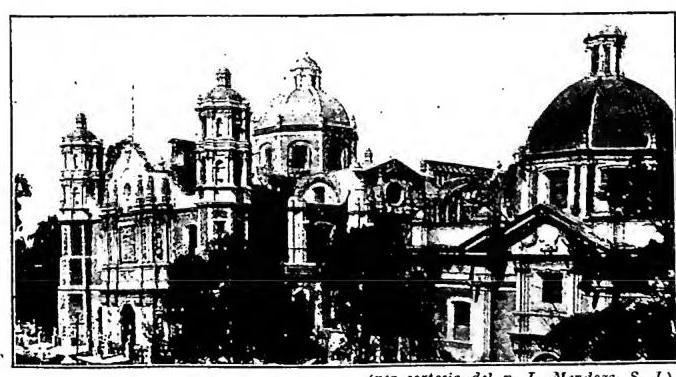
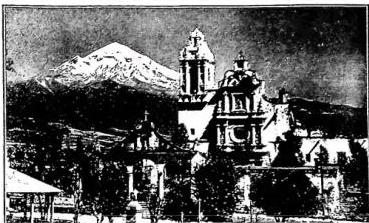
MESSICO - The volcano Popocatépetl, 5,452 m. - State of Puebla.
VI. SCHOOL SYSTEM
Since the establishment of the Secretariat of Education in 1921, there has been progressive standardization of public instruction. While primary education is under the jurisdiction of the federal Secretariat of Education, secondary and higher education are also administered by individual departments. Civic and socialist education is associated with instruction. Religious instruction is banned from schools, which were declared non-denominational by the law of 14 December 1874. The Querétaro law of 5 February 1917, enforced by Calles only in 1926, prohibits the clergy from establishing or directing schools. School attendance is compulsory from ages 6 to 16. The campaign against illiteracy, begun in 1920, is carried out through mobile schools known as Misiones culturales. Instruction is characterized by coeducation and extensive physical and premilitary training. In 1946, agricultural education was reformed.Instruction is divided into preschool, school, and post-school levels. Preschool instruction is provided in 777 kindergartens. School instruction comprises primary, secondary, and university levels. Primary education is conducted in 23,244 primary schools, classified as federal, state, municipal, company, private, adult, and Indian schools. Secondary education takes place in 377 secondary schools, divided into pre-vocational, vocational, agricultural, and academic institutions, which include 17 colleges, 57 teacher-training schools, and 43 technical colleges. Higher or university education is provided at the Universities of Potosí, Puebla, Veracruz, Yucatán, Nuevo León, and Jalisco; the Socialist University of Culiacán; the Workers' University of Mexico City; and the National University (formerly the Royal and Pontifical University) in Mexico City, founded in