
MOLISE. - A historical region of central Italy, generally united with Abruzzo and corresponding, in administrative terms, to the province of Campobasso.
I. GEOGRAPHY
The origin of the name, which dates back to the eleventh century, is uncertain; the original contado, which arose in the Lombard period28 December 1696. He was ordained a priest in 1652 and sent to Rome in 1663 as procurator in the cause of the venerable Francesco Simon. He remained in Rome and became celebrated as a spiritual adviser and writer on mysticism. Because of his works, he was commissioned by the Holy Office in 1685; having been tried, he abjured his Quietist errors in September 1687. The bull Caelestis Pastor of
Norman and subsequently incorporated into the Terra di Lavoro and the Capitanata, became an autonomous province in 1806. The territory reproduces the characteristics of neighboring Abruzzo, with an inland belt of high limestone massifs (Meta, Matese), followed toward the Adriatic (where M. extends from the Trigno to the Saccione) by an alternation of low mountains and clay-shale hills (hence the frequency of landslides). Like Abruzzo, M. was often devastated by earthquakes. It is predominantly an agricultural and pastoral region (cereals, vines, fruit), with little industrial development (hydroelectric industries have appeared only recently) and modest traditional craftsmanship. The province of Campobasso, covering 4,445 sq km, had 388,300 inhabitants in the last census (1936); by 1950 these had risen, despite considerable emigration, to 405,000; its density (90 inhabitants per sq km) is nevertheless lower than that of the entire district (110). Campobasso, the most populous city, approaches 30,000 inhabitants.
II. POLITICAL HISTORY
M. comprises part of ancient Samnium (Samnium, Samnites), inhabited by the Caudini, Pentri, and Frentani, who were federated among themselves at least in times of war and were subjugated by the Romans in 288 B.C. They also suffered defeat in the Second Punic War, as a result of which in 179 B.C. the region was repopulated with Ligurian colonies of servile status. Nor did better fortune befall them when they sided with the Marsi against Sulla. During these fierce and protracted wars, the principal Samnite cities—Alfedena (Aufidena), Boiano (Bovianum), Sepino (Saepinum), Termoli (Thermula), Trivento (Terventum), Larino (Larinum), Isernia (Aesernia), and Venafro (Venafrum)—were destroyed. Nevertheless, one may admire the ruins of the Roman forum at Altilia, the megalithic walls of Sepino, the remains of the Roman theatres of Boiano Vecchio, and the amphitheatre of La-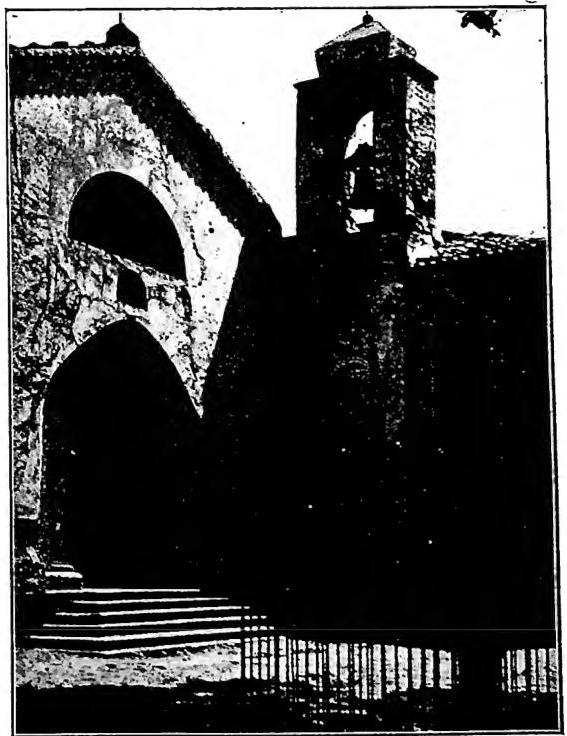
M. was first invaded by the Lombards and Byzantines, Benevento (v.). The names of nine Molisan counties are recorded, almost all
of Lombard origin: Venafro, Isernia, Campomarino, Trivento, Boiano, Sangro, Pietrabbondante, Termoli, Larino. During the Norman period, Boiano, with its gastaldate, appears as the center of the Molisan county, whose origins do not seem to predate 1053. In 1080, Ugo de Moles (de Molhouse), count of Boiano, had the city’s Cathedral built. Under the Swabians, another Ugo de Molinis styled himself count of M., and the designation subsequently passed to the region. Others would derive the name M. from the small village of the same name between Torello and Duronia, whose origins, however, are unknown. From 1200, Pietro di Celano sought to extend his Marsican county into M., and succeeded by marrying the Molisan countess Giuditta to his son Tommaso. In this way the Marsican-Molisan county was able to extend from the March of Ancona to Civitate in Puglia, and to rebel against Federico II, who ordered the destruction of its fortresses. The Molisio again appear as lords of the Molisan county under the Angevins, until Roberto il Saggio invested the Gambatesa with it; they were subsequently also called counts of Monforte. From then on, M. remained attached first to the Terra di Lavoro, and thereafter to the Capitanata; in 1806 it became part of Abruzzo, but as an autonomous province. Even today, the towns of Urori and Portocannone shelter Albanian colonies, while Acquaviva Colleccroce has been inhabited by Slavs since 1500.
III. CHRISTIAN HISTORY
When and by whom the Gospel was proclaimed in this region cannot be known with certainty. Saints and martyrs whom late Passions presented as the first local evangelizers, when they are not wholly legendary, are today explained by the later translation of relics from distant regions. Such is the case of St. Fotino or Potino, believed to have been a disciple of St. Peter. St. Castus, reputed bishop and martyr of Trivento, can at most be identified with the homonymous African martyr, venerated in so many other places of southern Italy. The supposed martyrs of Venafro, Nicander and Marcian, belonged to Tomis in Moesia. St. Benedict of the cathedral of Isernia is entirely absent from the episcopal lists.With regard to the letter of St. Leo I (6 March 459) “universis episcopis per Campaniam, Samnium et Picenum constitutis”, Lanzoni adds: “There were therefore several of them, probably as early as the fourth century.” Their primitive residences were certainly the same Samnite cities mentioned above. The names of their bishops can be traced from the middle of the fifth century for the dioceses of Alfedena, Alife, Boiano, Sejino and Venafro. The bishopric of Alfedena is said to have been transferred to Trivento in the tenth century; according to others, however, the diocese of Trivento had existed since the fourth century. The cathedral of Termoli, completed in the twelfth century, is the region’s most distinguished monument. The cathedral of Larino was completed in 1319. The episcopal see of Boiano has recently been transferred to Campobasso.
(photo East)
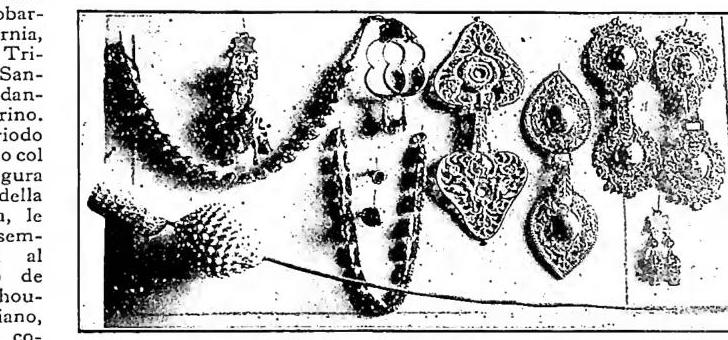
MOLISE - Gold and silver ornaments for festive costume - Roccamandolfi.
fracida, S. Maria Casalpinto (Morrone), S. Benedetto di Pettinari (Ururi), etc. In art, antiquity, and grandeur, the foremost of all was the Benedictine monastery of S. Vincenzo martire at Volturno, founded in 703 by the Lombards Paldone, Tatone, and Tasone. From the Chronicon of this monastery, written by the monk Giovanni in the 12th century, we learn which churches, monasteries, and possessions belonged to the Molise Benedictines at that time. A specific inventory of precious objects in gold, silver, and gems, and of sacred vestments, for the churches of the dioceses of Venafro, Isernia, Boiano, Guardialfiera, and Trivento, drawn up on 20 August 1241, was published by Evelina Jamison (v. BIBLICA). The region’s best-known saint is certainly Pietro d'Isernia, hermit of Morrone and subsequently Pope Celestino V (1294), initiator of the Benedictine reform of the Celestines (v.), which soon spread to France as well. Thus arose the Celestine abbeys of S. Maria di Canneto near Monfalcone del Sannio, S. Maria della Strada near Matrice, S. Giorgio in Petrella Tifernina, and S. Maria degli Angeli at Ripalmosani, as well as those at Isernia, Riccia, Guglionisi, Boiano, and Campobasso. During the first Franciscan century, the Friars Minor also founded convents at Isernia, Agnone, Campobasso, Serracapriola, and Morrone del Sannio. The Poor Clares of Agnone, Isernia, and Frosolone appeared at the same time. The best-known Dominican convent is the shrine of the Madonna della Libera near Cercemaggiore. The Capuchins founded their first convent at Termoli around 1530 and their second at Venafro in 1573. The Carmelite convent at Venafro is dated to 1328. At later periods, the Theatines, Piarists, and Redemptorists also opened a few houses in M. The present-day spiritual situation of M. is outlined under the entries for the respective dioceses. - Vedi tsvv. LXXXIV-LXXXV.