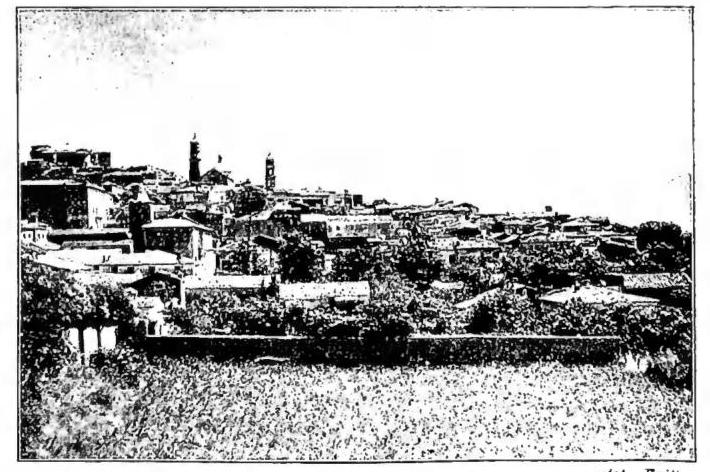
VENAFRO. - Ancient diocese and city in the province of Campobasso, situated at the foot of Monte Croce.
It was inhabited in very ancient times by the Oscan-Samnites; it flourished in the Roman age; Augustus established there a colony of veterans, whence its designation as colonia Iulia Augusta Venafrum. In the valley there remain ruins of a theatre and an amphitheatre. The Lombards established there a gastald dependent on the duke of Benevento; then, in the 10th century, it became a county; later it became a fief of the Pandona, Peretti, Savelli, Caracciolo, and Miranda families. The city’s patrons are the holy martyrs Nicandro, Marciano, and Daria. The first two are assigned by a Passio to V. (BHL, 6073), whereas the Hieronymian Martyrology gives them as martyrs of Durostorum in Moesia (P. Franchi de' Cavalieri, Note agiografiche, IV [Studi e testi, 24], Roma 1912, pp. 141-157). The first bishop appears to have been Costante, at the end of the 5th century; the see was vacant between 591 and 595 (Jaffé-Wattembach, 1135, 1190). The first diocesan synod was celebrated by Bishop V. Martinelli on 21 September 1634. The Cathedral, dedicated to Maria S.ma and built with Roman remains, has three naves; it was devastated by the earthquake of 1349 and by fire in 1356. It was reconsecrated in 1764 by Mons. Stabile. By a brief of 1743, Pope Benedetto XIV granted privileges to the canons. For statistical data V. ISERNIA, with which it has been united since 1852.