
LONGOBARDI. — They are considered to belong to the group of the East Germanic peoples. The origin of the name (Langobardi, not Longobardi, as it is commonly used) has not been clarified (from the long beard, as Paulus Diaconus says, or from the long spears?); the name Winnili, which Paulus Diaconus likewise attributes to them, means only warriors. Very scanty information is available about their language as well. Paulus Diaconus, who at the end of the eighth century gathered in his Historia Langobardorum as many facts as he was able to find, gives an account of their prehistory that is of little reliability. Their origin in Scandinavia is doubtful, perhaps asserted on the model of the Ostrogoths; uncertain too are the lands in which the people are said to have subsequently settled (without any chronological evidence). In reality, the L. first appear in history in the age of Augustus: in A.D. 5 Tiberius, after subduing the Chauci, fought against the L., who inhabited the lower Elbe. In the following years they appear in the coalition of peoples created by Maroboduus; they subsequently separated from it, and in 17 fought alongside the Cherusci against him. Roman historiography shows great appreciation for the L. on account of their courage and pride: Velleius Paterculus calls them “ ipsa ferocitate germanica ferociores ”; Tacitus says: “ Langobardos paucitas nobilitat; plurimis ac valentissimis nationibus cincti, non per obsequium, sed proeliis ac periclitando tuti sunt ”. Apart from the report of a raid into Pannonia during the Marcomannic War (A.D. 165), the L. are no longer mentioned by the Roman historical sources until the end of the fifth century, when they are found in Moravia, far from their original settlements.
In all probability, as had happened with other Germanic peoples, the L. had been caught up in the vortex of the Hunnic invasion and forced to move southward. When in 488 Odoacer overthrew the Kingdom of the Rugii, the L. descended to the Danube to occupy their settlements; at the beginning of the sixth century they moved into the region between the Danube and the Tisza, coming into contact with the important people of the Gepids. The L. now entered the sphere of imperial diplomacy, which made use of them to keep the Gepids and other barbarian peoples of the Danubian region in check. The king of the L., Watke (ca. 520–530), was connected with the royal houses of various barbarian peoples, including the Merovingians. In 546 Justinian invited the new king, Audoin, to transfer his people to imperial territory, on the right bank of the Danube, in Pannonia,
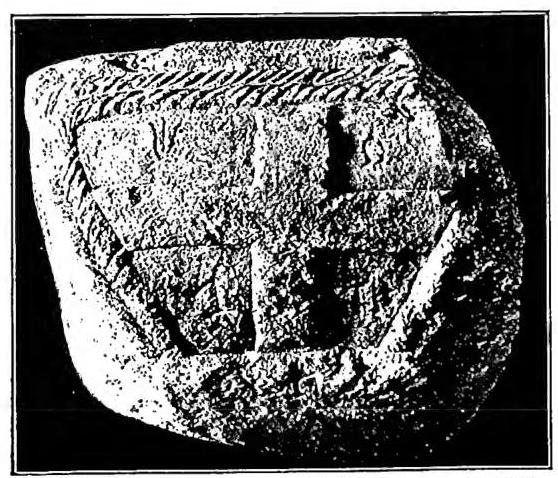
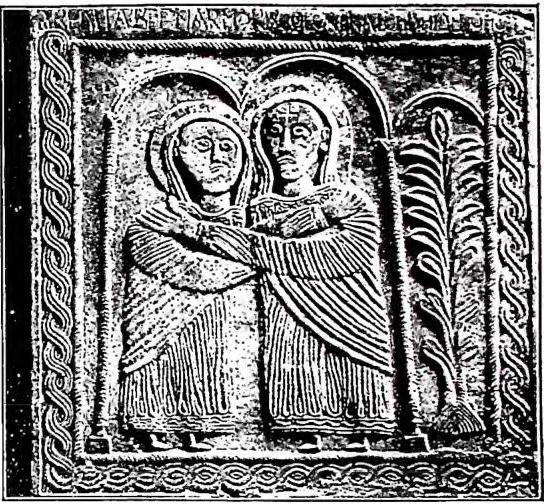
(from Memorie storiche forogialisti, 23 [1917], plate outside the text) LONGOBARDI - Visitation. Side of the altar of Rachis (8th century). Cividale.
The departure of the L. from Pannonia began on 2 April 568, according to the chronological record of Secundus of Trent, used by Paul the Deacon in his Historia Langobardorum. The L. dragged along with them various other minor ethnic groups, either conquered or vassal (Gepids, Sarmatians, Norici, Suebi); some Saxon tribes, attracted by the hope of booty, also came to reinforce Alboin’s people. These barbarians, whose number is unknown, descended without encountering opposition to Cividale del Friuli (Forum Iulii), where, however, they appeared only on 21 March 569. The imperial garrisons, too few and scattered, apparently offered no resistance and shut themselves up in castles and walled cities, leaving the invaders free to advance westward along the Via Postumia. A sad aura of terror immediately surrounded the name of the L. in Italy because of their massacres and destruction; the populations began to flee with their bishops toward the imperial centers. During their residence on the Danube, the L. had adopted a Christianity of the Arian type; many were still attached to old polytheistic cults, and anti-Catholic religious fanaticism exerted a considerable influence upon them. On 3 September 569 Alboin occupied Milan, still desolate after the sackings of 539; subsequently all Liguria was occupied. Here and there some islands of Byzantine dominion remained, consisting of castles and fortified towns; Ticinum also offered strong resistance and was occupied only in 572, although one should not suppose that Alboin remained at its siege for three years. The imperial governors, Narses and later Longinus, were unable to create an effective barrier along the Po, nor even in the Apennines; thus already in 569, apparently, bands
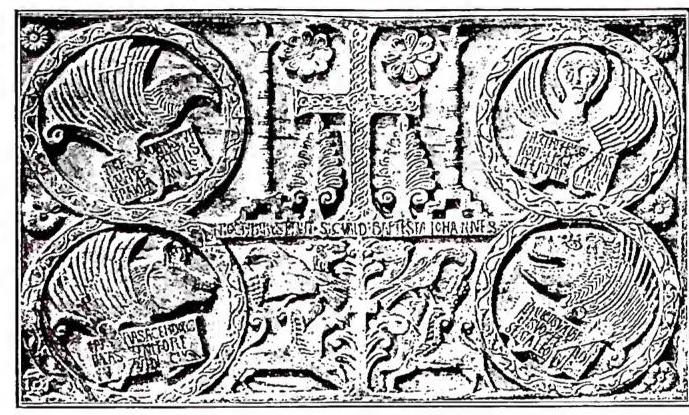
(from Memorie storiche forognolieri, 23 [1911], sec. [1911], sec. 1) LONGOBARDI - Pluteus of Patriarch Siguald (8th century), with the Cross flanked by the four symbols of the Evangelists - Cividale.
of L. crossed the Po and began ravaging Tuscia. The imperial failure to halt the invasion encouraged the formation of the legend that, in revenge against the imperial court, Narses had invited Alboin to descend into the peninsula.
The intoxication of conquest and the greed for plunder brought about the rapid disintegration of this people, whom the Romans had described as united and disciplined. The military leaders who commanded the various columns formed by fare, that is, by kinship groups, increased in prestige and authority in the eyes of their followers the more successful their enterprise proved. The fare settled without any order or principle, wherever and however their greed and violence could be satisfied. It is difficult, for example, to attribute the settlement of Gisulf’s fare in Friuli to a political act by King Alboin rather than to a desire for conquest on Gisulf’s part. The dispersal of the fare, while benefiting the various military leaders, harmed the authority of the King; likewise, the authority of the L. over the dependent ethnic elements suffered a severe blow. This new situation explains the crisis that struck the L. in 572: the Gepids who had gathered around Verona, led by a certain Elmichis, rebelled against the L., rallying around their queen Rosmunda. Elmichis and Rosmunda killed Alboin and, after marrying, seized the throne. The L. reacted against the Gepid attempt and proclaimed one of their leaders, Cleph, son of Beleos, king; he, however, was killed by one of his clients after little more than a year. Elmichis and Rosmunda, together with all their supporters, Gepids and L., separated from the Lombard mass and went to Ravenna, paying homage to the Emperor. The subsequent disappearance of Alboin and Cleph was disastrous for the Lombard monarchy: Cleph’s son, Autari, was unable, because of his youth, to have himself recognized as king. The L., concerned with the necessity of expanding their occupation in Tuscia, in the Tiber valley, and then still farther south in the Beneventan Apennines, paid no attention to what was happening at Ticinum. In the cities they conquered one after another, the Lombard leaders replaced the Byzantine dukes, assumed their title, and appropriated their functions and rights. Thus Lombard dukes appeared in the Italian cities: Paul the Deacon states that after Cleph’s death there were 35 dukes in Italy; but it is probable that the number was not stable, nor did every city have a duke.
At a certain point, the Lombard dukes had to consider the serious problem of consolidation; abandoning Italy for other regions or returning to Pannonia was out of the question. The poverty of the Italian region explains how, even in 569, bands of barbarians dared to cross the western Alps and advance to plunder in the Rhône valley. They encountered only moderate resistance, so that the raids in Burgundy and Provence became continuous for several years: in 575 the L. threatened Marseille itself.
But now the Merovingian king of Burgundy, Gontran, after driving them back, crossed the Alps in turn as a precaution and permanently occupied the valleys of the Dora Riparia (Susa) and the Dora Baltea (Aosta). Thus shut up in the peninsula, the L., who were still a people of shepherds—for their wealth apparently consisted in large herds of horses and pigs—or who at most had practiced a rudimentary agriculture in Pannonia, were forced to begin a new economic phase. Paul the Deacon refers to this rural settlement with the much-discussed and enigmatic phrases: «Hic Cleph multos Romanorum viros potentes, alios gladio extruxit, alios ab Italia exturbavit»; of the period when the L. were under the dukes, he says: «His diebus multi nobilium Romanorum ob cupiditatem interfecti sunt. Reliqui vero per hospites divisi, ut terciam partem suarum frugum Langobardis persolverent, tributarii efficiuntur». And for the reign of Autari he repeats: «Populi tamen aggravati per Langobardos hospites partiuntur». Thus there would have been a considerable destruction of the great Roman landowners; Lombard nobles would have replaced masters who had either fled or been killed on the estates; elsewhere barbarians would have settled in the country houses and forced the peasants to place at their disposal, according to Roman military law, one third of the houses and of the products of the soil.
Nevertheless, there is no documentary evidence of this organization of the terciae among the L., and it is doubtful that Paul the Deacon possessed any. It should be assumed that he applied to the L. what he read in sixth-century writers concerning the Visigoths, Ostrogoths, Vandals, and others. Although the settlement brought the barbarian fare into the Italian lands in their gentile unity, later Lombard documentation demonstrates that there were no collective but individual allotments: landowners held full rights over the cultivated land. Connected with the problem of the land is that of relations with the Roman citizens, a new issue for the barbarians. Historians and jurists long debated whether the Roman citizens were respected in their freedom or reduced to the inferior status of aldi. German historians generally followed the latter conception, in contrast with the Italian tendency, defended with precision and acumen by Schupfer. Certainly, the L. gradually had to adopt toward the Italians a regime of toleration, but they did not go so far as to incorporate the Romans into their citizenship, which was based on birthright and military capacity. Autari, like Alboin, Rotari, and Liutprand, is rex gentis Langobardorum; the Romans are juridically outside it, but not politically: they are within the regnum Langobardorum. The Italians enjoyed personal freedom, enabling them to attend to their affairs, buy, sell, and make wills, as well as religious freedom. Freedom belonging to subjects, not to equals. But as the L., both in the cities and in the countryside, increasingly felt the need, for the purpose of establishing themselves, to draw upon the technical abilities of the Italians, the victors’ attitude gradually changed; while the principle of ethnic differentiation remained intact, relations between the two populations assumed a character of mutual consideration. The later wars of conquest, from Rotari through Liutprand to Aistulf, no longer weighed upon the populations.
The Lombard invasion had not greatly concerned the government of Constantinople: precisely in 569 the Avars resumed hostilities across the Danube, and suspended them only after the Khagan Bajan purchased peace with an annual tribute. Thus, in Constantinople, the irruption of the L. into Italy appeared merely as one episode in the thorny problem of relations with the Danubian barbarians. The settlement, however, was viewed otherwise. Lacking the military means for energetic action, the governors of Ravenna resorted to seduction among the leaders. The split between the L. and the Gepids in 572 may already have been a consequence of Byzantine policy; after Cleph’s death, the corruption of the dukes was resumed: the dukes, isolated and at odds with one another, could more easily become greedy for gold than for glory.
Some military attempts were made, but without result: around 575 Badoarius, Justin II’s son-in-law, was defeated and killed. Penetration into central Italy made the Italian cities’ appeals for help more urgent; in 579, when Pelagius II succeeded Pope Benedict, Rome was completely blockaded. The Emperor Maurice, in order to resolve the Lombard problem, appealed to the Frankish kings, who viewed with displeasure the settlement of the L. on their borders. King Childebert undertook to intervene in Italy against the barbarians, in the service of the Empire; in 584 he crossed the Alps and advanced into Liguria, but the dukes of the most exposed cities shut themselves inside them and offered the Frankish king tribute and submission. Childebert preferred to accept the Lombard proposals and withdrew without fighting, provoking protests from the Emperor, who felt himself defrauded.
Paul the Deacon records for 584 the restoration of the Lombard monarchy in favor of Autari, son of Cleph, but it is not known how this came about; Paul the Deacon’s version—that the dukes spontaneously acclaimed Autari king communi consilio and gave half of their possessions to create a royal patrimony for him—is difficult to accept. It is more probable that this was an act of force by the young Autari, supported by some interested duke: other dukes must have opposed him, like that Droculf, who abandoned the L. and went over to the imperial side, resisting the King for a long time at Brescello. King Childebert’s interventions in Italy, in agreement with the imperial government, were repeated in 585, then in 588 and 590. Autari repeatedly sought to reach an agreement with the Frankish king, offering to marry his sister Clotsuinda; when rejected, he sought an understanding with the Bavarian duke Garipald, who gave him his daughter Theodelinda in marriage (589).
The political crisis that disturbed the L. in 590 was due not to the struggle with the Franks and the imperials, but to the internal situation: Autarit died suddenly in 590, and Paul the Deacon speaks of poison; the duke of Turin, Agilulf, seized the throne, married Theodelinda, and was thereby recognized by some of the dukes. Others, however, continued the struggle. To resist them, Agilulf sought to reach agreements with the Frankish kings and with the Khagan of the Avars. The imperial exarchs of Ravenna, left alone to fight, were concerned to maintain communications with Rome across the Apennines.
In 598, a one-year truce was finally concluded between King Agilulf and the exarch of Ravenna; it was renewed in 600 and again, after a resumption of hostilities, in 604, and thereafter repeated from year to year. Since the Empire neither wished nor was able to recognize the existence of the Lombard state, there could be no true peace; but both sides were convinced that the war effort had by then become futile. Thus, after so many years of war, the system of truces brought great relief to the Italian populations.
In the 7th century the king was the supreme head of the Lombard peo-
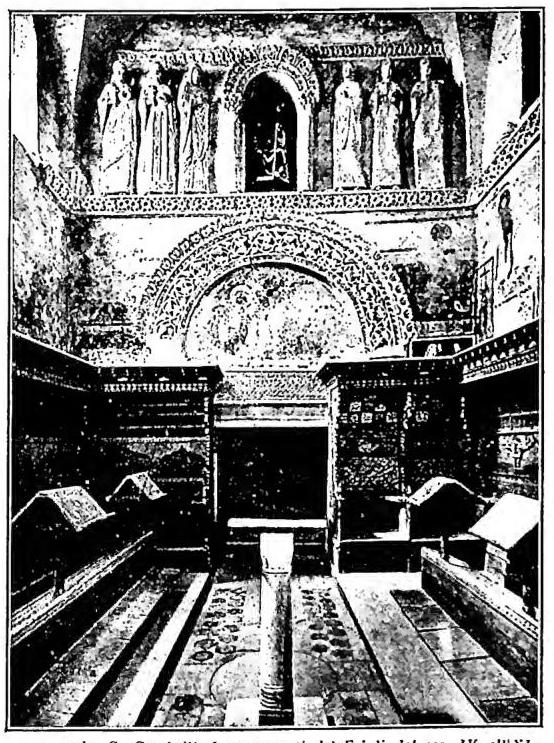
(from C. Cecchelli, I monumenti dei Friuli dal sec. IV all'XI, Rome 1812, inv. 30) LONGOBARDI - Entrance wall of the Longobard tempietto with stucco work - Cividale.
It is not easy to determine what the provincial administration of the Lombard state was. When they descended into Italy, the barbarians found there a theoretically perfect provincial organization: the provinciae, within them the cisitates, and the pagi. The Lombards allowed it to collapse of its own accord. They established dukes and gastalds in many centres, large or small, according to the circumstances of the conquest. In general, those who were called duces, and also iudices, settled in the principal cities, though this was not an absolute rule. As military leaders, the dukes inherited the financial, judicial, and administrative duties of the Byzantine officials. Special officials were the gastalds, entrusted with the administration of the royal patrimony and invested with extensive governing powers over the population of the district as well. Relying on them, the king tended to substitute gastalds for autonomous or independent dukes.
Lombard society comprised free and unfree men, like Roman society, and the two societies therefore readily tended to merge. The unfree included the rural slaves (rusticani), household slaves (ministeriales), and the aldi, who were semi-free: personally free, that is, but attached to the land like the Roman coloni. Above them were the free men, or arimanni (exercitales); originally equal because they possessed equal rights to bear arms, in the 7th century differences in landed wealth divided them into various ranks: from the propertyless one rose to the nobiles, men of great authority and wealth.
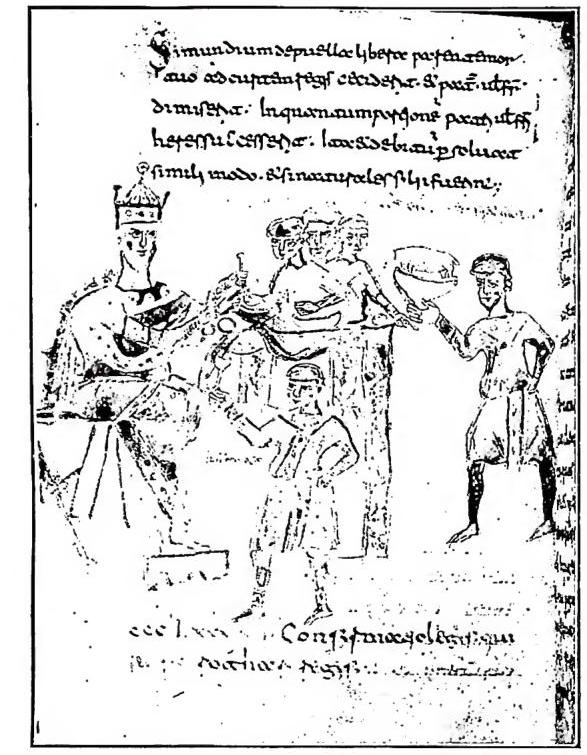
Moral and economic transformation had by then induced the Lombards to abandon the primitive barbarism of blood vengeance (faida), obligatory down to the seventh generation, and to adopt simple monetary compensation proportionate to the valuation of the person killed («sicut adpraeiatus fuerit, id est vuergeld»). The death penalty remained confined to a few cases: an attempt on the king’s life, desertion, and treason. Theft and the flight of slaves were punished severely; regulations concerning offences in the countryside were detailed, revealing the importance of livestock and cultivation to the Lombards. Just as, in criminal law, the guidrigild distinguished the free man from the slave, so in civil law the person in full possession of civil rights was distinguished by the «mundio» from one subordinated to another. Whoever possessed the mundio had the legal representation of the person subject to II. Under Lombard law, a woman was perpetually a minor: from her father’s mundio she passed to that of her brother, her husband, or, in the absence of relatives, the king. The presence of the mundoaldo was required for the drafting of the marriage instrument (fabula) necessary for the conclusion of marriage. In it were established the «meta» (the bridegroom’s gift to the bride’s family) and the «faderfio» (the family’s gift to the bride); once the marriage had been consummated, the husband made a gift to his wife (morgengabe, the morning gift). The right to donate and alienate one’s property was exercised with a reservation in favour of the children; the act required symbolic ceremonies (gnirethings = guaranty). Inheritance was likewise subject to conditions: first in succession were legitimate or illegitimate children; the woman participated in the absence of males; kinship was limited to the seventh degree. Slaves could be manumitted and acquire full civil rights; manumission was of different kinds and value. In judicial procedure, the plaintiff summoned the defendant to court by sending him the «wadia», a symbolic object confirming the regularity of the proceedings. There were two kinds of evidence for the prosecution: the oath administered through the sacramentals, from three to twelve (turatore), and, in the gravest cases, trial by combat between the parties. The Edict of Rotari appears to have had territorial character, but the position occupied in it by the Roman population remains a matter of discussion.
The Lombard monarchy never succeeded in establishing a solid organization capable of eliminating the danger posed by provincial particularist tendencies, nor in creating a military force of its own strong enough to confine the dukes to a limited sphere of action and make them disciplined executors of central authority. To live in peace, the kings instead had to resign themselves to allowing the dukes to seek to assert a precise autonomy in agreement with the local propertied class.
Although poor in information, the account of Paulus Diaconus attests to the dangerous continuation of struggles between kings and dukes. In 653, Aripert, son of the Bavarian Gundoald, brother of Queen Theodelinda, succeeded Rodoald, son of Rotari. At his death (661), however, his elder son Pertarito was opposed by his younger brother Godebert; the duke of Benevento, Grimoald, intervened in the conflict. Godebert was killed, while Pertarito took refuge among the Avars; but in 671, after Grimoald’s death, he returned to the throne and secured the succession for his son Cunibert, making him his colleague. Cunibert soon found himself confronted by the rebellion of Alachia, duke of Brescia, and of the Lombard element of Austria. Cunibert emerged victorious, but then had to fight another rival, Ansfrid, duke of Friuli. At his death (700), his son Liutpert reigned under the tutelage of the noble Ansprand. The duke of Turin, Ragimbert, however, rebelled, seized the throne, and at his death left it to his son Aripert. The latter in turn found himself confronted by a coalition of dukes; although he succeeded in eliminating Liutpert, he subsequently had to yield to Ansprand, who seized power and almost immediately left it to his son Liutprand (712).
These persistent struggles were no longer connected with the religious question, because the Lombards, under Pertarito and under Cunibert, had definitively converted to Catholicism; and even in the Beneventan region the last traces of idolatry had been destroyed by the preaching of Bishop Barbatus. They demonstrated only the inability of the Lombard nobility to exploit the favourable general policy. After Rotari’s war, a genuine peace treaty had been concluded between the Kingdom and the Empire—though it is not known precisely when—now that the Catholic Lombards offered hope of becoming clients of the Empire; relations with the Franks had also been regularized.
Liutprand (v.), an exceptionally long one (712–44), although surrounded by a certain aura of greatness, nevertheless demonstrates the serious defects of the Lombard state constitution and the impossibility of remedying them. In the first phase of his reign (ca. 712–25), Liutprand seems to have had no concern other than organizing the State with the greatest possible centralization, replacing the dukes with gastalds wherever possible. In his laws Liutprand accentuated the Catholic character of his rule, devoted to the Church of Rome; to demonstrate his deference to the Pope, he reaffirmed the restitution of the ecclesiastical patrimony of the Cottian Alps, already decided upon by Aripert II. Likewise, he declared himself respectful of the commitments undertaken with the imperial government; indeed, his predecessors seem to have behaved in the same way, even when the violent policy of Justinian II produced serious disturbances in the Exarchate of Ravenna. Even when Faroald II, duke of Spoleto, seemed, by a coup de main against Classe, to be reviving the old program of conquest, the King ordered him to withdraw.
But Faroald had opened the question of the division of the peninsula between the Kingdom and the Empire. When the question of iconoclasm provoked popular agitations in the Byzantine provinces and Pope Gregory II seemed to support resistance to the decrees of Emperor Leo III, the king of the L., under the pretext of protecting the Pope and the Church, intervened in the disorder of the imperial territory and occupied various cities. The ease of this expansion filled the Roman Curia with alarm, conscious as it was of the danger posed to it by the possible elimination of Byzantine rule from Italy. Gregory II inaugurated a policy of halting the anti-imperial movement and maintaining a faithful, or at least loyal, attitude toward Constantinople, forbidding the Lombard monarchy any attempt to penetrate the Byzantine dominions. King Liutprand now found himself confronted by two forms of opposition: papal-Roman autonomism, masked by fidelity to the Empire, and the autonomism of the dukes of Spoleto and Benevento; the two movements, moreover, feeling themselves equally threatened by the unifying aspirations of the monarchy of Pavia, were prepared to join forces. Gregory III and then Zachary remained faithful to this policy: on several occasions Liutprand attacked the Duchy of Rome and the Exarchate of Ravenna, but the papacy had taken upon itself the protection of imperial rights, and the Popes repeatedly intervened with the King to force him to withdraw. Liutprand’s policy was continued after his death (744) by King Rachis; in 749 he invaded the Roman Duchy, but Pope Zachary induced him to abandon the struggle. The consequence was a serious dissension among the Lombard leaders: Rachis abdicated and withdrew to Montecassino; he was succeeded by his brother Astolf (v.), leader of the more vigorous tendency among the L.; and indeed, in 751, he occupied Ravenna and the Exarchate with the determination not to withdraw again, then advancing against the Duchy of Rome. The Byzantine Empire, occupied in its bitter struggle with the caliphate, was certainly in no position to confront the Lombard advance.
(phot. Enc. Catt.)
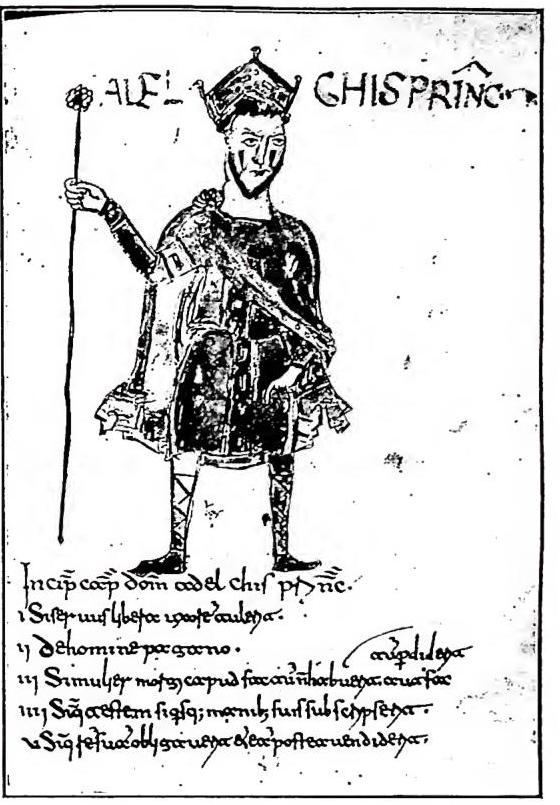
LONGOBARDI - Prince Adelchi. Miniature from the Codex Iequa Longobardorum (11th century) - Cava dei Tirreni, Library of the Abbey, cod. 4 (formerly 22), f. 1886.
the old obligations of dependence of Agilulf. The Lombard monarchy thus ceased to be independent and passed under the control of the Carolingian monarchy, which, for its part, asserted superiority over Rome with the title of patrician; the Empire now retained its rights over the Exarchate and Rome only in theory. Astolf and his successor Desiderius (v.) endeavored to give their relations with the Frankish monarchy a character of cordial friendship, and at a certain point Desiderius imagined that he had succeeded when he gave one of his daughters in marriage to Pepin’s son Charles and believed himself able to resume the policy of expansion in central Italy. But Desiderius now faced not the Byzantine Empire but the Roman Curia. Strengthened by Frankish support and the donation of Quiersy, the papacy stood as a factor of capital importance in Italian politics. Already at the very election of King Desiderius, Pope Stephen II had intervened as arbiter in the Lombard disputes. Paul I, for his part, had sought to wrest from the King of the L. the submission of the two dukes of Spoleto and Benevento. The marriage between Charles, King of the Franks, and the daughter of King Desiderius provoked the most vehement protests from Stephen III. The correspondence of the popes with the Frankish court, from this point onward at least, acquired a violent tone directed not only against King Desiderius but also against the entire Lombard people, which was called “a perfidious and most foul people, not to be counted among the nations, but from whom the race of lepers derives.”
Desiderius, overestimating the security of his ties with the Frankish court, attempted in 771 to impose himself on Stephen III with the support of a Roman faction. It was a grave error, because although the Frankish court did not intend to support the popes against the L. to the very end, neither could it allow King Desiderius to impose his authority in Rome. In that same year, 771, Charles repudiated his Lombard wife, while the widow of his brother Carloman took refuge with Desiderius. The rupture with Charles impelled Desiderius to act energetically in the Exarchate and the Duchy of Rome, in order to confront the Frankish King with a fait accompli. His program, however, failed: in 772 he did not dare persist when the new pope, Adrian I, threatened him with excommunication; instead, the Pope urged King Charles to intervene in his defense. The Frankish expedition took place as early as the summer of 773; the Lombard nation disintegrated in the face of danger; the dukes lost interest in the common fate. Desiderius, left alone with his forces to resist, shut himself up in Ticinum, while his son Adelchi was in Verona. In May 774 King Desiderius capitulated and surrendered, together with his consort Ansa, to the Frankish king, who in the first days of June assumed the title of King of the L. Two years later, some Lombard dukes attempted an uprising against the foreign King, but the attempt failed and led to the replacement of the Lombard dukes by Frankish counts in the government of the Italian cities. The Lombard population was respected and retained its possessions and offices until it slowly disappeared into the Italian people then rising anew.