
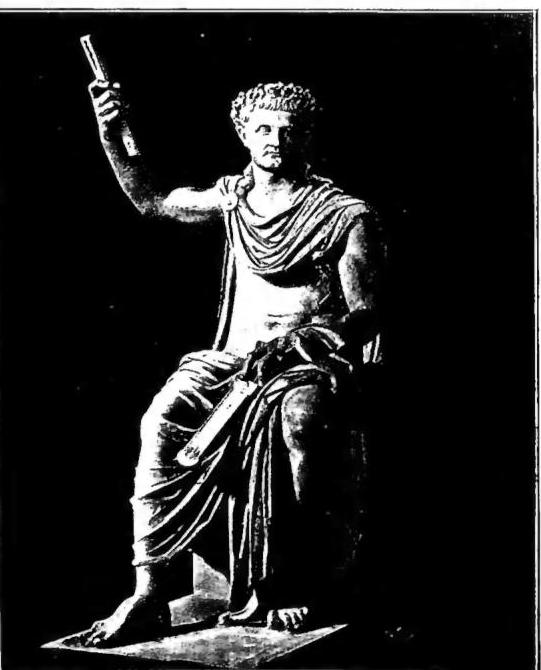
TIBERIO, CLAUDIO NERONE (Tiberius Claudius Nero; after his adoption by Augustus, Tiberius Iulius Caesar), ROMAN EMPEROR. — Born on 16 November 42 B.C., he died at the villa of Miseno on 16 March A.D. 37. In the New Testament he is explicitly named only in Lk. 3:1; he is referred to in Mt. 22:17, 21 and parallels (when Jesus is questioned about the lawfulness of the tribute to Caesar), Lk. 23:2 and Jn. 19:12, 15 (at Jesus’ trial before Pilate). During his reign (A.D. 14–37), the entire public activity of John the Baptist and Jesus took place, the martyrdom of s. Stephen occurred, and probably also the conversion of s. Paul.
Partially contemporary with him (Lk. 3:1 ff.) were Pontius Pilate (v.) as procurator of Judaea (A.D. 26–36), Herod tetrarch of Galilee (4 B.C.–A.D. 39), Philip tetrarch of the north-eastern regions of Palestine (4 B.C.–A.D. 34), Caiaphas, high priest of the Jews (A.D. 18–26), and Lysanias, tetrarch of Abilene (between A.D. 14 and 29). The determination of the “15th year of the reign of T.” (Lk. 3:1) would be very useful for establishing in which year of our era the preaching of John the Baptist and that of Jesus began (the latter began three, at most nine, months later), as well as the age of the Lord at that time (indicated too vaguely in Lk. 3:23). Unfortunately, both the beginning of the reckoning (from the death of Augustus: 19 August A.D. 14, or from the joint rule of T. with Augustus over the provinces, begun in 12) and the very method of reckoning remain uncertain (whether or not the intervening months up to the beginning of the following year were counted as a full year; for the Romans this was 1 January, and for the Jews 1 Tishri or Nisan). The conclusions therefore range between A.D. 26 and 29, with preferences for 26–27 and 28–29. Thus Jesus’ “about 30 years” (Lk. 3:23) may have been anywhere from 31 to 34.
T. is credited with great concern for the sound administration of the provinces; he used to say that “the duty of a good shepherd is to shear the flock, not to flay it”; he kept governors in office for more than three years, convinced that if the flies sucking the blood of a wounded man are driven away, others, thirstier still, will come and bleed him dry (Josephus, Fl. Antiq. Iud., XVIII, 6, 5). The best governor whom T. appointed to Syria was L. Vitellius (35–39), who played a major role in the affairs of Judaea (v. LEGATO, II. di Siria, 14). On the other hand, Sejanus, hostile to the Jews, may have influenced the appointment of Pilate as procurator of Judaea. Yet on several occasions T. granted them satisfaction against Pilate, as when he ordered the golden shields that Pilate had placed in Herod’s Palace in Jerusalem to be taken to Caesarea. It also seems that T. had Pilate secretly watched by Herod Antipas; certainly Pilate decided to pronounce the death sentence against Jesus for fear of being denounced as an accomplice of a defendant accused of the crime of treason (Lk. 23:2; Jn. 19:12 ff.).
(Alinari photograph)
It is highly probable that the tribute money shown to Jesus (Mt. 22:19 ff. and parallels) was T.’s; in that case it was made of silver and bore on the obverse the image of the Emperor crowned and surrounded by the inscription: Tiberias Caesar Divi Augusti P(ilius) Augustus, and on the reverse the effigy of Julia Livia with sceptre and flower, with the inscription Pontif. Maxim. around II. Livia bore the title “augusta” from A.D. 14 until 29, when she died: the inscription of a certain Nymphaeus, Abilene (v.) Lysanias, in honour of the “augusti” (Tiberius and Livia), therefore dates from this period. Paul Orosius (Histor. adv. paganos. VII, 4: PL 31, 1066–69; cf. Tertullian, Apol., V: PL 1, 290–92) reports that T., informed by Pilate of the death and resurrection of Jesus and of his miracles, wished to declare him a god; but the Senate opposed this. This account may be based on the apocryphal writings of Pilate, in which it is also stated that T. received Baptism after being healed while venerating Veronica’s sudarium (v. PILATO, Apocrifi di, n. 3).