
TIBET. — A vast, elevated plateau (averaging 5,000 m), situated between the Himalayas and the Kuen Lun; entirely desert in the west, with some pastureland in the southeast and somewhat less inhospitable terrain in the east, but everywhere difficult to access and, thus far, only very imperfectly known.
I. GEOGRAPHY
Its eastern section constitutes the two Chinese provinces of Tsinghai or Chinhai and Sikang; the remainder is subject to the Chinese government only formally. A country of herders and, locally, farmers, T. has a primitive economy, with very limited exchanges, and a population of barely 1 million souls over an area of 1.2 million sq. km. Conditions of the soil (mountains, lakes, deserts) and of the climate (extreme continentality, scant rainfall, violent storms) make life there difficult and precarious. Although governed by an oligarchy headed by the Dalai Lama, T. has been theocratic, authority being entirely in the hands of Buddhist priests, scattered among the numerous monasteries. The largest inhabited center is the capital Lhasa (approx. 20,000 inhabitants), which stands at 3536 m. above sea level.Giuseppe Caraci
II. HISTORY
T. (in Tibetan: Bod, pronounced P'ō) had been inhabited at least since the 11th century by semi-nomadic groups speaking Tibetan or related languages. There was no centralized state organization, and the country was divided into a series of small states dominated by an aristocracy largely of Central Asian origin. At the end of the 6th century, the princes of Yar-kluns (Yarlung) unified the country, giving it a monarchical-feudal structure.King Sroñ-btsan-sgam-po (ca. 620–49) entered into political relations with China and Nepal, and consequently, during his reign, the religious and cultural influences of China and India began to penetrate the country. Under his successors, T. became a great Asian power, engaged on equal terms in struggles with China on the one hand and the caliphate on the other. Central Asia, already occupied from 670 to 692, was definitively conquered, together with vast portions of western China, by K'ri-sroñ-ide-btsan (755–97); his reign also witnessed the definitive victory of the religious and cultural influence of India over that of China, and the adoption of Indian Mahāyāna Buddhism as the state religion in place of the ancient Bon-po religion. In the following decades Buddhism made ever greater advances, provoking a reaction from the Bon-po party (the assassination of King Ral-pa-can in 838). Glan-dar-ma then ascended the throne, a fierce persecutor
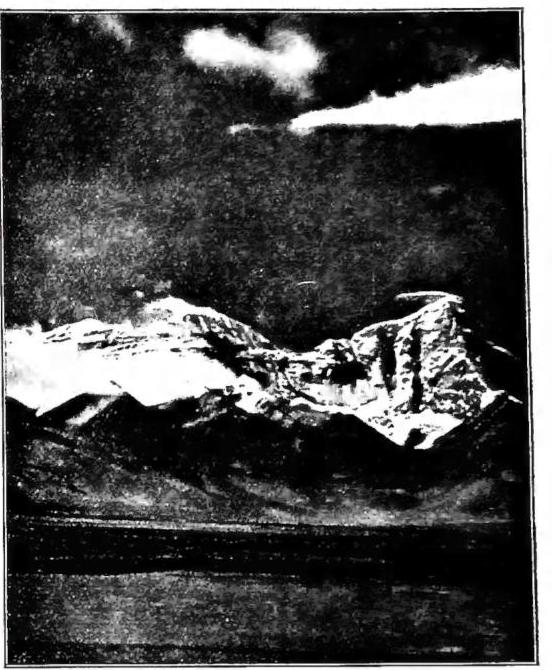
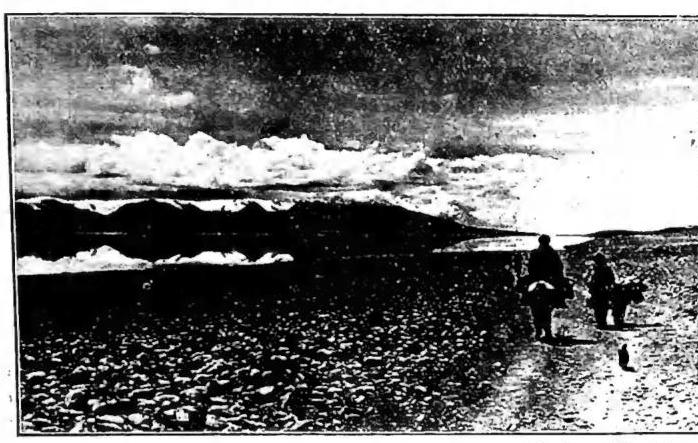
In 1875 the XIII Dalai-Lama T'ub-idan-rgya-mts'o was born, one of the most capable of the series. In 1904 an English mission, which had been forbidden entry into the country, forced its way manu armā as far as Lhasa and compelled the local authorities to enter into diplomatic relations with the English government of India. The Dalai-Lama, who had taken refuge in China, returned to Lhasa only to flee from it again, this time to India, in the face of the advance of a Chinese expedition that occupied Lhasa in 1910. Two years later, with the fall of the Empire, the Chinese occupation also collapsed, and T. entered a period of nearly forty years of de facto independence. The Dalai-Lama, having returned to Lhasa, governed the country firmly and wisely, relying (within clearly defined limits) on England. After his death in 1933, the search for his reincarnation was long and difficult, and the XIV Dalai-Lama was formally enthroned only in 1940. The regents who held power from 1933 to 1950, the incarnation of Rva-agren (Reting) and then that of Brag-k'ra (Taktra), proved weak and unpopular, and English support ceased with the independence of India in 1947. Thus, when China came under communist government in 1949, the political and military pressure exerted by the government in Beijing easily overcame the Tibetan government's limited possibilities for resistance. Under the Treaty of 23 May 1951, T. became an integral part of the People's Republic of China, with broad local autonomy under the government of the Dalai-Lama. China reserved control over foreign affairs, military affairs, and the development of the country's resources.
In September 1951 communist troops entered Lhasa. Although the Chinese, on the whole, proceeded with tact and prudent slowness, the end of the old lamaist and theocratic T. was by then only a matter of time.
Luciano Petech
III. EVANGELIZATION
The first missionary to enter T. was Antonio d'Andrade, S. J. It is now established that neither Marco Polo nor Odorico da Pordenone, O. F. M., actually entered it, but merely skirted its neighboring provinces. D'Andrade succeeded in opening the mission in 1624 at Tsaparang, capital of the western Tibetan Kingdom of Guge; however, in 1630 the mission was destroyed after this kingdom was occupied by the king of Ladak. The attempts of Fr. Francisco de Azevedo S. J. to open a mission in the Kingdom of Ladak failed, as did those of Frs. Estevão Cacella and João Cabral S. J. in the southern Kingdom of Tsang. Nor did the journey of Frs. Johann Grueber and Albert d'Orville from Beijing, via Lhasa, toward India in 1661 have any missionary effect. In 1703 Propaganda entrusted the Tibetan mission to the Capuchins. The first arrived in Lhasa in 1707, remaining there until 1712. In 1716 other Capuchins went to Lhasa, where they found the Jesuit Ippolito Desideri, sent by the archbishop of Goa. To him we owe the best description of T. from that period. By order of Propaganda he was compelled to leave Lhasa in 1721. Under the direction of the mission prefect Francesco Orazio della Penna di Billi O. M. Cap. (1720-1745), the Capuchins succeeded in building a church and a convent in Lhasa, but the numerical results of the conversions were very meager. In 1742 a persecution broke out, and in 1745 the Capuchins were compelled to leave T. permanently, settling in Nepal and northern India. The name of T. was nevertheless retained for this mission, although no genuine missionary activity could be exercised locally.During the 19th century, the two Lazarists Evariste Huc and Joseph Gabet reached Lhasa in 1844, but were expelled after six weeks. Heroic efforts and attempts at penetration were undertaken by the Missionaries of the Seminary of Paris, to whom the mission of T. had been entrusted in 1846, both from the Chinese and from the Indian side. But Frs. Nicolas Michel Krick and Augustin Etienne Bourry were murdered on 1 September 1854. Charles René Alexis Renou succeeded in settling in 1854 at Bonga, in a deserted valley of the Kingdom of Lhasa; in 1864, after Renou's death, Auguste Desgodins was definitively expelled from Bonga.
From that time T., properly so called, remained closed to Catholic missions. Only in the neighboring provinces, in the so-called Tibetan Marches to the East
and in northern India along the borders of Sikkim, were the Fathers of the Foreign Missions of Paris able to found some stations as advanced posts.
For the religion of T.: V. LAMAISMO.
- Vedi tavv. VII-VIII.
Giovanni Rommerskirchen