
INDIA. - This name refers both to the historical region of southern Asia corresponding to the triangular peninsula, situated between the Arabian Sea and the Bay of Bengal, along with the low plateau of lands connecting it to its northern mountainous margin (Suleiman Mountains, Himalayas), and to the political unit that was established there through the English conquest (Indian Empire), and, after the Second World War, the larger of the two independent states now consolidating there (Indian Union and Pakistan).
CONTENTS:
I. Geography
II. Political History
III. Non-Christian Religions of India
IV. History of Christianity
V. Early Christian Antiquities
VI. Art
VII. Educational System.### I. GEOGRAPHY.
The Indian territory, extending over more than 20° in latitude, essentially consists of three major natural units: the arc of majestic reliefs that delimit it to the north (in which, despite excluding the highest sectors, several peaks exceed 7,000 m.); the peninsula proper, which is also a highland, though with flattened and worn forms, albeit elevated along its margins (Ghats, or "hills": 2,670 m. in the west), which in turn loom precipitously over the coasts; and the alluvial belt stretching between these two regions from the Indus (Punjab) and the Ganges (Indostan proper), extremely humid in the east, progressively drier in the west, where it ends in a sandy desert (Thar). The climate naturally varies from zone to zone, but overall exhibits tropical and subtropical characteristics (high and constant temperatures) with seasonal rains (April–November) linked to the monsoon regime. The quantity and regularity of these precipitations, however, depend primarily on the disposition of the reliefs relative to the direction of the winds; thus, from sectors that rank among the wettest in the world (Cherrapunji, in Assam, averages 12,000 mm. annually), one passes to arid districts (Punjab, Sind), where annual rainfall varies so greatly as to sometimes cause severe famines (approximately half of India’s territory remains under this threat). In any case, the harvests and the existence of the vast majority of the population depend strictly on the behavior of the rains and the possibility of irrigating the land (the frequency of irrigation, which is 10% of cultivated areas in the east, rises to 75% in Sind). Similarly, the lush tropical vegetation (jungle) of Indostan and the Tarai, where the fauna also appears abundant (large felines, many animals harmful to humans), contrasts elsewhere (lower Indus) with steppes and treeless zones, and even entirely desolate tracts.
The racial and ethnic composition of the Indian population appears highly complex due to the variety of interbreeding, whose effects, combined with those of the caste division, explain the large number of groups recognized by modern scholars. A fundamental distinction between Dravidians (the oldest element remaining on the plateau) and Indo-Aryans (who later penetrated the country and still prevail in Indostan), favored by tradition, no longer holds discriminatory racial significance. The linguistic terrain is less uncertain: of the more than 200 different languages identified by censuses, the Indo-European ones account for approximately 60% of the inhabitants of the entire Indian region, with Hindustani predominating absolutely, having become the official language of the state with political independence. Equally notable are the religious divisions, to which the secession of Muslim Pakistan is essentially due.
INDIA - 1) State boundaries; 2) ecclesiastical circumscription boundaries; 3) railways.
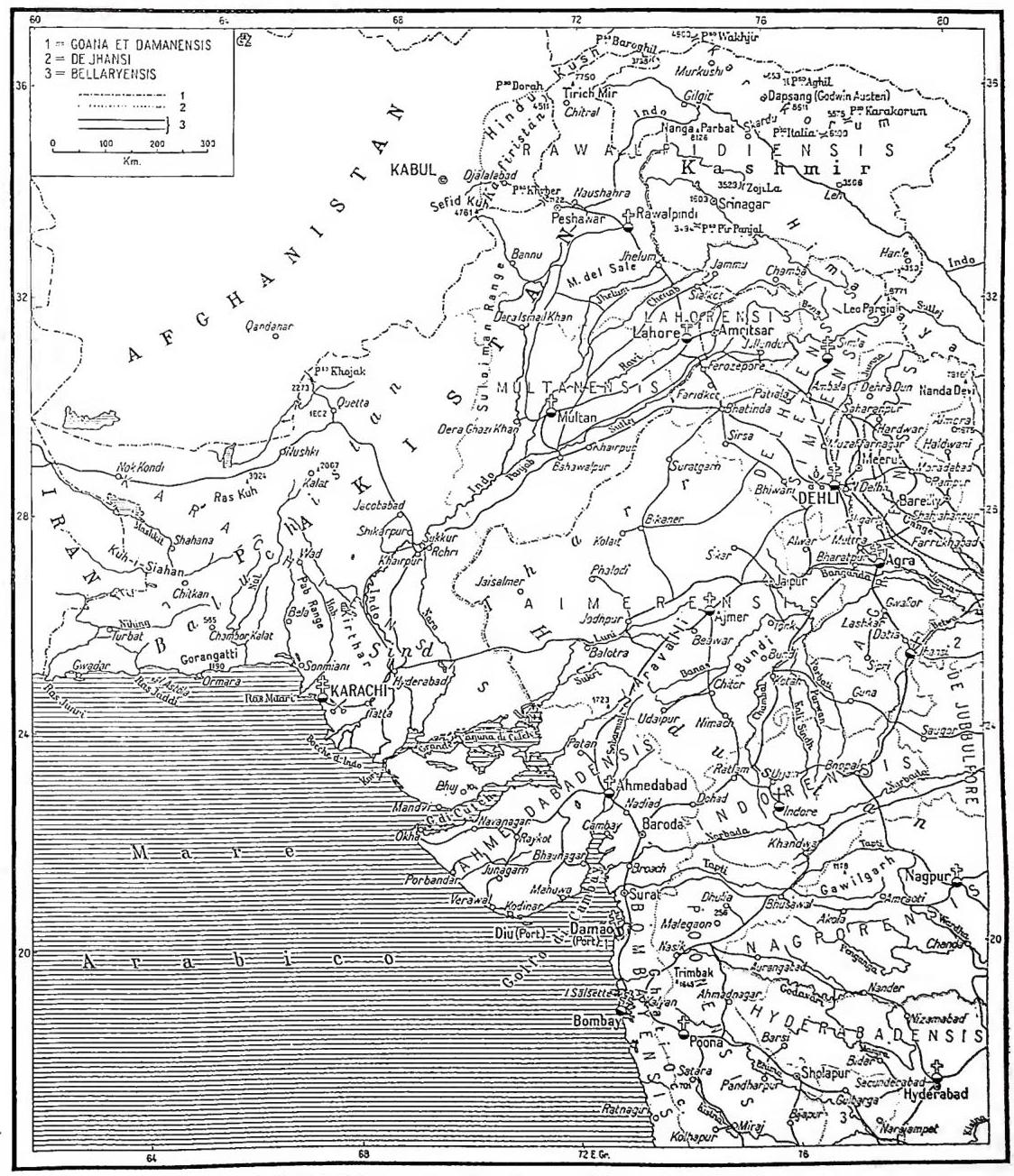
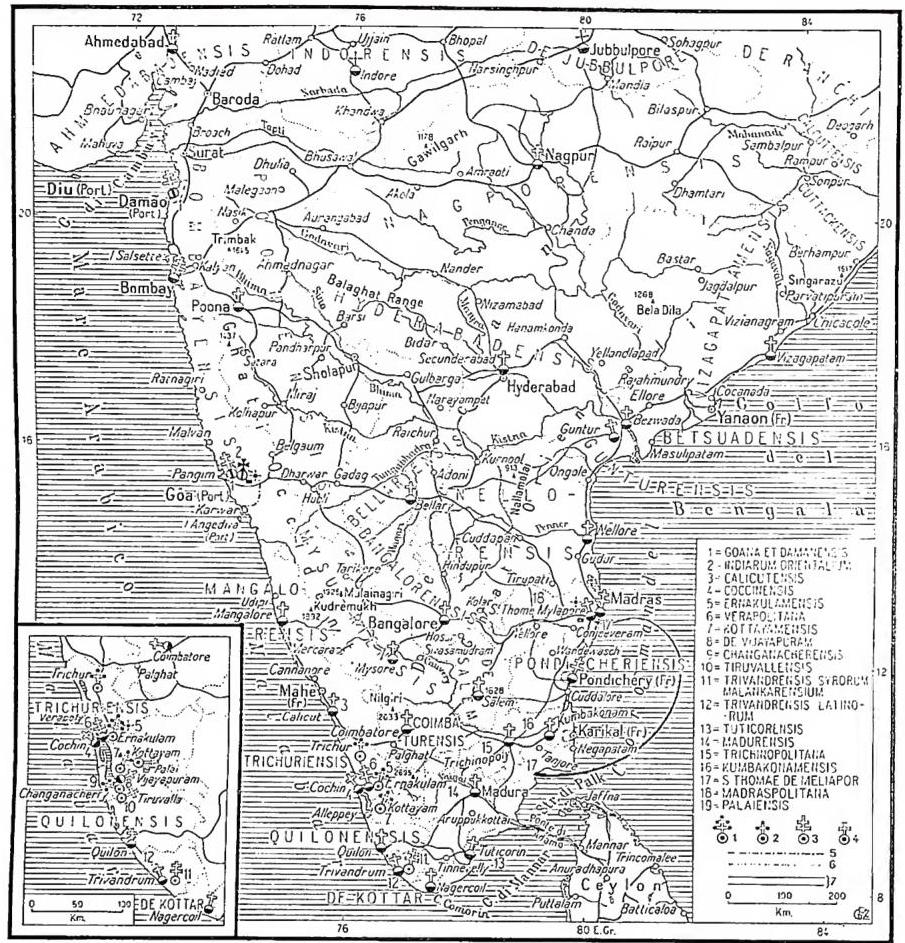
The predominant occupation is agriculture, still practiced, on the whole, with outdated systems but in continuous progress (irrigation, mechanization), and increasingly varied in its products. Rice, wheat, and sorghum dominate among cereals; cotton, jute (for which India holds an almost worldwide monopoly), and oilseeds (peanuts, sesame, rapeseed, flax, castor) among industrial plants; tea and coffee among shrubs. Notable are also the cultivations of sugarcane and tobacco. The livestock heritage is substantial (with its 136 million head of cattle and 46 million goats, India holds two world records), but animal husbandry is far from reaching its immense potential, which can also be said for forestry, despite its vast reserves and highly valuable timber. Coal and iron are present in numerous and rich deposits, nor are manganese, mica, copper, gold, petroleum, precious stones, etc., lacking, but the development of industries is still limited, except for the textile sector (cotton and jute mills). Nevertheless, great progress has been made in the last thirty years; the tendency to free itself from the need to import manufactured goods in this regard is evident.
Internal communications rely on numerous, excellent ordinary roads and a good railway network (65,200 km); however, this remains isolated from the innermost Asian territories. International trade is entrusted for 9/10 to the three major ports of Calcutta, Bombay, and Madras.
The new Indian State has absorbed over half a thousand distinct political-administrative units of the defunct Anglo-Indian Empire: the absorption and unification of this mosaic of governments will still require much time and effort. For now, independent India continues to be a member of the British Commonwealth by the will of its people. The Indian constitution is evolving toward democratic-republican forms based on elections.
II. POLITICAL HISTORY.
I. FROM THE ORIGINS TO THE MUSLIM CONQUEST
The sources for the history of India during the Hindu period are primarily epigraphy, numismatics, and the accounts of foreign travelers, especially Chinese; Indian literatures, with few exceptions, contain no properly historical texts. Later, the rich historiography of Muslim India, written in the Persian language, comes into play. The natural foundations of the peninsula's history are represented, on the one hand, by its inaccessibility from any direction except the sea and the passes of the northwestern frontier; on the other hand, by its natural division into three great regions: the Indo-Gangetic plain, the Deccan, and the far south. The historical development of each of these zones was largely independent.1. Prehistory and protohistory
India begins to be inhabited by humans in the early Pleistocene. From the Paleolithic period, numerous sites remain in the Deccan and southern India; the use of quartzite constitutes the main characteristic of the Indian Paleolithic. The Neolithic period is distinguished by an abundant but crude pottery; contrary to later periods, the dead were inhumed rather than cremated. Neolithic sites are found throughout almost the entire country, but especially in the north. From the Neolithic, there is a direct transition to the Iron Age; there are no traces of a Bronze Age civilization in India.In the transitional period between the Neolithic and the Iron Age, in the first half of the third millennium B.C., the first great Indian civilization appears: the civilization of the Indus (v. MOHENJO-DARO).
After the end of this civilization, darkness descends once again over Indian history. It is only known that at a later time (second millennium B.C.), the Arya (or Indo-Europeans) penetrated India from the northwest, pushing the Dravida southward and largely overwhelming the Munda, the two groups of populations that previously occupied the peninsula. Theirs was a civilization of herders and farmers, living in small villages and divided among numerous tribes. Initially confined to the Indus basin, they slowly expanded to occupy the entire Ganges basin and much of the Deccan. Over time, this amorphous Aryan population crystallized into a series of small states. Its social structure also gradually changed, evolving, among other things, the system of the four castes (varṇa), which from then on became the cornerstone of Indian society. Thus, the age of the Vedas transitions into that of the Brāhmaṇa and then into the era depicted in the two great epic poems: the Mahābhārata (v.) and the Rāmāyaṇa (v. : first half of the first millennium B.C); an aristocratic, chivalrous, and warlike society, marked by a great ferment of religious renewal, which gave rise to the profound speculations of the Upaniṣads.
2. Hindu period
At the end of the 6th century B.C., with the rise of the two great religious reform movements, Buddhism (v.) Jainism (v.), northern India emerges from the darkness of protohistory. Divided into a number of kingdoms (traditionally sixteen) and aristocratic republics, it witnesses the rise and expansion of the Kingdom of Magadha (present-day Bihar). In the first half of the 5th century B.C., the entire Ganges basin is subject to Magadha. Meanwhile, around 516, the Indus basin was conquered by the Achaemenids and remained for nearly two centuries a satrapy of the Persian Empire. Thus began that profound Iranian influence in the Indus Valley, which, later assuming a religious aspect with the advent of Islam, would lead in the 20th century to the region's separation from India. The 4th century sees the decline of Magadha and the fleeting incursion of Alexander the Great, not into India but into the Indian provinces of Persia. At the end of the century, a sudden movement of national unification brings Candragupta, founder of the Maurya dynasty (321 B.C.), to subdue much of India and obtain from Seleucus the cession of the Indus basin and Afghanistan. The Greek Megasthenes visits his court and leaves a brilliant description.The statistical data listed in the following table should be considered approximate, given the recent formation of the Indian Union.
| Federal Units | Area (sq. km) | Population 1949 (1000 inh.) | Density per sq. km | Capital and its population (1000 inh.) |
|---|---|---|---|---|
| Madras | 326,732 | 49,342 | 151.0 | Madras 777 |
| Bombay | 197,964 | 20,850 | 105.3 | Bombay 1,490 |
| West Bengal | 71,859 | 21,211 | 295.1 | Calcutta 2,109 |
| Uttar Pradesh | 275,515 | 55,021 | 199.7 | Lucknow 387 |
| East Punjab | 95,069 | 12,617 | 131.4 | Chandigarh |
| Bihar | 180,619 | 36,340 | 201.1 | Patna 176 |
| Madhya Pradesh | 255,280 | 16,813 | 65.8 | Nagpur 302 |
| Assam | 130,252 | 7,471 | 57.3 | Shillong 75 |
| Orissa | 83,383 | 8,728 | 104.6 | Bhuvaneshwar |
| (Former Provinces) States | 1,617,573 | 228,393 | 141.2 | |
| Saurashtra | 45,902 | 2,885 | 62.8 | Rajkot |
| Rajasthan | 332,580 | 13,085 | 39.3 | Jaipur 176 |
| Vindhya Pradesh | 63,733 | 3,569 | 55.9 | Rewa |
| Madhya Bharat | 120,040 | 7,150 | 59.5 | Gwalior 22 |
| Patiala and East Punjab | 26,153 | 3,424 | 130.9 | Patiala |
| Travancore and Cochin | 23,709 | 7,500 | 316.3 | Trivandrum 128 |
| Unions of States | 612,117 | 37,613 | 61.4 | |
| Hyderabad | 213,166 | 16,338 | 76.6 | Hyderabad 739 |
| Jammu and Kashmir | 213,024 | 4,021 | 18.8 | Srinagar 208 |
| Mysore | 76,287 | 7,329 | 96.0 | Bangalore 407 |
| Dynastical States | 502,477 | 27,688 | 55.1 | |
| Delhi | 1,486 | 2,000 | 1345.8 | Delhi 522 |
| Ajmer | 6,215 | 700 | 112.6 | Ajmer 147 |
| Coorg | 4,125 | 169 | 40.6 | Mercara |
| Andaman and Nicobar | 8,139 | 28 | 3.4 | Port Blair |
| Federal Territories | 19,965 | 2,897 | 145.0 | |
| Himachal Pradesh | 27,451 | 936 | 34.0 | Simla |
| Cutch | 21,912 | 500 | 22.8 | Bhuj |
| Bilaspur | 11,731 | 110 | 9.3 | Bilaspur |
| Bhopal | 26,125 | 1,331 | 50.9 | Bhopal |
| Rampur | 2,315 | 477 | 206.0 | Rampur |
| Cooch-Behar | 3,413 | 640 | 187.5 | Cooch-Behar |
| Tripura | 10,659 | 512 | 48.0 | Agartala |
| Manipur | 22,323 | 512 | 22.9 | Manipur |
| Centrally Administered States | 125,929 | 5,018 | 43.4 | |
| Indian Union | 2,878,061 | 301,609 | 105.1 |
The successors of Candragupta, Bindusāra (297-274) and Aśoka (274-236), from their capital Pāṭaliputra (present-day Patna), dominated the entire peninsula except for the far south; for the first and only time, the north and the Deccan were unified under an Indian king. Aśoka, a peaceful ruler, actively promoted Buddhist propaganda. His edicts, inscribed in stone across India, are a testament to his religious zeal and political moderation. His empire, remembered in Buddhist tradition as a true golden age, could not, however, survive; only fifty years after Aśoka's death, in 184 B.C., the Maurya gave way to the Śuṅga, whose kingdom, limited to the middle Ganges basin, marked a first reaction of Brahmanism. Then Magadha, weakened by its imperial effort, ceased for a long time to be a political center and even fell under the influence of the Andhra of the Deccan. Meanwhile, the Greeks of Bactria had appeared in the Indus basin, where, after 180 B.C., they established their own Indian dominion. Continuously torn by internal struggles and divided among various kings, the middle Indus basin nevertheless provided refuge for the Greeks when, around 130, nomads drove them from Bactria. The Indo-Greek kingdoms of the Punjab and Afghanistan, lasting until the early years after Christ, introduced artistic influence into India.
The Greek influence, which would later give rise to the Indo-Greek art of Gandhāra, was introduced into India through this channel; Greek astronomy also entered India by the same route. Taxila was a largely Greek city, as its ruins still testify today. But the Greeks were pursued into India by the same populations that had driven them from Bactria. The Saka, who founded ephemeral kingdoms in the northwest, managed to maintain themselves until the 4th century A.D. in central India, bearing the Persian title of kṣatrapa. The Parthians also made their appearance. In the 1st century A.D., however, both Parthians and Greeks were swept away by the Kuṣāṇa, a dynasty of Saka origin, which established a strong state straddling the Hindu Kush from the Syr Darya to the Ganges. In their kingdom, artistic and religious influences from Iran, Central Asia, the Roman Empire, and even China intersected. Their greatest sovereign, Kaniska (78-103 [?]), was a great protector of Buddhism, and Buddhism and Hellenistic art contributed to the flourishing of the magnificent Gandhāra art. In the 3rd century, the Kuṣāṇa Empire declined and disappeared from the Indus basin. India turned inward once more, and the following century saw the sudden reassertion of Magadha's power. The Gupta dynasty (from 320), particularly through the efforts of its second sovereign, Samudragupta (325-75), reunified the Ganges basin and central India as far as Gujarat, though it lacked the strength to penetrate the Indus basin and the Deccan. A Hindu dynasty but tolerant of other religions, the Guptas marked the apogee of Indian civilization; Sanskrit literature flourished, culminating in India's greatest poet, Kalidāsa; art shook off foreign influence and found its way in the purest Indian tradition. But even the Guptas did not last long. In the second half of the 5th century, they were worn down by repelling the invasion of the so-called White Huns from the northwest. By the middle of the following century, the Huns, who for a moment seemed poised to overwhelm northern India, were definitively repulsed. But after their disappearance, the Gupta Empire was no more than a memory of the past. Once again, a sovereign, Harṣa (606-47), attempted to unify the north; the most famous of the Chinese Buddhist pilgrims, Hsian-tsang, stayed at his court. But Harṣa had no successors; after his death, the era of great regional states began in northern India, which pursued a policy of pan-Indian equilibrium rather than imperial ambition. Kanauj took the place of Pāṭaliputra as the metropolis of the north. There ruled the Gurjara-Pratihāra (805-1040), originating from central India, who exhausted themselves in continuous struggles with enemies from the south and east, and received the final blow from the Muslim invasion of Maḥmūd of Ghazni in 1019. After decades of confusion, they were succeeded by the Gāhadāvāla, whose historical role was, for a time, the defense against the now-imminent Muslim threat, until they failed in their mission; at the end of the 12th century, Kanauj passed into Muslim hands. The supreme resistance against the invaders was instead the work of the Cāhamāna, a Rajput dynasty extending northeastward to include the territory of Delhi, from whom the city's position as metropolis of India dates. The last king, the heroic Prthivirājā III (1179-92), for many years held off the invader at the head of treacherous coalitions of Indian princes, until his defeat and death on the field of Taraori (1192) marked the passage of northern India under Muslim rule. The Hindu military resistance, overwhelmed in the Gangetic plain, took refuge in the hills and deserts of Rajasthan. There, the various Rajput princes maintained their fierce independence for centuries. Tenacious and courageous to the point of folly, they nonetheless lacked political qualities and the ability to remain united. However, the Muslims never succeeded in subduing them by force, and only the emperor Akbar, in the second half of the 16th century, managed to attract them with the magnetism of his powerful personality and the chivalrous trust he demonstrated toward them. For a century, the Rajput princes were among the best generals of the Mughal Empire.
The other great regional kingdom of northern India was Bengal and Bihar, where the Pāla (ca. 765-12th century) marked a final flourishing of art, Sanskrit literature, and Buddhism, before the latter definitively disappeared from India. The great monastery-universities of Nālanda and Vikramasila arose, from which Buddhism radiated toward Tibet. The Pāla were followed by the Sena, Shaivites, who, however, around 1200 fell almost without resistance to a few Muslim troops.
After the fall of the Guptas, central India and Gujarat lived their own lives under local dynasties. Malwa, once belonging to the Gurjara, later passed under the Paramāra (9th-12th century), a cultured dynasty, some of whose kings were poets of no small fame. In Gujarat, several minor dynasties (Valabhi, etc.), which ruled from the 6th to the 10th century, yielded in 974 to the Solanki, Shaivites but protectors of the Jains, whose literature and art (temples of Abu) reached their apogee precisely in that period and region. In 1232, the Solanki were dethroned by the Vaghela, who in turn disappeared in 1297 before the Muslim conquest.
After the decline of the Maurya, the Deccan saw the rise in the 2nd or 1st century B.C. of the power of the Sāṭavāhana or Andhra, who for three centuries played the role of a great power in the western Deccan and later in the eastern Deccan, sometimes extending their influence even north of the Vindhya Mountains. Under them, trade with the Roman Empire flourished. Buddhism and Brahmanism were impartially protected, while the Prakrit dialects reached their greatest splendor as literary languages. After the fall of the Andhra, the Deccan, free from northern interference, remained in a state of political impotence and fragmentation, which ended only around 550 A.D. with the rise of the Cālukya. From their capital at Badami, this dynasty subjugated the entire Deccan up to the Bay of Bengal and even attempted, though unsuccessfully, to interfere in the north. A branch of theirs (Eastern Cālukya), transplanted in 632 to the mouth of the Godavari, lasted until 1070, when it merged, through marriage, with the Cola. The Cālukya, Shaivites and Vaishnavites, were also protectors of Jainism and distinguished themselves for their enlightened governance; under their rule, the most beautiful parts of the cycle of paintings in the caves of Ajapā were created, which perhaps represent the highest expression of Indian art. In 753, the Cālukya were overthrown by the Rāṣṭrakūṭa, a truly imperial dynasty, which attempted the conquest of the south (coming very close to success) and intervened militarily in the struggles between the Gurjara and the Pāla in the north. It was precisely this dispersion of efforts that led to the downfall of the dynasty in 973. Their imperial monuments remain, however, in the grandiose temples carved into the rocks at Ellora. After them, the era of regional kingdoms and the balance of power also began in the Deccan. In the west, a Cālukya restoration took place, lasting until the end of the 12th century. In present-day Mysore, the Hoysala-Ballāla asserted themselves, struggling against the Cālukya and the Pāṇḍya. The Muslim conquest appeared in the Deccan a century later than in northern India. The Yādava, who succeeded the Cālukya, failed to stem it, and in 1312 the Deccan passed under Muslim rule. This lasted a long time; but during and after the Mughal conquest of the Muslim kingdoms of the Deccan (1686-87), the Hindu resurgence began from the western regions of the country. Through the efforts of the national hero Sivaji (d. 1680), the Maratha Kingdom arose, soon becoming a confederation. And the Maratha confederation, for nearly the entire 18th century, was the most important factor in Indian history, and was not destroyed until 1805 and 1818 by the technically superior English armies.
BIBL.
A. Cunningham, Ancient Geography of India, London 1871; V. SMITH, ADAM, The Early History of India, Oxford 1908⁴; J. Kennedy, The Indo-Greeks, in Journal of the Royal Asiatic Society, 1905; A. Foucher, L'art gréco-bouddhique du Gandhāra, Paris 1905-1951; R. Ghirshman, Iran, Paris 1951; H. C. Raychaudhuri, Political History of Ancient India, Calcutta 1950⁴; R. C. Majumdar, Ancient India, Bombay 1952; K. A. Nilakanta Sastri, A History of South India, Oxford 1955; Cambridge History of India, voll. I-III, Cambridge 1922-1930; The History and Culture of the Indian People, ed. R. C. Majumdar, Bombay 1951 ss.; Corpus Inscriptionum Indicarum, Calcutta 1888 ss.; Epigraphia Indica, Calcutta 1892 ss.; Indian Antiquary, Bombay 1872 ss.; Journal of the Royal Asiatic Society, London 1834 ss.; Journal Asiatique, Paris 1822 ss.
G. TUCCI
The south of the peninsula, which remained purely Dravidian in race and language, had been divided since time immemorial into three kingdoms: the Cera in the southwest, the Pāṇḍya in the far south, and the Cola in the southeast. The first held only local importance; not so the second, which had a long and troubled existence (around 1300 they were masters of almost all southern India) and became fully extinct only in the 17th century. The Cola were the imperial dynasty of the south. Long oppressed by a foreign dynasty, the Pallava, under whom Dravidian art was born and first flourished, the Cola reasserted themselves in the second half of the 9th century, reaching in the 11th century to affirm their sovereignty over all southern India, Ceylon, and even the coasts of the Malay Peninsula. Exhausted by this immense effort, the Cola, great builders of magnificent temples, disappeared in 1279 before a resurgence of the Pāṇḍya. Then came fragmentation, complicated by the Muslim invasion of 1310. The foreign threat, however, produced the coalescence of all Dravidian forces around a new state, rising from the ruins of the Hoysala-Ballāla Kingdom, which took its name from the new capital Vijayanagar, founded around 1336. The historical mission of Vijayanagar was the defense of the south against the Muslims of the Deccan, a task it fulfilled for more than two centuries with alternating victories and defeats, until it was overwhelmed by a Muslim coalition in 1565 (Battle of Talikota); but by then Islam in the Deccan had lost its expansive force, and Dravidian civilization was by then secure. Southern India did not experience a Muslim period but passed directly from the Hindu era to the English one.
II. FROM THE MUSLIM CONQUEST TO THE MOĠUL DYNASTY (711-1526)
In 711, Muḥammad b. Qāsim occupied Sind and the southern Panǧāb as far as Multān. The region remained under Arab governors, who, due to the fragmentation of the caliphate, became practically autonomous. The Muslims subjected the local populations to tribute, collected as usual through the indigenous administration. Unlike other countries conquered by the Arabs, conversions were few, and Islam remained a minority in India. Meanwhile, a peaceful Arab penetration, coming from the sea, was taking place on the Malabar coast, with the establishment of commercial colonies.A new phase of the conquest occurred with the Afǧān dynasty of the Ghaznavids (962-1186). Subuktigin (976-97) occupied the region west of the Indus, establishing the capital at Peśāwar. Maḥmūd (998-1030) pushed further, in a series of expeditions, into Kašmīr, Hindustān, and Guǧārāt; he permanently occupied the Panǧāb, transferring the provincial capital to Lahore.
In 1186, the Ghaznavids were supplanted in India by the Gōrids (1148-1215). With them, the Muslim conquest made further progress. Muḥammad Gōrī occupied, between 1186 and 1206, all of Hindustān, moving the capital to Delhi.
Upon the death of Muḥammad Gōrī, his governors, slaves of Turkish origin, divided the kingdom. The most important state was Delhi, where five dynasties succeeded one another: the "slave kings" (1106-90); the Ḥalǧī (1290-1320); the Tuǧluq (or Taǧlaq; 1320-1413); the Sajjid (1414-51); the Lōdī (1451-1526). To these dynasties must be added the Afǧāns, who from 1539 to 1544 temporarily regained power from the Moġuls. The sultans of Delhi exercised supremacy over the other states for a long time. Iltutmiš, of the first dynasty, subdued the governors of Sind and Bengal; during this period, there were numerous incursions by the Mongols of Čingiz Ḥān, who, however, did not settle in India. The Ḥalǧī advanced into the Deccan, conquering Dawlatābād; the Tuǧluq, with Muḥammad, pushed even further south, transferring the capital to Dawlatābād. Upon Muḥammad's death (1551), the state fragmented again; the invasion of Tīmūr Lang in 1398-99 contributed to the decline. While the sultans of Delhi retained only the territory surrounding the city, independent dynasties formed in the following regions: Bengal (1338-1576); Gawnpūr (1394-1476); Mālwā (1401-1530); Kašmīr (1334-1587); Guǧārāt (1396-1572); Ḥāndēš (1399-1599). In the Deccan, the Bahmanid dynasty (1347-1526) formed, which in its final period fragmented into five states: Berār (ʿImād Šāhī, 1484-1572); Aḥmadnagar (Niẓām Šāhī, 1490-1595); Bidar (Barīd Šāhī, 1492-1609); Biǧāpūr (ʿĀdil Šāhī, 1489-1686); Golkonda (Quṭb Šāhī, 1512-1687).
III. THE MOĠUL DYNASTY (1526-1858)
The Moġul (muǧal) dynasty was founded by the Mongol Bābar, a descendant of Tīmūr Lang and sovereign of a state in Afghanistan. He invaded India in 1526, defeating the last sovereign of the Lōdī dynasty of Delhi at Pānīpat. Upon his death (1530), all of northwestern India, with its center at Āgra, was under his control. His son Humājūn (1530-56) lost the kingdom to the Afǧāns (1539-54; V. above) and only in 1555 managed to recover part of II. The work was completed by his son Akbar (1556-1605): after a new victory at Pānīpat over Indian forces (1556), he took possession of all northern India, pushing south as far as Aḥmadnagar. Akbar was a patron and tolerant sovereign; he abolished the special tax on Hindus (ǧīṣjah), equalizing them fiscally with Muslims; he protected Hinduism, even attempting to establish a new unitary religion (tanshīd ilāhī or dīn ilāhī); he hosted Portuguese Jesuit missions. His son Gāhānǧār (1605-27) had to face externally the war against the Persians and internally numerous revolts by his sons. Under him, the English East India Company obtained the first authorizations to establish commercial emporia, which were to develop rapidly. Šāh Gāhān (1627-58) continued the war against Persia with varying fortunes and advanced into the Deccan. Here, his son Awrangzib distinguished himself, who, having usurped the throne (1658-1707), conquered the states of Biǧāpūr and Golkonda: all of India was under his control, except for the northernmost extremity, and the Moġul Empire had reached its greatest extent. Awrangzib pursued an orthodox religious policy, persecuting Hindus and thus reopening a rift that was to be an important cause of the state's crisis.After the death of Awrangzib, the Mughal Empire rapidly declined, fragmenting into autonomous states, the most important of which were the Sikhs in the Panjāb and the Marāthā in the Deccan. Under Muḥammad Shāhī (1719-48), the provinces of Ḥaḍdarābād, Āgra, Awdh, Bengal, and Rohilkhand became centers of autonomous governments. Nādir Shāhī of Persia invaded India in 1739, sacking Delhi and occupying the provinces west of the Indus. A second invasion was led by Aḥmad Shāhī Durrānī of Afghanistan (1756-57), who, passing through Sind and the Panjāb, reached Delhi once again. Meanwhile, the English East India Company had expanded its trading posts, the principal ones being Madras (1640), Bombay (1662), and Calcutta (1698). Competition with the French Company, which had its most important bases at Pondichéry and Chandernagor, shifted the penetration onto a political and military plane. The English prevailed with the Peace of Paris (1763). In 1765, Shāhī ʿĀlam (1759-1806) recognized the Company’s financial administration of the provinces of Bengal, Bihār, and Orissa. At this point, the British government intervened: with the "Regulating Act" of 1773 and the "Pitt’s India Act" of 1784, it assumed control of the Company and appointed its governor-general. While the authority of the Mughal emperors (Akbar II, 1806-37; Bahādur Shāhī, 1837-57) remained nominal, the English conquest expanded: the Marāthā were defeated (1803, 1817); Assam (1825), Coorg (1834), Sind (1843), and the Panjāb (1849) were conquered. Under the governorship of Lord Dalhousie, numerous inland states were annexed. This exacerbated the discontent of the natives. In 1857, the Bengal troops (sīpāhī) rebelled, taking the last Mughal, Bahādur Shāhī, as their leader. The revolt was bloodily suppressed, Bahādur Shāhī was deposed, and on November 1, 1858, the British Crown assumed direct rule of India, definitively replacing the East India Company.
In general: H. M. Elliot - J. Dowson, The history of I. as told by its own historians, 8 vols., London 1867-77; W. A. Smith, The Oxford history of I., 2nd ed., ibid. 1923; The Cambridge history of I., III. Turks and Afghans, Cambridge 1928; IV. The Mughal period, ibid. 1937 (fundamental); J. Allan - C. Wolseley Haig - H. H. Dodwell, Cambridge shorter history of I., ibid. 1934; G. Dunbar, A history of I. from the earliest times to the present day, London 1936 (German trans., Munich-Berlin 1937); V. Vacca, L'I. musulmana, Milan [1941]; L. Suali, Storia moderna dell'I., 2 vols., Milan [1941] (with annotated bibl.); W. H. Moreland - A. C. Chatterjee, A short history of I., 2nd ed., London 1945; H. G. Rawlinson, A concise history of the Indian people, 3rd ed., ibid. 1946; R. C. Majumdar - H. C. Raychaudhuri - K. Datta, An advanced history of I., 2nd ed., ibid. 1948; R. Grousset, L'Inde, Paris 1949.
On the period 711-1526: I. Prasad, L'Inde du VIIᵉ au XVIᵉ siècle (E. Cavaignac, Histoire du monde, 8, 1), Paris 1930. On the conquest and religious penetration of Islam: M. T. Titus, Indian islam, Oxford 1930. On Maḥmūd of Ghazna: M. Nāsim, The life and times of Indian Mahmud of Gazna, Cambridge 1931. On Muḥammad Tughluq: M. Husain, The rise and fall of Muhammad b. Tughluq, London 1938. On Tīmūr Lang: H. Melzig, Timur, New York 1940.
On the Mughal period: P. Kennedy, History of the great Moghuls, 2 vols., Calcutta 1902-11; S. M. Edward - H. L. O. Garret, Mughal rule in I., London 1930; Ibn Hasan, The central structure of the Mughal empire, Oxford 1936. On Bābur: F. Grenard, Vie de Baber, conquérant de l'Inde, Paris 1930; Memoir, ed. A. S. Beveridge, 2 vols., London 1931. On Humāyūn: Gulbadan Bāgam, Humāyūn-nāma, ed. and trans. A. S. Beveridge, ibid. 1902. On Akbar: V. SMITH, ADAM, Akbar, the great Mughal, 2nd ed., Oxford 1919; L. Binyon, Akbar, 3rd ed., New York 1935. On Jahāngīr and Shāh Jahān: W. H. Moreland, From Akbar to Aurangzib, London 1923. On Awrangzīb: J. Sarkar, History of Aurangzib, 2nd ed., 5 vols., Calcutta 1923-30. On the decline of the Mughal Empire: W. Irvine - J. Sarkar, Later Moghuls, 2 vols., Calcutta 1921-22; L. Sarkar, The fall of the Mughal empire, 2 vols., ibid. 1932-34. On the Marāthā: J. Grant Duff, A history of the Mahrattas, ed. S. M. Edwardes, 2 vols., Oxford 1921. On the Sikhs: J. Clark Archer, The Sikhs, Princeton 1946. On English expansion up to 1838: J. R. Seeley, The expansion of England, London 1883 (Italian trans., Bari 1838); A. Lyall, The rise and expansion of the British dominion in I., 9th ed., London 1926; E. Thompson - G. T. Garratt, Rise and fulfilment of British rule in I., ibid. 1934; P. J. Griffiths, The British in I., ibid. 1946; H. Furber, John Company at work, Cambridge 1948.
Sabatino Moscati
IV. HISTORY AFTER 1858
After the storm of 1858, several decades of absolute external calm followed, yet they marked the advent of a new political world. The autonomous imperial policy of the viceroys ceased, both due to stricter control by the British government, made possible by the telegraph, and because British dominion had reached India’s natural borders. The last efforts in this direction were the Afghan War of 1878-80; the conquest of Upper Burma (1885) and its annexation to India, a major error that was only rectified in 1936; and the almost futile expedition to Tibet, desired by Lord Curzon in 1904. Under British rule, and particularly through the Western-style university education it introduced, a new intelligentsia of lawyers and professionals was developing, while the old nobility and the princes of vassal states—now loyal supporters of England—slowly lost all prestige among the populations. In the last decades of the nineteenth century, these new classes, excluded from any involvement in public affairs by the paternalistic yet autocratic government of the viceroys, began timidly to make their voices heard. The organ of their demands was the Indian National Congress, founded in 1885, which for many years limited itself to requesting liberal reforms. The ferment of the new times and the growing pressure from below induced the British government to grant a first series of reforms in 1909 and a second in 1919—reforms that were always partial, insufficient, and behind the times. During the First World War, the Congress, now oriented toward autonomy (svarāj) and later toward complete independence (pūrṇa svarāj), fell under the influence of a man of genius, M. K. Gandhi, who organized it for active struggle using two typically Indian instruments: nonviolence and noncooperation. The struggle, complicated by growing tension between the Hindu and Muslim communities, took on highly dramatic aspects, especially between 1928 and 1934, and resulted in a third series of reforms (1935), which established provincial autonomy with local parliaments and ministries, while the central government remained almost autocratic for the time being. After some hesitation, the Congress assumed power in most provinces (1937), only to relinquish it at the outbreak of the Second World War (1939).The struggle continued during the war years, alternating campaigns of civil disobedience with periods of truce, while more active elements sought to intensify it by collaborating with Japan. Meanwhile, Muslims, increasingly dissatisfied with the Congress's attitude toward them, rallied around the Muslim League, demanding their own separate state. Once the war ended and the impossibility of keeping India subject any longer became evident, the new British Labour government yielded to the inevitable, while the Congress, having failed in every attempt at agreement, resigned itself to the secession of areas predominantly inhabited by Muslims. Thus, on 15 August 1947, two new states were born: Pakistan (v.). The Union faced a severe initial crisis due to an outbreak of religious fanaticism that forced millions of Hindus to emigrate from Pakistan and millions of Muslims to leave India, amid terrible scenes of massacre and looting; an indirect victim was Gandhi himself, assassinated by a Hindu fanatic. With the Constitution of January 1950, India adopted a federal republican form of government, maintaining a loose connection with the British Commonwealth. The issue of the feudal states of the Indian princes was resolved through their abolition or transformation into a few large federal units. The agrarian problem was addressed through a series of bold reforms. Relations with Pakistan still await resolution, particularly regarding the Kashmir question, disputed between the two states. In foreign policy, the government of Pandit Nehru, in power since 1947, seeks to maintain a balance on the Asian stage between the Soviet and Western blocs; whatever the outcome of this attempt, the fact remains that India has immediately assumed a leading role in Asian politics.
Luciano Petech
### III. NON-CHRISTIAN RELIGIONS OF INDIA
They are treated under the entries: BRAHMANESIMO; HUD-DHISMO; INDUSMO; JAINISMO; SIKHISMO; VEDISMO.
### IV. HISTORY OF CHRISTIANITY.
I. EVANGELIZATION
Legends recount that Christianity was introduced to India by the apostle St. Thomas (v. below). According to more reliable evidence, it entered in the 4th century through Christians who, during the persecution by the Persian king Shapur II (313-81), took refuge in Malabar (v. MALABARESI), giving rise to the Syro-Chaldean rite Christian Church, known as the "Christians of St. Thomas." They formed a separate community, a kind of distinct caste, holding the same rank as the nairs (nobles of the region), thus managing to preserve the Christian Church over the centuries. In the 14th century, some Franciscans—Giovanni da Monte Corvino, Odorico da Pordenone, and Giovanni Marignoli—traveling to China, came into contact with the Christians of St. Thomas. Four other Franciscans destined for China, in Tana and Salsette, suffered martyrdom.Modern Catholic missions began with the arrival of the Portuguese (1498) at Calicut. Secular priests, Franciscans, and some Dominicans established missionary stations in the territories occupied by the Portuguese. The center was first Cochin, then Goa. With the erection of the diocese of Goa (1534), elevated to an archdiocese in 1557, along with the suffragan sees of Cochin (1557) and Mylapore (1606), and the arrival of St. Francis Xavier and the Jesuits in 1542, missionary activity began to be better organized. However, it was initially limited to the Portuguese possessions around Goa and Bassein, where a small territory was under Portuguese rule, and to the cities where the Portuguese had built forts and factories. From the territories occupied in the 16th century, Muslims and Hindu priests were expelled, and temples were destroyed. The work of converting the natives was in the hands of the Franciscans, Dominicans, and Jesuits, and from 1572, the Augustinians. In other territories under the rule of indigenous princes, the fruits of apostolic work were quite meager. Greater success was achieved only on the southern coast. In the Fishery Coast, the Parava caste, numbering 20,000 in total, had placed itself under Portuguese protection. The Parava were baptized by the vicar general of Goa, Miguel Vaz, in 1536. St. Francis Xavier was sent to instruct them and organize the mission. In 1546, Xavier himself converted the Macua (Macavan) caste on the coast of Travancore. The two missions were continued by the Jesuits. The missionary activity undertaken by the Jesuits in the Mughal Empire did not achieve the hoped-for conversion of Emperor Akbar but led only to the founding of some Christian communities in the north. The most significant missionary success of the 16th century was the union of the Christians of St. Thomas, achieved by Archbishop Alessio de Menezes (1594-1610) at the Synod of Diamper (1599). For them, the diocese of Angamale was erected, transferred in 1605 to Cranganore, first as a suffragan of Goa, then elevated to an archdiocese in 1608.
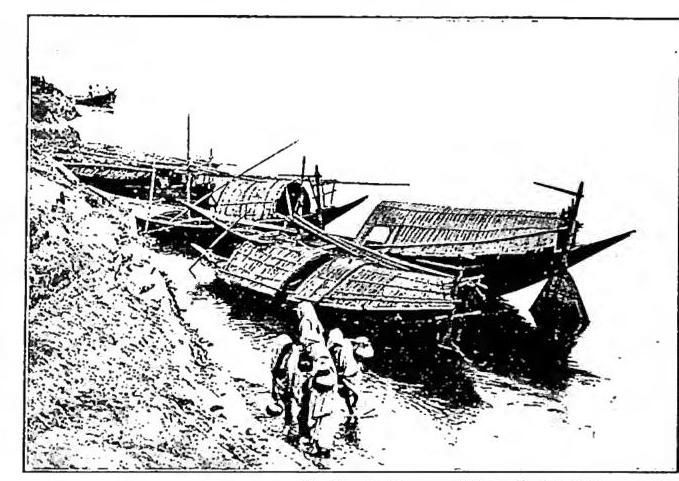
(from M. Hartmann, L'Inde, Paris 1918, rev. III)
INDIA - Boats on the banks of the Brahmaputra.
Opposition to de Nobili’s adaptation method resurfaced, despite Gregory XV’s approval in 1623 of four Malabar customs proposed by de Nobili. The apostolic visitor Charles Maillard de Tournon, appointed in 1701, issued a decree in 1704 condemning several practices tolerated by the Jesuits. The decree was approved by Rome. The Jesuits contested it until the final decision by Benedict XIV in 1744. The controversy caused significant harm and continuous unrest to the mission. The expulsion (1760) and suppression (1773) of the Society of Jesus, along with severe persecutions by Indian princes in the second half of the 18th century—particularly that of Tipu Sahib of Mysore in 1784—caused a serious decline in the southern missions. The missionaries of the Missions Étrangères de Paris replaced the Jesuits from 1776, at least in part of the territory, but were unable to stem the regression. The mission to Tibet, entrusted to the Capuchins in 1703, initially succeeded, especially under Orazio Penna di Billi (d. 1745), but in 1745 the expulsion of the missionaries put an end to II. The Capuchins later undertook the less fruitful mission of northern India, which in 1784 was separated from the apostolic vicariate of the Mughal Empire.
The revival of the missions began in the 19th century under Gregory XVI. The erection of new apostolic vicariates from 1832 and the practical elimination, if not de iure, of the dioceses of the Padroado—Cranganore, Cochin, and Mylapore—by the brief Multa praeclare (1838), led to the so-called Goan schism. The issue was partly resolved by the Concordat of 1857, introducing dual jurisdiction, and more effectively by the Concordat of 1886, which re-established the dioceses of Cochin and Mylapore, created that of Daman, and by the agreement of 1928, which incorporated Daman into the archdiocese of Goa and abolished dual jurisdiction. The dioceses of the Portuguese Padroado, which had suffered severe damage due to the expulsion and abolition of all religious orders (1832-34), were reorganized and reformed by new energetic archbishops and bishops. Currently, under Portuguese bishops with mostly indigenous clergy, they have thriving Christian communities.
In the apostolic vicariates, the primary task was to revitalize existing Christian communities, expand the field of activity, and, in competition with the British government and Protestant missions, give due importance to the development of schools. Alongside the Carmelites, Capuchins, Missions Étrangères de Paris, and Jesuits (who returned in 1836), other orders and congregations joined: the Sylvestrines (1842).
and the Oblates of Mary Immaculate (1847) in Ceylon, the Missionaries of St. Francis de Sales (1848) in Vizagapatam, the Congregation of Holy Cross (1853) in Bengal, the Milan Foreign Missions (1855) in Hyderabad and Bengal, the Mill Hill Missionaries (1875) in Madras, the Salvatorians (1889) in Assam; in the 20th century, the Salesians of Don Bosco, the Dominicans, the Lazarists, the Verbites, the Franciscans, and the Premonstratensians also arrived. Female congregations likewise entered the mission in great numbers, primarily for schools, hospitals, and dispensaries. The mission among pagans developed on a larger scale only toward the end of the 19th century, penetrating especially into regions inhabited by aboriginal peoples, as well as among the depressed castes and the pariahs. Most famous of all was the mission of the Jesuit Costante Lievens (1856-93), with extraordinary results among the Khols of Chota Nagpur. Among the higher castes, only a modest success of the Jesuits among the Brahmins of Trichinopoly is noteworthy. Generally, nearly insurmountable difficulties hinder conversion: the harsh laws of caste, which exclude Christians from family rights and advantages; the captivating splendor of Hinduism, intimately intertwined with all cultural life; Islam in northern India; the ideas absorbed by the ruling classes during their studies in Europe; in recent times, national pride and the communist threat have been added to these.
In 1886, Leo XIII established the ecclesiastical hierarchy with 7 ecclesiastical provinces and 17 dioceses. Through the work of the apostolic delegation since 1884 and the provincial councils held in all ecclesiastical provinces, greater uniformity was achieved in the governance of missions, ecclesiastical discipline, and the administration of the Sacraments. Moreover, from this period onward, the Catholic Church grew considerably in esteem in southern India due to the influence of Orders and Congregations, both contemplative and active, schools and charitable works, scientific studies, Catholic congresses, the formation of indigenous clergy, and an elite of laypeople who sought to exert their influence in public life, often with excellent results. The further development of the hierarchy in recent years has led, in India (including Ceylon), to 13 ecclesiastical provinces with 48 dioceses and 5 apostolic prefectures.
The Syro-Malabar Catholics, until the end of the 19th century under the direction of the Carmelites, obtained their own organization. In 1887, two apostolic vicariates were erected for the faithful of the Syro-Malabar rite, but under Latin bishops; in 1896, three vicariates were established with indigenous bishops of their own rite, and in 1911 another vicariate was added. In 1923, the ecclesiastical province of Ernakulam was erected with the suffragan dioceses of Trichur, Kottayam, and Changanacherry. From the Jacobite Church, in 1930, two bishops, with numerous clergy and many faithful, united with Rome; for them, the archdiocese of Trivandrum was erected in 1933 with the suffragan diocese of Tiruvalla.
The new political situation created in 1947 by the formation of the two independent states, India and Pakistan, presents the mission with new challenges. In Muslim Pakistan, the Church constitutes a negligible minority. In 1950, two ecclesiastical provinces were erected, Karachi and Dacca, and the archbishop of Karachi was appointed apostolic delegate for Pakistan. In Hindu India, the new constitution guarantees religious freedom; the establishment of the apostolic internunciature (1948) in Delhi, the capital of the state, has made closer cooperation between the government and the Catholic Church possible.
II. ECCLESIASTICAL ORGANIZATION
The ecclesiastical circumscriptions of India, excluding Pakistan, are as follows and depend on various dicasteries of the Roman Curia.3. From the Sacred Congregation of Propaganda Fide:
AGRA, erected as an apostolic vicariate in 1820 under the name of Tibet-Indostan, elevated to an archdiocese in 1886, entrusted to the Capuchins. - AHMEDABAD, a mission in 1934, a diocese in 1949, entrusted to the Jesuits. - AJMER, the apostolic prefecture of Rajputana in 1892, the diocese of Ajmer in 1913, entrusted to the secular clergy since 1949. - ALLAHABAD, the apostolic vicariate of Patna in 1845, a diocese since 1886 under the name of Allahabad from 1887, entrusted to the secular clergy since 1946. - BANGALORE, erected as a diocese in 1940, entrusted to the secular clergy since 1942. - BELLARY, erected as a mission in 1928, a diocese in 1949, entrusted to the Franciscans. - BEZWADA or VIJAYAYADA, a mission in 1933, a diocese in 1937, entrusted to the Pontifical Institute for Foreign Missions (Milan). - BOMBAY, part of the apostolic vicariate of Grand Mogul since 1720, an archdiocese in 1886, entrusted to the Jesuits. - CALCUTTA, the apostolic vicariate of Bengal in 1834, an archdiocese in 1886, entrusted to the Jesuits. - CALCUT, a diocese in 1923, entrusted to the Jesuits. - COCHIN, a diocese since 1558. - COIMBATORE, an apostolic provicariate in 1845, an apostolic vicariate in 1850, a diocese in 1886, entrusted to the secular clergy since 1940. - CUTTACK, a mission in 1928, a diocese in 1937 entrusted to the Lazarists. - DELHI and SIMLA, erected in 1910 as the archdiocese of Simla, renamed Delhi and Simla in 1937, entrusted to the Capuchins. - GORAKPUR, an apostolic prefecture in 1946, entrusted to the Capuchins. - GUNTUR, a diocese in 1940, entrusted to the secular clergy. - HYDERABAD, the apostolic vicariate of Hyderabad in 1845, a diocese in 1886, entrusted to the Pontifical Institute for Foreign Missions (Milan). - INDORE, an apostolic prefecture in 1935, entrusted to the Society of the Divine Word. - JHANSI, an apostolic prefecture in 1940, entrusted to the Capuchins. - JUBBULPORE or JABALPUR, an apostolic prefecture in 1932, entrusted to the Premonstratensians. - KOTTAR, a diocese in 1930, entrusted to the secular clergy. - KRISHNAGAR, the apostolic prefecture of Central Bengal in 1870, the diocese of Krishnagar in 1886, entrusted to the Salesians. - KUMBAKONAM, a diocese in 1899, entrusted to the secular clergy since 1930. - LUCKNOW, a diocese in 1940, entrusted to the Capuchins. - MADRAS, an apostolic vicariate in 1831, an archdiocese in 1886, entrusted to the Salesians. - MADURA, or MADHURAI, a diocese in 1938, entrusted to the Jesuits. - MANGALORE, an apostolic vicariate in 1845, a diocese in 1886, entrusted to the secular clergy since 1928. - MYSORE,
2. From the Sacred Congregation for Extraordinary Ecclesiastical Affairs:
GOA, in 1533 diocese, in 1558 archdiocese.
3. From the Sacred Congregation for the Eastern Church:
a) for the Syro-Malabar: CHANGANACHERRY, in 1896 apostolic vicariate, in 1923 diocese. — ERNAKULAM, in 1896 apostolic vicariate, in 1923 archdiocese. — KOTTAYAM, in 1911 apostolic vicariate, in 1923 diocese. — PALAI, in 1950 diocese. — TRICHUR, in 1896 apostolic vicariate, in 1923 diocese. — b) for the Syro-Malankara: TIRUVALLA, in 1933 diocese. — TRIVANDRUM, in 1933 archdiocese.
III. LEGAL STATUS OF THE CATHOLIC CHURCH IN INDIA
In its new Constitution, the fledgling Republic declares itself a secular federal State and, setting aside all religious or racial considerations, grants all citizens equal rights. These declarations and concessions are of great importance when one considers that, out of 319 million inhabitants, a large majority—260 million—profess Hinduism, while the remainder consists of the following divided minorities: 35 million Muslims, 100,000 Parsis, 7.5 million Buddhists, 3.5 million Sikhs, 1.5 million Jains, 4.5 million Catholics, and 3 million dissident Christians (Orthodox and Protestants).The rights enshrined in the Constitution for members of the various confessions, including Catholics, are as follows:
1. Freedom of worship and proselytism. — In the section titled Fundamental Rights, it is established that: « Subject to public order, morality and health... all persons are equally entitled to freedom of conscience and the right freely to profess, practise and propagate religion » (Constitution of India, Part 3, Art. 25 [1]). Furthermore: « The State shall not discriminate against any citizen on grounds only of religion, race, caste, sex, place of birth or any of them » (loc. cit., Art. 15 [1]). « No citizen shall, on grounds only of religion, race, caste, sex, descent, place of birth, residence or any of them, be ineligible for, or discriminated against in respect of, any employment or office under the State » (loc. cit., Art. 16 [2]). The above is solemnly confirmed by the words spoken on 6 July 1949 by the first extraordinary envoy and plenipotentiary minister of the Indian Republic to the Holy See upon presenting his credentials to the Holy Father: « The government and people of India assure Your Holiness that all those who depend religiously on the Roman Pontiff may live securely in the new State, openly professing their faith without any fear, and may also occupy in society the positions due to their merits » (AAS, 41 [1949], pp. 369-70).
2. Recognition of legal personality. — Again in the section of the Constitution dedicated to specifying fundamental rights, it is established that: « Subject to public order, morality and health... every religious denomination or any section thereof shall have the right: a) to establish and maintain institutions for religious and charitable purposes; b) to manage its own affairs in matters of religion; to own and acquire movable and immovable property; and c) to administer such property in accordance with law » (loc. cit., Art. 26). Consequently, every diocese (vicariate, prefecture, or mission) may obtain recognition of its legal personality through an application for registration (Register of Joint Stock Companies and Cooperative Societies). The certificate obtained will attest that the religious community has been recognized as a legal entity with Indian nationality, regardless of the nationality of its members or administrators.
3. Freedom of education. — The new Constitution also recognizes the right of religious and linguistic minorities, including Catholics, to open schools, which will be recognized by the State if they meet a need: « All minorities, whether based on religion or language, shall have the right to establish and administer educational institutions of their choice » (loc. cit., Art. 30 [1]). It also mentions financial aid to be distributed without discrimination: « The State shall not, in granting aid to educational institutions, discriminate against any educational institution on the ground that it is under the management of a minority, whether based on religion or language » (loc. cit., Art. 30
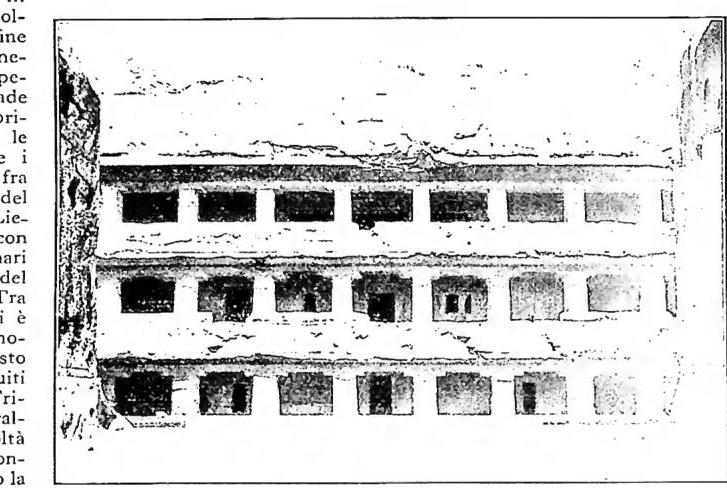
(photo: Fides)
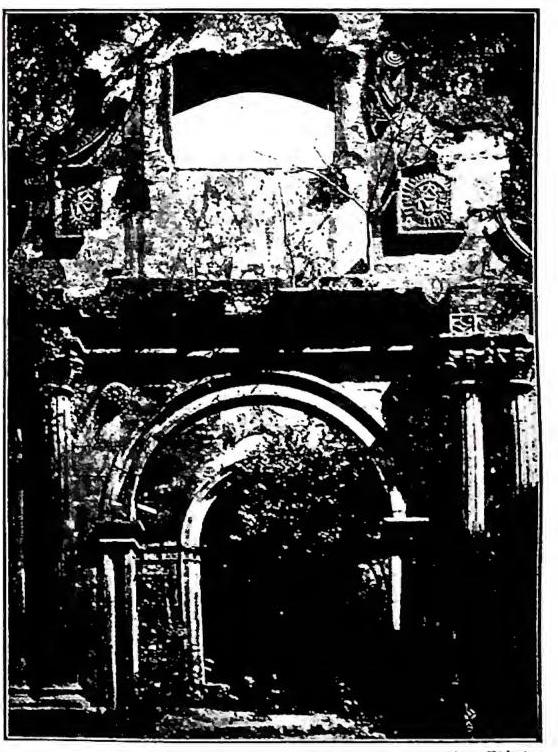
INDIA - Ruins of one of the Portuguese monasteries in Bassein, south of Bombay (16th century).
4. Marriage
The Constitution explicitly does not legislate on this point. What was in use under the British regime remains in force: ministers of the various faiths are authorized to perform marriage rites; after the celebration, there remains the obligation to notify the competent civil authorities.Throughout the Constitution, a broad spirit of tolerance and a humane understanding in advocating the concepts of fraternity, justice, and the dignity of the person are evident. Since the Indian Republic is a federation of States enjoying wide autonomy, it is not impossible that in one or another State the freedoms sanctioned by the Constitution may be interpreted, in concrete cases, with a certain flexibility to the detriment of minorities. The future of the Church in India (where some sixty dioceses are currently counted) therefore depends on how or by what men the Constitution will be applied in the individual regions.
5. Legal Status in Burma and Ceylon
Under the pontifical representation of Delhi are also Burma and Ceylon. The Apostolic Internuncio for India is simultaneously the Apostolic Delegate for the Island of Ceylon and Burma. In these two latter States, however, the legal status of the Church is somewhat different. Quite good in Ceylon, where, as in the other British dominions, the Catholic Church enjoys freedom of worship and proselytism, legal personality, and freedom of education; not so in Burma.The Constitution of the Union of Burma Republic states that all religions (including the Catholic one) may be embraced and professed with the utmost freedom, provided that religion does not serve as a pretext for interfering in the political affairs of the Republic. The official religion of the Republic is Buddhism. The government's policy regarding ministers of religion coming from foreign lands is to treat them like all other foreigners, that is, not to allow them to enter Burma except for very special reasons and only when it is absolutely impossible to find local ministers who can attend to the care of the followers of any religion.
This policy, in effect since January 1949, has made it practically impossible for new foreign missionaries to enter Burma.
Proselytism is free; it is prohibited only in schools recognized by the government. The legal personality of the Church is not yet well defined; in practice, until today, the Catholic Church was always considered a moral entity that could own property. Now, only native ministers can possess, buy, or sell goods in the name of the Church.
In government schools, the teaching of the Catholic religion is prohibited during regular lesson hours. In private schools, anything may be done as desired.
The State no longer subsidizes mission schools as was done before independence. The government intends to have all schools under its direct jurisdiction and is working toward this goal, but for now, it lacks sufficient personnel and facilities, therefore it permits and recognizes private schools, though it does not subsidize them.
In practice, the population, even pagan, prefers to send their children to Christian schools and particularly to Catholic schools, which are flourishing.
Pompeo Bargna
V. CHRISTIAN ANTIQUITIES.
The problem of the introduction of Christianity in India is closely linked with the study of the Acts of St. Thomas, a text elaborated in a Syriac environment and imbued with Gnostic and even pre-Manichaean concepts. This apocryphal text, based on the historical data it contains, points to the mid-1st century and to northwestern India during the reign of the Parthian king Gundophar, of the house of Sūrēn, who certainly ruled from 19 and after 45 A.D. No other document exists of Christianity in those regions during and after the same period, nor has it left any archaeological trace there. Another tradition, documented only much later, connects the preaching of St. Thomas with the communities existing in southern India, in Coromandel and Malabar, during the early Middle Ages. When it arose and on what basis, no one can know, since, although in the 6th century Cosmas Indicopleustes speaks of Christian communities in southern India and Ceylon, he does not connect them at all with the name of the Apostle.
How such communities formed can be imagined by considering the intense maritime traffic existing with the Red Sea and the Persian Gulf: Christian groups may have passed into southern India coming both from Egypt or the eastern regions of the Roman Empire and from the Sāsānid regions of Mesopotamia and Babylonia. The recent excavations at Virapatnam (falsely called Arikamedu) document the existence of a colony of Roman culture flourishing as early as 20-50 A.D.: relations are also clarified through the numerous findings of imperial coins from the 4th century onward (while only a few are found in northern India) and citations in Tamil texts. That Eastern Christian (Nestorian) elements prevailed is proven by the subsequent course of events, the documents, and the archaeological remains, amid the uncertainty of the earliest sources and the constant ambiguity regarding the meaning of the term "India" during the Middle Ages. It is certain that around 525 Cosmas found at Καλλιάνα a bishop consecrated to the see of Seleucia, just as in Ceylon the clergy also came from Persia. He recalls no trace of Christianity on the Malabar coast. The community in Coromandel and especially in Kērala (Travancore), however, thrived vigorously, probably with the support of the local ruler. Indeed, two
Evidence of an ancient Indian artistic civilization, dating back to 3000 B.C. and thus contemporary with Egyptian and Babylonian civilizations, has been found in the Indus Valley. This art reveals notable contacts with Sumerian art, and what has survived consists primarily of a large number of seals engraved in majolica, ivory, or stucco, terracotta figurines, and pottery decorated predominantly with arabesques.
No actual monuments remain from the immediately following centuries, largely because Indians primarily used wood and bamboo for their constructions. A true Indian art can therefore be identified only from the 3rd century B.C., with the introduction of Buddhism into the country by King Aśoka. The earliest artistic manifestations of this period reveal a strong Persian influence.
Buddhism was certainly decisive for the evolution of sculpture, which, starting from the representation of the deity as a sum of spiritual powers (resulting in the multiplication of arms, eyes, legs, etc.) and passing through a Helleno-Bactrian influence (1st–3rd centuries A.D.), would reach the monstrous forms inspired by the Brahminical doctrine of metempsychosis.
Few examples of painting survive, though it must have flourished in the adornment of sumptuous palaces; one of the finest remaining examples is the frescoes of Ajāntā from the 7th century. Miniature painting on palm leaves from the 13th century and on paper from the 15th century to the present day is well documented. Industrial arts were also highly developed, favored by the division of society into castes.
Of particular importance is architecture, which, though only approximately, can be distinguished into the following periods.
1. Buddhist Period. – Spanning from approximately the 4th century B.C. (Maurya dynasty, 326–185 B.C.) to the 4th century A.D. It is characterized by colossal temples called stupas and dagobas, intended
(fot. Fides)
#### VI. ART.
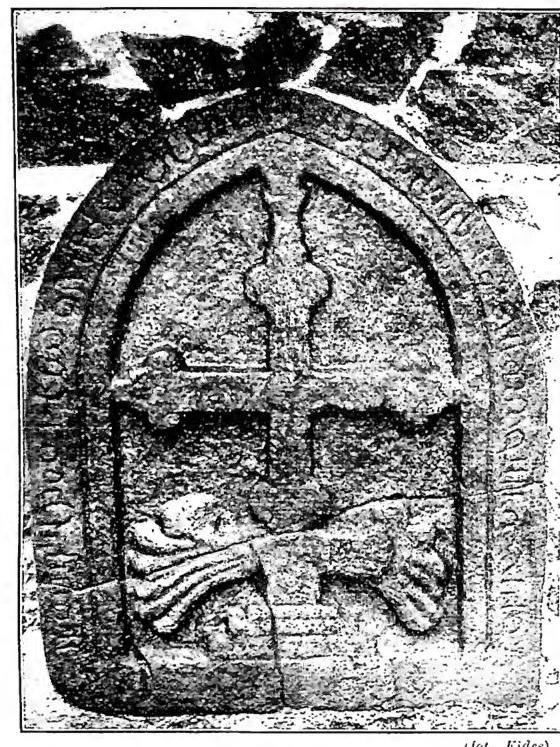
Documents attesting to two deeds exist in this regard: the first is an act by King Vīra-Rāghava-Chakravartin for the merchant Iravikkorran, the second by King Stanu-Rovi-Gupta, in which a Marvan-Sapir-Yso (perhaps Maran Sabrišo = our lord [the bishop Sabrišo]) transfers land in the vicinity of Quilon to the community of the Church of Tarasa. However, the dating of these documents is uncertain. Burnell dated the first to 774, while Venkayya placed it in the 14th century. It seems certain that a strong Christian group from Persia arrived in I. in the 8th century, contemporaneous with the immigration of the Parsis: it was led by a Tomaso of Kana (Knāyi Thōmā), and the identity of the name may have contributed to the formation of the legend of St. Thomas’s preaching in southern I. It is precisely from the 8th century that the oldest archaeological documents of Christianity in I. date: these are crosses, all similar to one another, proving their derivation from one another, all bearing the same inscription in Pahlavi, which proves their origin from Persia. From this inscription, of which there is not yet a completely certain and definitive text, it appears that the archetype was carved by an Afras ('pr's), son of Śāhārbukht (?), the Syrian (swry'y). Two of these crosses are found in Kōṭṭayam, one large and one small, the latter being the oldest of all; two others are located, one in Katamarran and the other in Maṭṭuchīra: that is, all on the western part of I. The only one on the eastern part is that at the sanctuary of St. Thomas in Mylapore, now a suburb of Madras. The second cross of Kōṭṭayam, in addition to the Pahlavi inscription, also bears one in Syriac, in estranghelo characters, reproducing Gal. 6:14. The crosses are carved on rectangular tablets topped with a semicircle: only the smallest in Kōṭṭayam, instead of a semicircular shape, has a pointed arch. The inscription is engraved on the raised border of the tablet, which stands out from the central field. In this field is depicted an arch supported by two columns, beneath which stands the cross with arms ending in trefoils: above the cross descends a dove vertically. The cross rests on a small hill formed by three steps, and from the point of contact two branches with foliage extend upward, while the streams of two of the four rivers of paradise flow downward. This symbolism is also found in Christian sculptures of Mesopotamia and Armenia.
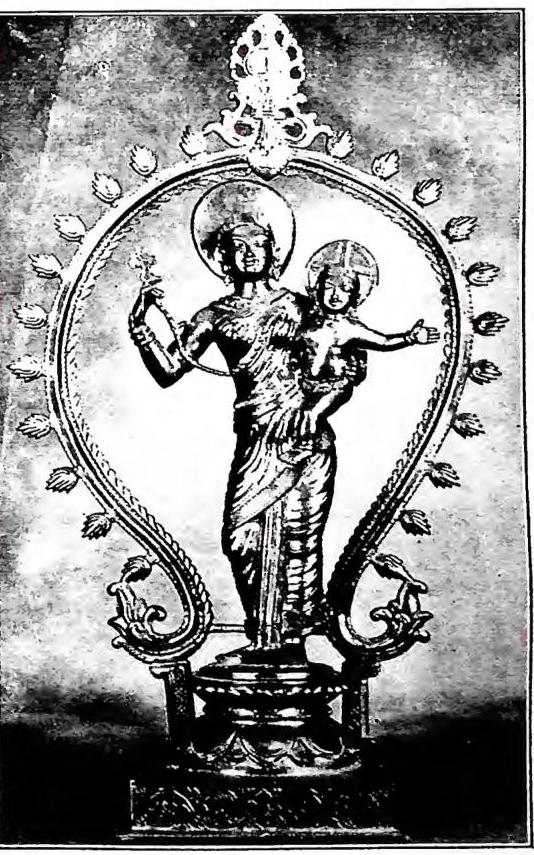
INDIA - Madonna and Child (in brass) with the characteristic Hindu arched frame, symbol of veneration - Rome, Missionary Art Exhibition 1950.
to preserve relics and consisting of a stone base upon which rises a grand and massive dome-shaped structure, often crowned by terraces; the vihara (monasteries) and chaityas (temples for gatherings of the faithful), carved into rock and rich in squat columns, sculptures, and decorations. One of the characteristics of this period, in fact, is the increasing plastic elaboration and the definitive replacement of wood and bamboo with stone.
2. Gupta or Brahminic Period. - Spanning from approximately the 4th century A.D. to the 7th century A.D., it is characterized by square-plan temples, also carved into rock and preceded by a pronaos with columns; the Buddhist dagoba in this period evolves toward the characteristic pagoda.
3. Hindu Period. - From the 7th to the 9th century A.D., with styles generally derived from the preceding period, marked by an upward accentuation of all constructions and an increasingly pronounced interpenetration of sculpture with architecture. The northern style is distinguished by towers with curved lines; the southern style by straight lines; and the central style by a fusion of the two types.
4. Medieval Period. - From the 9th century onward, documented almost exclusively in the south (in the rest of the country, architectural flourishing wanes by the 13th century), initially tending toward a simplification of form (9th-11th centuries, the classical era of southern architecture) before reaching, in the 14th century, a kind of baroque, which becomes increasingly accentuated, culminating in a stratified elaboration of ornamental details of purely scenographic effect.
5. Modern Indo-Christian Art. - Based on the principle that "Indian art must offer its beautiful garb to the Christian idea" and that "the conception and the resulting edifice will be something new; something different from Indian temples; yet Indian and Catholic" (C. Costantini, V. BIBLICA.), a few examples of this missionary adaptation of the country's architectural tradition may be cited here. A thoroughly modern simplicity characterizes the cathedral of Patna, while Indian influences mixed with Saracen reminiscences are visible in the Anglican church of Dornakal, located precisely in a region where the Muslim contribution was significant. A fine model for a Christian temple in Indian style was commissioned by the Spanish Jesuit H. Heras, who was among the most zealous advocates of the new ideas concerning the missionary adaptation of Indian art.
In painting, a flourishing of Christian art has only recently emerged, as church painting is generally of European origin or type. Poetically realistic and in the vein of Indian tradition are the paintings of the Goan Angelo Da Fonseca, though they do not lack echoes of Western art, sometimes reminiscent of the Pre-Raphaelites. Another Indian painter is Alfredo Thomas. Minor art is highly developed, producing various ecclesiastical furnishings.
VII. EDUCATIONAL SYSTEM.
The impetus for the advancement of education in I. was given by the following decisions:
1) The Macaulay decree issued in 1813, which established the introduction of the English language in schools. This decree paved the way for missions. 2) The Macaulay memorandum issued in 1835, which abolished the Urdu language, maintaining it only at the College of Delhi. 3) The William Bentinck decree issued in 1835, which established the norms for the education of the Indian people, to be conducted through European classics. It also facilitated the entry of missionaries. 4) The founding by Syed Ahmed Khan, in 1862, of the scientific society aimed at education through Oriental classics. Syed Ahmed Khan aspired to a school based on morality, the Muslim religion, and coexistence between pupils and teachers. 5) The proposal by Nawab Imadul Mulk in 1884 to establish a primary Urdu school in every village, an Anglo-Urdu school for every 10,000 inhabitants, and a higher school in each province. 6) The educational reform of Lord Curzon in 1896-97. 7) The educational reform of 1907, carried out by Arthur Mayhew and Akbar Hyderi, following the advice of Molvi Abdul Haq and Nawab Imadul Mulk. 8) The founding of Osmania University in 1917. 9) The government decree issued in 1920, which established that schools must be free from any official interference. 10) The recommendations of Brahmo Samaj concerning women's education in 1926.
Thanks to these principal decisions, at the time of independence, I. had 168,013 state elementary schools, well-organized Middle English, Middle Vernacular, and High Schools, and three types of universities: central government universities, universities dependent on Indian States, and private universities. Among the most famous are those of Calcutta, Madras, Bombay, Punjab, Allahabad, Benares Hindu, Mysore, Patna, Osmania, Dacca, Rangoon, Lucknow, Delhi, Nagpur, and Andhra. It also had 22 colleges for the training of secondary school teachers, 34 intermediate colleges for medicine, 141 intermediate colleges for commerce, 13 intermediate colleges for law, 2 art schools, numerous schools with unrecognized diplomas such as the Jole's Sanskrit Schools of the Pandits for Hindus, Maktabs for Muslims, 2,424 private schools, and the following Catholic missionary schools: 1,326 catechism and prayer schools, 4,260 elementary schools, 271 lower secondary schools, 200 upper secondary schools, 41 normal schools, 122 vocational schools, to which must be added those in Ceylon: 573 catechism and prayer schools, 698 elementary schools, 121 lower secondary schools, 6 normal schools, and 38 vocational schools.
The education of the indigenous Catholic clergy is provided in 4 novitiates, 27 minor seminaries, and 11 major seminaries. There are also schools for catechumens. - Vedi tavv. CXII-CXV.