
SPIRITUAL COMBAT. – Ascetic repression of temptations and vicious inclinations, attainment of the moral ideal. The struggle for life and for improving and elevating its form exists not only as a sublimating and selecting force in the organic and social worlds, but particularly in the spiritual and supernatural world. That the Christian’s spiritual life is a struggle is one of the concepts most insistently inculcated by the writings of the New Testament: «He shall not be crowned except he who has fought lawfully» (II Tim. 11, 5).
The teaching that spiritual life is a struggle is developed particularly in the Pauline Epistles. After his conversion, the Apostle’s life is a «bonum certamen». Christian life is represented by him as an arduous struggle, with alternating fortunes, ending only with death—a struggle of the greatest importance, since eternal life is at stake (I Cor. 9, 26 ff.; Hebr. 12, 4).
There are in us, in fact, as it were two beings, «two men»: the regenerated «new man», produced by Grace, living in the «spirit», who strives to actualize and develop the supernatural organism initiated by Baptism; but beside him there persists the «old man», the «animal», «natural» man, living in the «flesh», that is, yielding to the disordered tendencies deriving from original sin.
In this «old man», not annihilated by Baptism in his evil tendencies, that is, in «concupiscence», lies the enemy to be fought. Concupiscence is threefold: «concupiscentia carnis, oculorum et superbia vitae» (Io. 2, 16). The struggle of the «new man» against the disordered attraction of sensual pleasures and earthly goods, and against pride, is made more arduous by the intervention, in support of the internal enemy, of two other terrible external enemies: the world (that is, the whole body of those who oppose Christ, with their doctrine and way of life, to which the Christian must be «crucified» and vice versa: Gal. 6, 14; cf. I Cor. 7, 31); and the devil, through whose envy sin, death, and unrestrained concupiscence entered the world, and against whom one must struggle continually (Eph. 6, 12).
These three enemies of our soul are in reality one alone. The «old», carnal man inevitably comes into conflict with the «new man»; they cannot coexist, but one must necessarily die, since, while the «carnal» man is enticed by pleasures without moral concerns, the «spiritual» man abhors forbidden pleasures, sacrificing them to duty, that is, to the divine law.
Hence the perpetual spiritual combat, which transforms the Christian into an «athlete» and a «soldier», fighting unto death for an immortal crown (Eph. 6, 10-16: the armor of Christ’s soldier). The struggle does not cease during earthly life, since all efforts to free oneself from the «old man» succeed only in weakening him, strengthening the «new man» against him.
The writings of the Apostolic Fathers, with their eminently ascetic character, all develop the concept of Christian life as spiritual combat. This stands out particularly in the first part of the Didaché, the moral catechesis (chaps. 1-6), also called the «book of the two ways»; Pseudo-Barnabas summarizes in chaps. 18-21 the doctrine of the «two ways» set forth in the Didaché. Notable references to spiritual combat are also found in the Shepherd of Hermas, which teaches encratism understood in the orthodox sense of asceticism. Christian life is likened to spiritual combat above all in the II Epistle of Pseudo-Clement, a homily in which the speaker proposes, after a brief introduction on Jesus Christ (chaps. 1-4), his theme (chaps. 5-7), namely, the spiritual combat that the Christian must wage against the world; the concept of this struggle is developed in chaps. 8-17 (this heavenly combat consists especially in the development of Christian virtues: penance, purity, charity, trust, etc.), and concluded in chaps. 18-20 with a fervent exhortation to serve God and to fight for him, whatever the cost. Patristic literature of the second and third centuries is literature of spiritual combat, since the Church found herself in a century of struggle.
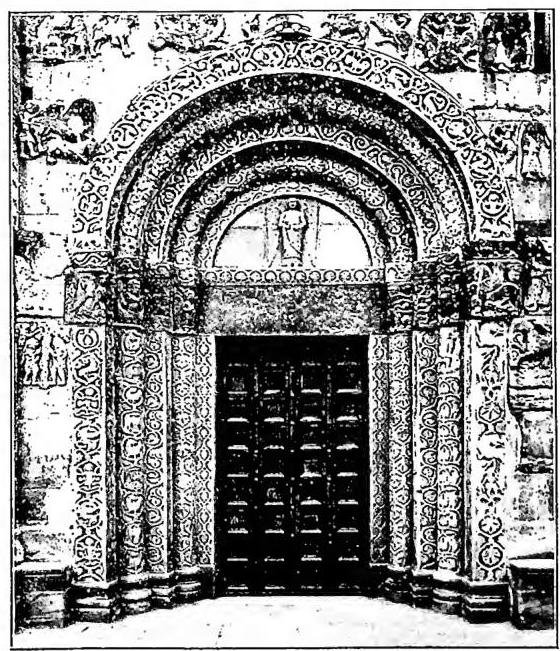
(Brogi photograph)
COMACINI, MAESTRI — Portal of the church of S. Michele (ca. 1170) — Pavia.
in the battle against the vices of the world (chap. 1). Origen develops the concept of the Christian’s struggle against the devil, the world, and the flesh (De principiis, III: PG 2, 425–562, 641–1632). St. Ephrem, whose spiritual doctrine exerted a great influence in the Eastern monasteries, considers the spiritual life in the light of a spiritual combat, whose weapons, ready to sustain the Christian in victory, he indicates as fasting, temperance, prayer, holy reading, the practice of the virtues, and in particular charity, virginity, patience, humility, and penance (cf. G. S. Assemani, Opera omnia graece, latine, syriace, Greek series, I, Rome 1732, p. 66; II, pp. 321–22, 461; especially in the Trattato sulla vita spirituale, Greek series, I, pp. 258–82; and in the work on the formation of monks, III, pp. 337–56), a concept taken up by St. John Chrysostom, St. Nilus the Abbot, and the whole of Eastern monasticism. Of these F. Cayré writes (I, p. 497 ff.) that they seem to have particularly meditated on the fact that this life is a spiritual combat; they understood and savored the words with which St. Paul exhorted the Ephesians to put on the armor of God. The enemies against whom the monk must fight are the devil and the vices. The monk had to be particularly vigilant against Satan, temptations, demonic obsessions and illusions, learning to recognize their assault in the restlessness of the soul, and resorting to the three weapons: prayer, work, and fasting. This teaching is very well expressed in St. Jerome and in Cassian’s Institutiones e Collationes to the monks.
In the Psychomachia (PL 60, 3, 11–90), the Christian poet Prudentius celebrates in 915 hexameters the spiritual combat of the Christian virtues against vice, in which «prima petit campum, dubia sub sorte duelli pugnatura Fides». The idea is taken up in the Scala (κλύμαζ) Paradisi of St. John Climacus, and adopted by St. Bernard and St. Thomas Aquinas, who in spiritual combat gives particular importance to the capital vices, the sources of every sin.
St. Ignatius of Loyola’s Esercizi spirituali are entirely centered on the concept of spiritual combat: they are the «spirituality of effort... spirituality of combat». Indeed, the spirituality of St. Ignatius has a military bearing. Christ is a captain who invites us to fight at his side (P. Pourrat, op. cit. in bibliography, p. 67). To respond to this invitation is to enter his army, which must not only defend itself but advance on the offensive, taking up, in order to secure victory, the very powerful weapon of the particular examen (v. ESAME DI COSCIENZA), because the soldier of Christ must conquer virtue as strongholds are conquered.
The influence of Ignatian teaching is particularly profound and recognizable in the C. s., one of the finest ascetical writings of the sixteenth century. Scupoli (v.), a Theatine, is commonly regarded as the author of this treatise, a copy of which he gave to St. Francis de Sales in 1590. In the first edition (Venice 1589) it contained only 24 chapters, which subsequently grew to 33, 40, and finally the present 66; in these successive revisions the logical order among the chapters was disrupted, and the style lost some of its ingenuous grace. Dedicated to the «Supreme Captain and most glorious triumpher Jesus Christ», the C. s. opens with the inquiry «in what Christian perfection consists»; it then demonstrates that to acquire it one must fight, and that four things are necessary for this battle: distrust of ourselves, confidence in God, the practice of virtue, and prayer, since Christian perfection is wholly interior and results from the totality of the virtues that make us die to ourselves, so that we may submit ourselves entirely to love. The C. s. then deals with the defense of the intellect, which must guard against two enemies that continually attack it: ignorance and curiosity; and above all with the defense of the will in relation to the supreme end, toward which all interior and exterior actions must be directed, because in man there are «many wills» that wage a profound war against one another. The C. s. then indicates how to combat the evils of the senses, and the acts that the will must perform in order to acquire virtue, offering valuable counsels on how to combat our vicious passions, and on the arts and deceptions by which the devil seeks to fight and deceive those who wish to devote themselves to virtue and those who already find themselves in the bondage of sin. Stern is the law of spiritual combat, which must be accepted each day, since «the first thing your inner eyes must observe, once you have awakened, is to see yourself within an enclosed arena governed by this law: whoever does not fight there remains dead forever». A precious weapon for fighting is prayer and Holy Communion. The C. s. was highly esteemed by St. Francis de Sales; although it lacks the enchantment of the De imitatione Christi, it remains one of the classic works of ascetical literature.