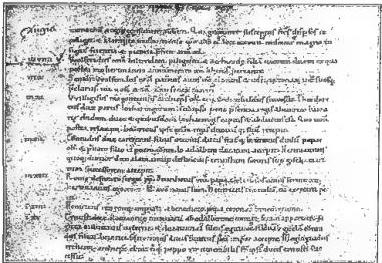
ERMA. — One of the Apostolic Fathers, flourishing ca. the middle of the second century. He wrote The Shepherd, in Greek. The Muratorian Fragment attests that he was the brother of Pope Pius I and that he composed his work in Rome during the pontificate of the latter (ca. 140–55); the Liberian Catalogue says the same. The work provides us with further information. The author, who declares his name several times (Vis., I, 4; 2, 2; 4, 3; II, 2, 2, etc.), was born a slave, probably in Arcadia (Sim., IX, 1, 1–10), and was sold to a Roman matron, Rode, whom he desired to marry (Vis., I, 1, 1–2). Having been freed, he took up commerce, and had a wife and children (Vis., I, 3, 1; II, 3, 3; II, 6, 7). Because of his own faults, particularly his lies (Mand., II, 3), and those of his loquacious wife and children who, blasphemers and lustful, denounced their parents during a persecution (Vis., II, 2, 2–3), he was reduced to poverty and took to cultivating a small plot on the Via Campana, about ten stadia from the Appian Way (Vis., III, 1, 2; IV, 1, 2). He and his relatives repented of their past conduct (Sim., VII, 4). As he was going toward Cumae, he received his revelations (Vis., I, 1, 3; II, 1, 1), in which he was ordered to transcribe from a book received from the matron what he was to announce to the elect (Vis., V, 5–7), making two copies; one he was to send to Clement, evidently the bishop of Rome, who would send it to the other cities (Vis., II, 4, 3).
Some (Bardenhewer, Bareille, Leclercq, Casamassa) regard the autobiographical data as literary fictions, contradicted by the testimonies cited above and by the conditions of the Church as represented in the work, which bring us to the middle of the second century, to which the Muratorian Fragment assigns it, and incompatible with the personality of the author, whom the writing shows to have been an influential member of the Roman clergy. Others (Zahn, Edmundson) reject the testimony of the Fragment, adhering to the data of the work. Many (Harnack, Grosse-Binuckmann, De Champagny, Spitta, Altaper) attempt to reconcile the internal and external testimonies by denying the unity of the work, whose different parts would have been written successively. There is no proof that the author of The Shepherd was PE, mentioned in Rom. 16, 14, as Origen asserted (Comm. in Rom., X, 31).
The Shepherd presents an original structure. It is preceded by 5 Visions: in the first, Rode appears, reproaching H. for an evil desire; then an old matron in splendid clothing manifests to him the Lord’s anger against him and his household and exhorts him to penance. In the second, the matron hands him a book to copy, then reveals its contents to him, an announcement of forgiveness and of an impending calamity; then a young man tells him that the matron is the Church. In the third, the matron, who appears youthful, shows him a tower, a figure of the Church; then a young man explains the meaning of the three aspects under which the Church appeared. In the fourth vision he sees a monster, which the Church later tells him is a symbol of the great tribulation that is imminent. In the fifth vision the angel of penance appears in the guise of a shepherd (hence the title of the book).
There follow 12 Precepts (Mandata), dictated by the angel, in which faith, the fear of God, continence, simplicity, innocence, long-suffering, and prudence are inculcated; doubt and sadness are censured; and the true and false prophets, and good and evil desires, are discussed. Finally, in ten Similitudes, the angel exhorts him to make good use of riches, expounds the condition of the Church in this life and the next, the merit of fasting, the necessity of penance, and the value of tribulation.
The Shepherd belongs to the literature of the apocryphal Apocalypses. The core of its preaching is penance: to Christians who are greatly relaxed, it inculcates the duty of repenting and changing their lives, announcing the imminent persecution, which will be followed by a renewal of the Church. The admonitions to the rich are especially insistent.
Consequently, the most important part of its doctrinal content concerns penance. H. proclaims its necessity and asserts that, after the penance of Baptism, there is a second penance, of an extraordinary character, granted only once and extending to all sins; it includes repentance and satisfaction and requires belonging to the Church. Works of supererogation are praised, and the distinction between precepts and counsels is noted; among the latter are mentioned fasting, celibacy, and martyrdom. Trinitarian and Christological doctrine is very confused: the Son of God seems to be identified with the Holy Spirit;
the Holy Spirit became incarnate: and since the flesh in which he dwelt served the Spirit in holiness and chastity, God made it a sharer in the Holy Spirit (adoptionism); therefore one could not speak of the Trinity until after the exaltation of Jesus, the consequence of his holy life.
Of the angels, H. distinguishes six superior ones, created by God first, and many inferior ones; moreover, good angels and evil ones; every person has a good angel and an evil one with him. In the Church he names the apostles, bishops, teachers, deacons, deaconesses, prophets, and false prophets; Clement, the bishop of Rome, has a certain responsibility also for the other churches. Baptism is administered by immersion, in the name of the Lord; it remits all sins, gives life, and imprints the seal of the Son of God. Marriage is indissoluble even in the case of adultery; the husband must dismiss the wife who persists in adultery, and readmit her, but only the first time, if she repents; marriage is permitted, but
(Int. Biblioteca Vaticana)
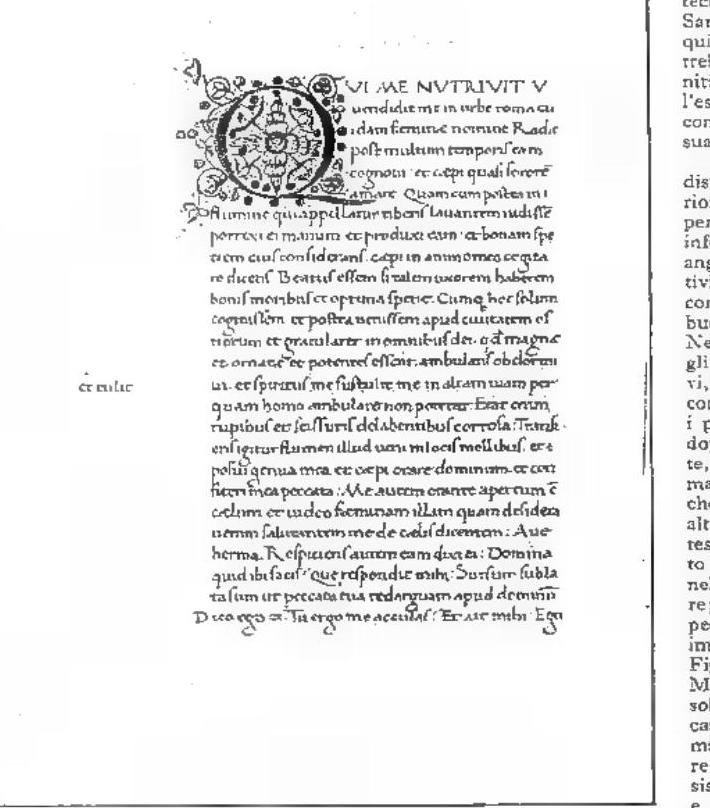
ERMA - Prima visione del Pastore nella versione latina - Biblioteca Vaticana, cod. Urb. lat. 486, f. 60° (sec. XV).
La fortuna del Pastore, grandissima nei primi tempi, andò poi decadendo. Ireneo (Adv. Heer., V, 20, 2), Clemente Alessandrino (Strom, I, 17; VI, 14), Tertulliano cattolico (De orat., 16), l'Adversus aleatores pseudo-ciprianeo (cap. 4), lo citano come Scrittura. Origene inclina a crederlo ispirato (Comm. in Rom., X, 31), ma sa che altri non lo riconoscono tale (Comm. in Matth., 14, 21) e taluni lo diaprezzano (De princ., IV, 11); fra questi è Tertulliano montanista (De pud., capp. 10 e 20). Il Frammento muratoriano, pur elogiandolo, lo esclude dal canone biblico. Il Cod. Sinaitico della Bibbia ci ha trasmesso le 5 Visioni e i primi 4 Precetti.
BIBLIA: Il testo ci è pervenuto, oltre che nel citato Cod. Sinaitico, in un cod. del Monte Athos (secc. XIV-XV), quasi per intero, e frammentariamente in vari papiri. Il più importante è pub-
blicato da C. Bonner. A popyrus codex of the Shepherd of Hermas (Univ. of Michigan Studies, Humanistic Series, 22). Ann. Arbor 1934. Si possiede una versione latina (Vulcan), probabilmente del II sec.; un'altra (Palatina), del V sec. e molti frammenti in lingua copta. Per le edizioni e traduzioni,
V. PADRI APOSTOLICI
Studi: Bardenhewer, pp. 465-87; W. Schmid-O. Stachlin, Geschichte der griechischen Litteratur, II, II, 6ª ed., Monaco 1924, pp. 1220-23; G. Bareille, Hermas, in DTHC, VI, coll. 2268-88; H. Leclercq, Hermas, in DACL, VI, coll. 2265-80; A. Casamassa, I Padri apostolici, Roma 1938, pp. 101-216. Per la dottrina sulla penitenza cf. E. V. B. Pouchmann, Penitentia secunda, Bonn 1946. Corresiconi al resto di A. Pusch in Studi dedicati alla memoria di P. Ubaldi, Milano 1937, pp. 83-85; id., La langue d'Hermans, in Mélanges offerts à M. Octave Navarre, Tolosa 1935, pp. 361-65; Cf. inoltre: R. van Deemker, Der Hirt des Hermas, Apokalypse oder Allegorie?, Delft 1920; A. von Ström, Der Hirt des Hermas, Allegorie oder Wirklichkeit? (Arbeiten aus dem Neutestum, Seminar in Uppsala, 3), Lipsia 1936; E. Peterson, Beiträge zur Interpretation der Visionen im Pastor Hermans, in Orientalia Christi, Periodica, 13 (1947), p. 625 seg. Michele Pellegrino