
CODICE. -
An ancient term indicating a collection of writing material—papyrus, parchment, wax tablet—assembled in quires. Seneca (De brevit. vitae, XVIII, 4) defined it as a « contextus plurium tabularum ». In general, it may be said that the codex is a way of arranging and preserving writing, different from the scroll, which is characteristic of the use of long strips of papyrus; the codex, on the other hand, already used for bronze diplomas, diptychs, and tablets, became widespread with the use of parchment; nevertheless, about ten codices in papyrus from the sixth to the tenth centuries are still extant, whereas the oldest parchment codices to have come down to us date from the third or fourth century. Today the term codex is generally applied to manuscripts on parchment or paper that have the form of a book.
In describing codices, certain technical expressions are used, which are also retained in the description of the oldest printed books, since for a long time these tended to imitate the parchment codex in their external forms.
Carmelo Trasselli
ART. — To the beauty of the letters and the decorum with which they are distributed across the leaves of the ancient codices containing the sacred texts, the orderly little fields of words, there was added, from the earliest days of the Christian faith, illumination (v.).
Bibles (v.), Evangeliaries (v.), Psalters (v.) were embellished with figurations intended to make the narration of the events of the New and Old Testaments more intelligible.
In this field, the development and formal evolution of the codices corresponded to those of illumination itself. And it may be said that, in the oldest examples (the Quedlinburg Bible, Berlin, Royal Library, 4th century; the Evangeliary, Cambridge, Corpus Christi College Library, cod. 286, late 6th century), the miniatures adorning them reveal the same characteristics that were proper to painting in Italy in that period.
From the 6th century through the 9th, while pictorial art, and consequently illumination as well, was slowly and laboriously evolving in Italy, the finest codices were produced within the orbit of Byzantine art, until the iconoclastic controversy brought development in this field to a halt as well. In these Byzantine codices, however, there is clearly evident a conception of the composition of the page that was not dissimilar
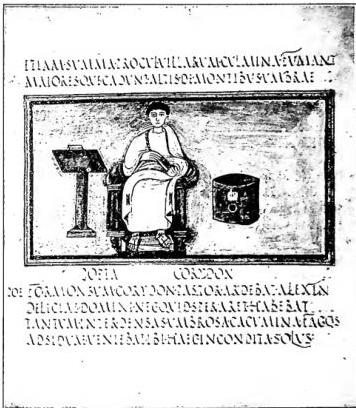
(formerly Sansoni) CODICE — The poet Virgilio with lectern and capsa, a miniature from the Vergilius romanus (5th century) — Vatican City, Library, cod. Vat. lat. 3867.
(photo: Pierpont Morgan Library)
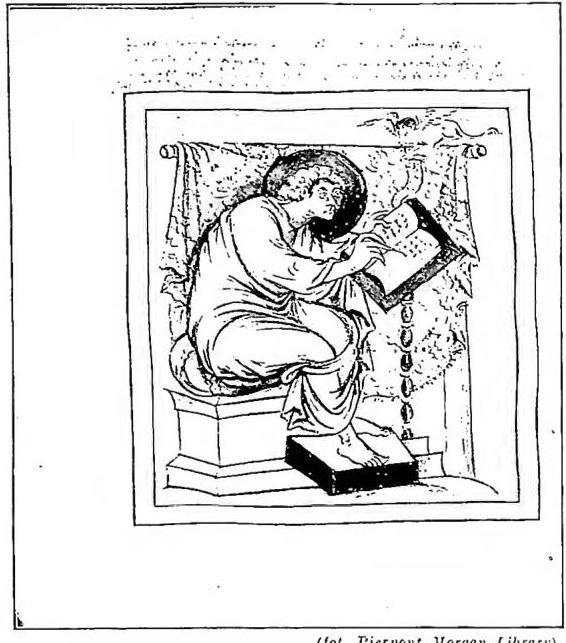
CODICE - The evangelist Luca, a miniature (9th century) in a codex containing the four Gospels, perhaps originating from Liège—New York, Morgan Library, MS 640.
different from that possessed by the ancients; that is, the illustration, the miniature, is understood as an adjunct that may or may not be inserted into the architecture of the page, without necessarily forming an inseparable unity with the characters of the text. In this respect, the manner of conceiving the organic distribution of the graphic and illustrative elements of the page as it appears in codices produced in the British Isles contrasts both with that of Italian and Byzantine codices. In them there is a new and unified sense of decoration, not only in calligraphic forms but also in the arrangement of the text on the pages, and above all in the large initials. These are illuminated, and the letters are formed with strange wormlike interlacings, foliage, monsters, anthropomorphic beings, etc., which, painted in gouache and vivid colors, wind, coil, and intertwine with unpredictable logic within clearly delimited spaces. This taste soon spread, and its reflections reached the Byzantine workshops and those of the Italian monasteries, where calligraphers and illuminators divided among themselves the work on the more demanding projects, whereas, at least in the oldest British codices, it seems to have been executed by a single person. The pre-Carolingian and Carolingian codices, too, as well as the others bearing characters derived from them (v. ARTE), perpetuate that taste for a unified sense of page decoration, tending toward ever greater clarity. The Carolingian workshops then produced several codices that must be regarded as masterpieces of the most refined medieval taste.
In many of the codices produced at the monastery of Bobbio, a center of intensive cultural exchange with the regions of northern Europe, and in many of those produced in the Benedictine monasteries of southern Italy, especially Montecassino, the manner in which spaces are distributed on the pages, the importance assigned to the gigantic and complex initials, and the very style of the miniatures illustrating the texts clearly reveal the portals of that Nordic taste which, moreover, was then very widely diffused throughout the territories of Germany.
Meanwhile, once the conflicts connected with the struggle against the iconoclasts had been overcome, the art of the miniature flourished anew in the East between the 10th and 12th centuries; beautiful codices were produced and gathered with loving, intelligent care in the imperial libraries, or transferred to the West as objects of high value.
The intense activity that characterized the Romanesque age everywhere was reflected also in the production of codices; it multiplied their production in the scriptoria of the monasteries, where, to meet ever greater demand, lay calligraphers and illuminators were also summoned to work. Moreover, alongside sacred texts, codices now transcribed secular works such as chivalric romances, studies of law or medicine, and treatises on every subject, even the art of hunting, such as the De arte venandi cum avibus composed for Federico II, of which a copy produced for King Manfredi (1258–66) remains in the Vatican Library (cod. Pal. lat. 1271).
Furthermore, as in every other field of art, the Romanesque age in the codices is characterized by the intensification and development of the features proper to the preceding age, and by their progressive and constant enrichment with expressive possibilities which, in this case, resulted in an ever greater unity and concreteness in the composition of the page. Here large initials still echo elements of Carolingian and pre-Carolingian culture (Bible of the Municipal Library of Perugia, cod. 459); or superimposed scenes in spacious areas recall very ancient decorative themes perpetuated in the use of the exultet (Vita s. Benedicti, cod. Vat. lat. 1202); or complex figurations display direct relationships with Anglo-Saxon illumination (Chronicon Vulturnense, Vatican Library, cod. Barb. lat. 2754).
Thus the advent of the Gothic period was prepared; properly understood, its spirit first manifested itself remotely in the field of art precisely in the composition of certain illuminated pages of Irish codices, where the need and taste for enclosing and restricting the flights of a heated imagination within the tight and unpredictable logic of a tangle of lines had already been resolved in artistic forms, inside the large initials which, occupying half or three quarters of the page, divide the spaces into a thousand meanders. Yet Gothic taste created its masterpieces in the field of codices precisely through the organic distribution of the material—whether writing or miniature—on the page.
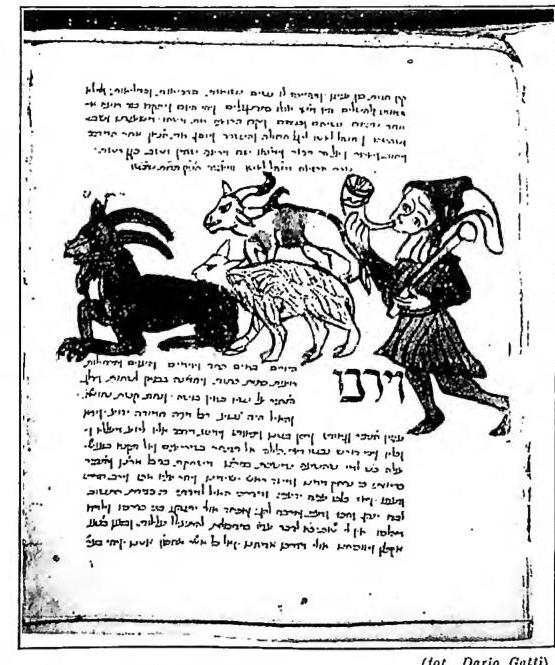
(photograph by Dario Gatti)
CODICE - Page of the Hebrew codex of Legends of Animals by R. Jishāq b. Šelōmōh b. Abī Sahulah. Copied in Germany (1483) - Milan, Ambrosian Library, D.S.I 41
It already renders many works, still to be assigned to the Romanesque period (e.g., British Museum library, Add. Ms. 18.720), admirable, and thus achieves works of absolute beauty in the 13th, 14th, and 15th centuries, especially in the centers where Gothic culture and taste flourished most intensely and authentically: here in Italy, in Siena, Bologna, and Lombardy; beyond the Alps, in France, where codices such as Les tres riches heures of the duke of Berry (Chantilly, Condé Museum), in the harmony of their composition and the balance of the relations between the space allotted to writing and that allotted to decoration, have no equal.
The Renaissance brought to Italy the sense of the new architecture of classical taste, also in the distribution of the parts on the pages of codices, so that at times the pages rich in miniatures of works such as the Bible of Borso d'Este (Modena) and that of the duke of Urbino (Vatican Library) would seem to have been designed, in their distribution of spaces balanced among bases, pillars, frames, and architectural elements, by an architect rather than by a calligrapher or illuminator.
When those forms spread to the other regions of Europe, the art of printing had already rendered the labor of calligraphers futile, while the art of illumination had by then been reduced to a debased yet refined craft practice. From the earliest times, the leaves of codices were held together by bindings (v.). These were made of parchment, leather, painted wood, or wood covered with cloth, parchment, or paper, but also of embossed metal sheets adorned with stones and enamels, often rising to the dignity of true works of art. - Vedi Tavy. CXXIII-CXXIV.