
EVANGELIARIO. — By E. (from evangeliarium [= ius], evangeliare, or also evangelistarium) is meant the liturgical book containing the Gospel passages to be read during the year at Solemn Mass.
The term E. is neither original nor the only one. More often one finds capitulare evangeliorum (8th century), corresponding to capitulare lectionum for the Epistles. The Middle Ages indulged in many other names: breviarium (= ius) lectionum evangelii, tituli, quotationes, tabula, registrum, volumen, liber, libellus, ordo, opusculum, pronuntiatio, intitulaciones, terminationes, inventarium evangeliorum. It was also called comes, but with the difference that capitulare indicated only the list of pericopes, at most with the incipit and the explicit, whereas the comes reproduced the entire pericope.
I. HISTORY
The history of the E. follows very closely, often merging with it, that of the epistolary. The first outline of the E. is found, as with the epistles, in the indication of the respective passages to be read on specified days, an indication placed in the margin of the sacred text. At first, these were sporadic instances, because originally, and in certain Churches until the 4th century (Africa) and the 5th (Ravenna), the normal system for reading Sacred Scripture was the lectio continua, that is, a book was read from beginning to end, a little at a time, for the period determined by the person presiding over the assembly, who then commented on the passage read in a sermon.But from the earliest times, on solemnities commemorating the great mysteries of the Redemption—Easter and Pentecost, then, in the 4th century, Christmas and Epiphany—and also during certain periods of the year, such as Lent and Advent, the lectio continua was interrupted to make way for the corresponding Gospel narrative. Thus, little by little, the series of pericopes for the principal feasts of the year came into being.
From the sermones of St. Augustine, S. Beissel was able to reconstruct the lectionary arrangement, at least for the Easter period, in use in the African Church (cf. Entstehung der Perikopen des Römischen Messbuches, Freiburg in Br. 1907, p. 44); the series established by Beissel should now be supplemented by the sermones post naurinus reperit published by Morin in the Miscellanea agostiniana (Rome 1930).
In the 7th century, the period to which the oldest manuscripts surviving to us date, the system of reading is found to have changed considerably. In place of the lectio continua, there appears a list of the pericopes (called capitulo as early as the 5th century), fixed once and for all. There are no certain elements for establishing how the transition from one arrangement to the other took place, and we must therefore content ourselves with conjecture.
As early as the beginning of the 3rd century, there emerged a tendency to fix the constituent elements of worship. This tendency became more pronounced in the following centuries. Thus it came about that the reading of Sacred Scripture, too, moved toward a fixed arrangement. To this must be added the disappearance of the catechumens (5th century), for whom the lectio continua chiefly constituted the first Christian instruction imparted through the liturgical celebration. It is certain, in any event, that a fixed lectionary organization was in force in Africa in 400 (St. Augustine, Sermo 86, Tract. da quarta feria post Pascha, in Miscell. agost., I, Rome 1930, p. 324; Sermo 315, 1: PL 38-39, 1426; Tract. VI in Ioann., cap. 18: ibid., 35, 1433) and in Gaul in 450 (Sidonius Apoll., Epist. IV, 11, 6: ibid. 58, 516; Gennadius, De script. eccles., 79: ibid. 1103 ff.).
And since the liturgical development of the various Churches of the West followed a parallel course, it is probable that Rome, too, before the 7th century, perhaps even as early as the 5th, had its own arrangement of scriptural readings. The reading was entrusted to clerics, who fixed day by day the text to be read, marking its reference in special lists (capitulum, whence the term capitulare was applied to the lists and later to the volume of pericopes) at the beginning of the sacred Codex, or transcribing the pericope in a separate volume.
This conjecture of Klauser is based on the fact that the oldest Roman collections of Gospel pericopes surviving to us are in the form of lists or actual lectionaries; but also on the fact that, throughout the entire series of existing manuscripts, there is no third form of scriptural collection.
The golden age of the Capitularia Evangeliorum was the 9th century, in which no fewer than 140 codices are recorded. In the 10th century the number declined considerably. In the 13th century the Capitulare definitively began to wane.
And this is understandable. Already in the Montecassino Missal, written perhaps in Rome around 700, the pericopes appear for the first time in a final form: the lessons are inserted into the Missal together with the other parts of the Mass. This form would develop in the following centuries, until it became the norm with the plenary Missals of the 13th century.
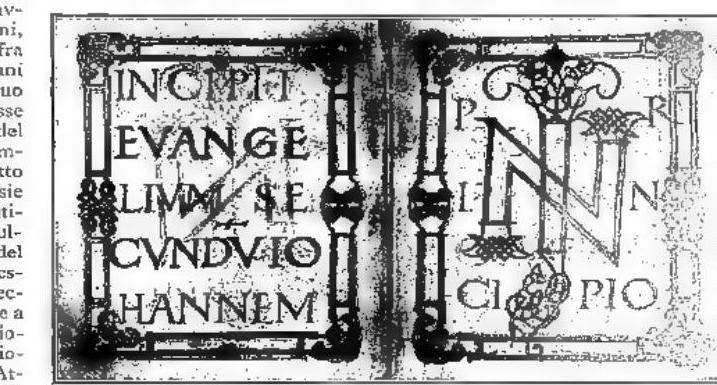
II. TYPES
The Capitulare Evangeliorum were first studied by Cardinal Tommasi and, more recently, with rigorous scientific method, by Frere and Klauser, who independently arrived at identical conclusions, apart from some differences of detail. Klauser, who extended his investigation to more than 1,300 manuscripts, classifies the capitularies into four types:Type II. This represents the pure Roman usage around 645 and has its finest exemplar in the Würzburg manuscript (University Library, cod. mp. th. f. 62; ed. G. Morin, Liturgie et hostilques de Rome au milieu du VIIe siècle d'après les listes d'évangiles de Würzburg, in Rev. bénéd., 28 [1911], pp. 286–330; V. also by the same author: Les notes liturgiques de l'Evangélaire de Burchard, ibid., 10 [1893], pp. 113–26), also called the E. of Burchard, because it seems to have belonged to s. Burchard, an English monk who later became bishop of Würzburg from 741 to 753.
Type A. — This still represents the pure Roman usage, but at a later period, around 740, and is represented by the codex aureus (now in the Municipal Library of Trier, cod. XXII), written around 800 (ed. K. Menzel, Die Trierer Ad-Haubschrift, Leipzig 1880, pp. 15–27).
This type also includes the capitulare found in the E. of s. Cuthbert (British Museum, Cotton Nero D. IV), transcribed at Lindisfarne from an E. used in the church of Naples and brought to England after the middle of the 7th century (edited by G. Morin, La liturgie de Naples au temps de sa Grégoire, in Rev. bénéd., 8 [1891], pp. 481–93, 529–37, in Anecdota Maredolana, I, Maredolana 1893, pp. 426–35).
Type E. — This again represents the pure Roman usage of 755. The principal manuscript is cod. lat. 1588 manu. acq. of the National Library of Paris, written around 800.
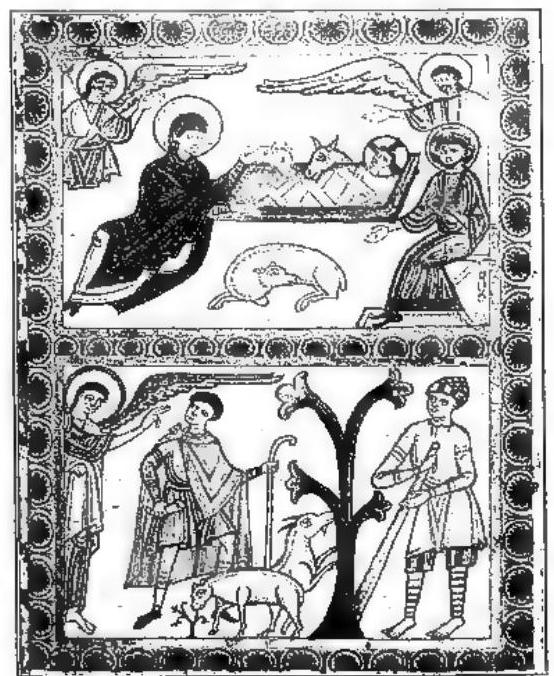
(photograph by Orlandini)
EVANGELIARIO — Nativity and Announcement to the Shepherds. Illuminated page from the E. known as that of Countess Matilde (11th century) — Nonantola, Abbey.
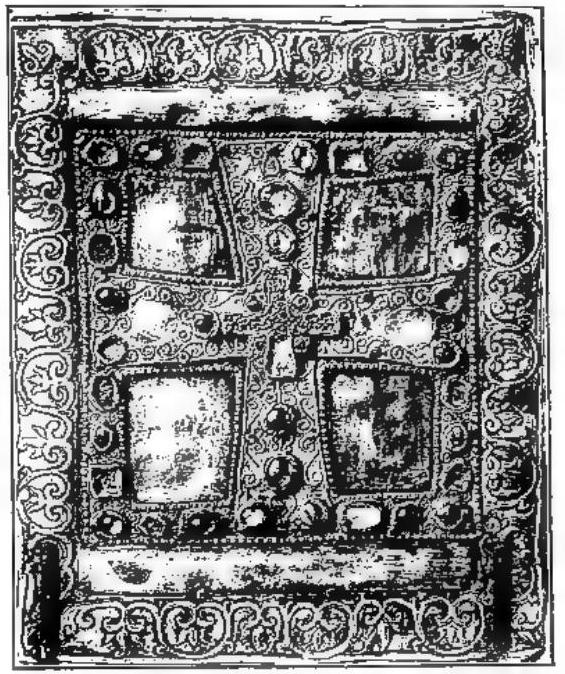
EVANGELIARIO – Cover of the E. of S. Maria in Via Lara (11th century) – Vatican Library, Sacred Museum.
III. IN THE LITURGY
The Church has always professed great veneration and respect for the E. Art has expressed this sentiment by representing it upon a throne. Thus in the mosaics of Ravenna, Roma, and Aquileia. At the Fourth Council of Constantinople (869), held in the basilica of S. Sofia, the E. stood upon a throne together with the relic of the Holy Cross. The Middle Ages knew another usage, dating back to the fifth century: that of keeping the Book of the Gospels upon the altar—the word of God close to the Eucharist. Even today, since the time of Giustiniano, oaths are sworn upon the Gospel.In the pontifical liturgy of the Middle Ages, the E. was carried to the altar with great pomp, in procession before Mass, by an acolyte accompanied by a subdeacon. Upon arriving in the presbytery, all the clergy stood as a sign of homage. The subdeacon then received the E. from the acolyte and placed it upon the altar, where it remained until the chanting of the Gospel. The consecrated table, which in ancient times tolerated no other object except the oblations, received the E. This ceremony has remained, in part. The E. is now carried in the pontifical entrance procession to the altar, before the celebrant; but, as soon as he has kissed it after the Confession, it is placed on the credence table. Other signs of veneration are the incensing and the lighted candles that accompany its reading.
All ceremonies already largely recorded in the Ordo Romanus I of the eighth century (cf. M. Andrieu, Les Ordines Romanes du haut moyen-âge, II: Les textes, Lovanio 1948, pp. 87-88), and partly completed and developed in the following centuries. They are the living expression of the Church’s faith in the word of God.
BIBL. The principal documents relating to the E., besides those found in the sources cited in each instance, have been collected by G. Godu, Evangiles, in DACL, V, coll. 852-923; J. Baudor, Capitulare Evangeliorum, ibid., II, coll. 2060-69; J. M. Tommasi, Opera omnia, ed. A. P. Vezzosi, Roma 1750, pp. 421-526; J. Baudor, Les Évangéliaires, Parigi 1907; W. H. Frere, Studies in early roman liturgy: III. The roman gospel-lectionary, Londra 1935; T. Klauser, Das Römische Capitulare Evangeliorum, I: Typen, Münster in West.
1935; it is the most complete work on the subject (two further volumes will follow, one on the evidence relating to the dating of the individual types, the other on the classification of the remaining capitularies). On pp. xxiii-xxv it provides an extensive bibliography through 1934 (cf. also Ephém. lit., 30 [1936], pp. 81-83). Annibale Bugnini
IV. DECORATION
Belonging to various phases of sixth-century Eastern art is a considerable group of E., including the purple codex of the cathedral of Rossano; the Syriac codex known as that of Rabula (a monk of Zagba in Mesopotamia), dated to the year 586 and now in the Biblioteca Laurenziana of Florence; and the codex of Sinope, today in the Bibliothèque nationale of Paris. Connected with these, although later (tenth century), is the E. of Etschmiadzia (Armenia), enclosed in an earlier ivory diptych.The E. preserved at Cambridge in the Library of Corpus Christi College (cod. 286) perhaps belongs to the group sent to England to Augustine of Canterbury by Pope Gregory I (540–604). It seems to have been executed in Rome or southern Italy, since the miniatures adorning it reflect the pictorial forms characteristic of central Italy between the sixth and seventh centuries.
The E. of Lindisfarne, now in the British Museum, also belongs to the beginning of the seventh century. Its beautiful miniatures of initials demonstrate the refined sense of decoration characteristic at that time of the art flourishing in the British Isles.
During the golden age of the E., that is, under Charlemagne, special schools were established alongside the monasteries’ scriptoria. Working with devotion, intelligence, and artistry, they produced true masterpieces. The monastery of S. Martino at Tours, directed by the celebrated Alcuin; the schools of S. Gallen, Mera, Reims, and Orléans; the abbeys of Corbie, Luxeuil, and others left splendid works. Among the most famous calligraphers of the period are deservedly remembered Alcuin, author of the E. given by Charlemagne to the abbey of the Most Holy Saviour at Aniane (Montpellier); Godescalco, who wrote the E. now in the Louvre; and Pietro, to whom the E. of Charlemagne now in the « Schatzkammer » of Vienna is owed. Also noteworthy are the miniatures of the Ada codex, in the Municipal Library of Trier, and of the E. of Echternach of the twelfth century preserved at Gotha.
In the ninth and tenth centuries the opening pages of the E. were dyed purple. The page frames and the initials, both large and small, were made of gold, followed by the titles and rubrics (E. of Carlo di Rohan-Soubise, now in the Bibliothèque nationale of Paris); finally, the entire remainder was written in gold or silver (E. of S. Martino des Champs, now in the Bibliothèque de l’Arsenal). This golden magnificence reached its greatest splendour in the Carolingian period and then declined.
Belonging to the beginning of the twelfth century, and having miniatures that recall the manner of Cassinese painting in the initials and that of Roman painting of the period in the figures, is the E. originating from Farfa and now in the Biblioteca Vallicelliana of Rome (cod. E. 16). The figures of the E. perhaps originating from the Roman Convent of S. Cecilia, now in the Laurenziana of Florence (PL 17–27), also display a similar taste; whereas the E. originating from the Convent of the SS. Apostoli, likewise in Rome and now in the Biblioteca Vaticana (cod. Vat. lat. 5974), has a distinctly Byzantine character, since it was executed in the twelfth century by the miniaturists of the Greek abbey of Grottaferrata.
Characteristic as well are the forms proper to the miniatures of the E. given by Countess Matilde to the abbey of Polizone ca. 1109. The codex is now in the Morgan Library in New York and reflects the modes characteristic of painting in northern Italy at the beginning of the twelfth century.
Reflections of Ottonian art are found in a codex of the cathedral of Vercelli and, still more vividly, in another kept in the treasury of the cathedral of Padua, executed in 1170 by an Isidoro doctor bonus.
The E. from the end of the twelfth century known as that of Countess Matilde, which is in the abbey of Nonantola, contains some miniatures imitating Germanic models, while others display a freer and more lively manner, in harmony with contemporary Italian painting.
E. became more frequent in subsequent periods, likewise reflecting in their decoration—as in other sacred texts—the modes proper to the regions in which they were executed.
Drawings and paintings were used to embellish and enliven the E. The initials were preferred by the calligraphers, who either employed symbols (the hieratic phase) or reproduced nature (the naturalistic phase); subsequently, a tendency developed toward the representation of buildings, scenes, and fictitious or even real figures, such as donors, the great personages of the period, or the calligrapher himself. The preservation of a great number of historical portraits is owed to liturgical books; without them, these would never have reached the present day (e.g., Carlo il Calvo in the E. of St. Emmeran of Ratisbon; Enrico III and the empress Agnese, Corrado il Salico, and Gisèle in that of the Escurial; Countess Matilde in her E. in the Biblioteca Vaticana (cc.)). Magnificence is also evident in the binding of the manuscripts. Already S. Ambrogio recalls: «arca Testamenti undique auro tecta idea: doctrina Christi» (Epist., IV, 4: PL 16, 890). Two fifth-century ivory tablets, which covered an E., are preserved in the cathedral of Milan. The case of the E. of Monza (sixth century), given by Queen Teodolinda to the church of S. Giovanni, is clad in gold leaf. Ivory and gold were used extensively for the E. For the ninth century, one may cite the ivory adorning part of the E. of Lorach in the Biblioteca Vaticana; for the tenth century, the ivories of the E. of Echternach; and for the eleventh, the celebrated binding of the E. of Besançon. Ivory was fastened with gold and silver plaques, but entire bindings were later made of these precious metals, as in the Gothic E. of Uffla (Codex argentens) and the bindings decorated with enamels and relief work from the regions of the Meuse and the Rhine. — Vedi av. LVII.