
ROSSANO, DIOCESI of. - The city of R., in the province of Cosenza, rises on the extreme eastern foothills of the Sila mountains, facing the Ionian Sea, from which it is a few kilometers distant.
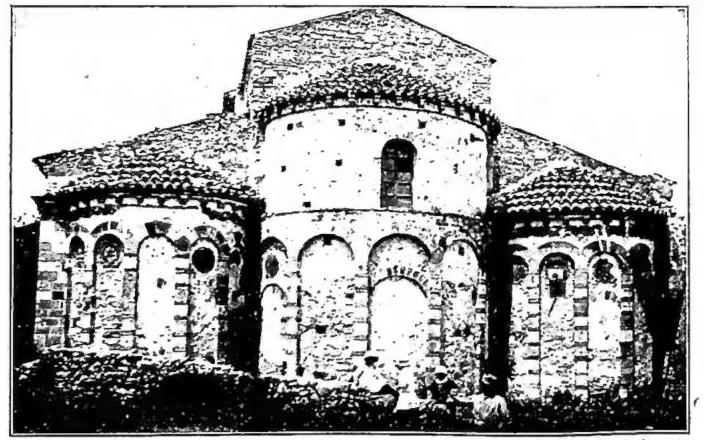
Of little importance in Roman times, it became extremely important during the Byzantine domination, which made it the center of resistance against the invasions of the Saracens and chose it as the seat of the governor of the Duchy of Calabria. It reached its apogee in the 10th century, at the time of St. Nilus, and in the 11th, shortly before the advent of the Normans. With these new rulers, the center was moved first to S. Marco Argentano, then to Mileto, and finally to Palermo, as a result of which R. lost its strategic importance and declined.
It is to be excluded that the episcopal see is of apostolic origin, nor can one accept the claims of those who would have the church of S. Michele Arcangelo di Codigno consecrated by Bishop John in 350. In reality, R. succeeded Thurii when that city was destroyed by the Saracens or the Lombards toward the end of the 7th century. Indeed, the last bishop of Thurii is that Theophanes who appears in the Synod of Pope Agatho in 679.
Therefore, R. is undoubtedly of Byzantine foundation and its origin can be assigned to the first half of the 8th century. However, it should be noted that in the Greek Diatyposes it does not appear in Notitia I, but only in III and X, which date from the time of Leo VI the Wise, that is, the beginning of the 10th century. In these Notitiae R. appears as a suffragan of Reggio, which was the metropolis of the eparchy of Calabria. The title of archbishop, assumed by Romanus, prelate of R., appears for the first time at the foot of a Greek document of 1088, and not in 1091, as Minasi and Fabre erroneously believed. However, it should be noted that it was already in vogue from the 10th century, as results from the Life of St. Nilus, who was requested as archbishop of R. around 970. Nonetheless, R. was never a metropolis, and the persistently advanced requests to have as a suffragan the diocese of Cariati, formed with part of its territory in 1438, were never granted by the Holy See. The territory of the diocese of R. suffered a second mutilation when in 1919 the diocese of Lungro was established, which took away the towns of Albanian origin, among them S. Demetrio Corone, the intellectual and historical center of the Italo-Albanians. However, Spezzano Albanese, which had adopted and still maintains the Latin rite, remained annexed to R.
The Greek rite, established in R. from the beginning, was maintained until 1640, when it was replaced by the Latin one through the work of Archbishop Matteo Saraceni. An attempt at replacement made by Count Roger met with such opposition from the people of Rossano that he thought it appropriate to recede. The Greek rite was sustained by the Basilian monks, who had established themselves in the numerous Greek monasteries of the diocese, of which R. alone had seven. Among these monasteries, special mention is due to the two very famous ones of S. Adriano, near S. Demetrio Corone, founded by St. Nilus in 950 and illustrated by Gay, and that of S. Maria Nuova Odirigia or of the Patirion, founded between R. and Corigliano around 1100 by St. Bartholomew of Simeri, which became a very important center of Byzantine civilization in the West throughout the Middle Ages. It has been illustrated by P. Batiffol, who wrote a splendid monograph on it and stated that the Patirion is for Greek humanism what Bobbio is for Latin humanism.
Among the Latin abbeys, the following should be remembered: the Benedictine one of S. Maria di Camigliano near Tarsia, the Florensian one of S. Angelo Militino, and the Cistercian one of S. Maria de ligno Crucis between Corigliano and Acri. The Mendicant Orders established themselves there in recent times: the Augustinians
(photo Ass. Mezzogiorno)
ROSSANO, DIOCESI di - Apses of the Patirion (12th century).
in Tarsia, the Observants in R., the Minims and Capuchins in R. and Corigliano.
In the Latin field, the following are remembered: Blessed Marino, of the Franciscan Third Order, and Silvestro Di Franco, a Capuchin who was a distinguished preacher, procurator general, and highly appreciated ascetic writer. Outside of R., mention should be made of Fr. Matteo Persiano, Fr. Francesco Longo, a very prolific theological and canonist writer of the Capuchins, and Fr. Tommaso Puglisi, a distinguished Carmelite historian, all from Corigliano; the Ven. Fiorentino da Longobucco, companion of St. Francis of Paola.
Among its prelates, worthy of note, besides Theophanes Kerameus and Matteo Saraceni already mentioned, are Vincenzo Pampinella, who undertook many diplomatic missions for the Holy See; Cardinals Francesco Colonna, Girolamo Verallo, and Gianbattista Castagna, who was later Pope Urban VII; Cardinal Lucio Sanseverino, who held a synod in 1594; Andrea Adeodati of the Benedictines, Francesco Maria Muscettola of the Theatines, and finally Orazio Mazzella, a distinguished theologian, later archbishop of Taranto.
Originally it included all four Gospels. In its present state, it consists of 188 leaves, numbered in modern times with black ink on the recto and verso, and contains Matthew and Mark up to 16:14; it reveals transpositions and mutilations at the beginning and the end, the latter due to a fire, as deduced from burn marks on the outer leaves.
Its discovery is attributed to O. von Gebhardt and A. Harnack, who saw it in 1879 at the Chapter of R., but already in 1845 the Italian journalist C. Malpica had reported on II. Nor could the manuscript have remained hidden for long, since it was probably still in use in the 15th century (the period when the Latin rite supplanted the Greek one in the territory of R.) and the current binding, posterior to the aforementioned losses, cannot date back any earlier than the 17th-18th century.
The miniatures clearly reveal its Eastern origin from Asia Minor: whether specifically from Cappadocia, as some maintain, cannot be proven. The stylistic elements and iconographic characteristics suggest a comparison with the Vienna Genesis (Cod. Vindobonensis gr. 31, of the 5th-6th century) and the Sinopensis O (Cod. Parisinus, suppl. graec. 1286, plus a leaf preserved at Mariupol on the Sea of Azov); on the other hand, the harmonic balance of the various compositional elements, the vivid sense of color, and the technical skill of a distinctly Byzantine imprint have prompted comparisons between the scenes of the Gospel Book and the mosaics of Ravenna, which, however, appear more static and uniform. It is noteworthy that the four surviving purple manuscripts of the Greek text of the Gospels (the Codex purpureus N, divided between the libraries of Vienna, London, Patmos, Leningrad, and the Vatican; the Beratinus Φ; the Sinopensis O; and the Rossanensis Σ) all belong to the same redaction (the recensio Caesariensis) and date back to the same era (6th century); their provenance is also likely identical.
A few kilometers from the town, on a deserted and impervious ridge, stands another distinguished medieval monument, the ancient monastery of S. M. del Patir or Patirion, founded by Bartolomeo da Simeri in the very early 12th century (bull of Pope Paschal II of 1105). Of the ancient Basilian cenoby today only some remains of the cloister and the church are left: the latter has a basilica plan with three apses decorated on the exterior with polychrome tesserae of Siculo-Norman derivation. To this cultural orbit also belong the fragments of the fine mosaic pavement, commissioned by Abbot Blasio, successor of Bartolomeo, in polychrome tesserae with animal figures, friezes, and an inscription. Belonging to the Patirion was the 15th-century panel of the Hodegetria with the Crucifixion on the reverse, a repetition of an ancient Byzantine icon, now preserved in the church of S. Pietro in Corigliano.