
OTTONE III, EMPEROR and King of Germany. - O. III was only 3 years old when he succeeded his father, Otto II;
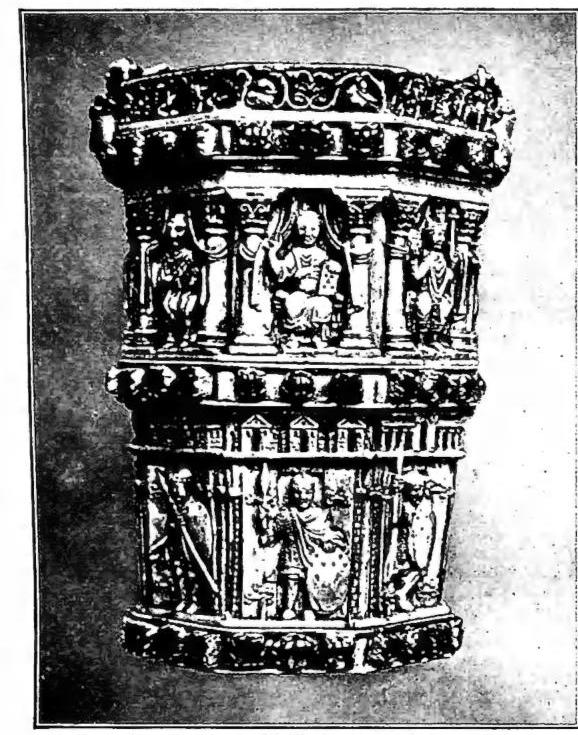
(from G. Ladner, I ritratti dei Papi nell'antichità e nel medioevo, Vatican City 1911, p. 187, fig. 185)
The crown of O. III was saved thanks to the skill of the regent, his mother, Theophanu, an intelligent and prudent woman whose circumspection succeeded in repairing her husband's shortcomings and compensating for her unpopularity in Germany. Lothair's unexpected death, the support of the episcopate, and dynastic loyalty—which checked the Bavarian opposition—represented equally favorable circumstances. Theophanu wisely renounced Sicilian adventures and showed moderation in Roman affairs, allowing the Romans to choose Pope John XV themselves and the Crescenzi to recover their patrician dignity. She also managed to pacify the Slavic borders on the Elbe and limit Czech ambitions by supporting the Duke of Poland. In reality, the credit for her policy should be attributed to her advisor, Archbishop Willigis of Mainz, thanks to whom the same course of conduct was able to survive Theophanu's death under the regency of her mother-in-law, Empress Adelaide, with whom Theophanu had closely cooperated during her lifetime. The struggle against the Slavs remained on the agenda until O. III reached maturity (966).
Six years of personal rule (996-1002) sufficed for him to bring the ambitions of the Saxon dynasty to their apogee, while also compromising them through their rash breadth. The son of a Greek woman and an exceptionally cultured Saxon, O. III did not hesitate for long between his father's Mediterranean and Eastern dreams and his mother's anti-Slavic policy. Nourished by classical culture and formed under the beneficial influence of holy persons such as Gerbert, St. Adalbert, and St. Nilus, O. was a mystic dreaming of a universal empire where he would advance the Kingdom of Christ. Rome exercised an irresistible attraction over him. Seduced by it, he wanted to dominate it; but Germanic atavism reclaimed its rights, and Otto I's brutality reappeared in his methods, alternating with phases of asceticism and meekness. Few characters are as complex as that of O. III. He imposed a German pope on the Romans, Gregory V, from whom he received the imperial crown on May 21, 996. He suppressed a revolt fomented by the Crescenzi with the utmost rigor, and his confused policy in southern Italy came close to bringing him just as many setbacks as his father had faced, who had aimed higher and possessed a broader vision.
In Gerbert of Aurillac, whom he elected pope under the name of Sylvester II without notifying the Romans, the Emperor found a colleague suited to his measure. By mutual agreement, Pope and Emperor—the only two of the world—worked toward the establishment of the Christian Empire. Hungary, baptized and united directly to Rome, became the "Apostolic Crown." The autonomy of the Polish and Czech Churches attested to the universal character—increasingly Roman and less and less German—of O. III's ideal, who assumed the title: "Roman, Saxon, Italian, servant of the Apostles, by the grace of God, August Emperor of the world." He intended to adhere to all traditions; on May 19 in the year 1000, Pentecost Sunday, he solemnly proceeded with the exhumation of Charlemagne's body in Aachen. He took upon himself, so it is said, the golden cross of the great Emperor, and the legend spread of a mysterious message from Charles to his imitator. O. III also wished to marry a Greek princess and thereby concentrate in himself the rights of the Eastern and Western Empires. Above all, he dreamed of the greatness of Rome, where he resided habitually from 999 onward, renewing ancient and Byzantine ceremonial at court. As servant of the Apostles, he considered himself the lieutenant of St. Peter.
Yet from the end of his reign, the preludes of an inevitable competition between the two heads of the Christian world already manifested themselves. Rome itself, ungrateful and hostile above all to German influence, rose up and forced the Emperor to withdraw to Monte Gargano, which he left only to die (Jan. 24, 1002). The insults with which the Lombards greeted his remains were the funeral knells of the dream of universal dominion, to implement which O. left no heirs.