
ORIENT, EMPIRE OF THE
### I. ROMAN EMPIRE OF THE EAST
The Byzantine Empire, which historically has always called itself—and should be called—the Roman Empire of the East, had a history spanning more than a millennium, divisible into three periods corresponding to those of any human or social organism: formation, from the foundation of Constantinople to the accession of Justinian I (326–565); consolidation, marked by internal conflicts arising from the new division of the Empire into civil-military provinces called themata, the assault of barbarians from the north and east seeking territories, and the spread of Islam—consolidation that reached its glorious apex under the Macedonian dynasty (565–1025); and the dissolution of political and social life due to escalating external threats, internal intrigue stifling sound policy, the rupture of religious unity with the Latin Church, and the expansion of the West, which, through commercial routes, managed to occupy the throne of Byzantium for 54 years and dealt the Empire a blow from which it never recovered (1025–1453).
#### 1. From Constantine to Justinian (326–565)
During this transitional first phase, the elements that would become specific to Byzantine history were established. Constantine, a Balkan-born valiant soldier, immediately recognized that the defense of the Roman Empire lay in the Balkans, the frontier between Asia and Europe. As a shrewd politician, he intuited that Christianity held all the hopes for the future and ensured that the new capital he founded at Byzantium—a small municipality in Thrace—was oriented toward Christianity from the outset, while old Rome remained too steeped in pagan memories. He accepted Diocletian’s administrative division of the Empire into four great provinces but abolished the tetrarchs, who had pursued an overly personal and independent policy, replacing them with four praetorian prefects directly dependent on him. Like Diocletian, he maintained the separation of civil and military administration, ensuring both converged in a council of state ministers (sacrum consistorium), the official organ through which the Emperor implemented his policies.
The Senate no longer constituted a diarchy with the princeps; it retained only honorary prerogatives and those of municipal governance for the new city. If its members were admitted to the prince’s cabinet, it was through the ranks of the new bureaucracy. The new servants of the state were no longer chosen from the old aristocracy but from the middle class, for whom bureaucratic titles of nobility were created, corresponding to functions within the imperial cabinet.
From Constantine onward, the elements that would define the specific monarchy of Byzantium are discernible, though they would take their definitive form only under Justinian.
Constantine’s successors—Constantine II (d. 340), who inherited the West; Constans (340–58), who received Italy and Africa; and Constantius (350–61), who governed the East and, from 350, the entire Empire—continued their father’s policies, aside from fratricidal struggles and usurpations. Julian (361–63), son of a brother of Constantine, attempted to revive paganism in its Neoplatonic form but died in battle against the Persians in 363.
Under his successors Jovian (364), Valentinian I (364–78), Gratian (375–83), and Valentinian II (375–92), the Empire became increasingly bureaucratized, assuming the character of a vast organization. With Theodosius I the Great (379–95), Christianity was affirmed ever more rigidly, and the Empire remained permanently divided between its western and eastern halves, which, despite the legal fiction of Roman imperial unity, lived their own lives, each ensuring its own preservation.
For the West, under Honorius (d. 423, son and successor of Theodosius) and Valentinian III (425–455), the 5th century was that of the barbarian invasions: Vandals, Visigoths, and Suebi of Germanic stock, who reduced the most important western provinces—Britannia, Gaul, Spain, Africa—to barbarian principalities. These more or less assimilated barbarians infiltrated the Empire’s army and administration, rendering services while altering its ethnic character and, in part, assimilating its language and Christian religion. After Valentinian III, nine emperors succeeded one another on the debased western throne; Rome was sacked again by Gaiseric (455), until the Herulian Odoacer, leader of Germanic troops in the service of Emperor Romulus Augustulus, deposed the ephemeral sovereign (476) upon being refused settlement in Italy and assumed power directly. In theory, this did not signify the end of the Western Empire but the transfer of Italy under the authority of the Eastern Emperor.
In the eastern section of the Empire, matters proceeded peacefully in terms of external attacks, as Goths and Ostrogoths were directed toward Italy, but political and religious disputes arose from the never-extinguished rivalry between Constantinople and Alexandria, taking the form of religious contention. After the ineffectual Arcadius (393–408), his son Theodosius II (408–50) succeeded him, no more energetic than his father, though he left his name to the Theodosian Code, which compiled imperial constitutions from 312 to 437, valid for both sections of the Empire. From that date onward, however, it held value primarily for the West, while in the East it was replaced a century later by Justinian’s Corpus Iuris.
Theodosius II lived under the tutelage of his elder sister Pulcheria, who, upon his death, married the elderly and energetic Marcian (450–57), who resisted Attila, who then turned toward the West. His successors were Leo I (457–74), Leo II (d. 474), Zeno (474–91), and Anastasius (491–518), who married Zeno’s widow. With Anastasius began the penetration of the Slavs into the Balkan Peninsula.
From a religious standpoint, Zeno and Anastasius leaned toward Monophysitism, recognizing that the West was practically lost to the Empire and that the eastern provinces—Egypt, Palestine, Syria—needed to be kept favorable, where Monophysite heresy signified a national assertion against Constantinople. Anastasius’s successors abandoned this pro-Eastern policy in an attempt to regain a political position in the West, one forever lost, and left the eastern frontiers undefended, from which the final ruin of the Byzantine Empire would come.
Anastasius I was succeeded by Justin I (518–27) and then by his nephew Justinian I (527–65), who cherished two ideas above all: the Roman idea, by which he sought to reunite the West—then occupied in Italy by the Goths, in Africa by the Vandals, in Thrace by the Bulgars—with the Empire and to unify prior legislation into a single body (Corpus Iuris Civilis); and the Christian idea, which he regarded as the symbol of political unity’s safeguard.
2. From Justinian to the Macedonian Dynasty (565-1025)
The period from Justinian to Heraclius (and this demonstrates how politically unenlightened Justinian’s Westernism was) was among the most desolate in the history of Byzantium. War against the Slavs and Avars who had penetrated the Balkan peninsula; the Lombard conquest of Italy; war against the Persia of Chosroes II, to whom Justin II (565-78) had refused the agreed tribute; a peace treaty with the latter by Emperor Tiberius II (578-82), who triumphed through the arms of his general Maurice, who succeeded him on the throne (582-602) and died assassinated in a military revolt, after which the centurion Phocas (602-10) became emperor. But Chosroes II of Persia, with whom Maurice had once negotiated, moved to avenge him, and although Heraclius (610-41) killed the oppressive tyrant and succeeded him in the Empire, he invaded Syria, occupying Jerusalem (614) and carrying off the wood of the True Cross, then Egypt and Asia Minor, while the Avars battered at the gates of the capital. Initially uncertain whether to transfer the capital to Carthage, Heraclius then threw himself upon Persia, penetrating through Armenia, and after a campaign lasting five years, succeeded in breaking the Persian army, reconquering Armenia and Syria, and recovering the wood of the True Cross and the imperial insignia. And since during his critical situation he had understood the need to keep the Monophysite populations of Syria and Egypt friendly, he devised, at the suggestion of the Byzantine patriarch Sergius, the conciliatory formula of the single will of Christ, which he imposed with a special document, the Ekthexis (= exposition [of the faith]) of 638, provoking the protests of the West and initiating the Monothelite controversy, which, not quelled by a further decree, the Typos (= the model, the norm) of Constantine II, son of Heraclius, was closed by the Sixth Council of Constantinople (681), which ruled in favor of the Western protest.Meanwhile, the religious-political invasion of the Arabs had moved from Arabia, wresting Syria from Byzantium in the battles of Aǧnādayn (633) and Yarmūk (636), and proceeding to the conquest of Persia in the battles of Qādisiyyah (636) and Nihāwand (642).
The history of Heraclius’s descendants presents a lamentable succession of folly and massacres; the exception was Constantine IV Pogonatus (668-85), who, with the help of Greek fire, repelled the Arabs besieging Constantinople; ceded to the Bulgars the lands they had already occupied; and, to eradicate the Monothelite heresy—which no longer had any reason to be upheld given the loss of Syria and Egypt—convened the Sixth Ecumenical Council, mentioned above, which ratified the doctrine of Rome.
The emperors who succeeded Constantine IV were inert and cruel. Justinian II (685-95), Leontius (695-98), Tiberius III (698-705), Justinian II again (705-11), Philippicus Bardanes (711-13), Anastasius II (713-16), Theodosius III (716), under whom the Arabs, advancing into the Bosporus, seized Constantinople.
To save the Empire, squeezed between Slavs to the West and Barbarians to the East and now on the brink of ruin, arose Leo III (717-21) of Germanicopolis in Syria, also called the Isaurian. Together with his son Constantine, he sought to improve the internal conditions of the Empire by promulgating (726) the Ecloga, that is, a collection or extract of laws drawn from the Justinianic compilation with the aim of making it more practically agile and "philanthropic," conforming it to the changed conditions of the Empire. The Ecloga remained in force until the legislation of the Basilica (v. below). After having averted the Arab assault and destroyed their fleet, he revived, with special laws, the army (νόμος στρατιωτικός "military code"), maritime commerce (νόμος ναυτικός "nautical code"), and agriculture (νόμος γεωργικός "rural code"), afflicted by the grave evil of latifundia. He sought to remedy this by issuing measures in favor of small property and striking at the great latifundists who exploited the Anatolian colonate, reduced to miserable conditions; among the greatest latifundists were the monks, whose possessions were exempt from all fiscal burdens. It cannot be excluded that the struggle against sacred images (iconoclasm), which he initiated, had as its essential motive the struggle against monasticism, which held so much of the Empire’s landed property and was the painter of sacred images, the devoted propagator of their veneration, and their most strenuous defender.
His son Constantine V Copronymus (741-75) continued the iconoclastic struggle, persecuting the defenders of sacred images even to martyrdom; he kept the Arabs at bay, defeated the Bulgars after a long campaign, and concerned himself with agriculture by sending colonies of Slavs to Bithynia and Syrians to Thrace to improve the lands. Leo IV the Khazar (775-80), his son, who succeeded him, continued the iconoclastic struggle but in a mitigated form and soon associated his son Constantine VI (780-97) with the Empire. The latter was assisted by his mother Irene, regent during his minority, during which there was a pause in the iconoclastic struggle, condemned at the Ecumenical Council of Nicaea (787), to which Pope Adrian I sent his legates.
Constantine VI, who had successfully contained the Bulgars, saw Hārūn al-Rashīd cross Asia Minor as far as Scutari; he witnessed the Empire lose every vestige of authority in the West due to the creation of the Holy Roman Empire (800), retaining only the possessions of southern Italy, Sicily, and Illyricum, which Leo III had already removed from the hierarchical obedience of the pope, and ended up blinded by his mother, from whose tutelage he had sought to free himself. But Irene was punished for her cruelty when Nicephorus (807-11), minister of Finance, seized the Empire (802), which he governed along the line marked by the Isaurians, protecting agriculture, imposing a tribute (καπνικάν) on monasteries, and abolishing all fiscal exemptions. He was assassinated during a campaign against the Bulgars. After Stauracius, his son-in-law Michael Rangabe (811) succeeded him, pursuing a policy encouraged by the iconophile St. Theodore the Studite, but for his administrative ineptitude and military incapacity in the struggle against the Bulgars, who were devastating Thrace and Macedonia, the army, which had raised Leo V the Armenian (813-20) on its shields, paid the price. With Leo, the Asian current, concerned with agriculture and administration and opposed to clerical interference in public affairs, thus returned to the throne, adhering to an iconoclastic program, which it applied, however, without persecuting iconophiles. He fell victim to a palace conspiracy, and Michael II (820-29) succeeded him, under whom the Arabs occupied Sicily and Crete, and then Theophilus (829-42), a fervent iconoclast. Upon his death, the Empress Theodora governed as regent during the minority of her son Michael III the Drunkard (842-67) and definitively restored, after a council (whose acts, now lost, fully confirmed those of Nicaea), the veneration of images; this restoration is consecrated by a solemn liturgy called the Feast of Orthodoxy, which the Byzantine Church celebrates on the first Sunday of Lent. The struggle, which ethnographically represents the contest between the Greek and Eastern elements of the Empire (the iconoclastic Emperors are Easterners, Syrians first and then Phrygians, as are the elements composing their army), and socially the defense of small property against the large estates held by nobles and monasteries, concluded after nearly a century of conflict, leaving the good seed of agricultural protection with the development of small agricultural property and administrative reform, a seed that would bear fruit during the Macedonian dynasty, under which the Byzantine Empire reached the apogee of its power and extent.
During his reign, the Photian schism erupted, which, though initially resolved, would later produce the definitive split between the Greek and Latin Churches.
His son Leo VI, called the Wise (886-912), was the true compiler of the Basilics desired by his father, but his military skill did not match his learning, as he suffered a severe defeat at the hands of Simeon, Tsar of the Bulgars. His son Constantine VII, called Porphyrogenitus (912-959), was also a great scholar who devoted himself to erudite compilations (De thematibus, De administrando imperio, Biography of Basil I); meanwhile, his father-in-law Romanus I Lecapenus (959-63),
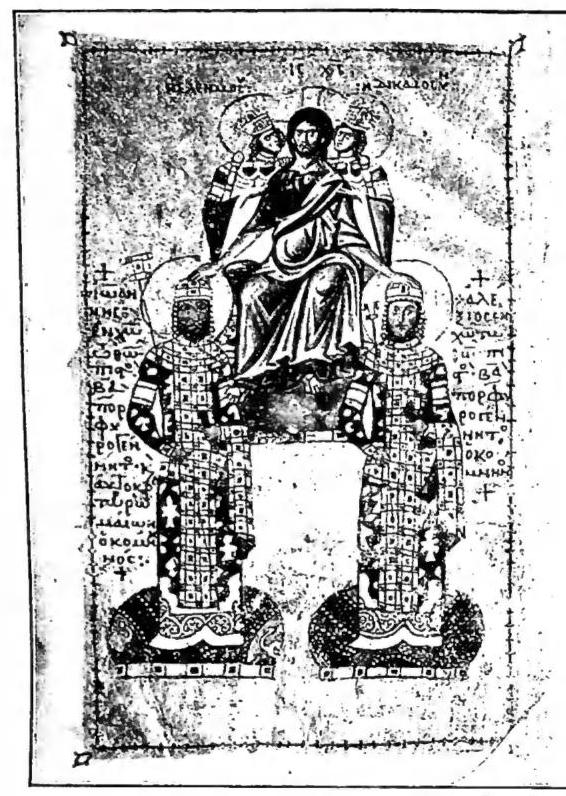
ORIENTE, Impero d' - Coronation of John and Alexius Comnenus. Miniature (11th-12th centuries) - Vatican Library, cod. Urb. grec. a B. f. 19 V.
who had been associated with the Empire, opposed the Bulgars, who were again pressing at the gates of Constantinople, with little success, while, with better fortune, he secured the Empire’s possessions in southern Italy: the thema of Longobardia (land of Otranto, southern Lucania, and Apulia) and the thema of Calabria, which were later united by Nicephorus Phocas in 965 into a single thema of Italy, whose governor resided in Bari with the title of catapan.
Succeeding Constantine was his son Romanus II (959-63), whose widow Theophano (mother of the two minors Basil, the future Bulgar-slayer, and Constantine) married Nicephorus Phocas (963-69), who drove the Arabs from Crete, Anatolia, and Syria, and died assassinated in a palace conspiracy. John Tzimisces (969-76) ascended the throne, an excellent general, also related to the Macedonians by having married Theodora, sister of Romanus II. He victoriously penetrated Mesopotamia and in Syria resumed the struggle against the Bulgars, whom his successor Basil II (976-1025) bloodily defeated, earning the title of "Bulgar-slayer." He also had the satisfaction of seeing the Russia of Vladimir accept baptism en masse (988), thus entering the orbit of Byzantine influence.
4. Decline. The Comneni, the Angeli, and the Palaeologi. — With the death of Basil II begins the downward trajectory of the Empire, coinciding with the disappearance of small landowners, who returned under the economic yoke of great feudal lords and monks: the Paulician and Bogomil heresies are an aspect of this political, social, and ethnic (Slavic) antinomy. Constantine VIII, Basil’s brother, was inept (1025-28). With his two daughters, Zoe, who successively married Romanus III Argyrus (1028-34), Michael the Paphlagonian (1034-41), and Constantine IX Monomachus (1042-54); and Theodora, who appointed Michael VI Stratioticus (1056-57) as emperor, the Macedonian dynasty became extinct.
With the extinction of this dynasty, which, in addition to military glory, had also enjoyed the aura of legitimate dynastic succession, the great lords of Anatolia proclaimed one of their own, Isaac Comnenus (1057-59), as emperor. After two years, he had to cede his place to Constantine X (1059-67), followed by Romanus IV Diogenes (1067-71), Michael VII Ducas (1071-78), and Nicephorus Botaniates (1078-81), until the Empire once again fell into the hands of a man capable of guiding it to better fortunes, Alexius Comnenus (1081-1118), nephew of Isaac, whose family governed the Empire for almost the entire 12th century. Alexius skillfully maneuvered among the various enemies oppressing the Empire, pitting Pechenegs against Cumans, Normans against Venetians, and the crusaders of the First Crusade against the Turks. His son John (1118-43) then inherited a less burdensome legacy and was able to devote himself to improving the state’s finances, which he left in good condition to his son Manuel (1143-80).
The latter was a chivalrous soldier, had sympathy for the Latins, and was the last sovereign to do honor to the throne of Byzantium. His son Alexius II (1180-83) had his throne usurped by Andronicus I (1183-85), who paid with his life for his evil deed, which he had colored as a national resurgence against the Latin encroachment favored by Manuel and Alexius II. Under the following treacherous dynasty of the Angeli—Isaac II (1185-95), Alexius III (1195-1203), and then Isaac II again (1203-1204)—Constantinople fell into the hands of the Latins of the Fourth Crusade, while the dynasty of Byzantium perpetuated itself in the seat of Nicaea (v. sotto).
A. M. Ammann
The reconquest of the capital under Michele Paleologo (1259-61) did not remedy the fate of the Byzantine Empire, now condemned, with the Turks masters of Anatolia, Slavs and Franks in possession of the Balkans, Venice master of the Aegean islands and the best Levantine ports. Nor did the ecclesiastical rapprochement with Rome, attempted by Michele VIII (1261-82) at the Council of Lyon to procure Latin aid, yield any fruit. Under his son Andronico II (1282-1328), the Turks established themselves permanently in Brussa; his grandson Andronico III (1328-41) witnessed the expansion of the Serbs led by Stefano Dušan; the usurper Giovanni Cantacuzeno allowed the Turks to settle in Gallipoli and Thrace. Giovanni V Paleologo, son of Andronico III (1341, 1354-76, 1379-91), saw the Turks become champions of his legitimacy and restore him to the throne against the new usurpation of his own son Andronico IV. Manuele II (1391-1425) traveled to Europe to invoke aid against the Turks of Bajazid, who besieged Constantinople; the same did Giovanni VIII (1425-48), who signed the doctrinal union with the Latins at the Council of Florence, a union broken by the Greeks, due to their anti-Latin hatred, immediately after its signing.
The last of the Paleologi dynasty and of the Byzantine sovereigns was Costantino XI (1448-53), who died as emperor on the breach opened by the artillery of Maometto
II. The political legacy of Byzantium was inherited by the Ottoman Turks, while its religious legacy—prepared by the establishment of the patriarchate of Moscow granted by the patriarch of Constantinople Geremia II (1589), who arrived in the Muscovite capital in search of aid—would in time be de facto absorbed by Russia, with its theocratic monarchy founded on imperial power and the "Orthodox" hierarchy
Vedi tav. XXI.For the Heraclian dynasty (610-711): A. Pernice, L'imperatore Eraclio, Florence 1905. For the Isaurian dynasty (717-802): L. Bréhier, La querelle des images (VIIIe-IXe siècles), Paris 1904; J. B. Bury, A history of the Eastern Roman Empire from the fall of Irene to the accession of Basil, I, London 1912; G. Ostrogorski, Studien zur Geschichte des Byzantinischen Bildestreites, Breslau 1929. For the Macedonian dynasty (867-1025): A. Rambaud, L'Empire grec au Xe siècle: Constantin Porphyrogénète, Paris 1870; J. B. Bury, Roman emperors from Basil II to Isaac Komnenos, in English hist. Review, 4 (1889), pp. 41-64, 251-85, reprinted in Selected Essays, Cambridge 1930; G. Schlumberger, Un empereur byzantin au Xe siècle: Nicophore Phocas, Paris 1890; C. Neumann, Die Weltstellung des byzantinischen Reiches vor den Kreuzzügen, Leipzig 1894, French translation, Paris 1905; G. Schlumberger, L'épée byzantine à la fin du Xe siècle, I, Jean Tzimiskes, Les jeunes années de Basile II, ibid. 1896 (covers 969-989); id., L'épée byzantine à la fin du Xe siècle, II, Basile II, le tueur de Bulgares, ibid. 1900 (covers 989-1025); J. Gay, L'Italie méridionale et l'Empire byzantin depuis l'avènement de Basile Ier jusqu'à la prise de Bari par les Normands (867-1071), ibid. 1904; A. Vogt, Basile I empereur de Byzance (867-886) et la civilisation byzantine à la fin du IXe siècle, ibid. 1905; D. De Guldencrone, L'Italie byzantine, Etude sur le haut moyen âge (400-1056), ibid. 1914; S. Runciman, The emperor Romanus Lecapenus and his reign, Cambridge 1929. For the Comneni dynasty (1081-1183): F. Chalandon, Les Comnènes: études sur l'Empire byzantin au XIe et XIIe siècles, I: Essai sur le règne d'Alexis I Comnène (1081-1118), Paris 1900; II: Jean II Comnène (1118-43) et Manuel Ier Comnène (1143-80), ibid. 1914; F. Cognasso, Partiti politici e lotte dinastiche a Bisanzio alla morte di Manuele Comneno, Turin 1912. For the Angeloi dynasty (1185-1204): F. Cognasso, Un imperatore bizantino della decadenza: Isacco II Angelo, in Benerione, 19 (1915), pp. 45-70, 246-89. For the Laskarid dynasty of Nicaea (1204-61): A. Gardner, The Lascarides of Nicea, The story of an Empire in exile, London 1912. For the Paleologi dynasty (1261-1453): G. Schlumberger, Le siège, la prise et le sac de Constantinople par les Turcs en 1453, Paris 1915; C. Chapman, Michel Paléologue, restaurateur de l'Empire byzantin (1261-82), ibid. 1926; L. Petit, Manuel II Paléologue, in DThC, IX, II, coll. 1925-32. Nicola Turchi
II. LATIN EMPIRE OF THE EAST — The Fourth Crusade, proclaimed by Innocent III and organized by a group of Franco-Flemish princes with the support of the Republic of Venice, instead of heading toward the coasts of Syria and Egypt, was influenced by various interests and directed toward Constantinople to restore the legitimate emperor Isaac II Angelus to the throne; but the subsequent discord between Crusaders and Byzantines led to open war. The Latins conquered Constantinople on 12 April 1204. Already beforehand, the leaders had decided on the partition of the conquest: a college of electors (six Venetians and six French) would designate the new emperor, who would, however, receive only a quarter of the Byzantine territories; of the remaining three quarters, half would go to the Venetians and half to the Crusader princes.
In May 1204, the election of the emperor took place: Boniface of Montferrat, who had led the expedition, was set aside, and the Venetians had Baldwin, Count of Flanders, chosen; he was crowned in Hagia Sophia on 16 May. He was assigned the territories of eastern Thrace and the northern coasts of Asia Minor with the islands of Samothrace, Lesbos, Chios, and Samos; of the capital, he possessed only five eighths, as Hagia Sophia with three eighths of the city belonged to Venice. The Doge of Venice assumed the title of despotes, lord of one and a half quarters of the Empire of Romania, though in practice the Republic could not occupy all that was due to II. It occupied the Ionian Islands, only Dyrrachium in Epirus, only Coron and Modon in the Peloponnese, and then many islands which it granted in fief to various citizens: thus arose the Duchy of Naxos, the Marquisate of Cerigo, the Grand Duchy of Lemnos, and the Duchy of Crete, which should actually have belonged to the Marquis of Montferrat; the latter received Thessalonica with Thessaly and Macedonia and the title of king, as a vassal of the emperor; thus Baldwin granted various territories in fief to his loyal knights: one was made Duke of Nicaea, another of Philippopolis, and another lord of Demotika. To involve the greatest number of Crusaders in the organization of the Empire, Baldwin created six hundred knights and granted them fiefs.
Only apparently loyal, Geoffrey of Villehardouin, nephew of the chronicler of the Crusade, founded the Principality of Achaea, and Otto de la Roche the Duchy of Athens.
But while the Crusade had succeeded in dislocating Byzantine territories, Emperor Baldwin and his allies failed to prevent the formation of several Greek states on the periphery that claimed to continue the Byzantine tradition. Theodore Lascaris, son-in-law of Alexios III Angelus, immediately after the fall of Constantinople managed to establish a government in Nicaea, gathering around him the surviving Byzantine clergy and aristocracy, and in 1206 had himself crowned emperor; in Trebizond, Alexios and David Komnenos, grandsons of Andronikos I, created a Byzantine empire; in Epirus, Michael Angelos Komnenos established a government and assumed the title of despotes; in Rhodes, Argos, and Sparta, great Byzantine lords created particular lordships.
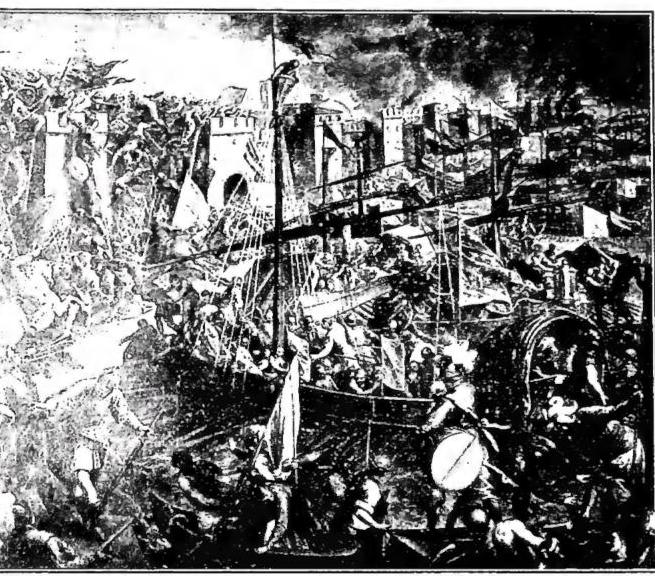
ORIENTE, Empire of the East. The Crusaders conquer Constantinople for the second time with the aid of the Venetians. Painting by Domenico Tintoretto (16th century). Venice, Doge's Palace, Hall of the Great Council.
With the support of Henry of Hainault, he occupied Tzurulon, Didymoteichon, Adrianople, Philippopolis, and Mosynopolis, putting Alexios III Angelus to flight, but provoked the opposition of the Marquis of Montferrat, who claimed Adrianople for himself. Boniface went to besiege these cities, and the conflict between the two rivals was only quelled by the arrival of the Doge of Venice and the other Crusader princes. However, the possession of Thrace led to another serious conflict between the Latin Emperor and the Tsar of the Bulgarians, who had only in November 1204 been crowned by a legate of Innocent III. The Tsar aspired to create a Greco-Bulgarian empire, while Baldwin demanded the restitution of all territories that had been part of the Byzantine Empire. War broke out in the spring of 1205: on 14 April, Baldwin was defeated and taken prisoner, dying shortly afterward in captivity.
The disappearance of the Latin Emperor seemed to mark the end of the Empire. The Bulgarians advanced as far as the Sea of Marmara; in Asia Minor, the Greeks of Nicaea reclaimed the territories occupied by the Latins in the preceding months.
The energetic Henry of Hainault assumed the regency of the Empire and, with great skill, saved the situation, driving back Greeks and Bulgarians. In August 1206, news of Baldwin’s death arrived, and Henry of Hainault was then made emperor. The enemies, however, persisted: in 1207, the Bulgarian Tsar and the basileus of Nicaea jointly moved against the Latins. The Emperor succeeded in driving the Bulgarians from the siege of Adrianople; Ioannitsa was killed in the attempt to conquer Thessalonica, and now Henry of Hainault defeated the new Tsar Boris at Philippopolis (1 August 1208). In Asia, he restored peace, leaving Nicomedia and Cyzicus to Theodore Lascaris.
The Emperor then had a brief respite to address the needs of the Empire. Having gone to Thessalonica after the death of Boniface, he organized the government of the new king, Demetrius of Montferrat, still a minor (1209). At Ravennika (in Phrygia), he convened a solemn parliament where he received the homage of the Latin barons Otto de la Roche of Athens and Geoffrey of Villehardouin of Achaea; even the Byzantine despotes of Epirus paid him homage. In 1211, peace was broken by a resumption of war with the Emperor of Nicaea, who was defeated. The Latins thus succeeded in expanding their occupation in Anatolia.
For the internal organization of the Empire, the most important problems were religious: foremost was the question of Greco-Latin coexistence. Innocent III, though initially protesting the diversion of the Fourth Crusade, after the capture of Constantinople bowed to the accomplished fact, celebrating the Latin triumph as a miracle wrought by the Divinity.
It was then hoped that the organization of the Latin Empire of the East would serve to realize the union of the two Churches. He therefore provided for the archiepiscopal sees with Latin prelates, while also leaving Greek prelates in the episcopal sees, provided they adhered. In reality, the Greek clergy, though remaining in their sees, silently regarded the Orthodox patriarch established in Nicaea as their head. Innocent III long persisted in tolerance; he allowed the continuation of Greek rites, then began to negotiate, seeking to persuade the Greek prelates to reconciliation through papal legates. The negotiations, held at various times, led to no result; indeed, the Greeks repeatedly protested to Emperor Henry of Hainault against the harsh methods of the Latin prelates. The Emperor often took a stance in favor of his Greek subjects. Even within the Latin Church of the victors, there were conflicts. The Venetians had imposed one of their citizens, Tommaso Morosini, as patriarch, hoping to create an entirely Venetian clergy: the Latin Church would become an emanation of the Venetian government. Hence arose lively and continuous conflicts between French and Venetian clergy, as well as struggles between bishops and knights over ecclesiastical possessions. In 1210, the Emperor held a second Parliament at Ravennika to examine religious disputes.
Henry of Hainault died in Thessalonica on 11 June 1216. The Latin barons elected his brother-in-law Peter of Courtenay, Count of Auxerre, in his place; he was crowned in Rome by Honorius III on 9 April 1217, but while traveling overland from Dyrrachium to Constantinople, he fell into the hands of the despotes Theodore Angelos and was killed in prison. Peter’s son, Robert of Courtenay, was summoned from France and crowned in Hagia Sophia on 25 March 1221.
Robert of Courtenay reigned until 1228, when he was succeeded by his underage brother Baldwin, for whom the former king of Jerusalem, John of Brienne, came to govern as regent and was also proclaimed co-emperor.
Upon John of Brienne’s death in 1237, Baldwin II was left alone to face a desperate situation. Even the reign of Robert had been a succession of lamentable events. Taking advantage of the Latin Emperor’s incapacity and the diminished strength of the Latins in Romania, enemies on all sides had organized and appeared threatening.
The Despotate of Epirus had slowly expanded into Macedonia and Greece; while the king of Thessalonica, Demetrius, traveled to the West seeking aid, in 1221 the Greeks of Epirus occupied Thessalonica and put an end to the Latin Kingdom. In Asia, upon the death of Theodore Lascaris in 1222, his son-in-law John Ducas Vatatzes succeeded him as emperor, a man of great political skill. He indeed understood the danger that, by overthrowing the Latin Empire of Constantinople, his actions might be exploited either by the Bulgarians or the Greeks of Epirus. It was therefore necessary to proceed with great caution.
In 1224, he attacked the Latins, defeated Peter of Courtenay, and occupied Cyzicus, the Troad, Lesbos, Chios, and Samos. He then crossed the Dardanelles, occupied Madytus and Gallipoli, and drove the Latins from Adrianople. Meanwhile, the Despot of Epirus advanced into Macedonia and Thrace, expelling John Vatatzes from Adrianople. The conflict between the two leaders could have been exploited by the Latins, but Robert of Courtenay was indolent, and Baldwin, who succeeded him, was a minor. In Constantinople, there was talk of appointing the Bulgarian tsar John Asen as regent, but this was refused. The tsar now sought to occupy Constantinople, but the Despot of Epirus opposed him. Greeks and Bulgarians fought: Theodore Angelus was defeated and taken prisoner (1230). John Asen then believed himself master of the situation, but against him rose the basileus of Nicaea, John Vatatzes. Distrusting one another, they resigned themselves to an alliance against Latin Constantinople, but the siege attempts of 1235 and 1236 failed. The Bulgarian tsar later feared playing only into the hands of his ally and sought an understanding with the Latins.
John Vatatzes then turned against the Greek Despotate of Epirus-Thessalonica and, after the death of the Bulgarian tsar, succeeded in occupying Thessalonica and wresting Macedonia from the Greek Despotate (1252). When John Vatatzes died in 1254, the Empire of Nicaea surrounded the Latin Empire of the East on all sides, reduced to Constantinople and the great fiefs of Athens and Achaea.
His son Theodore II Lascaris reigned too briefly (1254-58) to resolve the problem of conquering Constantinople. He had to content himself with strengthening the state and reducing the domains of the Greeks of Epirus by taking from them Dyrrachium, Vodena, Ostrovo, and Diavoli. By now, the Latin emperor Baldwin II was at his wits’ end: his travels to the West to seek aid had come to nothing; without financial means, he had been forced to sell the relics of the churches of Constantinople.
Upon the death of Theodore II Lascaris in 1258, the able general Michael Palaeologus assumed the regency for the very young John IV and had himself proclaimed co-emperor (1259). The final hour had struck for the Latins of Constantinople. In 1259, Michael VIII attacked the Despotate of Epirus and destroyed its forces in the battles of Pelagonia. In 1260, he decided to conquer Constantinople: having crossed the Dardanelles, he occupied Selymbria and advanced toward the Latin capital. He attacked the quarter of Galata but failed in his attempt. Before renewing the attack, he sought to secure allies by concluding the Treaty of Alliance of Nymphaeum with Genoa (13 March 1261): Michael VIII made great economic concessions to the Genoese to have them at his side in the struggle against the Latin Empire of the East and its protectors, the Venetians. But already in June 1261, he sent an army against Constantinople, and on 25 July, without encountering resistance, the general Alexios Strategopoulos entered Constantinople. Baldwin II escaped by fleeing, taking with him the Latin patriarch. The Latin Empire of the East had ceased to exist after fifty-seven years of wretched existence.
Michael VIII entered the Bosphorus capital on 15 August 1261. Baldwin II went to the West seeking aid, but new attempts to find allies were in vain. In 1267, Pope Urban IV and Manfred, king of Sicily, arranged a coalition with the deposed Michael II, but Michael VIII defeated the despot and took him prisoner. The coalition could not, in any case, succeed, because the Pope could not agree to leave King Manfred in charge of the struggle against the Byzantine Emperor. The champion of the Pope against both Manfred and Michael VIII was to be Charles of Anjou.
On 15 May 1267, in Viterbo, in the presence of Clement IV, Baldwin II concluded an agreement with Charles of Anjou, ceding to him the rights over the domains of the Latin Empire of the East, reserving for himself only Constantinople. Subsequently, Philip, son of Baldwin II, married Beatrice, daughter of Charles of Anjou. The latter could thus consider himself the legitimate lord of the Empire of Romania and direct his policy toward the conquest of Constantinople. The consequence of such a policy, however, was to be the Sicilian Vespers.