
CARTAGINE, ARCIDIOCESE OF. —
I. HISTORY
The origins of the Church of Carthage, like those of the African Church in general, are still obscure: the hypothesis of a direct apostolic preaching finds no support in the oldest testimonies of the African writers themselves, such as Tertullian and St. Augustine; they rather insist on the relations between the African Church and that of Rome, while not denying that the first news of the new faith could have reached Africa and particularly Carthage either from Alexandria or from the ports of Syria and Asia Minor. It seems that the regular preaching of the Gospel and the foundation of the Church were most likely the work of ministers sent or come from Rome: hence the bond of dependence and devotion that bound Carthage and Africa to the Roman See, and the characteristically Latin imprint that African Christianity always bore.When Carthage had its first bishop is not known: the first certain one is Agrippinus, who lived between the end of the 2nd century and the beginning of the 3rd, but it does not seem credible that before him the Church of Carthage did not have its own hierarchy, considering that already in 180 the first known martyrs of Africa were those of Scilli—not from a city, but from a modest village in the interior—and that already before the end of the same century, at the time of the African pope Victor, a bishop is recorded at Leptis Magna, an important city but much smaller than Carthage. If, therefore, in this period the Church of Carthage enters history with a complete organization in all its parts, in its hierarchy and in the composition of the various categories of the faithful (confessors, widows, virgins), it must be admitted that it had a previous period of life, the events of which, however, remain for now unknown. Moreover, Agrippinus, by the very position that Carthage held with respect to all the other African provinces, appears already to enjoy a certain primacy over the bishops of proconsular Africa and Numidia: indeed, he convened a synod in Carthage, the date of which is unknown, to discuss the question of the baptism of heretics. Other councils later than this seem to be alluded to in some passages of Tertullian and St. Cyprian: but nothing precise can be said about them.
To Donatus (236–48), who had condemned Privatus of Lambesis at a synod of 90 bishops, succeeded St. Cyprian (248–58) (q.v.), who played a notable part in the question of the lapsi (q.v.) and asserted episcopal authority against the schism of Novatus and Felicissimus. Against Novatian he sided with Pope Cornelius, but he came into conflict with Pope Stephen over the question of the baptism of heretics, in which Cyprian, according to the practice of the African Church, adhered to a principle opposed to that of the Roman Church. Two, or according to some three, councils, in 255 and 256, supported and confirmed Cyprian’s thesis; lively letters were exchanged with Rome, yet no break in mutual communion occurred. The new persecution ordered by Valerian in 257 relegated the conflict to the background; and the relations between Rome and Carthage, both struck at their heads—the pope Stephen and Cyprian, martyred in September 258—returned to their former cordiality.
From this time the bishop of Carthage was the recognized head of the bishops of proconsular Africa and Tripolitania; but even the bishops of nearby Numidia and of more distant Mauretania acknowledged the supremacy of Carthage in matters concerning all North Africa and relations with neighboring countries.
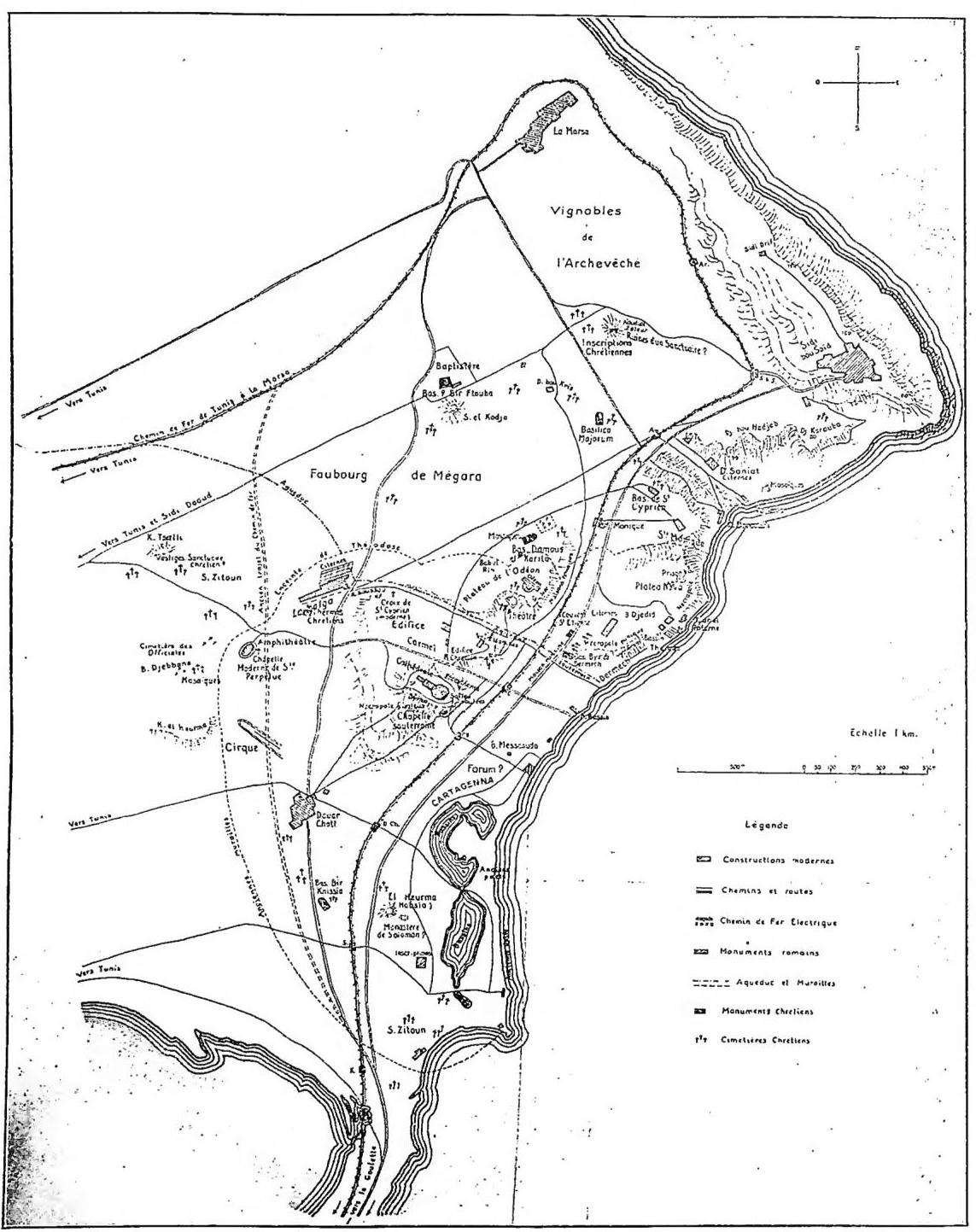
(from J. Vautrin, Les basiliques chrétiennes de Carthage, Paris 1933)
CARTAGINE – Plans of Christian C.
At the time of Diocletian’s persecution (303), the see was held by Mensurius.
Once again, the prudent and moderate conduct of the bishop provoked the protest and opposition of the more zealous elements within African Christianity, so prone, by the very nature of the population, to intolerance, and gave rise to the Donatist schism, which, for more than a century, with social, economic, and political causes converging into it, divided and afflicted the African Church. The schism broke out only after the death of Mensurius (311), when, to his successor Ceciliano, the opposing party opposed another bishop in the person of Majorinus; upon his death, probably at the end of 315, he was succeeded by Donatus, called the Great.
The struggle intensified also due to the intervention of imperial authority, which convened councils in Rome and Arles for the condemnation of the Donatists.
The legitimate bishop was unanimously recognized in Rome and outside Africa: Ceciliano attended, the only African bishop to do so, the Council of Nicaea (325), and his successors, Rufus, at the Roman council against the Arians ca. 340, Gratus, at that of Sardica (343), Restitutus at that of Rimini (359). In 349 the emperor Constantius sent two officials, Macarius and Paulus, to C. to attempt a reconciliation of the parties, but their mission failed and bloody conflicts ensued; Gratus convened a council, hoping to bring his adversaries to reason, but in vain, for after Donatus, who died in exile (between 350 and 355), came Parmenian, who wrote extensively against Catholics. The period from 390 to 411 is marked by an almost uninterrupted series of councils, normally convened in C. by the bishop Aurelius, to put an end to the schism.
The struggle was embodied on the Catholic side in St. Augustine, still a simple priest at the Council of Hippo (393), then bishop, and in Aurelius, the greatest of the bishops of C. after Cyprian; to them is owed the happy conclusion of the council of June 411, presided over by Aurelius himself, which was attended by 279 Donatist bishops and 286 Catholic ones.
At the same time or shortly thereafter, the Church of C. also had to suffer, though to a much lesser extent, other errors: Manichaeism and Pelagianism. Pelagius himself had gone to C., but had left almost immediately, leaving behind his companion Caelestius; even he, however, had been forced to depart after a first council, convened in 411 by Aurelius, had condemned his error. Other councils followed in the subsequent years up to 418, always on the same issue. Moreover, in this period councils in C. were almost annual, and the see of Carthage, thanks not only to its primatial position but also to the virtues of its bishop, united in unity of purpose and doctrine with St. Augustine, enjoyed the highest authority throughout Africa. This authority manifested itself both in the religious and in the civil sphere. Thus Aurelius successfully defended the rights of Africans in the question of whether bishops and clergy could appeal to Rome in case of disputes; he promoted the drafting of a codex canonum Ecclesiae africanae; he overcame the last resistance of paganism by establishing in 399 his see in the very cell of the temple where the Carthaginian goddess Caelestis had been venerated until then; and he finally defended his city from the violence of the comes Marinianus.
The probable year of Aurelius’ death is 429; he was succeeded by Capreolus, of whom we know that he had himself represented at the Council of Ephesus by the deacon Bessula: during the episcopate of Capreolus Africa was invaded by the Vandals, but C., as is well known, was not taken by them until 439, when the see of Carthage was occupied by the bishop Quodvultdeus.
The invasion of the Arian Vandals marked the beginning of new sorrows and new persecutions for Catholics; the struggle, now more, now less intense under Gaiseric, reached its peak of violence under his successor Huneric. The Church was thus left almost desolate, and remained in this state until 454, when Valentinian succeeded in obtaining the appointment of a new bishop, Deogratias, distinguished for his charitable assistance to prisoners captured in the Sack of Rome. After Deogratias’ death in 457, the see of C. remained vacant for many years more; an ordinance of the king prohibited the ordination of new bishops in Zeugitana, thus bringing about what Victor of Vita calls “the closing of the churches.” In 475 a mitigation of previous rigors allowed exiles to return home, but C. could not have its own bishop again until 481, under Huneric, thanks to an edict that granted equal rights to both the Catholic and the Arian cult.
This bishop was Eugenius, whose name is linked to the new and more bitter phase of the struggle, which reached its climax in the council of 484. At that time C. had beside the Catholic bishop an Arian patriarch, Cyrila, who accused Eugenius, leading to a resumption of persecution. The emperor of the East, Zeno, intervened, obtaining from Huneric the convening of a council: 470 bishops were present at its opening on 1 February 484. However, the obstructionist and provocative attitude of the Arians caused the meeting to fail from the very beginning, and this was followed immediately by the exile of Eugenius and many other Catholic clergy. Their return could only take place after the death of Huneric, under Gunthamund; but at the accession of Trasamund, Eugenius was forced once again to abandon his see and went to settle in Gaul at Albi, where he died in 505. The see of C. thus remained vacant, nor could the presence in C. of Fulgentius of Ruspe, recalled from his exile in Sardinia by King Gunthamund, who wished to be instructed in the Catholic faith, but was soon made to leave because of the protests of his adversaries, bring more than momentary relief. In 523 Ulderich granted the return of the exiles and the election of a new bishop, Boniface: on 5 February 525 a council could thus be held in the basilica of Agileo, aimed above all at putting the Church of C. in order after so many trials, and in general the entire African Church.
With the Byzantine conquest, the Catholic faith regained its full and secure independence, along with the rights and privileges that the Vandals had abolished. C. had its primatial position reconfirmed, which it had held previously and which during the years of persecution the bishops of Byzacena had attempted to usurp. In order to regulate the new situation that had arisen, Reparatus, who succeeded Boniface, convened a council in 536, which ended with the sending of delegations to Rome and Constantinople to present to the Pope and the emperor the requests of the African episcopate, requests that were fully granted.
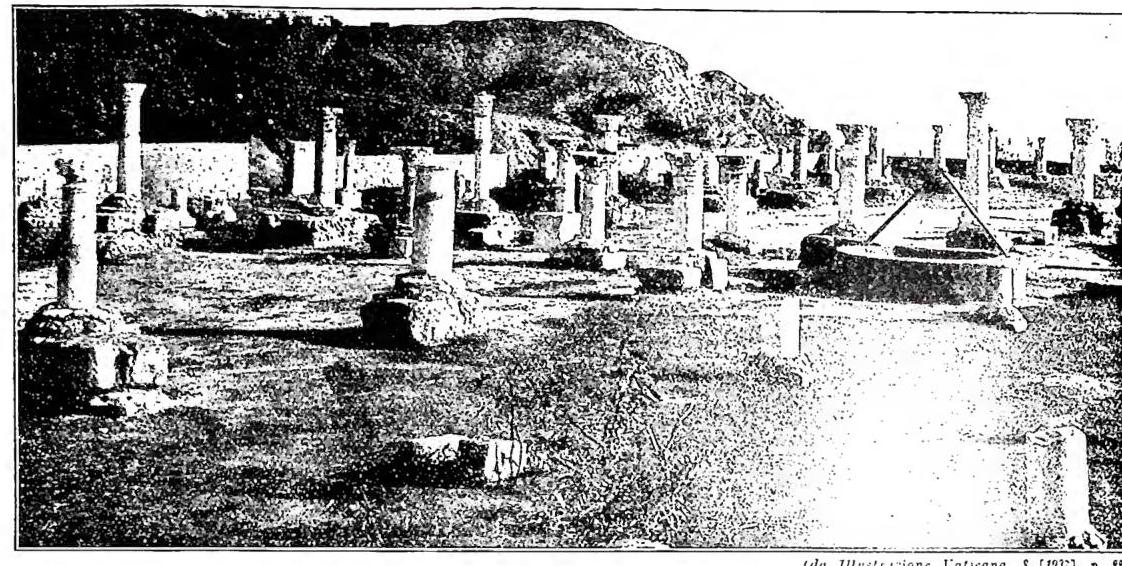
(from Illustrazione Vaticana, 3 [1817], no. 15)
CARTAGINE - Remains of the basilica of St Cyprian (6th century).
When the Arab invasion struck the eastern provinces of Syria and Egypt in the mid-7th century, the flight of numerous elements of the population and clergy brought to Africa the doctrinal disputes then current in Eastern Christianity, particularly those of Monothelitism and Monophysitism, from which the African Church had generally remained aloof. A famous dispute was held in July 645 at C. between Abbot Maximus and Pyrrhus, the former Patriarch of Constantinople, which ended with the latter’s temporary abjuration of his error.
A few years later, all of Africa as far as the Atlantic was traversed by the Arabs, who by the end of the century had established their dominion there. The small number of invaders did not, however, immediately alter the character and way of life of the region, which only gradually declined and became depopulated. The see of C. was naturally among the last to expire. A record of it is still found in the second half of the 11th century, after the second and more severe invasion of the Banū Hilāl. A letter from Leo IX in 1053 reveals that Africa still had at this time five bishops, over whom the Pope reaffirmed the primacy of the Carthaginian one, a certain Thomas. Twenty years later, in 1073, Gregory VII wrote to the bishop of C., Cyriacus, and to the faithful under his care, lamenting that they had accused their shepherd before the Muslims, causing him fresh pain beyond that inflicted by the condition of his city. In 1076, alongside Cyriacus there remained only one other bishop in Africa; the Pope took care to consecrate a third so that the three might be able to consecrate others if necessary. This is the last document that survives regarding the Carthaginian see, and it is not rash to suppose that with the death of Cyriacus or one of his immediate successors it remained constantly vacant; indeed, with the close of the 11th century every trace of Roman and Christian life in Africa vanished irretrievably, so that when such life reappeared after about two centuries, it did so with an entirely different stamp from the ancient.
Thus, when in 1192 the bishop of C. still appears in the Liber censuum of the Church of Rome, it is most likely only a formal remembrance, without any corresponding factual existence.
The Church of C. was revived at the end of the 19th century, after the Treaty of Bardo (12 May 1881) placed the Bey of Tunis’s state under French protection. With the bull Materna Ecclesiae caritas of 10 November 1884, Leo XIII restored the primatial see of C., appointing as its titular the Cardinal C. Lavigerie, already Apostolic Administrator of Tunisia and Archbishop of Algiers. For some months, construction had been underway on what had been the acropolis of ancient C. for a new cathedral dedicated to St Louis, King of France; the church was consecrated on 15 May 1890. By a papal brief of 5 August 1918 it was raised to the dignity of a Basilica. After Cardinal Lavigerie (d. 1892), the see was held successively by Mgr Combes (1893–1922), Mgr Lemaître (1922–39), and the present incumbent, Mgr Gounot, who had previously served as coadjutor with right of succession.
Catholic life has taken ample development on the very site of the ancient city with the foundation of numerous religious institutions, and from it radiates to nearby Tunis and the rest of the region.
The International Eucharistic Congress of 1930, marking the fifteenth centenary of the death of St Augustine, consecrated the Catholic revival of the glorious African metropolis.
Pietro Romanelli
II. COUNCIL OF C. (1 May 418). —
1. History
In the series of Councils of C. it is the 15th or 16th. It is of great importance both for the gravity of the doctrine defined—namely, the relationship between grace and nature—and for the gravity of the error condemned, namely Pelagianism. The Council of C. is closely connected with the Council of Diospolis (Lydda; cf. Acts 9:32), which it in a sense took up and completed by adding the condemnation of the heresiarch. At Diospolis, held on 20 December 415 in the presence of 15 bishops and Pelagius himself, the subject was the doctrine of original sin and its effects, the necessity and function of grace, and the nature and limits of free will in relation to the attainment of perfection (cf. Mansi, IV, 312–20). The doctrine defined was strictly orthodox: Pelagius subscribed to the condemnation of the doctrines attributed to him and was thus readmitted to communion with the faithful. The verdict of Diospolis, however, surprised especially the bishops of the African Church, who, meeting in council at C. in the number of 68, and then at Milevis in the number of 61 in 416, reaffirmed the condemnation launched against Pelagius in 411 and begged Innocent I to confirm it with his authority. Innocent I, indeed, on 27 January 417, confirmed and made his own the decisions of the African council, while refusing recognition to the Council of Diospolis. Pelagius and Celestius then, with vague and equivocal professions of faith, attempted to take advantage of the good faith of Pope Zosimus, successor of Innocent, and Pelagius succeeded in obtaining personal absolution. Zosimus communicated the news to the African bishops, accusing them of precipitousness and misunderstanding in their condemnation of Pelagius and summoning them to present their case before his tribunal within two months. Aurelius, Bishop of C., then begged him to defer judgment, and meanwhile on 1 May 418 he convened at C. a plenary assembly of 214 bishops: this is precisely the historic Council of C. under discussion. The Council, reaffirming the previous condemnations of 411 and 416 against the persons of Pelagius and Celestius and their doctrines, condensed into nine canons the traditional doctrine on original sin, grace, and free will. Meanwhile, however, Zosimus—unknown to the African bishops—had in March 418 condemned the two innovators. In the summer of that same year, moreover, he published a document that has remained famous in history, the Epistola Tractoria, in which he imposed on all the bishops of the world the obligation to subscribe to the condemnation of Pelagian heresy. It was a plebiscite of faith throughout the Church; only 18 Italian bishops, incited by Julian of Eclanum, refused to subscribe.2. Doctrinal content
Let us premise: 1) although for a long time attributed to the Council of Milevis (416), it is now established that the canons in question belong to the Council of C. (418; cf. H. Noria, Historia pelagiana, I, Louvain 1702, p. 42 ff.); 2) there has also been much discussion about the number of canons: some manuscripts report eight, another nine. The disputed canon is the third in the series of nine and is missing in the manuscripts that list only eight. Its authenticity is sufficiently established (P. Ballerini, Ad s. Leonis Magni opera appendix: PL 56, 112–14). The inspiration of the canons, if not their drafting, is certainly from St Augustine, whose works also provide the best commentary on them.The Pelagian doctrine maintained the integrity of human nature, in no way impaired by Adam’s personal fall. This theory is refuted in the first three canons of the Council of C. by defining the existence, transmission, and effects of original sin. Starting from the effects and, more precisely, from the most apparent external effect, the first canon establishes the penal character of death, in opposition to the Pelagian error that called it a natural and necessary consequence of the human constitution, thereby denying the existence of the preternatural gift of immortality. The second canon establishes: 1) the existence and universality of original guilt for all without exception, including children; 2) the strict sense of guilt in original sin; 3) the mode of transmission, namely carnal generation; 4) the remedy and its absolute and universal necessity, namely spiritual regeneration through Baptism. To the denial of guilt and punishment in the original fault, Pelagianism had added a confusion between the natural and supernatural orders: heaven is a strict right of inheritance for nature in the state in which Adam was created, that is, the state in which children are born. This is precisely what the third canon condemns, while at the same time denying to unbaptized children an intermediate place of true happiness. The Fathers of the Council of C., concerned to eliminate the coexistence of a state of guilt with a state of supernatural happiness, assign to children, together with the devil, a privative unhappiness, that is, a lack of God, without pronouncing on positive unhappiness, that is, on punishments as retribution.
Sin is blotted out by grace: in the next three canons, therefore, the nature, necessity, and function of grace are defined. Pelagianism, anticipating the Lutheran error, held that grace is synonymous with remission of guilt, but rejected the concept of grace as a prevenient aid to avoid guilt, claiming that merit for avoiding evil belongs solely to free will. The fourth canon, condemning this error, asserts that grace is both the lifting from the fall and the avoidance of II. “We grant,” the Pelagians equivocated, “that grace anticipates in order not to fall, but only in the sense that it enlightens the intellect regarding what is to be done or avoided, not in the sense that it moves the will effectively to will what the intellect has recognized.” Grace—replies the fifth canon—acts upon the intellect to enlighten it and upon the will to move it effectively toward the good. “We grant too,” the Pelagians insisted, “that grace acts upon the will, but only in the sense that it helps it to will more easily what, in an absolute sense, it could do by itself, albeit with greater difficulty.” The sixth canon then intervenes to establish the absolute impossibility—not merely a relative one—of free will in fulfilling the works of the divine law, since Christ has warned us: sine me nihil potestis (not difficilius potestis) facere (Jn 15:5).
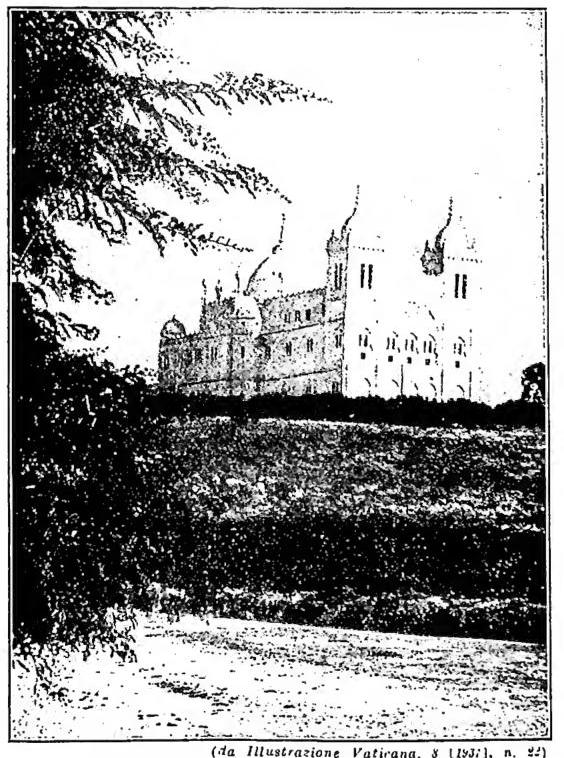
CARTAGINE - Basilica primaziale consacrata
dal card. Lavigerie nel 1890.
se non indecorosa per il libero arbitrio, almeno inutile e superflua. Non per umiltà, dichiara il settimo canone, ma in verità ognuno deve riconoscersi peccatore. Ognuno quindi deve chiedere la misericordia di Dio con la preghiera, che, spiega l'ottavo canone, è necessaria non più al peccatore che al giusto, il quale perciò deve pregare per sé e non solo per gli altri, come interpretavano i pelagiani, intimamente convinto, conclude il nono canone, che anch'egli è bisognoso e manchevole e perciò con non minore sincerità del peccatore deve gridare a Dio: dimitte nobis debita nostra (Mt. 6, 12).
Concludendo: il Concilio di C., spuntando le sottigliezze dell'eresia, sventandone gli equivoci, stroncandone ogni tentativo di evasione, fiaccava la capacità di resistenza del pelagianesimo e ne chiudeva la prima fase di lotta; anticipava nel medesimo tempo la confutazione degli errori dei secoli futuri, precisando in termini chiari, sintetici, completi il pensiero tradizionale della Chiesa sul complesso problema dei rapporti tra Grazia e natura.
Vito Zollini
III. ARCHAEOLOGY
The earliest places of assembly of the Christian community of Carthage, referred to by Tertullian with the word ecclesia (De virginibus velandis, 13: PL 2, 907; De pudicitia, 4: ibid., 987), cannot be identified; they must have been located within the city (P. Monceaux, Histoire littéraire de l'Afrique chrétienne depuis les origines jusqu'à l'invasion arabe, I, Paris 1901, p. 16). St Cyprian spent his last night with his people in the Saturn quarter. The Basilica Novarum is certainly of pre-Constantinian origin and most probably the same as that called in areis novis or of Tertullus, the friend of St Cyprian (Ep., 12), as was first pointed out by Cardinal G. Mercati in 1898 (D'alcuni nuovi sussidi per la critica del testo di s. Cipriano, in Studi e documenti di storia e diritto, 19 [1898], pp. 321-63; republished in G. Mercati, Opere minori, II [*Studi e Testi, 77], Vatican City 1937, pp. 153 ff.). It is mentioned in a letter of Mensurius, bishop of Carthage at the time of Diocletian (PL 43, 638). It possessed a library and an archive, from which in 303 the civil authority removed heretical books instead of the Holy Scriptures (Optatus, 1, 19; 3, 1); St Augustine preached there once (Serm., 14: PL 38, 111). The hall was so vast that in 455 Bishop Deogratias housed prisoners of Gaiseric there (Victor of Vita, De pers. Vand.*, 1, 8, 25).Like Rome, Carthage was administered by seven deacons, each in charge of one of the seven ecclesiastical regions. Documents mention a Liberatus archidiaconus Ecclesiae carthaginensis regionis sextae, a Gaudiosus diaconus regionis quintae, and a Mena fu lector regionis qu(artae) o qu(intae): CIL, VIII, 13-423. Some basilicas are known by their regional designation: for example, in a basilica of the II region the Councils of 403 and 410 were held (PL 43, 814); in the III region there was a basilica dedicated to St Peter, where St Augustine delivered Sermon 15 (PL 38, 115); the basilica of St Paul was in the VI region.
The Basilica Restituta or Ecclesia catholica Restituta was within the city; Victor of Vita calls it the one «in qua semper episcopi commanebant» (De pers. Vand., 1, 5). A first council was held there in the year 390, and others up to 419. It was occupied by the Arians; St Augustine preached there several times (Serm., 19, 29, 90, 112, 277; PL 38, 132, 185, 559, 643, 1257). Procopius mentions a basilica near the Forum (De Bello Vand., II, 14).
The basilicas of Gratian, Theodosius and Honorius are known only from documents. St Augustine preached there (Serm., 156, 163; PL 38, 849, 889). That of Honorius was in the temple of Caelestis. On Easter day 399 Bishop Aurelius placed his cathedra in the cella of the temple, which is supposed to have been on the Hill of Juno (A. Audollent, Carthage romaine, Paris 1901, pp. 262 and 538). Procopius records that Justinian had built at Carthage the basilicas of the Theotokos and of St Prima.
The Theotokos was located within the palace precincts. Some verses inserted in the Latin anthology of Carthage (Anthol. lat., no. 380) were copied there; Monceaux believed they were inscribed beneath two frescoes depicting the Nativity and the Passion of Jesus Christ. The remains of the basilica have been thought identifiable on the Byrsa hill. The basilica of St Prima was erected by Justinian in honour of a martyr of Abitina. A basilica in honour of the martyr Julian (probably of Antioch) is mentioned by Leontius in the life of Gregory of Agrigento (PG 98, 563).
In the region of the Mandracium, one of the ports of Carthage, stood the basilica of Sancti Agilei. Agileus is a martyr commemorated in the calendar of the Church of Carthage on 25 January.
After occupation by the Vandals, it was restored to Catholics by Guntamund in 487 (Prosperi Aquitani Appendicula ad Chron.; PL 51, 606). The people conducted St Fulgentius in triumph there with the other bishops who had been exiled in Sardinia (Vita Fulgenti; PL 65, 145). A council was held there in the year 525. Bishop Domninus sent relics of the martyr Agileus to Gregory the Great (Gregorii I Registr., XII, 1). A sermon for the feast of St Agileus is known (Possidii indiculus; PL 46, 19).
From the Byzantine period comes a small oratory adapted in a hall of a Roman public building on the north-east slope of the so-called Hill of Juno, behind the Byrsa. It is an aula divided into two naves by a row of columns (L. Poinsot and R. Lantier, L'archéologie chrétienne en Tunisie [1920-32], in Atti del III Congresso di archeol. crist., Vatican City 1934, p. 390).
All other basilicas of Carthage are funerary and therefore outside the city. Carthage had no underground burials but burials in the open air, in places called cemeteries, as Tertullian shows (De anima, 51: PL 2, 738), though mostly in areae. The Christians of Carthage possessed these at least from the time of Tertullian, since he explicitly speaks of de areis sepulturarum nostrarum (Ad Scapulam, 3: PL 1, 701). Most of the Christian funerary areas are found between the road from Tunis to La Marsa, Koudiat-Zateur and Sidi-bou-Said, generally contiguous to Roman tombs; a group from the Byzantine period (still inhabited) is located in the lower city, near Douar-ech-Chott and the port quarter (R. Lantier, Notes de topographie carthaginoise. Cimetieres romains et chrétiens, in Comptes-rendus de l'Académie des Inscriptions et Belles lettres, 1922, pp. 22-28). Various basilicas arose on these areas.
The basilica of Damous-el-Karita was discovered in 1878 in the area north of Carthage between the hill called of Juno and the village of Sidi-bou-Said. A vast enclosed area, with a semicircular atrium, a portico with a gallery of columns in black marble; from the atrium, occupied by tombs, one passes north to a trichora chapel, while on the opposite side one enters a quadrilateral divided into nine naves (m. 65 × 45) with two apses situated to the south-east and south-west. In the centre of the quadrilateral remain the bases of four large pillars which Gsell supposed supported a dome (Chronique africaine, in Mélanges d'arch. et d'hist., 18 [1898], p. 222). There are also the four bases of a ciborium. The floor of the central nave and the apses was decorated with mosaic; beneath that of the minor naves were tombs. A funerary cell with five arcosolia was a small hypogeum with an equal number of arcosolia. To the south-west of this basilica is a second one (m. 35.70 × 24.55) containing a baptistery. Other halls and cells follow. Nearby, in 1912, a subterranean rotunda was found with sixteen columns of Numidian marble, with capitals adorned with animals and acanthus leaves. From Damous-el-Karita comes the finest example of non-funerary Carthaginian sculpture, namely bas-reliefs relating to the childhood of Jesus, dated by De Rossi, Bayet and Audollent to the 4th century, by Bréhier and Lapeyre to the 5th, and by Wilpert to the 6th. They depict, on two slabs, four scenes: the annunciation to the shepherds, the adoration of the shepherds, the reappearance of the star and the adoration of the Mag
i. It is probable that originally they decorated the door of the basilica near which they were found in 1883 (A
L. Delattre, La basilique de Damous-el-Karita, Constantine 1892; id., in Recueil de Constantine, 24 [1880], pp. 37-68; 25 [1881], pp. 279-395; 27 [1883], pp. 1-53).The Basilica of the Holy Martyrs of Scillium or of Celerina. – The group of twelve martyrs of Scillium, who were killed in Carthage on 17 July 180 (BHL 7527, BHG 1645), had a basilica over their tomb where St Augustine preached (Serm., 155: PL 38, 841); their anniversary was also celebrated in the 6th century, as shown by the calendar of the Church of Carthage. Victor of Vita calls the basilica Scillitanorum vel Celerinae. This name refers to the martyr commemorated by St Cyprian as a relative, along with Laurence and Egnatius, of the confessor Celerinus (Ep., 39, 3); she is listed in the Martyrologium Hieronymianum under the dates of 3 February, 24 and 28 September. St Augustine preached “in basilica Celerinae” (BHL 4906, 7). Delehaye wonders whether the eponym is the martyr or the founder (H. Delehaye, Les origines du culte des martyrs, 2nd ed., Brussels 1933, p. 279).
The Basilica Maiorum was discovered by Delattre in 1906 at Mcidfa, between the station of Ste-Monique and that of La Marsa. The building material was scattered between La Marsa and Sidi-bou-Said; only wretched remnants of pillars remain. The basilica (61 × 45 m) had seven naves divided by columns. Beneath the pavement was a burial area. In the centre of the central nave stood the confessio, consisting of a small chapel 3.60 × 3.70 m. In front, within the apse itself, were small recesses for relics. Near the confessio a well was filled with human bones and about 7,000 fragments of Christian inscriptions. Among the ruins of the building an inscription from the 6th century was found, relating to the martyrs Satur, Saturninus, Revocatus, Secondolus, Felicitas, Perpetua, passi nonis martiis and Maiulus (CIL, VIII, 25.038); this group, except for Maiulus, is mentioned in the Passio of Perpetua and Felicitas. But given the late date of the inscription, these could be mere relics (P. Monceaux, Histoire litt. de l'Afrique chrétienne, IV, Paris 1912, pp. 469–70). A second epigraph mentions Santus Secundulus (CIL, VIII, 25.038ᵃ); a third is dedicated to Perpetue filie dulcissimae (A.-L. Delattre, Le Cimetière de Mcidfa à Carthage, in Comptes rendus de l'Acad. des Inscriptions et Belles lettres, 1906, pp. 402 ff.; id., L'area chrétienne et la basilique de Mcidfa à C., ibid., 1907, pp. 118 ff., 516 ff.; id., La Basilica Maiorum. Tombeau des saintes Perpétue et Félicité, ibid., 1908, p. 59 ff.; 1911, pp. 566–83).
The acts of St Cyprian clearly distinguish the ager Sexti, the place of martyrdom, from the place of burial, which took place ad areas Macrobi Candidiani... in via Mappaliensi iuxta piscinas (PL 3, 1505), a place where St Augustine points to the memorial of the blessed Cyprian (Conf., V, 8, 15: PL 32, 713), or where he delivered sermons ad mensam Cypriani (Serm., 131: PL 38, 729). Victor of Vita indicates two splendid and spacious basilicas outside the walls dedicated to St Cyprian: one where he shed his blood, the other where his body was buried, a place called Mappalia (De pers. Vand., I, 1, 5).
It seems that in the time of St Augustine, at the place of St Cyprian’s martyrdom, the ager Sexti, there was only a table (mensa) (cf. Serm., 310: PL 38, 1413) and not yet a basilica; however, the basilica was already built by the year 439, when it was occupied by Gaiseric (Ch. Saumagne, Les basiliques cypriennes, in Revue archéologique, 66 [1909], pp. 188 ff.).
Near the sea, in the place called “les larmes de Ste-Monique,” facing Sidi-bou-Said, Fr Delattre discovered a basilica built over pagan tombs. It has seven naves (60 × 35.65 m) divided by spolia columns with Ionic and Corinthian capitals; the presbytery is deep, the ciborium stands almost at the centre of the median nave, the altar was probably wooden; beneath the pavement, especially in the presbytery, are many tombs, some decorated with mosaics, others constructed from strigilated sarcophagi. The hall is preceded by a rectangular atrium (35.55 × 20 m), equipped with a large underground chamber. Against the north-east side of the building is a subterranean room with eight tombs. Fr Delattre collected among the earth more than 9,400 fragments of funerary inscriptions, some bearing consular dates of the years 424, 438–39, 454; but none of these fragments contains confirmation of his hypothesis that this basilica is the one erected over the tomb of St Cyprian (A. Delattre, Une grande basilique près de Ste-Monique à Carthage, in Comptes-rendus de l'Acad. des Inscript. et Belles lettres, 1916, pp. 150–64; 1917, pp. 507–29).
The Basilica of Dermech. – In 1899, 100 m from the Antonine Baths, near the sea, on the slope of Bordj-Djedid, a seven-naved basilica was found, built entirely of concrete, with an entrance on the south side above the oldest Punic necropolis of the city. The hall (40 × 21 m) had a mosaic pavement, spolia columns; the median nave had eight paired columns; the wooden altar was covered by a ciborium supported by four columns of pink marble, with bases adorned by Greek crosses. Beneath the altar was a cavity for relics. On the north side, through two doors, one entered the baptistery, consisting of a rectangular hall with a square enclosure of 12 granite columns connected by gates. In the centre was a hexagonal font covered by a ciborium supported by four columns of pink marble; water was supplied through a channel from a cistern. To the north of the baptistery a door led into an apsed hall divided into three naves, the consignatorium; behind it were other small rooms; to the north-east were many Christian tombs, among them a sarcophagus with the Good Shepherd and a banquet scene. Gauckler dated the basilica to the last years of Vandal rule or to the Justinianic age; it was destroyed at the time of the Arab invasion of 695; it does not seem to have served much for worship and bears traces of fire and plundering (P. Gauckler, Basiliques chrétiennes de Tunisie, Paris 1913, p. 17).
The Basilica of Bir-el-Knissia (“the well of the Church”). – Near the Arab village of Douar-el-Chott, on the road between La Goulette and La Marsa, remains of a Christian church appeared as early as 1888; further excavations in 1913 and 1922 brought more to light.
The building, very ruined (46.60 × 25.60 m), had three naves, with a mosaic pavement covering many tombs; its remains date it between the 5th and 6th centuries AD, but there are no elements to specify further (A.-L. Delattre, La basilique de Bir-el-Knissia à Carthage, in Comptes rendus de l'Académie des Inscriptions et Belles lettres, 1922, pp. 302–307; 1923, pp. 449–51).
The Basilica of Faustus. – A martyr Faustus of Abitina was martyred in Carthage in February 304 (P. Monceaux, Histoire littéraire de l'Afrique chrétienne depuis les origines jusqu'à l'invasion arabe, III, Paris 1901, p. 540); but it is not known whether he is to be identified with the eponym of the cemetery basilica mentioned by Victor of Vita (De pers. Vand., I, 8; II, 6, 17; III, 9). It was built before the year 418, in which a council was held there; others were held in 419 and 421. St Augustine preached there several times (Serm., 23, 111, 261: PL 38, 155, 645, 1202). The bishop Deogratias, who had been consecrated there in 454, converted it into lodgings for prisoners taken in Rome by Gaiseric. It is mentioned again in 535.
Basilica of Bir-Ftouha. — On the road between Malga and La Marsa, repeated excavations carried out in the area known as Bir-Ftouha (1888, 1895, 1897, 1928) brought to light a hexagonal baptistery with a mosaic pavement and fragments of columns thought to belong to a basilica; the excavations of 1928–29 revealed a thermal building and a trichora occupied by Christian burials (A. Delattre, La basilique de Bir-Ftouha à Carthage, in Comptes rendus de l'Acad. des Inscr. et Belles lettres, 1928, pp. 252–55; 1929, pp. 23–29). The basilicas of Carthage so far explored all belong, in their construction, to the period of Byzantine rule. E. Albertini recognizes in their architecture an affinity with that of the East and particularly with Syria (L'Afrique du Nord française dans l'histoire, Lyon–Paris 1937, p. 116). The only building with just three naves is that of Bir-el-Knissia; all the others have at least five and go up to nine and eleven at Damous-el-Karita. The apse is flanked by the diaconicum and the prothesis, which communicate only with the side aisles; however, these are missing in the basilica Maiorum and at Damous-el-Karita. The basilicas of St Cyprian and Bir-Knissia are equipped with an atrium. At Dermech the ciborium is surrounded by railings; the altar must have been of wood; the basilica Maiorum has a confessio; the columns generally come from earlier Roman buildings.
The floors of the basilicas were covered with mosaic decoration rich in birds, fish, vine tendrils, and singing birds; in the basilica of Bir-Ftouha there are the four rivers of paradise and stags drinking from them.
A characteristic decoration inside the basilicas is sometimes provided by squares of terracotta, perhaps with simple floral motifs; there are a few examples of crosses, or animals such as stags, lions, dolphins, and twice the Blessed Virgin with the Child Jesus. These have been dated to the 4th century (R. de la Blanchère, Carreaux de terre cuite à figures, in Revue archéologique, 45 [1888], p. 303). In an underground chapel beneath the hill called St Louis, a fresco was identified showing a nimbed figure to its right and three other figures of the same size and two smaller ones. It is believed that the central figure represented Jesus Christ.
In 1935 a collection was detached and placed in the Lavigerie Museum, also called St-Louis de Carthage, established to preserve the more perishable archaeological material, illustrated since 1899 by Delattre, Babelon, Boulanger, and Martin with later supplements in 1913 and 1915. Other material is preserved in the Alaoui Museum at the Bardo, illustrated by Gauckler and La Blanchère in 1907 with later supplements by Poinssot, Hautecoeur, Méri, Merlin, Drappier up to 1921. From documents we also learn of the existence of some monasteries, such as the female one in quo reliquiae s. Stephani sitae sunt (De promissionibus: PL 51, 842). Gauckler believed it was near the basilica of Dermech. The general Solomon, at the time of Belisarius, had erected a monastery toward the port of Mandracum, where later Ariobindus took refuge. Near the basilica of Celerina the monastery of Bigna is recorded (Victor of Vita, Passio hear. martyr., III, 52).
A Jewish cemetery in the locality of Gamart was discovered repeatedly from 1887 to 1903 in the area northwest of ancient Carthage where the Arab village of Gamart now stands. It consists of more than one hundred and five small burial chambers (A.-L. Delattre, Gamart ou la nécropole juive de Carthage, Lyon 1895; id., Deux hypogées de Gamart, in Revue tunisienne, 11 [1904], pp. 8 ff.).
G. B. De Rossi illustrated an ivory pyx with the scene of the multiplication of the loaves discovered at Carthage and later transferred to Livorno (Pisside eburnea cartaginese sulla quale è effigiato Gesù Cristo distribuente i pani eucaristici, in Boll. d'arch. crist., 5th series, 2 [1891], pp. 47–54) and also ancient molds found at Carthage for casting in lead devotional medals and crosses to be worn on the chest (ibid., pp. 146–48). — See Pl. LIV.