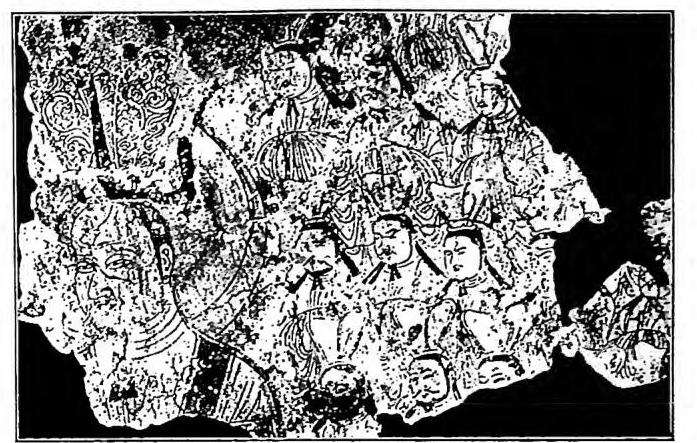
MANI and MANICHAEISM. —
I. LIFE
Mani was born at Mardinu or Afrunya in Babylonia on 14 April 216. His name is of Aramaic origin; the form Manichaeus derives from Syriac: Mānī hajā = “Mani the living” (Gnostic terminology; V. the self-designations current among the Naassenes in Hippolytus, Ref., V, 8, 31 ff.). His father Patek (Patig, Patakias) came from Hamadan (Ecbatana) in Sfedia and belonged to the ruling family of the Arsacids. His mother Marjam was likewise descended from royal stock.Mani, therefore, although born in Babylonia, was of Persian origin and came from a noble family. In Babylonia his father had become an adherent of a Baptist sect of an encratite character (nuqtasilah), whose members called themselves “the pure” and wore white garments. Their encratism corresponded to Christian encratism. They were probably Christians, but were not identical with the Mandaeans (cf. E. Peterson, in Vigiliae christianae, Amsterdam 1949; a different interpretation in H.-Cr. Puech, Le manicheisme, etc., Paris 1949, p. 41 ff.). Raised in this environment, Mani later separated himself from the Baptists. From Kephalaia, VI, ed. cit. below, p. 33, 31 ff., it emerges that the dispute concerned the matter of Baptism: water, which for Mani belonged to the evil world (perhaps on the basis of a Marcionite tradition?). Indeed, Manichaeism rejected Baptism in water (Puech, op. cit., pp. 87, 180 ff., nn. 363, 364). But the break with the Baptists was probably also connected with a revelation that he had received at the age of twelve, the age of discretion, when the religious obligations of the Baptists perhaps began. The Twin Spirit (Paraclete) appeared to him and revealed to him the Entire Truth (v. PECIA, op. cit., p. 42 ff. The description given in the Kephalaia, I, pp. 14, 30 ff., is preferable to that in the Fihrist, which speaks of two revelations). The figure of the Twin Spirit is known from the Apocryphal Acts of the Apostles (v. E. Peterson, op. cit., pp. 156–60). One may perhaps say that his separation from the Baptists led Mani to the group of radical encratites, who replaced Baptism in water with the experience of the Pentecostal Spirit and were not averse to accepting private revelations. Around the years 240–242 Mani was in India (Kephalaia, I, pp. 15, 24 ff.), more precisely in Turan and Mekran (modern Baluchistan), where the King, recognizing in Mani the true Buddha, converted to Manichaeism (H.-Cr. Puech, op. cit., p. 45). From India he returned (by sea) to Persia, summoned by King Sapor I and recommended by the King’s brother, Pārāz, who had become an adherent of Mani. The meeting, which probably took place on 9 April 243 (Puech, op. cit., p. 46), was favorable to Mani. He was granted freedom to preach throughout the Persian territory. As part of the King’s (comitatus), Mani also took part in the war against the Romans (probably against Valerian, 256–60). Freedom of worship under Sapor I gave Mani the possibility of undertaking extensive missionary journeys throughout the Persian territory. After Sapor I’s death and the accession to power of his second successor Bahrām I (274–77), the situation changed. The King was under the influence of the Magi, who, led by the mōbēd (priest) Kartir, accused Mani of destroying the Mazdean religion. The heresiarch was imprisoned and died after
26 days of suffering, probably on Monday, 26 February 277 (ibid., p. 53), in prison. His martyrdom in the Manichaean tradition is called crucifixion, although Mani did not undergo the punishment of the cross. For his adherents the “apostle” suffers the death of Jesus, an idea not unknown also in the Apocryphal Acts of the Apostles (v.).
II. THE WRITINGS OF MANI AND THE MANICHAEANS
Manichaeism had seven canonical writings: 1) the Sāpurakān, a book written by Mani in the Persian language (pehlēst) and dedicated to Sapor; 2) the Pangelo (the living one); 3) the Treasure of Life; 4) the Pragmotsia (Treatise); 5) the Book of Mysteries; 6) the Book of Giants; 7) the Letters. These six writings were composed in the Syriac language (Eastern Aramaic; Puech, op. cit., pp. 67 and 149, n. 262). A character, so to speak, of half-canonical status must be attributed to the Kephalaia and to the Epistola fundamenti (of the latter, known among the Manichaeans in North Africa, a Chinese treatise, still unpublished, appears to speak; Puech, op. cit., p. 149, n. 262). The fragments of the Book of Giants were published by W. B. Henning, in Bull. of the School of Oriental and African Studies (11 [1943], pp. 52-74), and the Kephalaia by Polotsky and Böhlig (Stuttgart 1936-39). Our knowledge of Manichaeism increased considerably following the discovery of Manichaean texts in the Coptic language (v. C. Schmidt and H. J. Polotsky, Ein Mani Fund in Aegypten [Sitzungsber. Berlin. Akad. 1933, 1]) and of Manichaean texts in various languages found in Turkestan (v. e.g., F. W. Müller, Handschriftenrester in Estrangelo-Schrift aus Turfan, in Abhand., Berlin. Akad. 1904; F. C. Andreas-W. Henning, Mittelfranische Manichäica aus Chinesisch-Turkestan, I, II, III, Sitzungsber. Berlin. Akad. 1932, 1933, 1934; W. Henning, Ein manichäisches Bet- und Beichtbuch, in Abhand., Berlin. Akad. 1936, n. 10; language]; id., Manichäische Dogmatik aus chinesischen und iranischen Texten. Sitzungsber. Berlin. Akad. 1933, 13, for other publications by Henning V. PECIA, op. cit., p. 150, n. 263; language). Of Manichaean writings in the Coptic language, the following have been published: H. J. Polotsky, Manichäische Homilien (Stuttgart 1934); C. R. C. Allberry, A Manichaean Psalmbook, II (there 1938); V. T. Säve-Söderbergh, Studies in the Coptic Manichaean Psalm-Book (Uppsala 1949). In the light of these new materials, the Manichaean excerpts in Theodore bar Kōnaj (8th century) can now be studied, V. H. Pognon, Inscriptions mandates (Paris 1898-99), in the Fihrist (= catalogue) of Muhammad b. an-Nadim (d. in 1995), V. C. Flügel, Mani (Leipzig 1862); the Acta Archela, ed. Beeson (there 1906), and the reports found in Sahrastānī, Alexander of Lycopolis, Titus of Bostra, Simplicius, and especially St. Augustine (the anti-Manichaean writings in CSEL, 25, Vienna 1891-92, also contain: Evodius, De fide).III. THE EXPANSION
No up-to-date study exists on the expansion of the Manichaean religion. For its propagation in the West V. Em. de Stoop, Essai sur la diffusion du manichéisme dans l'Empire Romain (Ghent 1909). On Manichaeism in Muslim countries V. H. H. Schaeder, Manichter und Muslim, in Zeitschrift der deutschen morgenländ. Gesellsch., 82 (1928), p. 76 ff.; G. Vajda, in Riv. degli studi orientali, 17 (1937), p. 173 ff.; U. Pestalozzi, Il manicheismo presso i Turchi occidentali ed orientali, in Rend. R. Istit. lombardo di scien. e lettere, 67 (1934), pp. 417–97. On its diffusion in Central Asia and the Far East V. P. Pelliot, in Rev. d'hist. et de littérat. relig., new series, 3 (1912), pp. 97–119 and: Les traditions manichéennes au Fou-kien, in Tsoung Pao, XXII, Paris 1923, p. 193 ff.; W. Henning, Neue Materialien zur Geschichte des M., in Zeitschr. d. deutsch. morgenld. Gesellsch., 90 (1936), p. 1 ff. It is especially noteworthy that the Turkish people of the Uighurs in the territory of Turfan embraced Mani’s religion up to the twelfth century.IV. THE DOCTRINE
Mani’s teaching is based on the concept of a continuing prophetism, which, however, under the influence of the Christian religion, fixed a limit to the arrival of new messengers from the celestial world. The coming of the Paraclete, with whomMani identifies himself, signifies the end of the world and the end of the mission of these messengers. From this point of view Mani remains bound to the Christian tradition. The doctrine of continuing prophetism is known from the ideas of the Judaeo-Christians (v. most recently: H. I. Scheeps, Theologie und Geschichte des Indenchristentums, Tübingen 1949, pp. 87–116, 335–340). It is also found in the gnosis of the Sethians (v. the [Syriac] Book of the Caves and the Coptic Gnostic book Revelation of Adam to his son Seth,
V. H
Ch. Puech, in Coptic studies in honor of W. E. Crum, Boston 1950, p. 137).This must be a matter of either Jewish or Judaeo-Christian speculation, which Mani will have come to know in Mesopotamia. The names of the messengers in the list vary according to circumstances. Sometimes they include the names of the patriarchs of the Old Testament, sometimes also the names of Zoroaster, Buddha, Lao-tseu, Jesus, etc. (v. Ch. Puech, Manicheisme cit., p. 144 f). Mani is distinguished from his predecessors by his status as Paraclete, the “seal of the prophets,” and the “apostle” of the “last generation.” Mani took the term “apostle” from the Christian tradition, although broadening the concept of apostle, perhaps under the influence of the Apocryphal Acts of the Apostles. From the same source also comes his conviction of the ecumenicity of his mission. Mani’s self-designation as “apostle of Jesus Christ” at the beginning of his epistles is clear proof that Mani did not intend, as is often attributed to him, to found a new religion, but wished only to bring Christian Revelation itself to its ultimate fulfilment. To a certain extent, Mani’s mystical illumination can be interpreted within the framework of the ideas of the Encratites in Mesopotamia. Mani, who rejects married life, becomes an “apostle” and as such receives the Paraclete, the “twin” spirit. The Paraclete makes the voice of God heard by him and teaches him the whole truth (v. Io. 15, 26, 16, 12). The mystical union with the Paraclete, which according to Kephalaia (p. 16, 23 f.) caused him to become “one body and one spirit” with him, is based on St Paul, I Cor. 6, 17. The intellectual character of the illumination by the Paraclete leads him toward a Gnostic knowledge (v. Kephalaia, p. 15). The Encratite basis of Mani’s gnosis is evident in his identification of matter with concupiscence. Without concupiscence, a material world would not exist. Matter is dark because concupiscence lacks the light of intelligence. The dualism of God and Hyle, of Light and Darkness, in Mani is therefore ultimately an anthropological dualism; but the extension of anthropological dualism to the entire world is justified by the analogy that exists between microcosm and macrocosm. Just as Judaeo-Christian eschatology is not merely a doctrine of the salvation of man but also concerns the entire world, so Mani’s doctrine is concerned also with the universe. The situation of fallen man is, so to speak, reflected in the situation of a fallen universe. If in man God—that is, the soul of man consubstantial with God—and Matter—that is, the body, viewed under the aspect of its concupiscence—Light and Darkness are mingled, it must be assumed that the universe too is in the same state of mixture. The light and darkness in the world, which at the beginning were separated into two clearly distinct realms, have become mingled, just as the soul has become mingled with the body. One day Hyle sees the realm of Light and is seized by the desire to invade this foreign territory. The idea of an attack by the primordial darkness was perhaps suggested to Mani by a Jewish or Christian tradition that attributed to the Pneuma of Gen. 1, 2 the function of separating the region of light from that of darkness (Gen. 1, 4; cf. Theophilus of Antioch, Ad Autolyc., II, 13: PG 6, 1072–73). The Father of “greatness” (majesty) confronted the attack by sending “the primordial man-