
MACARIO il GRANDE. — Also called the Egyptian or the Elder. Palladius (Hist. Laus., 17; ed. C. Butler, I, Cambridge 1899, pp. 43, 5 sgg.) and Rufinus (Hist. monach., 28) speak of him. Neither of them knows anything about a literary activity of his; nevertheless, many believe that a letter attributed in Latin and Syriac to M. and addressed “Ad filios Dei” (PG 34, 406–10) is an authentic work of M.
A critical edition of the Latin text was produced by A. Wilmart: La lettre de Macaire, in Revue d'ascétique et de mystique (1 [1920], pp. 58–83). The assertion of its authenticity is based on Gennadius (De vir. ill., X), who knows of a letter by an M. “ad iuniores professionis suae” (v. Egypt; id., Gennadius of Marseilles on Macarius of Egypt, both in Journ. of theol. studies*, 20 [1919], pp. 345–49). On the other hand, however, the content of the letter corresponds completely to the ideas of the homilies of Pseudo-Macarius.
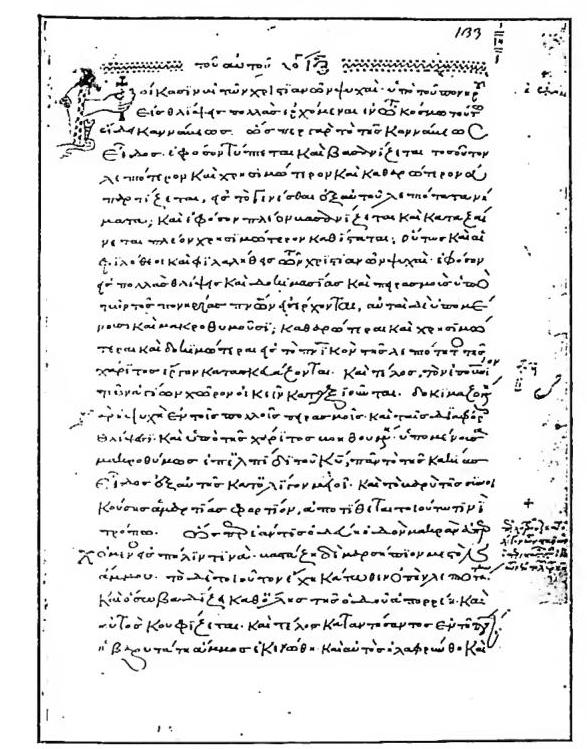
Thus H. Dörries, in his book Symeon von Mesopotamien ([Texte und Untersuchungen, 55, 1], Leipzig 1941), arrived at the conclusion (p. 378 sgg., against P. Resch, La doctrine des premiers maîtres égyptiens, Paris 1931, p. 39 sgg., and M. Viller – K. Rahner, Aszese und Mystik in der Väterzeit, Freiburg 1939, p. 96 sgg.) that the letter is inauthentic. This conclusion may perhaps be conceded to Dörries; nevertheless, it still remains to be explained how, of the entire vast apocryphal literature of the Homilies of Pseudo-Macarius, only this letter has been preserved in Latin. The first edition of Giovanni Picus contained 50 Greek Homilies of M. (1559, reprinted in PG 34, 449–822; H. I. Floss also included some additions in Migne); G. L. Mariott added another 7 homilies (51–57) from an Oxford manuscript containing 57 homilies of M. (v. Macarii Anecdota [Harvard theol. studies, 5], Cambridge 1918). A large part of the tradition of M.’s homilies in Greek (a translation also exists in Georgian: V. J. Karst, Littérature georgienne chrétienne, Paris 1934, p. 54) was collected and studied by H. Dörries (op. cit.), while the Syriac and Arabic translation was studied by W. Strathmann, Die arabische Makariustradition (Göttingen 1934).
A critical edition of the text of the homilies of Pseudo-Macarius was prepared by E. Klostermann for the CSEL. On the methodological principles for this difficult edition V. E. Klostermann, Symeon und Makarius (Berlin 1944). It emerges from the Arabic translation that the true name of the author of these homilies is a certain Simeon, an ascetic who lived in Mesopotamia. The attribution of the homilies to M. il G. may perhaps have served to facilitate the introduction of homilies of a heretical character into an orthodox milieu. The Messalians, moreover, among whom the origin of the homilies must be sought, boasted that they were following in the footsteps of Antonius and M. (Histoire Nestorienne: PO 5, 279 and Theodore b. Koni, Liber scholiorum). The origin of the homilies in a Messalian milieu (v.) is beyond doubt (the only dissenting opinion is that of W. Völker, in Theol. Literaturzeitung, 68 [1943], pp. 129–36); the proof was furnished by L. Villecourt, La date et l'origine des homélies spirituelles attribuées à Macaire (in Comptes rendus des séances de l'Académie des inscriptions et belles lettres, Paris 1920, pp. 250–58). The detailed studies of H. Dörries, however, have shown that this is a mitigated Messalianism: the author frequently polemicizes against the position of radical Messalians. On the other hand, the history of the text shows that corrections were made in it to remove excessively obvious heresies (an example is given by E. Klostermann, loc. cit., p. 24). For this reason, the study of the history of the text is indispensable for evaluating the individual ideas, and a unification of the collection of 64 homilies (represented by Vat. gr. 694) and the collection of 50 homilies does not appear possible (v. E. Klostermann, loc. cit., p. 6). H. Dörries’s aim is to reconstruct from the homilies the “Asceticon” of the Messalians, which would have underlain the condemnation at the Council of Ephesus (431), following the action of Amphilochius of Iconium. This reconstruction, however, remains hypothetical. There is still no study that situates historically the ideas and vocabulary of M.’s homilies. It is certain, however, that the author knew the apocryphal Acts of the Apostles, not only the Acts of Thomas but also the Acts of Peter; he also knew extracanonical sayings of Jesus, and his vocabulary likewise shows contacts with pseudo-Clementine literature. He may have come from an Encratite milieu in Mesopotamia, and this would also explain the kinship between the mysticism of (divine) light in Pseudo-Macarius and that of the Encratites. It may be said that the homeland of this asceticism and mysticism was Christian Mesopotamia.