
HERESY. — Greek word (αἴρεσις), meaning “choice,” “selection.”
SUMMARY:
I. General notions
II. In dogmatics: heresy as doctrine
III. In moral theology: heresy as sin
IV. In canon law: heresy as delict
V. In the history of the Church
VI. Archaeology.I. GENERAL NOTIONS
The term, very frequent in profane usage, originally served chiefly to indicate a preference for a given religious, philosophical, or political doctrine, then the followers of such a doctrine, and finally the doctrine itself, without, however, including any note of reproach or condemnation. In the New Testament, where it occurs nine times, it is used in the sense of a sect or doctrine to be rejected: thus St. Paolo rejects the title of heresy applied by the Jews to nascent Christianity (Act. 24:14).HERESY — The religion that casts out heresy. Sculpture by P. Legros (1695–90). Altar of St Ignatius — Rome, Church of the Gesù.
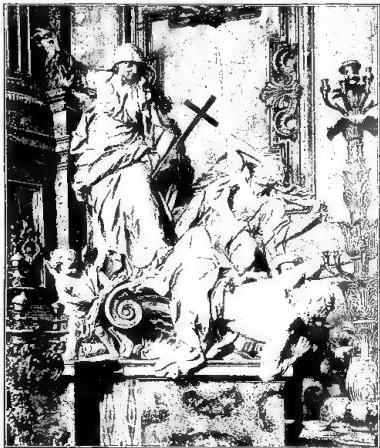
Heresy presents multiple problems for theology, which must be examined from the dogmatic, moral, canonical, and historical points of view.
II. IN DOGMATIC THEOLOGY: HERESY—DOCTRINE
Considered objectively, heresy may be defined as “a doctrine that directly contradicts a revealed truth” as such proposed by the Church to the faithful. Three elements are therefore involved: 1. A revealed truth, that is, one contained implicitly or explicitly, but formally, in at least one of the two sources of Revelation. Consequently, neither truths deduced from revealed principles by means of a premise belonging to the natural order (theological conclusions), nor philosophical truths or facts that are intimately and necessarily connected with the declaration and certainty of Revelation itself can constitute matter for heresy. Such truths and facts do indeed fall within the sphere of the Church’s infallibility, from which they might also receive certainty and absolute immutability; they do not thereby become revealed, however, that is, truths to be believed on the authority of God or, as is commonly said, with divine faith. 2. An intervention of the Church’s infallible magisterium attesting the revealed character of the doctrine, whereby what was previously only an object of divine faith acquires the qualification of a truth to be believed with divine and Catholic faith. 3. An opposition to revealed truth; and this opposition must be immediate, direct, and contradictory.When one of these elements is lacking, a proposition cannot properly be called heretical; rather, according to the case, it will be called: proximate to heresy, if it contradicts a doctrine proximate to the faith, that is, one which, although not yet defined, is regarded by theologians as definable; erroneous, if it denies a theological conclusion or, in general, a truth intimately connected with dogma; sapiens haeresim, if the form of expression in certain circumstances gives rise to suspicion of heresy (v. CENSURA).
III. IN MORAL THEOLOGY: HERESY—SIN
St Thomas reduces it to a species of positive infidelity (Sum. Theol., 2ᵃ — 2ᵃᵉ, q. 11, a. 1). As a sin, therefore, it is commonly defined as “the voluntary and pertinacious error of a Christian against a divine-Catholic truth.”It is said: 1. Voluntary error. The sin of heresy, in fact, corresponding in the contrary sense to the act of faith, is first of all an act of the intellect consisting in an erroneous judgment against the rule of faith. It may appear as a denial or also as a positive doubt that reduces certainty to mere opinion. Negative doubt, which is limited to a suspension of judgment, although it may be gravely sinful, does not yet directly oppose faith. Positive doubt, on the other hand, precisely because it weakens adherence to the Church’s teaching, is already a formal revolt against faith itself, which entails a firm and unshakable assent. In addition to the intellectual element, an impulse on the part of the will also plays a role in the genesis of heresy, analogously to what occurs in the act of faith: indeed, only through such influence can it be explained how the intellect may freely determine itself to give erroneous assent concerning Revelation. 2. Pertinacious. This pertinacity constitutes the specific element of its moral culpability. It does not consist in a special obstinacy, but in a person’s awareness that he is opposing the rule of faith; without this awareness, heresy will be merely material, not formal. 3. Of a Christian, so that the capable subject can only be one who, through Baptism, has become part of ecclesiastical society: the catechumen, therefore, or one who has been invalidly baptized, may commit the sin of infidelity, but not that of heresy. 4. Against a truth, etc. These words refer to the objective element treated above.
The sin of heresy is divided into: 1. formal and material, according to whether or not it is joined with pertinacity; 2. internal and external, according to whether it exists only in the mind or is also manifested externally; 3. occult or public, according to whether it is disclosed to no one or to only a few and in secret, or before a considerable number of people.
Among sins of infidelity, it is the most serious, because it opposes the virtue of faith more than any other; indeed, by reason of this opposition it surpasses the gravity of every sin except hatred of God. This gravity is reflected in the many consequences that affect the heretic in his relations with Christian interior life and with ecclesiastical society. The most important are: 1. the loss of the life of Grace; 2. the destruction of the infused virtue of faith; 3. separation from the body of the Church in the case of public heresy, whereby the heretic becomes an estranged and separated member, even if, as the more common doctrine holds, he adheres to heresy only materially. It is not certain that the same can be said of the occult heretic, that is, one who has not yet officially professed himself to be such.
IV. IN CANON LAW: HERESY—OFFENCE
Heresy, insofar as it breaks the unity of the Church, is by its nature an eminently antisocial act; it therefore cannot escape the coercive power of the Church. However grave the sin of heresy may be with regard to doctrine and morals, if it remains a purely internal act it does not yet constitute an offence in the juridical sense of the word and is therefore not subject to canonical sanctions. To become such, heresy must also possess an external character, whether public or occult. This external manifestation may be expressed in any manner, through signs, writings, words, or actions, provided that it is sufficiently clear that what is involved is genuine and fully deliberate adherence, that is, formal adherence.The manner used by the Church in repressing heresy varied throughout the centuries. At first extremely severe, it later somewhat tempered its original rigour, while still reserving very burdensome penances for this offence. Once the Empire had become Christian, civil penalties such as exile, confiscation of property, and even death were added to ecclesiastical penalties. The struggle against heretics was particularly harsh after the year 1000, owing to the emergence of new heretical movements. The institution of the Inquisition dates from this period (v.).
The penalties currently in force are the following (can. 2314 of the CIC): 1. Heretics incur excommunication ipso facto. 2. If, after being admonished, they do not repent, they shall be deprived of benefices, dignities, pensions, ecclesiastical offices, and other positions; they shall be declared infamous and, if clerics, after a second admonition, deposed. 3. Those publicly enrolled in or adhering to non-Catholic sects are thereby infamous, and, if clerics, after having been fruitlessly admonished, must be degraded.
Anyone suspected of heresy who, after being admonished, remains uncorrected shall be prohibited from performing legitimate ecclesiastical acts and, if a cleric, shall be suspended a divinis; if within six months he does not amend his ways, he shall be considered a heretic (can. 2315).
Absolution from excommunication is reserved to the Apostolic See; if, however, the offense was referred to the Ordinary in the external forum, even by free confession, he may, after the abjuration (v.), absolve the offender in the external forum; the latter may therefore receive absolution from the sin from his confessor (can. 2314 § 2).
V. IN THE HISTORY OF THE CHURCH
The breadth of the subject permits only a brief mention of the major heretical movements, for which the relevant entries should be consulted.1. Patristic period. — Heresy appears with the very rise of the Church. Its first manifestations came from the Jewish milieu, through groups that had converted to Christianity without definitively breaking away from the Synagogue: the Ebionites, the Nazarenes, and the Cerinthians belong to this category. An analogous movement arose in the pagan milieu in the second century with Gnosticism: it represented the attempt of pagan thought to absorb and transform evangelical doctrine, turning it into a religious philosophy. Marcionism, millenarianism, and Manichaeism were likewise heresies arising through contamination by other religions. On a distinctly Christian basis, by contrast, Montanism arose in the third century, proclaiming the third and final Revelation, that of the Holy Spirit. Meanwhile, controversies with the heretics, together with the penetration of the Gospel among the educated classes, opened a new series of heresies of a predominantly intellectual character, which would subsequently lead to the denial of the most fundamental dogmas. It was Trinitarian doctrine that was first denied between the second and third centuries, both in the East through Subordinationism and in the West through the Monarchianism of Noetus and Praxeas, later developed into Sabellian Modalism: these errors would culminate at the beginning of the fourth century in Arianism, which denied the divinity of the Word, followed by Macedonianism, an analogous heresy concerning the Holy Spirit.
Once the Trinitarian controversies had ceased, the struggle flared up again in the East between the fifth and sixth centuries on the Christological level. Nestorianism, which denied the unity of person in Christ; Monophysitism, which confused his natures; and, subsequently, Monothelitism, constituted the most important deviations in this field. In the meantime, the West became engrossed in problems concerning the Church, the Sacraments, and Grace: hence Donatism and, above all, Pelagianism, both vigorously opposed by St. Augustine. Iconoclasm represents the last great heresy of this troubled patristic period, which nevertheless had decisive importance for the precise formulation of dogma.
2. Early Middle Ages. — In the period following that of the Fathers, noteworthy were the Adoptionism of Elipandus of Toledo and Felix of Urgel, and the Predestinarianism of Gottschalk. The Greek Schism also belongs to this period; at least in its beginnings, however, it did not involve particular heretical affirmations. Of an entirely different nature were the dangers that the Church had to face after the year 1000. Popular reform movements of a distinctly anarchic and anti-ecclesiastical character were proliferating everywhere. The Cathars, the Waldensians, and later the pseudo-mystical currents of the Joachimites, the Fraticelli, and the Beghards were the most significant expression of this heretical ferment. Subsequently, the constitution of the Church was also threatened by the doctrine of Marsilius of Padua and the so-called conciliar theories. When the movements of the English Wycliff and the Bohemian Hus were added, the ground would already be prepared for the outbreak of the Lutheran revolt.
3. Modern age. — The modern period opens with Protestantism, which broke the unity of the Western Church and led to the gradual detachment of European life and culture from Christianity. New trials awaited the Church in the eighteenth century. The Reformation had indeed occasioned extremely serious controversies concerning Grace and freedom, from which arose movements that, while professing to be orthodox, were in practice rebellious against dogma and the hierarchy, such as Baianism and, above all, Jansenism, a heresy of exceptional importance whose repercussions extended into the twentieth century. Meanwhile, in the juridical sphere, the intensification of nationalism and the absolutism of sovereigns gave rise to Gallicanism, Febronianism, and Josephinism, which placed the Church in serious difficulty in its relations with the State. The controversies in the moral sphere were also noteworthy in this period, leading to the condemnation of Laxism, Rigorism, and Quietism. In the nineteenth century, by contrast, Traditionalism, Fideism, Ontologism, Hermesianism, Güntherism, and the “Old Catholics” had considerable influence in France and Germany. The other errors against which the Church had chiefly to defend itself in this century were less heresies than forms of total defection from Christianity. The last serious attack was the more recent one of Modernism, through which an attempt was made to introduce Rationalism into the fields of theology and biblical criticism.
For moral theology: s. Tommaso, Suarez, De Luzo sopra citati and especially s. Alfonso de' Liguori, Theologia moralis, I, ed. Gaude, Roma 1907, p. 310 sgg., where many references to earlier authors may be found. In addition to the classic works of D'Annibale, Bucceroni, Ballerini, Lehmkuhl, among the more recent authors especially A. Werneersch, Theologia moralis principis, II, 3ᵃ ed., Roma 1937, pp. 22 sgg.; D. e M. Pühenner, Manuale theologia moralis, I, 6ᵃ ed., Friburgo in Br. 1940, pp. 364 sgg.; J. Aermys-C. Damen, Theologia moralis, I, 14ᵃ ed., Torino 1947, pp. 267 sgg.
For canon law: as regards works prior to the CIC, see Michel, op. cit. Among the commentators on the CIC, V. F. Cappello, De centuris, Torino 1916, passim; E. F. Mackenzie, The delles of heresis, Washington 1932; G. Cheledi, Ius poenale, 4ᵃ ed., Trento 1935, p. 75 sgg.; M. Conte a Coronata, Institutions I, C., II, 8ᵃ ed., Torino 1939, p. 247 sgg.; e. IV, ivi 1935, p. 279 sgg.; G. Cheledi-P. Ciprotti, Ius Canonicus de delictis et poenis, 5ᵃ ed., Vicenza 1943, pp. 75-80.
For history: the decisions of the Church against the various heresies are collected in Dens-U. For the authors who collected the heresies in corpus, cf. J. Hermann, Historie des hérésies, Rouen 1712; G. Arnold, Deparrische Kirchen- und Ketzschistorie, Francoforte sul Meno 1729; F. Van Ranst, Historia bacteriorum et bacterium, Venezia 1735; W. Walch, Entwurf einer vollständigen Geschichte des Ketzereins, Lipsia 1769; C. Cantù, Gli eretici in India, Torino 1865-67; A. Lombardi, Paulistien, bulgares et bonismanes en Orient et Occident, Basilea 1870; F. Tocco, Le. nel medioevo, Firenze 1884 (tendentious); J. Dellinger, Beiträge zur Sektageschichten des Mittelalters, Monaco 1890; G. Volpe, Movimenti religiosi e sette ereticali nella società medioevole italiana, 2ᵃ ed., Firenze 1926. Among the various dictionaries of heresies, V. Ph. Fritz, Ketzscheihon, Rathbone 1858; F. A. Plumut e J. Claris, Dictionnaire des hérésies, in J. P. Migne, Encyclopedia théologique, XI e XII, Parigi 1847; J. H. Blunt, Dictionnaire et sect., Londra 1903; G. Runciman, Le manicheismo médiéval, L'hérèse duolite dans le christianisme, vers. franc., Parigi 1948; H. Jedin, Storia del Concilio di Trento, vers. it., Brescia 1950; P. Havait, Les délits d'hérésie d'apostaste et de schisme, in Revue d'ancourisme de Tournai, 5 (1930), pp. 134-39; G. Welter, Hist. des sectes chrétiennes des origines à nos jours, Parigi 1922 (the author is scattolico).
VI. ARCHAEOLOGY
If by this word we are to understand a system or doctrine, and consequently a sect that rejects part of the Church’s teaching, very few are the works of art whose heterodox character can be demonstrated and defined with certainty. Christian-heretical scenes must not be confused with those of purely pagan origin, even when tinged with mystical features that may have some connection with Christianity.Leaving aside, as being of a rather magical character, the numerous collection of amulets and gems, which the Gnostics made extensive use of, we know of some monuments of the so-called major arts whose decoration reveals more or less evident mixtures of purely Christian motifs with others that are more mysterious and seem attributable to heterodox speculations. The most typical case is constituted by the hypogeum of the Aureli on the Viale Manzoni, although the interpreters have not succeeded in reaching agreement in determining the sect that used it: Gnostic, Carpocratian, Marcionite, Montanist?
The heretical character of the so-called hypogeum of Trabio Giusto on the Via Latina is very doubtful. The same may be said of the representations discovered beneath the triglia “in catacumbas.”
Two sarcophagi in the Museo delle Terme were attributed by Wilpert to Gnostic patrons: one would represent Simon Magus instructing Helen, the other Christ the teacher between James the Less and Mary Magdalene; his arguments, however, are not entirely convincing.
As regards epigraphy, too, inscriptions have been considered heretical by Cecchelli and Calder, which Ferrua, on the contrary, has not accepted as such.