
BEGHINE and BEGARDI. — The beghine belong to that category of persons who follow a way of life midway between that of simple laypeople and that of religious properly so called. For this reason they were originally called not religiosae, but mulieres religiosae: they are pious women, virgins or widows, who live together within an enclosure or “beguinage” (beguinagium), either inhabiting common houses or dwelling, alone or in groups of two or three, in individual little houses consisting of one or more rooms. They do not pronounce the three traditional monastic vows, but only those of obedience and chastity, and these temporarily, so that the b. do not bid a total farewell to the world; nevertheless, they lead a common life of piety similar to that of the cloister.
In considering their history, the beghine and the begardi who from the beginning developed within orthodoxy must be distinguished from those who professed heretical doctrines. Indeed, it has been established that the term beguinus or beguina was originally used in Brabant, in the territories of Liège and the Rhine provinces, to designate heretical Cathars or adherents of similar movements in general; another contemporary designation for these heretics was that of apostol[i]ci, deriving from their practice of a poor and itinerant life. Etymologically, the epithet beghina certainly does not derive from s. Begga, who lived in the seventh century and was in no way the founder of the beghine, while only at a late date, in the seventeenth century, was she chosen by them as their patroness; nor does it derive from Lambert “li beges” (d. ca. 1177), who was not the founder of their local movement but one of its various organizers; indeed, the nickname “li beges” was maliciously applied to Lambert of Liège because he was unjustly accused of belonging to the sect of the Cathars, that is, the “begini” or “beges.” On this basis, some authors (J. Van Mierlo) would regard this designation as a popular corruption of the name “Albigenses” (al-beghini?), given to the heretical Cathars in southern France; others would consider it a derivation from the supposed Anglo-Saxon verb “beggen” (to chatter, pray, or beg). Given the serious difficulties of both hypotheses, it does not seem implausible that the word begginus, in its heretical meaning, derives from the Old French term bege (today beige), used of raw or undyed wool, together with the suffix -inus, analogously to what occurred with its close synonym biz[=]occo, derived from bizo (grey, indicating grey or uncoloured cloth) and a suffix, and with the epithet umiliato, in Lombardy, derived from the humble garment, that is, one without colour, undyed, ash-grey, also called beretino, whence the name “berettini,” by which the Humiliati were called by the people; likewise with the French etymological and historical doublet of bizocco, namely biset (Frère bis), deriving from bis (= grey) and the suffix
(from J. A. Goris, Ars Belgica IV, Lierre - Bruxelles 1933)
BEGHINE – Church of the Béguinage, built from 1664 to 1666. The façade was renovated in 1767 by Van Everbroeck-Lierre.
diminutive -et. The earliest spellings, begina, begginus, in French begin, begine, support this interpretation. It is also established that the Cathars, called “apostolics,” wore an undyed, grayish cloth, that is, bege. The term beg[ur]ardus is a later development (first half of the thirteenth century) of beguinus; subsequently, however, it was applied almost exclusively in a heretical sense to other heterodox manifestations of a pantheistic and quietistic character, such as, for example, the Amalricians, BEMA (v.), and above all to Spirit (v.), or Spirit of Freedom.
The Beguine movement in general is a manifestation of that religious fervor which pervaded the twelfth and thirteenth centuries and gave rise to various forms of ascetic and evangelical life, such as that of the Waldensians in southern France with its offshoots, including the “poor Catholics”; that of the “Humiliati” in Lombardy; and, specifically with reference to associations of “religious women,” that of the Beguines in Brabant, the papelarde (or pappalarde) in northern France, the bizocche (or pinzocchere) in central Italy — such as, for example, b. Filippa Mareri and her first followers at Petrella Salto (Rieti), and certain other groups of devout women in Tuscany and elsewhere, to whom Cardinal Ugolino (1218) subsequently gave a rule of the Poor Clares — and, finally, that of the beate in the land of Spain. This movement, very extensive but still fluid in its forms, could be called Beguineism or Bizocchism. It included men (boni viri, boni valeti, boni pueri, etc.) and above all those “mulieres religiosae” who were either affiliated with a male institute (the Humiliati, the poor Catholics) or united in independent associations, and who devoted themselves to a religious life distinct from the traditional monastic institutions. Because of certain external similarities with heretical groups, and because of the suspicion and hostility of the anti-reformist element of the clergy, these persons were denigrated and even persecuted as heretics; even the members, for example, of the Franciscan and Dominican institutes, who crowned this religious movement, were sometimes mockingly called begards, while the same epithet, as well as that of bizocche, would become synonymous with spiritual (Franciscan) and fraticello: “viri qui vulgariter fraticelli seu... bizochi sive beguini, vel aliis nominibus nuncupantur” (Sancta romana, 30 Dec. 1317; cf. C. Eubel, Bull. Franc., V, Rome 1898, p. 134).
The Beguine movement and institution in the proper and original sense arose and took shape in the eastern and southern part of present-day Belgium, around 1170. The first adherents generally belonged to the category of the “recluses”; these “religiosae mulieres” or “conversae” lived enclosed, more or less strictly, in little cells grouped around a church or chapel, or around a monastery, usually one of men, or near or within a hospital, practicing a life that was half active and half contemplative, like hermits. The monasteries known as double monasteries were especially suited to receiving these recluses within the community of virgins or widows, rigorously separated from the community of monks; this practice was particularly widespread in the earliest Premonstratensian canonries. It also happened that, within a non-double monastery of monks, a “converseria,” a refuge for such women, was gradually established. At the beginning, these recluses or lay sisters were customarily associated with a religious Order, whose rule they followed. But from the middle of the twelfth century
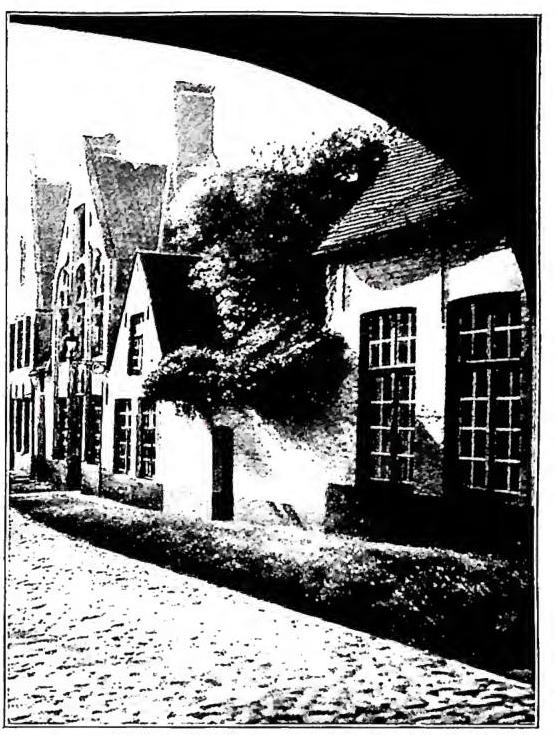
(from Images de Bruges, introduction by Mauclair, Paris 1928)
BEGHINE - The béguinage of Bruges.
These primitive béguine communities were
nevertheless not in conformity with canonical norms, because they practiced an almost cloistered common life without the necessary affiliation to a monastic Order, that is, without a legally approved rule. The Fourth Lateran Council (canon 13) of 1215 likewise prohibited the introduction of these innovations. Yet the following year, James of Vitry, great protector of the primitive béguine congregations of Belgium, obtained from Honorius III the distinguished privilege of their recognition, which was extended also to those of France and Germany. This approval, although unwritten, favored the spread of the new institution throughout western and central Europe; in fact, all the forms mentioned above of improper béguinism, or bizzocchism, in order to preserve their institution, condemned by the Lateran canon, adopted the approved program of the béguines of the Low Countries, and along with the program also their epithet, organization, and mystical doctrines (the Flemish school). The previously approved Humiliati were an exception.
In the Flemish regions of Belgium and Holland, beginning in the first half of the thirteenth century, extensive and populous autonomous béguinages were established: they were small towns, enclosed by walls, with their own sanctuary, cemetery, and parish priest, one or more infirmaries, special convents, and individual little houses inhabited by hundreds of béguines, who, in their free time from prayer, spun wool, cared for the sick, and watched over the dead; as their rule, they followed certain diocesan statutes.
The thirteenth century marked a first apogee: beautiful but simple churches in the Gothic style; a grandiose mystical literature in the Flemish vernacular, originating for the most part with the woman writer Hadewych, who already heralded Ruysbroek (v.). There was a dangerous period in the early fourteenth century, owing to the condemnations of the Council of Vienne (1311, published in 1317) against irregular béguines and begardi, and against heretical doctrines; fortunately, those decrees made an exception, often renewed thereafter, for the orthodox and honest members faithful to the approved forms. A second apogee followed in the seventeenth century: notable and richly decorated churches in the Baroque or Rococo style. Despite the suppressions during the French domination (end of the eighteenth century), several “béguinages” survived to the present day, although the number of béguines has become very small. Those of Bruges and the two of Ghent retain real vitality; in Holland, the best known are those of Amsterdam and Breda.
The begardi of mercy (care of the sick and free burial of the dead), also called cellites, alexians, lollards, schwestr[i]oni, appear principally from the fourteenth century onward in the Rhenish provinces, Holland, and likewise Belgium, although their origins seem to date from the same period and region as those of the béguines, with whom (begutte) they lived in double communities, as mentioned above. There were also begardi weavers, better known by the designation begards; lay religious devoted to the wool industry, entirely similar to the Lombard Humiliati. They are already encountered in the first half of the thirteenth century and are an almost exclusive feature of the Belgian cities. They led a common life, not in agglomerations of huts, but in their own convents. Since they had no particular approved rule, they affiliated themselves, as did most of the béguines, with a recognized Third Order, especially that of the Franciscans. Toward the end of the fifteenth century they abandoned the loom of the lay religious in order gradually to adopt the more common distinction between priest-fathers and lay brothers. They disappeared with the French Revolution.