
ROCOCÒ. – A term that came into use in France in the 1700s to designate, together with the other term “rocaille,” a particular type of decoration—shell incrustations, imitations of rocks, bizarre arabesques—with which, under Louis XIV and especially under Louis XV, rustic structures (baths, grottoes, fountains) and furnishings were adorned. Today, in a broader sense, the term r. denotes the figurative civilization of the 1700s,
I. ARCHITECTURE
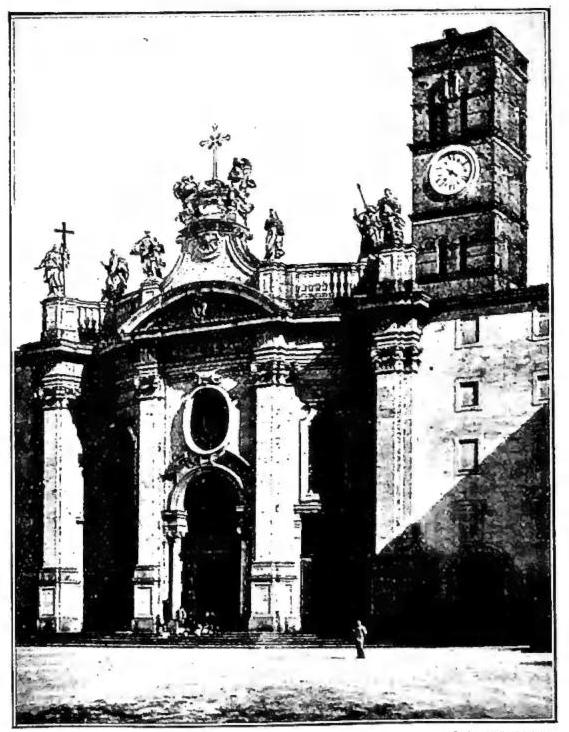
Rococo forms were realized as early as the third decade of the seventeenth century by Borromini (1599–1667), active in Rome in competition with Bernini. His style spread throughout Italy and abroad, from where it returned to Italy enriched with French elements (Piedmont, Liguria, Lombardy) and Spanish ones (southern Italy).A very active center of Rococo was Piedmont, where the Theatine father from Modena Guarino Guarini (1624–1683), a follower of Borromini, the Messinese F. Juvara (1676–1736), B. Alfieri, and G. B. Planteri worked. In Rome and Naples, Rococo shared the field with the resurgent classicizing forms (represented by A. Galilei, L. Vanvitelli, and, in part, F. Fuga) and often appears fused with them, as in the façade of S. Croce in Gerusalemme (D. Gregorini, P. Passalacqua), classical in the single order of its monumental Corinthian pilasters, but Rococo in the curvilinear movement and lively intricacy of the crowning. Rococo took on distinctive characteristics in Sicily and Apulia; here, on the one hand, the hackneyed “Plateresque” decoration (from the Spanish platero, silversmith), nourished by Spanish influences, flourished from the seventeenth century onward, with its center at Lecce, where the local stone provided suitable material; on the other, ingenious architects such as G. B. Vaccarini, who rebuilt Catania after the earthquake of 1693, and P. Picarale (Syracuse, Cathedral), asserted a sense of grace and restraint. The structural forms remained those of the Baroque: especially in church façades, with curvilinear movement and superimposed orders (usually two: Rome, the church of the Maddalena by G. Sardi [1680–1753], Madonna della Quercia
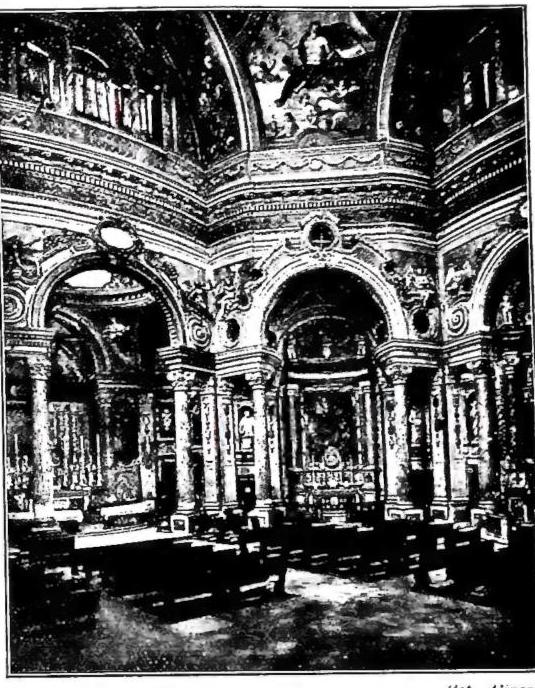
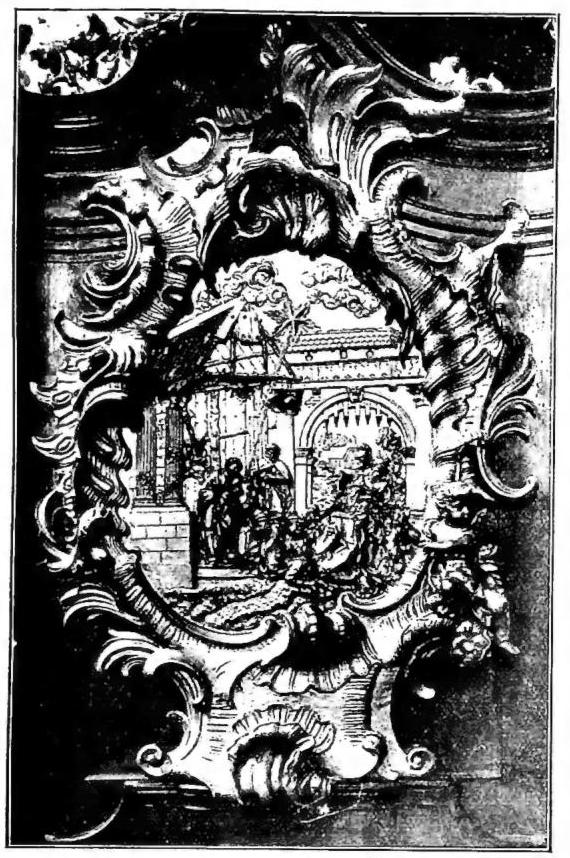
In civil architecture, the use of inexpensive stucco decoration also allows multi-family dwellings to adorn themselves with a Rococo character. Adapting to the requirements of a more practical and intimate life, noble palaces too are divided into apartments, replacing the solemn seventeenth-century salons with small, numerous rooms, to which corresponds, on the façades, a thickening of the openings; this, together with the sinuous movement of the wall surfaces and the varied, delicate design of the mouldings, lends them a graceful and light appearance. In Rome, examples of Rococo building are the Palazzo Doria Pamphilj (G. Valvassori), Piazza S. Ignazio, arranged like a stage set (F. Raguzzini), and the staircase of the Trinità dei Monti
(F. De Sanctis). In Piedmont, the Palazzo Carignano in Turin (Guarini), with its broad, sinuous frontage, and the hunting lodge at Stupinigi (Juvara), with its mansard roof like those of French castles and four wings radiating from a central oval structure, are noteworthy. In southern Italy, palaces often have a cheerful and brilliant appearance, not uninfluenced by French currents: the exceptionally elegant courtyard of the Palazzo Bonagia in Palermo may be cited.
In France, Rococo expresses itself less through architecture (in which the disciples of Mansart—Robert de Cotte, Boffrand, Jacques Gabriel—repeat the measured and solemn forms of the great century) than through the arrangement and decoration of interiors, especially in civil buildings. In the hôtels, which had become less monumental, more comfortable, and more luminous, with the collaboration of such gifted sculptors as J. B. Lemoyne, the Adams, the Slodtz, and Guibert, interiors of exquisite elegance were created, such as the oval salon of the Hôtel Soubise in Paris and the rooms of the Petit Trianon at Versailles, in which—executed in stucco—flexible motifs of ribbons and garlands, grasses and flowers, cupids and nymphs unfold.
Rococo architecture flourished luxuriantly in the Germanic countries, particularly in Vienna, Dresden, and Potsdam. In religious architecture, Italian models were followed; in civil architecture, on the other hand, French influences generally predominated, brought by R. de Cotte, F. Cuvilliès, and other French architects and artists exiled following the religious wars. Renewed after liberation from the Turkish threat (1685), Vienna, which had welcomed Italian influences since the seventeenth century, gave its Rococo the style—restrained on the exterior and exceedingly elegant in the interior—of L. von Hildebrandt (born in Genoa and a pupil of Carlo Fontana), author of the Kinsky Palace and the Belvedere Palace; yet it also felt the influence of French taste imported by J. N. Jadot, who built the Palace of the Academy of Sciences. In Dresden, a destination for French and Italian architects, Rococo instead expressed itself in the pompous forms of the Zwinger pavilion (M. D. Poppelmann), in the heavy forms of the Frauenkirche, and in the bizarre scenography of the Hofkirche (G. Chiaveri). Finally, in Potsdam, the Sans-souci pavilion, erected by Frederick the Great according to his own designs (architect G. W. von Knobeldorff), was inspired by the Grand Trianon. The castles deserve separate mention: the most magnificent, that of Würzburg (architect D. Neumann, frescoed by Tiepolo), is a typical example of sumptuous German Rococo.
In Spain, after the extravagances of the “Churrigueresque” style—only partly attributable to J. de Churriguera, who died in 1725—as seen in the portal of the Hospice in Madrid and the Palazzo di S. Telmo in Seville, a return to restraint was marked by the arrival of F. Juvara, whom Philip V entrusted with the construction of the Royal Palace of Madrid (completed by G. B. Sacchetti). Ventura Rodriguez, among others, worked along this stylistic line.
II. DECORATION AND FURNISHING
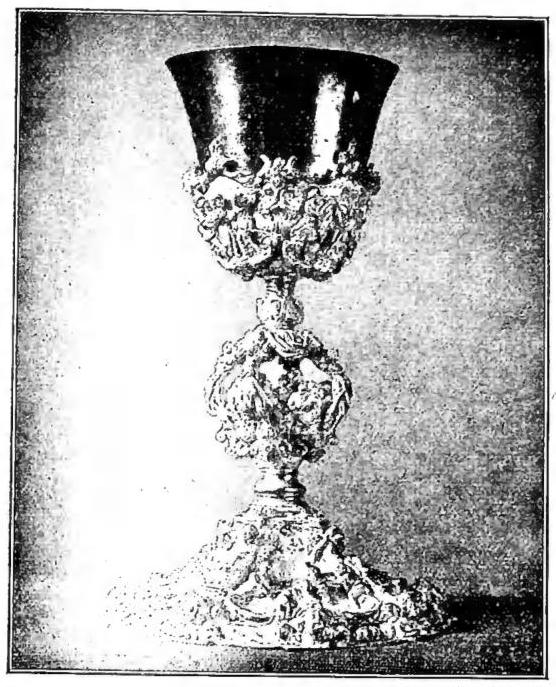
Alongside stucco and marble, one of the materials most widely used for decoration is ceramics. Its manufacture, perfected by the discovery of hard-paste porcelain (at the beginning of the eighteenth century at Meissen in Saxony), spread to Venice, Doccia (Ginori), and Capodimonte (Naples), while production intensified at Delft and Sèvres (under the direction of the sculptor Falconet), for the making not only of statuettes and vessels, but also of panels and furnishings, as in the Japanese Palace in Dresden, which Augustus II had envisioned entirely decorated with Dutch ceramics, or in the First Trianon (now destroyed), known precisely as the Porcelain Trianon. The art of tapestry-making also received great impetus, especially in France, which served as a model for all Europe with the tapestries of Beauvais and the Gobelins, based on compositions by Boucher, Fragonard, and Coppel. In Italy, the Medici manufactories, the one in Turin, to which the painters of the House of Savoy contributed (the Venetian G. B. Crosato, the Neapolitan F. De Mura, the Frenchman Pêcheux, and the Turinese Beaumont), and the manufactory of Naples, which often used French models, acquired renown.In the field of decoration and furnishing, France leads the way, with the decorator J. A. Meissonnier, a native of Turin, «dessinateur... du Roi»; with C. Cressent, cabinetmaker, sculptor, and chaser, creator of exquisite pieces of furniture
French taste spread particularly in Germany, in the decoration of Sans-souci, the work of Swiss artists who followed Robert de Cotte, as well as in the interiors of Bavaria (the castles of Schleissheim and Nimphenburg; the Munich Theater), where F. Cuvilliès worked, author of the « Civil Baukunst Werk » (1738). In Italy, while Piedmontese decoration (the Palazzi di Carignano, Saluzzo-Paesana, and dell'Accademia filarmonica, the Palazzo reale in Turin; the castles of Moncalieri, Rivoli, and Stupinigi) reflects French influences, as do Piffetti’s furniture, inlaid with ivory, mother-of-pearl, tortoiseshell, and metals, Venetian decoration, in the city’s casini and ridotti and in the sumptuous villas of the Brenta, expresses its own style in Brustolon’s carved furniture, in lacquered pieces with flowers and figures and decorated with mirror inlays, in the exotic motifs of panels, tapestries, and splendid brocades (the « cineserie »), and in Murano glass.
Elegant and restrained in Austria, marked by France but not without a strong local character in Russia under Empress Elizabeth (Catherine II instead encouraged a revival of classicism), rococo decoration possesses an independent character in England, especially in furniture, with a pronounced tendency toward linearity and simplicity during the three periods of Queen Anne, Chippendale, and Sheraton - Vedi tav. LVIII.