
CATANIA, ARCHDIOCESE of. — City of Sicily at the foot of Etna and almost midway between the two extreme points of the island’s eastern coast. The hub of the industrial and commercial activity of all Sicily, it has an entirely modern character, owing to the earthquake of 1696, which destroyed its ancient monuments. It is an archiepiscopal see without suffragans. The Cathedral, dedicated to s. Agata, patroness of the city, is the city’s only parish, assisted by several filial churches. The territory of the archdiocese is extensive (1,331 sq km), extending over 23 municipalities of the province of the same name; it has 296 churches, 74 parishes, 309 diocesan priests, 170 regular priests, 26 houses of religious men and 71 of religious women, as well as more than 10 educational institutions for males and 23 for females. The inhabitants number 430,000, all Catholics (1948).
I. HISTORY
Founded around 730 B.C. and enlarged by a colony of Chalcidians, C. became one of the principal cities of the island and for three centuries governed itself according to its own laws. In 477 B.C. it was conquered by Hiero of Syracuse, who, having relegated the inhabitants of C. to Lentini, repopulated it with Greeks and Syracusans. Reconquered by Ducetius (461 B.C.), it later suffered plunder at the hands of the troops of Dionysius I of Syracuse, who entrusted it to a contingent of Campanian mercenaries in his service (403 B.C.), until a few years later (396 B.C.) it fell under the dominion of the Carthaginians. In 353 B.C. it was occupied by the Greeks, but did not regain its ancient freedoms until Timoleon of Corinth took control of its government. When Pyrrhus landed in Sicily in 278, C. was among the cities that welcomed him amicably; but in 263 the centuries-long Roman domination of C. began (Eutropius, II, 19). A « Civitas decumana » at the time of the Republic (Cicero, In Verr., III, 103), in the 1st century it enjoyed great economic prosperity. Later declared a colony by Augustus (Strabo, VI, 268, 272; Pliny, Nat. hist., III, 89), it remained so until the end of the Empire. In the 4th century it was still acclaimed as the most beautiful city in Sicily after Syracuse.During the barbarian invasions it suffered at the hands both of the Goths and of the Ostrogoths; its last incursions took place during the war between the Byzantines and the Goths (549–51). From that time until well into the 9th century C. fell under the peaceful tyranny of Justinian’s successors. After 853 the city was again subjected to intermittent incursions by the Muslims, into whose hands it definitively fell in 974. With this new
(Anderson photograph)
The origins of Christianity in C. are obscure, as indeed they are throughout Sicily. The name of the city appears several times in the Martyrologium Hieronymianum, but its certain martyrs are two: Agata (v.) and Euplo, both soon venerated in Sicily and beyond. The Acta Eupli exist, though in their present form they do not date back to the time of the persecutions (BHL, 2728); they probably derive from now-lost contemporary acts (cf. P. Franchi de' Cavalieri, Note agiografiche, VII [*Studi e Testi*, 49], Roma 1928, pp. 1–54). From these acts it may be inferred that Euplo was martyred between 303 and 304. Consequently, the Church of C. predates the 4th century. In view of the historical conditions governing the spread of the Gospel in the Mediterranean, it is nevertheless not rash to trace the origins of the Church of C. back to the 2nd century. Reliable information concerning the establishment of its hierarchy is lacking, however. Legend has it that the city’s first bishop was Beryllus, consecrated by St Peter together with Pancrazio of Taormina and Marciano of Syracuse. The source of this information is the «Vita e martirio di s. Pancrazio di Taormina» (BHG, 1410), a late and fanciful document from the period of the iconoclastic persecution, which cannot be regarded as reliable. Likewise, Severo or Severino, who is also said to have been bishop of C. in the time of Licinius (307–23), is mentioned in the «Atti dei ss. Alfio e Cirino», composed between the end of the 8th and the beginning of the 9th century.
As for Domninus, who is among the signatories of the Council of Ephesus, and Paulus, who was present at the Council of Chalcedon, they were Eastern bishops, not bishops of C. The first historically attested bishop is Fortunatus, who in 515 was sent with Ennodio of Pavia by Pope Hormisdas to Constantinople (Jaffé-Wattenbach, 774). Later one encounters Elpidio, in the time of Pope Pelagius (558–60), from whom he received consecration (ibid., 892, 992, 1030). During the pontificate of Gregory the Great, the see of Catania was held by Leone (ibid., 1139, 1994). Information about the bishops of the 7th century remains scarce: only a Giovanni is known to have attended the Roman Synod of 649, and his successor Giuliano to have attended that of Constantinople in 678. Meanwhile, the iconoclastic persecutions inaugurated by Leone Isaurico in the first decades of the 8th century marked the beginning of the detachment of the Sicilian dioceses from the Roman patriarchate. C. followed the fate of the others and was placed under the Byzantine patriarchate.
From this time onward, Greek-speaking bishops are found on the see of C., such as St Leone II, who lived in the time of Leone Isaurico, Teodoro, who attended the Council of Nicaea in 787, and Eutimio, a friend of Fozio (850). Around the middle of the 8th century, C. was raised to the status of an autocephalous archiepiscopal see, and this status was recognized subsequently, in the time of Leone il Saggio; indeed, under Giovanni Zimisce (869–97), C. appears among the great ecclesiastical metropolises to which the dioceses of Sicily were subject. With the Arab conquest, the organization established by the Byzantines was destroyed forever, since after the arrival of the Normans C. arose to new life, but as a simple diocese.
The Norman conquest of Sicily began in 1061, with the assistance of the emir of C., who offered himself as an ally to the new conquerors. The city fell into their hands in 1071, but ten years later it rebelled in order to return to the Muslims of Syracuse. This suggests that during the Muslim domination the inhabitants had converted to the Muslim religion. After the reconquest, unlike other cities on the island, it was granted in fief by Ruggero I to the holder of the abbey of S. Agata, founded by the same count of Sicily: the Breton Anserio, formerly prior of S. Eufemia in Calabria (1091). Urban II, approving his appointment, consecrated the elect as bishop, establishing that in the future the abbot of S. Agata would at the same time be bishop of the diocese (Jaffé-Wattenbach, 5460). Immediately afterward, once the boundaries of the new diocese had been established, Ruggero began the construction of the abbey and the Cathedral. From this time until the second half of the 16th century, C. would have its regular chapter, composed of Benedictine monks. Anserio apparently lived until 1124; it was left to his successor Maurizio to receive (1126) the relics of S. Agata, brought back from Constantinople. A few years later, the papal schism of 1130–38 made its repercussions felt in C. as well. Anacleto II, supported by Ruggero II, raised Messina to a metropolitan see (ibid., 8423) and subjected C. to it as a suffragan, whereas Urban II had placed it directly under the Holy See. This acquiescence was revoked after the death of Anacleto II; Maurizio’s successors remained simple electi for thirty years, whom Rome refused to recognize. The situation became normal in the time of Alessandro III, who in 1168 ratified the election of Giovanni Aiello (ibid., 11415), who shortly afterward died beneath the ruins of the Cathedral together with 40 monks in the earthquake of 1169. At the beginning of Norman rule, the bishops of C. were prominent figures at court: Ruggero (1195–1207), tutor of Federico II; Gualtiero di Palearia (1207–32), formerly Federico’s tutor and chancellor of the kingdom, who later (1221) fell from favor and went into exile. The troubled political situation of those years and the struggle between the Hohenstaufen and the Holy See caused the see to remain vacant for many years. Even in 1258, Ottone Capuzio, elected bishop by Innocent IV, had been unable to take possession of his diocese. The calm restored after Carlo d’Angiò’s installation as king of Sicily did not last long: when the revolts of 1282 broke out and the Angevins were driven from the island, the Sicilians, assembled in parliament at C.—from then on the seat of government—transferred the crown to Pietro II of Aragon (1282). Thus began a long dispute between the Angevins and the Aragonese, in which the Holy See sided with the former. The political situation had repercussions in the religious sphere, and Boniface VIII, who had sent Cardinal Gerardo of Parma to C. to strengthen the position of Roberto d’Angiò, who had temporarily established himself there (1299) with the help of a conspiracy plotted against Federico III, was unable to secure the entry of the bishop Gentile whom he had appointed; Gentile subsequently died outside his see in 1304. Leonardo Fieschi, who succeeded him (1304–31), definitively abandoned his diocese after 1314. Niccolò di Ceccano, who was to take his place, likewise remained a simple electus and died in Rome (1339), since that same year the Cassinese Benedictine Niccolò de Grelis was appointed. Meanwhile, the death of Federico III (1337) plunged Sicily into complete anarchy during the brief reign of Pietro II (d. 1342) and that of the inexperienced Ludovico, who died of dysentery in 1355. C., as the seat of government, became the center of bitter struggles that devastated the territory and undermined royal authority. The episcopal see, however, had an eminent leader in the Franciscan Gerardo Odon (1342–48), formerly a disciple of Duns Scotus, a great theologian and minister general of his Order. As early as 1331, Giovanni XXIII had sent him to Italy to undertake peace-making efforts. Through the activity of its bishops, such as Giovanni di Luna (1348) and Marziale (1355), the life of the diocese continued to be intimately bound up with political events, until it became involved in events of broader significance, such as the Western Schism. It was raised to an archdiocese by Gregory XVI on 28 July 1844.
II. CULTURAL INSTITUTIONS
The abbey of S. Nicolò occupies the foremost place in Catania’s cultural history in the eighteenth century, with its rich library, museum and natural-science cabinet, and its learned monks: Bartolomeo d’Alessandro (d. 1919), Emiliano Guttadauro (d. 1856), the archbishop Nicolò Tedeschi, an eminent theologian (d. 1741), Placido Scammacca (d. 1787), and above all Vito M. Amico, an eminent historian.Today, alongside the old Benedictine library, two other libraries founded at approximately the same period still remain: the University Library (eighteenth century), begun with the private collection of G. B. Caruso and that of the Jesuits, suppressed in 1767, and the Ventimiliana Library, attached to the University, which is the former private library of the bishop of C., Salvatore Ventimiglia, who donated it to the University in 1783.
The Athenaeum of Catania is the foremost cultural institution. Associated with its foundation are, besides the names of Alfonso I il Magnanimo, who decreed its establishment in 1434, and Eugenio IV, who sanctioned its establishment in 1444, those of the celebrated jurist and future archbishop of Palermo Nicolò Tedeschi (1383–1445) and the bishop of C., Giovanni de Primis (d. 1449), both citizens of Catania and future cardinals.
III. MONUMENTS
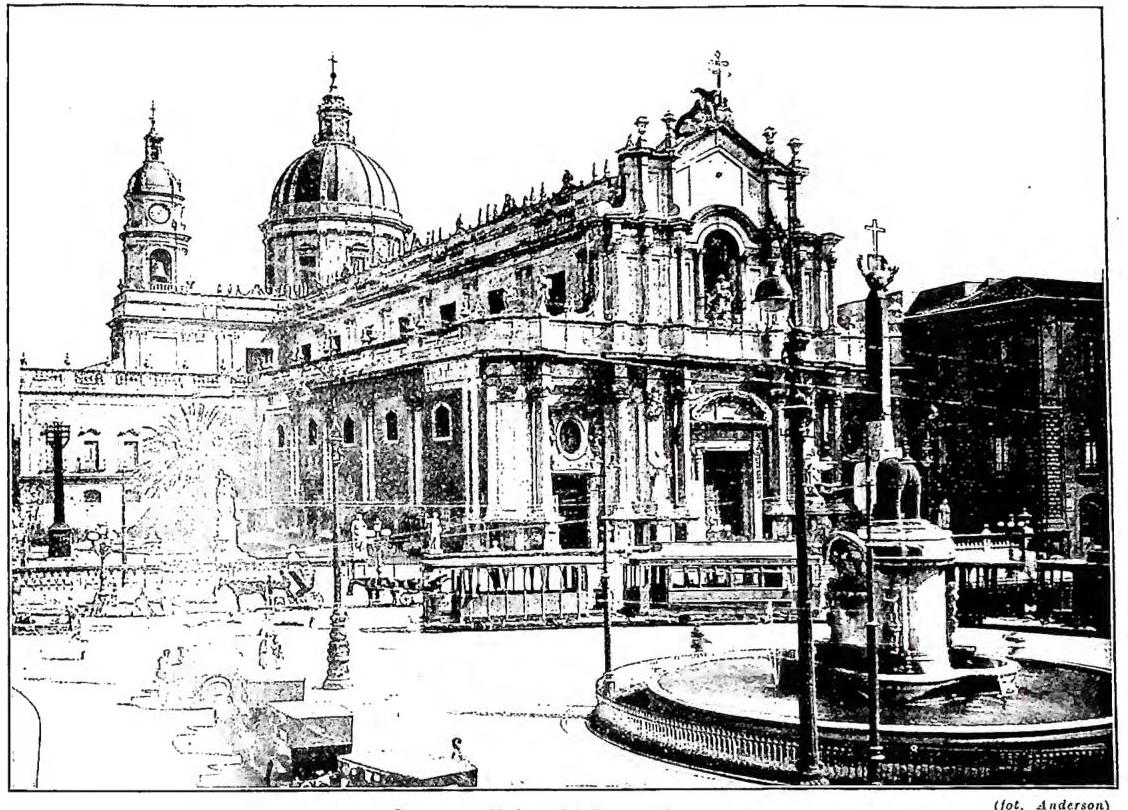
Among the city’s noteworthy monuments, besides the Benedictine church of S. Nicolò, built according to a design by the Roman architect G. B. Contini, the Cathedral must be mentioned; of the Norman-period construction, it preserves only the three massive apses. The church, left incomplete in its façade, has no equal in grandeur among the other churches of Sicily.After the earthquake of 1696, reconstruction was entrusted to G. B. Vaccarini, who was responsible for the façade and the city’s urban reorganization. Worthy of note inside is the funerary monument of the viceroy Ferdinando de Acuna, by the Messinese sculptor Antonello da Fieri. Also noteworthy is the church of S. Carcere, with its thirteenth-century portal, which once adorned the façade of the Cathedral. One of the most significant eighteenth-century complexes of C. is located in Via Crociferi, with the church of S. Giuliano on one side and, on the other, the church of S. Benedetto and that of S. Francesco Borgia, with the former Jesuit college, now a charitable hospice. In the convent of S. Niccolò are frescoes removed from the Roman catacombs, much retouched. — Vedi Tav. LX.
In particular, the older scholarly works by: P. Carrera, Delle memorie historiche della città di C., 2 vols., Catania 1639-42; J. B. De Grossis, Catanese decachordum sive novissima sacrae catanensis Ecclesiae notitia..., 2 vols., there 1642-47; id., Catana sacra sive de episcopis catanensis, there 1654; V. M. Amico, Catania illustrata, 4 vols., there 1740-46; R. Pirri, Sicilia sacra, 3rd ed., I, Palermo 1733, pp. 513-97; F. Ferrara, Storia di C., there 1829; V. Cordaro Clarenza, Osservazioni sopra la storia di C., 4 vols., Catania 1833-34. As regards recent scholarly bibliography, for ancient history reference may be made to Lanzoni, pp. 624-29; P. Franchi de' Cavalieri, Note agiografiche, VII (Studi e Testi, 49), Rome 1928, pp. 1-75; G. Libertini, Tarde iscrizioni catanesi e bolli bizantini, in Arch. stor. Sic. orient., 27 (1931), p. 50 ff.; id., C. nell'età bizantina, ibid., 28 (1932), pp. 242-68; H. Achelis, Römische Katabombenbilder in C., Berlin 1932; A. Ferrua, Osservazioni sulle iscrizioni cristiane catanesi, in Bollettino storico catanese, 3 (1938), pp. 33-59; B. Pacu, Arte e civiltà della Sicilia antica, IV, Rome 1949, pp. 9 ff., 35 ff., 112 ff., etc.
For the medieval period, besides the well-known work of E. Caspar, Roger II, Innsbruck 1904, pp. 613-27, and the more recent work of L. T. White, Latin Monasticism in Norman Sicily, Cambridge, Mass. 1938, pp. 104-17, the papal registers published to date must be taken into account for the episcopal succession: G. Pressutti, Regesta Honorii papae, Rome 1881; Ch. Grandjean, Les registres de Benoît XI, Paris 1883; G. Dizard, Les registres de Boniface VIII, there 1896; E. Jordan, Les registres de Clément IV, there 1893; C. Bourell de la Roncière, J. de Loye and A. Coulon, Les registres d'Alessandre IV, there 1902; J.-M. Vidal, Benoît XII. Lettres communes, there 1903 ff.; G. Mollat, Jean XXII (1316-34). Lettres communes, there 1904-39; Eubel, I, pp. 176-77.
For the modern period: besides vols. III and IV of Eubel, pp. 174-75 and 141-42, cf. also, for the last period: V. Messina, Biografie dei vescovi cataneri dei secc. XVIII e XIX, in La Sicilia sacra, 5 (1904), pp. 4-26, 142-62, 289-313, 445-66; 6 (1905), pp. 126-41, 228-50, 395-421; cf. also F. Coco Liccardelli, Sacerdoti catanesi memorabili del sec. XVIII, ibid., 3 (1901), pp. 215-18, 268-74. For cultural history, besides R. Sabbadini - M. Catalano, Storia documentata della R. Università di C., 2 vols., Catania 1898-1913, V. also V. Casagrandi, L'Archivio della R. Università di C., there 1897, and the commemorative articles for the centenary in Archivio storico per la Sicilia orientale, 30 (1934), pp. 182-398; M. Gaudioso, L'abbazia di S. Nicolò l'Arena di C., ibid., 25 (1929), pp. 199-243; C. Naselli, Letteratura e scienza nel convento di S. Nicolò l'Arena, ibid., pp. 245-323. For the artistic history of C., reference should be made especially to R. Pennisi, Notizie storiche sulla cattedrale di C. e sull'offresco della grande abside, in Asso, 23 (1927), pp. 249-96; G. Basile, Le opere di Antonio da Freri nella cappella di S. Agata della cattedrale di C., ibid., 28 (1932), pp. 95-121; F. Fichera, G. B. Vaccarini e l'architettura del Sestecento in Sicilia, 2 vols., Rome 1934; Cottineau, I, cols. 631-32.