
Valerius Licinianus Licinius
ROMAN EMPEROR. — Born ca. AD 250 in Dacia Ripensis, that is, in the region south of the Danube which Aurelian had chosen to call thus after being forced to abandon the true Dacia, whose borders to the north of the great river were too insecure. It is by no means unlikely that his parents were peasants; at that time it was quite possible to rise very high from the lowest social strata; the most common path was through the military. L. was a soldier, and good fortune placed him near another rough man destined for the highest honours, Galerius, also from Dacia Ripensis and of modest origins (he was called Armentarius) and raised by Diocletian to the rank of Caesar. Their shared life led to friendship; when Galerius became Caesar, he took his former tent-mate with him. L. was usefully at his side in the difficult war against the Persians, which began badly but then turned out so fortunately that it could be celebrated with Galerius’ triumphal arch at Thessalonica.
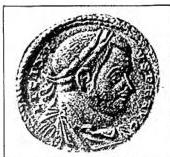
LICINIO - Coin.
Augustus L. (11 Nov. 308). The solution, evidently championed by Galerius, violated the principles already established by Diocletian himself, since it disregarded the rights of the Caesar Maximinus Daia and proposed an "homo novus" like L. When it came to implementing the decisions of the Carnuntum conference, L., who was supposed to take possession of the entire West, could do nothing against Maxentius and Constantine and had to content himself with exercising his authority in a very restricted area between the Alps and the Danube.
A few years later Galerius died (311), and Maximinus Daia, the Caesar of the easternmost provinces, deemed the moment ripe to avenge the rebuff he had suffered at Carnuntum. Proclaiming himself Augustus, he rushed to take possession of Asia Minor, bringing his army to the Asian shores of the Bosporus. L. had to resign himself to recognizing his possession of all the Asian provinces and Egypt, managing to retain for himself Thrace and the Balkan peninsula. Meanwhile, Constantine, with the battle of Saxa Rubra, put an end to the Italo-African empire of Maxentius (28 Oct. 312), and L., who had been unable to be a friend either of Maxentius or of Maximinus Daia, drew close to the victor. He met him in Milan, married his sister, and issued with him the edict of freedom for Christianity.
Returning to his part of the empire, L. found that Maximinus Daia had crossed the Bosporus and occupied Byzantium and Heraclea. War could no longer be avoided, and indeed it was fought in Thrace at Campus Serenus with the full victory of L., followed by the precipitate flight of his rival to Tarsus in Cilicia and his subsequent death (314). L. was master of half the empire, but precisely now he gave proof of his nature as a suspicious, impulsive, and cruel barbarian. He indeed had all those sought out and killed who might have laid claim to the throne, sparing not even the relatives of his benefactor Galerius. Moreover, even apart from the deficiencies of L.'s personality, it was difficult, even for intrinsic reasons of the differing interests of the two parts of the empire, to maintain good accord between the two emperors who remained after the failure of Diocletian's tetrarchic system. The divergences grew ever worse from 314 onward and degenerated into open war, in which L. was defeated near Adrianople (323) and then near Chrysopolis (323). Through the intercession of his wife, Constantine's sister, his death sentence was commuted to relegation to Thessalonica. But since he continued to weave intrigues even there, he was brought to trial by the Senate and condemned to death, which he suffered at the hands of the Goths during an attempted escape, or by order of Constantine, in Thessalonica (325).
The disagreement between the two emperors had also manifested itself in their treatment of Christians: L. was and remained a pagan, but he had been able to see the failure of Diocletian's persecution and to note the change of heart of Galerius, who had been the fiercest of the persecutors. Thus he was tolerant toward Christians and not only subscribed with Constantine to the so-called Edict of Milan but, when he went to war with Maximinus Daia, who had remained an obstinate persecutor, issued a decree that promised restitution of confiscated goods to Christian subjects, the rebuilding of churches, etc. (13 June 313). Matters began to change when, with the rise of the preaching of Arius, L. showed himself favorable to it, placing himself in contrast with Catholic bishops who were exiled, imprisoned, and prevented from holding councils. And since Constantine increasingly openly protected Christians, L. in contrast took a hatred of them and oppressed them in every way. Such was the man, far inferior to the high dignity to which only in these troubled times was it possible for him to attain.