
MACEDONIA. - The south-central region of the Balkan peninsula, until 1912 included in European Turkey and divided among Greece, Yugoslavia, and
Bulgaria. It corresponds approximately to the depression lying between the Rhodope massif, the lower course of the Mesta, and the Pindus range, widening southward, where it opens onto the Gulf of Salonica. It comprises the basins of the Bistriza, Vardar, Struma, and Mesta rivers and extends over approximately 67,000 sq. km., with a population of approximately two and a half million inhabitants, distributed over the extensive territory of which 51% belongs to Greece, 39% to Yugoslavia, and 10% to Bulgaria.
I. GEOGRAPHY
Geologically, M. has no distinctive features, being composed in its various parts of crystalline schists, granites, sandstones, serpentines, and limestones. Morphologically, it displays a characteristic division of the relief into numerous basins (fluvial and lacustrine) of tectonic origin. In the Aegean region the climate is typically Mediterranean, with dry summers and mild winters; inland, on the other hand, it assumes increasingly continental characteristics. The most important centres of Greek M. are Salonicco, Cavala, Dráma, Seres, Skoplje, and Monastir. Agriculture and pastoralism are the foundations of economic life: wheat, barley, rye, maize, and rice are cultivated most intensively; among industrial crops, tobacco is important, absorbing approximately half of agricultural production. Mineral resources exist, owing to the presence underground of chromite, pyrite, zinc, magnesite, etc. Tobacco, cocoons, flour, hides, and opium are exported; textiles, timber, paper, machinery, and chemical products are imported. The port of Salonicco, the southern outlet for Central Europe, is rather a regional port; moreover, all internal and foreign trade is insufficiently developed because of the instability of political life.Gastone Imbrighi
II. ECCLESIASTICAL AND CIVIL HISTORY
The first organized mission to Europe of which documented memory has been preserved is the one that St. Paul conducted in M. around the year 50. The decision to go there was taken after clear and repeated signs of the divine will (Act. 16:9). When the Apostle arrived there, M., already a Roman province for two centuries but for many years troubled by invasions of Thracians, Bessi, and Scordisci, and subsequently disturbed by the gathering there of the large armies of Brutus and Cassius and of Antony before Actium, had finally regained a period of peace and prosperity. With the Danube reached as the frontier of the Roman state, M. could, under the Augustan administrative arrangement, be left to the administration of the Senate, as one of the provinces pacatae et inermes. The population, fundamentally Greek (even if Isocrates and Demosthenes had never wished to recognize it as such), had been augmented by many elements from other peoples, thanks especially to the numerous colonies of veterans settled there by the triumvirs and by Augustus, who in M. precisely found the great armies to be discharged of Caesar’s assassins and his avengers.Silas and Luke went to M. with Paul; when Luke comes to speak of this journey, he suddenly changes the verb from the third person to the first person plural (Act. 16:10). Having crossed from Troas to Samothrace and then landed at Neapolis (today Cavalla), they reached nearby Philippi (v.), which had received an important settlement of Roman colonists and also had a Jewish nucleus, to whom Paul addressed himself on a Sabbath, when they had assembled outside the city, near the river. Conversions and persecutions were not lacking. After Paul had freed a possessed woman, the missionaries were accused before the magistrates, as Jews who were causing disturbances; they had them beaten with rods and shut in prison. Paul disclosed his status as a Roman citizen and received apologies and a request that he depart. Passing through Amphipolis and Apollonia, the Apostle and his companions proceeded to Thessalonica (v.), which had been declared a free city and was at the same time the seat of the provincial governor. It therefore bore the titles of πρώτη Μακεδόνων and μητρόπολις, and, thanks to its good harbor and the construction of the Via Egnatia, enjoyed considerable prosperity. The Jewish colony there must have been numerous and wealthy; in the synagogue, for three consecutive Sabbaths, Paul spoke, explaining the Scriptures and announcing the coming and Resurrection of Christ. Many were converted, both Jews and Gentiles. But zealous Jews accused the missionaries before the authorities of rebellion against Caesar, and the authorities, not having found them, brought Jason, who had hosted them, before the tribunal. When the other faithful learned of these events, they sent Paul and Silas away by night to Beroea (today Verria), where there was also a synagogue in which Christian preaching was heard with great interest and resulted in many conversions. However, the obstinate Jews of Thessalonica, having learned that Paul’s work was continuing, came to Beroea, stirring up hostility and disturbances, so that the faithful sent Paul away; he traveled as far as Athens, though he left Silas and Timothy in Beroea, and they later joined him at Corinth (Act. 22:13 and 18:5). Although thus strongly opposed, the Christian communities that arose from this preaching lived and flourished, and St. Paul always remembered them with pleasure and affection, as shown by his two Epistles to the Thessalonians (v.), which are the oldest of his, and Epistle to the Philippians (v.). The latter, written by the Apostle during the first of his imprisonments in Rome, knows of a Church already fully constituted, with a bishop and deacons. Paul desires to see again the brothers of Philippi, who were faithful to him at the beginning of his preaching; he will send Timothy to them as soon as possible, and has sent Epaphroditus, of whom he has so much good to say. Aristarchus of Thessalonica accompanied Paul on his final journey to Rome, recounted in Act. 27:2. The Second Epistle to the Corinthians was written during Paul’s second stay in M., after the hostile demonstration that compelled him to leave Ephesus (II Cor. 1:16). The Macedonians Sopater of Beroea, Aristarchus and Secundus of Thessalonica, and Gaius, who is here called a native of Derbe and shortly afterward (ibid. 19:29) is called a Macedonian, accompanied him. Paul praises the Macedonians to the Corinthians, especially for their generosity in almsgiving, despite their poverty.
There is much reason to doubt the missions in M. of St. Matthew and St. Andrew, mentioned by Isidore (De vita et morte sanctorum, 67). Little is known about the subsequent history of the Church of M. In the Greek Menaia and historical Martyrologies the following are listed as the first Macedonian bishops: Aristarchus at Thessalonica, Epaphroditus at Philippi, Onesimus at Beroea. We possess a letter to the Philippians by St. Polycarp of Smyrna (v.), which gives strong testimony to the vitality of the Church of Philippi. In a passage from the Apology of Melito of Sardis addressed to Marcus Aurelius, cited by Eusebius (Hist. eccl., IV, 26, 10), it is said that Antoninus Pius wrote to various cities, including Thessalonica, because they had not stirred up riots against the Christians. From 253 onward, incursions by the Goths began and recurred; they defeated and killed the emperor Valens in the great battle of Adrianople (378) and did not cease until the emperor Zeno succeeded in driving away Theodoric and his Ostrogoths, unloading them in Italy.
The persecutions also produced victims in M. The Acts of the martyrdom suffered at Thessalonica during the persecution of Diocletian by a man, Agatho, and six women, as well as by the megalomartyr Demetrius, formerly governor of Achaea, have been transmitted. The presence of Macedonian bishops is recorded at nearly all the major councils, beginning with that of Nicaea, and councils were also held at Thessalonica itself.
In Constantine’s division of the Empire into four praetorian prefectures, M. became part of the prefecture of Illyricum, whose capital was initially Sirmium but later, for a time, Thessalonica, where the emperor Theodosius I resided on several occasions and where he received Baptism during a serious illness.
When, under the sons of Theodosius, the division of the Eastern Empire from the Western became definitive, the dependence of the prefecture of Illyricum upon one Empire or the other naturally became a subject of dispute. As regards ecclesiastical organization, Rome vigorously defended its jurisdiction over the Churches of Illyricum, and evidently so that it might exercise it more effectively, Pope Siricius entrusted the bishop of Thessalonica, Anysius, with the functions of his vicar; these functions were confirmed more than once by subsequent popes. This dependence upon Rome, naturally viewed with disfavor by the patriarch of Constantinople, was terminated around 730 by the emperor Leo III the Isaurian.
Among Macedonian Christian writers, only Paulinus of Pella is remembered; he lived in Gaul, however, between the end of the fourth century and the middle of the fifth, and wrote verses in Latin.
Meanwhile, profound ethnic changes in M. are recorded with the immigration of numerous Slavic tribes, which began in the time of the emperor Justin (518–27) and continued until well into the seventh century. After the destruction of the wealthy city of Sirmium (581) by the Avars, the masses of Slavs brought by them unsuccessfully besieged Thessalonica (611), and settled in its vicinity; they destroyed Stobi, the capital of Roman M. Salutaris (today Pusto Gradsko on the Vardar), and Justiniana Prima (built in 536 by the emperor Justinian as
(from F. Perilla, A travers la Macédoine, Athens 1932, pp. 111–13)
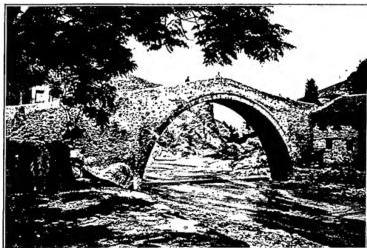
MACEDONIA - Byzantine bridge - Elassona.
With the occupation of the Greek city of Sardica (809), the last remnant of M. also passed under the Bulgars, who, with the baptism of their duke Boris in 865, became definitively Slavicized (v. BULGARIA). To defend national and state independence from Constantinople, Boris temporarily drew closer to the Church of Rome and, after their expulsion from Moravia in 886, generously welcomed the disciples of the Apostles of the Slavs, the ss. Cyril and Methodius, who were Greeks from Thessalonica, the capital of M. (v. CIRILLO (COSTANTINO) E METODIO, SANTI). They completed the work of Christianizing the Slavs of M., which had already begun earlier.
The most famous among these, venerated by the people as saints, are Clement of Ochrida (v. CLEMENTE DA SCATIA) and Naum. They made the city of Ochrida, on the shores of the lake of the same name, not only an important hierarchical center (v. ACCIDIA), but also a celebrated cultural hearth of the Old Slavonic language, which in reality is nothing other than the dialect of a tribe from the vicinity of Thessalonica, raised to the dignity of the ecclesiastical-literary language of the Slavs. In 893 the Bulgarian emperor Simeon appointed Clement bishop of Velitsa, within whose boundaries Ochrida lay. He was also buried there, in the church dedicated to him, discovered in recent excavations (1950), while Naum was buried in the important monastery he founded on the southern shores of Lake Ochrida.
After the fall of the Danubian Bulgarian Empire to the Greeks in 971, Ochrida reached its greatest splendor under the emperor Samuel, not only as the capital of western Bulgaria but also as heir to the autonomous patriarchate of Trnovo. But the emperor Basil II, the Bulgar-slayer, destroyed the two-century-old Bulgarian domination in M. in a sea of blood, occupying Ochrida in 1018. He left there the seat of the autocephalous metropolis with about thirty suffragan dioceses, which no longer claimed succession from the Bulgarian patriarchate of Trnovo, but rather the privileges of the Roman metropolis of Justiniana Prima.
M. remained under Byzantine rule despite many Slavic insurrections and rebellions, to which the emperors responded with punitive measures, deporting many of them to Asia Minor. The renewed Bulgarian state under the emperor Kalojan, crowned at Trnovo by the papal legate in 1204, gradually took possession of all M., except Thessalonica, where the Latin Empire of the same name arose (1204–16). At this same time the monks of Mount Athos united with the Church of Rome. In the period that followed, M. was contested by the Bulgars, the Latins, and the Greeks of the Despotate of Epirus and the Empire of Nicaea, who remained masters of the country until the appearance of a new contender from the north: Serbia. In 1282 the Serbs seized Skoplje, and under Stefan Dušan, the greatest Serbian king (1331–55), they took all M., Albania, Epirus, and Thessaly; he therefore crowned himself at Skoplje in 1346 as «emperor of the Serbs and the Greeks» (Imperator Rasciae et Romaniae). After him the state dissolved into many sem independent counties, whose rulers became Turkish vassals, among them King Marko (Kralj or Kraljević Marko), lord of Prilep, the principal hero and a highly idealized figure in the popular poetry of all the South Slavs (d. 1394). The Turkish rule, which lasted for more than five centuries, brought further ethnic and religious changes to M. Masses of Turks immigrated from Asia Minor, especially the seminomadic Juruk shepherds of Konia (hence still called Koniati). They drove most of the Vlachs from the Balkan mountains beyond the Danube into present-day Romania and northwestward into the Croatian and Serbian territories.
The Albanians, on the other hand, grew considerably stronger, especially after the Islamization and migration of the Serbs toward the north. A portion of the Bulgars (Pomaks) and the Greeks (Valachides) converted to Islam. The remnants of the medieval Catholic colonies of Croats (Raguseans) and Saxon miners survived until the end of the seventeenth century in Skoplje, Kratovo, and elsewhere, and at Letnica still today, administered by the bishops of Skoplje and Prizren.
During this difficult period, the «ecumenical» patriarchate, taking advantage of its privileged position in the Turkish Empire and of the influence that the wealthy «Phanariot» families exercised at the Sublime Porte, abolished the Slavonic liturgy and burned the Slavonic sacred books, while choosing bishops and the higher clergy exclusively from among the Greeks. Greek pressure in M. reached its peak after the abolition of the autocephalous Church of Ochrida (1767). Meanwhile, however, the Bulgarian national revival also began in M., with Father Paisie, Macedonian by birth, who was the first to write a history of Bulgaria (1762). Likewise, the movement for the emancipation of the Bulgarian Church from the detested Phanariots first appeared at Skoplje in 1829. In the ardor of the struggle against the Phanar and the Greeks, a strong movement for union with Rome first began in the city of Kukuš (Kilkis), north of Thessalonica; more than 60,000 people soon joined II. Pius IX himself consecrated the first united bishop, the igumen Joseph Sokolski, in 1861.
Concerned by the prospect that all the Macedonian Bulgars might return to the Catholic Church, Russia, and alongside it England, maneuvered with the Sultan, who by his firman of 11 March 1870 established the Bulgarian exarchate, with its seat in Constantinople, independent of the «ecumenical» patriarchate. The Synod of the Greek Church therefore excommunicated those who adhered to the exarchate and condemned them as «racists» («phyletists»). The excommunication was lifted only in 1945.
The cause of the Union suffered a serious blow in M. with the abduction of Bishop Sokolski, due to Russian intrigues, after which all trace of him was lost. Some of the faithful remained devoted to the Union, but were severely scattered by the wars, the destruction of Kukuš, and forced migrations. As a result, the vicariate of Thessalonica, founded in 1883 and administered by the Lazarists, practically disappeared. Today, among the faithful of the Eastern rite, in the three parts into which M. is divided, those under Bulgaria belong to the Bulgarian Catholic exarchate of Sofia (approximately 7,000), those under Yugoslavia to the diocese of Crisio (5 parishes with 3,000 faithful), and those under Greece to the apostolic vicariate of Greek M., established in 1926. In the first two parts the Eucharistine Sisters work; they were founded in 1883 by Mother Giuseppina Alleotti. The cause of the Union still enjoys broad sympathy in M., both among the people and among intellectuals. Roman-rite Catholics, mostly recent immigrants, have their diocese at Skoplje.
Because of the numerous and bloody uprisings provoked by the Macedonians’ struggle for independence, the racial mixture, and the intrigues of the neighboring states in this central and strategically most important area of the Balkans, M. is regarded as an “erupting volcano,” the “powder keg of Europe,” and “quintessence of the near eastern question.” Various solutions have been attempted
to this hitherto unresolved problem. The unsuccessful conference between the four great European powers and Turkey for the drafting of the Bulgarian Statute of 1876, as well as the Treaty of Peace of S. Stefano in 1878, had assigned the whole of M., with Skopje, Castoria, and Ochrida, to Bulgaria. The Congress of Berlin in 1878 left M. to Turkey, fearing too strong an influence of Russia in the Balkans. A solution was sought—especially after the bloody uprising in western M. on the feast of S. Elijah, 2 Aug. 1903, according to the old calendar (“Blindensko vostanie”), with hundreds of villages destroyed and 5,000 combatants killed—through internal reforms, but in vain. Both the Greeks, who obstinately insist on seeing in the Orthodox Macedonians nothing but “Bulgarophone Greeks,” and the Serbs, who for their part present the Macedonians as “Slavs without a specified national consciousness,” ready to become “southern Serbs,” see the possibility of realizing their aspirations only through a partition of M. The Macedonian Bulgarians, especially after the creation of the I.M.R.O. (Internal Macedonian Revolutionary Organization), considering the presence of numerous national minorities in the territory, desire an autonomous Macedonian State organized on the model of Switzerland—that is, not on nationalistic but on regional principles—with the motto: M. to the Macedonians. The Balkan War of 1912 did indeed drive the Turks out of M., but the new Balkan War and the Peace of Bukarest in 1913 divided M. among the Greeks (1,015,000 inhabitants), Serbs (1,071,000 inhabitants), and Bulgarians (213,000), a division later confirmed by the Peace of Neuilly in 1919, at the further expense of the Bulgarians. The exodus and expulsion of hundreds of thousands of people began, especially after the exchange of populations between Greece and Turkey in 1922.
Of the approximately 2,300,000 inhabitants before the Balkan War of 1910, 1,000,000 were Bulgarians (there are no official statistics by nationality, but only by religion), 540,000 Turks, 250,000 Greeks, 184,000 Albanians, 78,000 Vlachs, 40,000 Gypsies, and 100,000 Jews and others.
Tito’s regime in Yugoslavia recognizes Yugoslav M. as one of the six federal Republics of Yugoslavia and attempts to create a new “Macedonian language.”
The unfortunate partition of M., the population’s perpetual unrest, and Russia’s effort to “liberate” and “unify” the country still make M. one of the most dangerous neuralgic zones of Europe today. - Vedi tav. CXIX.
BIBLI: K. Jireček, Geschichte der Bulgaren, Praga 1876; H. Gelser, Das Patriarchat von Ochrida, Lipsia 1902; L. Dominian, The Frontiers of Language and Nationality of Europe, Nuova York 1917; Derjavin, Les Rapports Bulgare-Serbs et la Question Macédonienne, Losanna 1918; A. Belč, La Macédonie, Parigi 1919; L. Jireček-Radonjic, Istorija Srba, Belgrado 1922-23; G. Weigand, Ethnographie von Macedonien, Lipsia 1924; I. Snjegarov, Istoria na okrišťkata arhiepiskopopija-patrijarija, Sofia 1924 e 1932; Statistica con cenni storici della gerarchia e dei fedeli di rito orientale, Città del Vaticano 1932; Ch. Anastasoff, Autonomous M., St. Louis 1945; I. Mihailoff, M. a Switzerland of the Balkans, ivi 1950; G. Stadtmüller, Geschichte Südosteuropas, Monaco 1950. Per l'arcivescovo di Ochrida V. A. P. Péchaire, in Echos d'Orient, 35 (1936), pp. 183-204, 280-323, e V. Laurent, Le patriarche d'Ochrida Athanase II et l'Eglise Romaine, in Balcania, 8 (1937), pp. 3-65.
Stefano Draganović