
THEODOSIUS I, ROMAN EMPEROR. — Born at Cauca on 11 January 347, died at Milan on 17 January 395. Having entered the army, he followed his father in the campaigns in Britain and Africa; but after his tragic death (376) he withdrew into private life. He was recalled to service by Gratian after the battle of Adrianople (378), with the rank of magister equitum; shortly thereafter he was appointed Augustus (January 379) and entrusted with the Eastern Empire. He immediately set about pacifying those pro-
vinces through judicious military and diplomatic action, curbing the ambitions of the barbarians who were raiding along the frontiers.
In August 383 Magnus Maximus was proclaimed emperor by the soldiers of Britain and descended into Gaul; Gratian, abandoned by his troops, took refuge at Lyons, but was betrayed and killed by the governor of the city. T., compelled by the rapidly unfolding events, accepted the fait accompli and recognized Maximus’s rule over Britain, Gaul, and Spain. In 387, however, the usurper entered Italy with the evident aim of seizing it; Valentinian II, together with his mother Giovina, fled to Thessalonica. T. could tolerate this no longer and, having pacified the eastern frontiers of the Empire through an agreement with Persia, marched against Maximus; the latter was defeated at Petovio and, having taken refuge at Aquileia, was betrayed by his own soldiers and killed (August 388). While the general Arbogast pacified Gaul by defeating Maximus’s son, Flavius Victor, T. remained in Italy until 391. During this period he had the two famous conflicts with St. Ambrose, in which the Saint succeeded, in the name of his spiritual authority, in imposing his will on the fiery Emperor. At Callinicus (Cappadocia), the Christians had burned down the synagogue; T. ordered that it be rebuilt at the expense of the city’s bishop, but Ambrose obtained the revocation of the order (St. Ambrose, Epist., 40 ff.: PL 16, 1148–69). More important and sensational was the affair of Thessalonica; there the citizens, who had been unable to secure the release of a charioteer, had risen up and killed the authorities. T. ordered a reprisal in which several thousand people were massacred. St. Am-
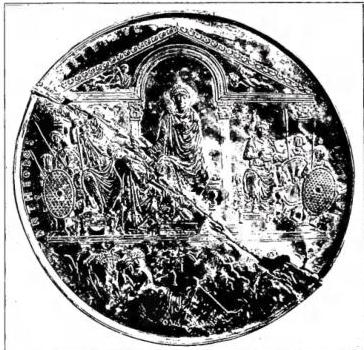
TEODOSIO I, IMPERATORE ROMANO - Missorium of T. I with Valentiniano II and Arcadio. Silver clipeus of 388 with the inscription IN THEODOSIVA PERFET. AUG. OR DIEM FELICISSIMVM X. - Madrid, Royal Academy.
Ambrose vigorously protested against the brutal act and wrote a letter to the Emperor threatening him with excommunication unless he did penance; after some evasion T. humbly submitted to the bishop’s injunctions and at Christmas 390 was readmitted to Communion (s. Ambrogio, Epist., 51: De obitu Theodosis: PL 16, 1209-14, 1447-68).
Having returned to the East, T. still had to fight against the barbarians, with whom, after defeating them, he concluded a peace treaty in 392. In the West, however, another usurper arose; the general Arbogaste, after the death of Valentiniano II (May 392), whom he may have had assassinated, had the rhetorician Flavio Eugenio proclaimed emperor. Supported by the pagan party, led by the prefect of the praetorium Nicomaco Flaviano, Eugenio came to Italy; T. marched against him and defeated him near the river Frigidus (Friuli): Eugenio and Arbogaste were killed in battle (summer 394). The Roman Empire once again returned to the hands of a single sovereign worthy and capable of ensuring prosperity and tranquility for all, but these hopes were soon frustrated, since, having fallen seriously ill, T. died at Milan in January 395, leaving as heirs his two sons Arcadio and Onorio, whom he had already appointed Augusti in 393.
If T.’s activity was beneficial to the Empire, no less important was his religious policy with regard to Catholicism and paganism; for he sanctioned the definitive triumph of the former over the various heretical sects and hastened the disappearance of the latter, which still had fanatical supporters among the senatorial class. T. did not directly act against individuals, but, continuing the policy of Costanzo II and Graziano, succeeded fully in attaining his goal. In 381 and 383 he deprived apostates of their civil rights (Cod. Theod., XVI, 7, 1-2). After the death of Graziano, he sent the prefect Cinegio to Egypt with the explicit order to prohibit idolatry and close the temples. While in Rome, after his victory over Massimo, he rejected the repeated petitions of the Senate requesting the restoration of the Altar of Victory; indeed, in a speech he urged the senators themselves to abandon their pagan superstitions and embrace Catholicism. Shortly afterward he withdrew all state subsidies for the worship of the temples and prohibited every public pagan ceremony in Rome, threatening severe penalties against the authorities who tolerated them (ibid., XVI, 10, 10); the same decree was extended to Egypt (ibid., XVI, 10, 11), and in 392 to the whole Empire, establishing fines and confiscations against transgressors (ibid., XVI, 10, 12). Finally, after his victory over the usurper Eugenio, he applied with greater rigor all the laws previously enacted against paganism.
This action undertaken by T. against idolatry, besides being inspired by his feelings as a convinced Christian, also arose from the realization that paganism could no longer sustain the old Empire, threatened on every side by the barbarians; only Christianity could infuse it with new vitality and, permeating it with its catholicity, could save and preserve its continuity. The true and only Christianity of T. therefore could be none other than the Catholic faith, the same faith that Pietro had preached at Rome and that his successor Damaso taught (ibid., XVI, 1, 2). From this derives all his religious policy in combating heresies, and particularly the one that in the 4th century had more than any other attacked Catholic orthodoxy: Arianism. From the very beginning of his government, having fallen ill at Tessalonica, he requested Baptism from the local bishop, but before receiving it he wished to ascertain that the bishop was orthodox. Having settled in Costantinopoli in 380, his first concern was to induce the Arian patriarch Demofilo to adhere to the Catholic faith; when the latter refused, he recognized the Catholic s. Gregorio, to whom he restored all the churches of the city (ibid., XVI, 5, 6). He took part in the Council of 381 and confirmed its decisions against the heretics (ibid., XVI, 1, 3). In 383 he sought to bring about reconciliation among the various sects and summoned their leaders to Costantinopoli to examine their respective professions of faith; the discussions led to no result, and T., having accepted the Catholic profession, had all the others burned and promulgated several edicts prohibiting every assembly of heretics (ibid., XVI, 5, 11-13).
T.’s multifaceted legislative activity thus soon led to the total disappearance of Arianism from the Empire.