
IDOLATRY (εἰδῶλον λατρεία). - I. NOTION.
- In its literal meaning it indicates the worship of idols. The term idol (εἰδῶλον) in Sacred Scripture is used with various meanings: it denotes entities both real and imaginary, to which worship is rendered; and the hagiographer is aware that often, beneath an image and an effigy, men offer their worship to demons; but commonly the name idol denotes the image of a false divinity (Deut. 32, 17; Ps. 106, 37; I Cor. 10,20 etc.; cf. also F. Prat, Idole, in DB, III, cols. 816-25).
St. Augustine calls idolaters those who give effigies the worship that is due to God.
It should be borne in mind that humanity has rendered and renders its worship to idols in various ways. In the ancient Greco-Roman pagan world, while the common people did not separate the divinity from its image, the theologians, so to speak, of paganism did not share in this error, although they too believed that the spirit of the god dwelt in the images and made them venerable and beneficial.
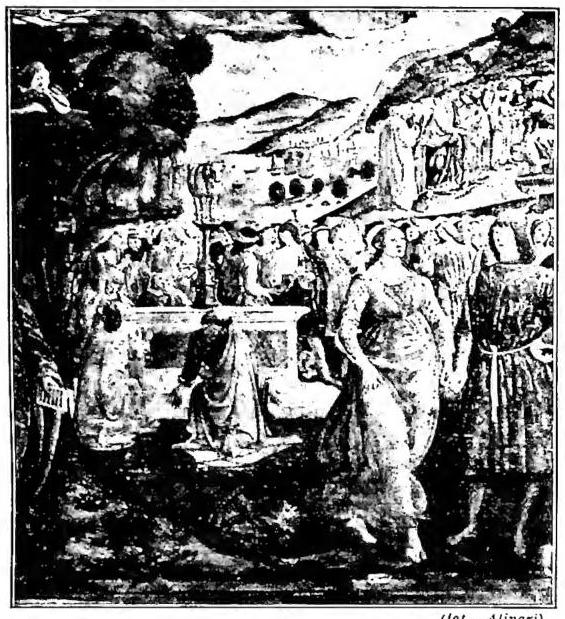
As for the origin of idolatry, it is known from Revelation itself monotheism (v.). But as for knowing what the causes of idolatry were, this is not easy (v. POLITEISMO). Today, among the paganizing world living on the margins of Christianity, crude forms of idolatry have been replaced by other subtler, but no less dangerous forms of idolatry, and matter, the collectivity, blood, the
(Alinari photograph)
IDOLATRIA — Adoration of the golden calf. Detail of the fresco by Cosimo Rosselli (1483) — Vatican, Sistine Chapel.
State. In order to demonstrate the different degree of culpability of the ancient and modern idolaters, it is therefore necessary to distinguish the various forms and various manifestations of idolatry.
II. DIVISION
First of all, one may distinguish: 1) idolatry through ignorance: this is the case of unbelievers and pagans, who sincerely believe that idols are the true divinity; 2) real idolatry, which is the sin of those who, knowing the true God, worship idols: this case is frequent in the history of the Jews; 3) simulated idolatry, which is the sin of those who, out of fear of persecution, perform the external act of worship before idols, without offering them internal worship; the so-called «lapsi» (v.) belonged to this category in antiquity. Idolatry «through ignorance» or «simulated» is also called material idolatry, whereas «real» idolatry is called formal. The latter may in turn be subdivided into perfect and imperfect. It is perfect when divine honors are attributed to a creature, with the conviction that it truly possesses divine powers. In this case idolatry is joined to unbelief (v. INFEDELI). It is imperfect when the falsity of the idols is known and yet, moved by a feeling of hatred toward God or by the hope of obtaining some advantage from the demon, one renders divine worship to the idol known to be false.III. MALICE
Every idolatry that does not arise from invincible ignorance is a grave sin. In the Old Testament it was prohibited by the first commandment of the Decalogue and punished with the severest penalties (Deut. 5, 7-9; 7, 25-26, etc.). Under the evangelical law, during the first centuries of the Church, idolatry was regarded as one of the gravest sins and subjected to a public and very lengthy penance.The malice of this sin consists in the fact that it entails a true rebellion against God, depriving him of the worship due to him alone and directing it toward creatures. It is therefore no wonder that Sacred Scripture uses very strong terms against this sin: it calls it “fornication,” “prostitution” (cf. Ex. 34, 15; Lev. 17, 7; Deut. 31, 16, etc.).
It is also idolatry to offer sacrifice or other acts belonging to the worship of latria to angels, saints, and, in general, beings superior to man and inferior to God, because, although these beings are close to God and dear to him, not all superiors are nevertheless owed equal reverence and honor. God, in particular, is owed a worship superior to that due to all other beings, namely, the worship of latria. However, idolatry, considered from the standpoint of the sinner, is more or less grave according as one practices it knowingly or out of ignorance (Sum. Theol., 1ᵃ-2ᵃ, q. 94 a. 3). It is clear that simulated idolatry caused by fear is less grave than real idolatry arising from perversity of heart; nevertheless, it is always considered a mortal sin.
For in every case the virtue of religion is offended by outwardly granting to a creature the honor reserved exclusively for God: it is a perfect lie in religious matters, and it is often accompanied by grave scandal. Finally, it constitutes a serious failure against the precept of professing one’s faith also outwardly. Therefore it is never permissible to simulate the worship of idols, not even to save one’s life.
According to all moral theologians and Saint Thomas himself, a priest commits idolatry if he distributes unconsecrated hosts to the faithful or exposes an unconsecrated host to the adoration of the faithful (Sum. Theol., 3ᵃ, q. 80, a. 6).
For the sin of idolatry during the first centuries of the Church: V. ASI.