
POLYTHEISM. — From the Greek πολίς = many and θεός = god, it is the belief in and worship of several divinities independent of one another, as opposed to monotheism. It should be noted, however, that belief in many supernatural beings who depend upon a single Supreme Being is in itself a belief compatible with monotheism. P. is also called paganism and, less correctly, idolatry; the latter means the worship of material objects, which is often, but not necessarily, associated with p. In the Old Testament, the religious opposition between the worshippers of the true God and polytheists was also a national opposition between the people of Israel and foreign peoples. In the New Testament, the worshippers of the true God, according to the revelation of Jesus Christ, are contrasted with all other religious communities, regarded as pagan, with the exception of the Jews. The accentuation of this general distinction and ignorance of other religions in the Middle Ages led Muslims also to be considered pagans, and therefore polytheists.
P. actually dominated in almost all the ancient high civilizations: that of the Greeks, the Romans, the Semites, and the Egyptians; in India; in China (according to some); in Japan; in the high civilizations of ancient America; and it is currently dominant in most civilizations outside Europe and among peoples without writing who nevertheless possess an advanced external culture, such as the Polynesians and the western Sudanese. From the fact of the widespread diffusion of p., the old history of religions, oriented evolutionistically, took its pretext for considering p. a general transitional stage of every religion according to the following evolutionary process: polydaemonism–polytheism–monotheism. This evolutionary process was often extended backwards: before polydaemonism (animism), another stage was posited, for example one in which religion was linked to purely material objects (fetishism) or associated with merely impersonal forces. In fact, among polytheistic religions, certain tendencies toward monotheism are manifested not infrequently, as, for example, in the syncretism of the later period of the Roman Empire. These tendencies, however, ordinarily restrict their influence to the narrow circle of philosophers, or elevate a particular divinity above all the others for political reasons. This lasts only until political conditions change, as happened precisely in Egypt and Babylonia.
(photo: Enc. Catt.)
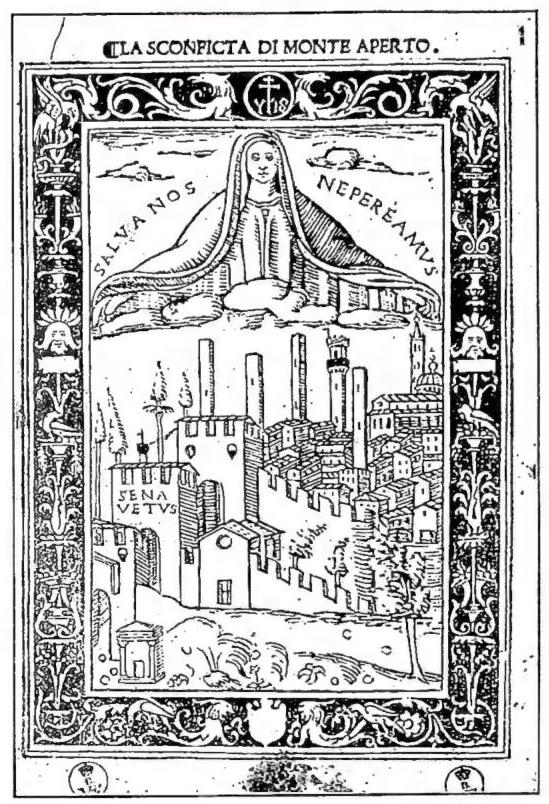
POLITI, LANCELLOTTO — Siena protected by the Virgin, woodcut by L. P. prefixed to La sconficta di Monte Aperto, Siena 1502. Copy in the Biblioteca nazionale — Rome.
South-eastern Australians, the Fuegians, etc., as well as among nomadic pastoral peoples: the Turks, the Hamites, the Hamitoids, the Nilotes. In many cases, the great ethnological antiquity of this monotheism has also been demonstrated through comparative research.
The origin of p. in religions that were already monotheistic is explained: 1) by the separation and formation of hypostases, that is, by the fact that the qualities and functions of the one God are rendered independent and transformed into personal figures placed beside him—for example, lightning and thunder, and sometimes even his own dominion over certain natural beings, such as wild animals and fish; 2) by the personification of the individual parts of nature, for example, the heavenly bodies; by the sublimation of the spirits of nature into divinities, such as the spirits of water, air, the mountains, etc.; 3) by the divinization of deceased men and mythological figures, such as ancestors, especially the forefather, kings, heroes, and particularly culture heroes or saviours; 4) in a materially more advanced and specialized culture, by the origin of divinities assigned jurisdiction over individual activities (e.g., hunting, war, trades), and those who practise them; 5) in mixed cultures, resulting from the domination of nomadic pastoral peoples over agricultural peoples, by the conjunction of the Sky God with Mother Earth; 6) by political centralization: when many city-states, each having its own local god, are united into a great state, the local divinities too are gathered into a pantheon, in which genealogical, for the most part artificial, relationships are established among the various divinities. In all six of these processes in the formation of p., the preceding one Great God becomes obscured and vanishes, becoming a deus otiosus, without influence on practical life, especially on moral life. In many polytheistic religions there are traces of a former Great God who has lost his significance.