
PIGMEI. — This is the name given, from a Greek term (πυγμῶς = men as tall as a fist) already known to Homer, to the representatives of a highly primitive human race, who still live in small nomadic groups, devoted to hunting and gathering, in the inland forest regions of the Belgian Congo (the basins of the Ituri, Ubanghi, and Sanga) and in some areas of central-western Africa (southern Cameroon, Gabon, Spanish Guinea). Their names are numerous and varied: Aka, Efe, Bambuti, Akoa, Bekwi, BaYele, etc. Some groups, such as the BaBinga, the BaTwa of the Equatorial and southern provinces of the Belgian Congo, the homonymous BaTwa of Ruanda, etc., display, to a greater or lesser degree, divergent racial characteristics, resulting from the interbreeding of P. with forest Negroes, and are collectively called Pygmoids. The name P. is also extended to certain residual populations of southeastern and insular Asia, traditionally known as Negritos, who share with the P. properly so called (Africans) the striking somatic characteristic of extremely short stature (averages close to or below 150 cm.), isolation in forest environments, and the primitive and crude character of their economic and social life: they are the inhabitants of the Andaman Islands (Andamanese, formerly called Mincopi), the Semang of the interior of Malacca, and the Aeta of the Philippines. The Asian P. must also be carefully distinguished from pseudo-P. groups, such as the Sakai of Malacca, and still more the Tapiro, Goliath, and related groups of New Guinea (Melanesian P.), the latter in reality being merely a short-statured variety of the Papuasid race.
In his recent anthropological classification (1941), Biasutti grouped the pygmy races separately within the larger “branch of the Negroids,” reducing them to four (Bambutid, Andamanid, Semangid, Actid). The last three, Asian, each consist of only a few thousand or perhaps a few hundred individuals, and are in demographic decline; the African groups, on the other hand, are more numerous and vigorous, and according to Schebesta would total perhaps 100,000 individuals (including the mixed-bloods). The racial problem posed by the P. remains one of the most open and debated among anthropologists: according to one thesis (Kollmann, W. Schmidt, Bryn, G. Montandon, and others), they constitute the most ancient stratum of present-day humanity, whereas according to another theory (Virchow, Schwalbe, Sarasin, Fischer, Valois, etc.), the P. are a group formed through secondary differentiation, as a result of various causes (isolation, adaptation to the forest environment, mutation), at the expense of an already existing melanoderm stock of races of normal stature. An interesting attempt to reconcile the two opposing theories was proposed by Schebesta (1940): the pygmy subraces would derive from a single undifferentiated archaic race (Negrid), from which the Negroes and Melanesians would likewise have separated. The P., as a specialized, “fossilized” race, would have been formed not through degeneration, but through a process of selection in the virgin forest. Biasutti, moreover, arrived at an opinion not substantially different, quite independently.
The following are enumerated among the distinctive characteristics of pygmy culture: clothing reduced to a loincloth; absence or rarity of ornaments, painting, and mutilation of the person; dwellings everywhere of primitive types (screens, beehive huts, caves); primitive methods of kindling fire (by groove, rotation, or sawing) and, in one case (the Andamanese), ignorance of any such procedure; absence of pottery, weaving, stoneworking, and regular systems of numeration; predominant weapons, bow and arrow; an economy based on gathering and hunting; a monogamous patriarchal family, with the woman equal to her husband; non-exogamous totemic clans (in Africa), but without true chiefs; slavery unknown; cannibalism rare and probably attributable to borrowing. Within this overall framework, clearly marked by primitivism, the study of religious beliefs takes on particular interest, and it is appropriate to review them for each of the principal groups.
1. Religion of the African P. — The credit for the delicate investigations in this sphere belongs almost exclusively to Catholic missionaries.
Among the P. of Gabon (Akoa), Fr. H. Trilles established the existence of several orders of beliefs, whose objects are: first, a Supreme Being (Khm-um), creator of the world and of human beings, omnipotent and omniscient; now dwelling in heaven but formerly living on earth beside his creatures (for some of the myths concerning him, V. COSMOGONIA); then, beneath Khm-um, the lesser spirits, also created by him, some benevolent (verva), others hostile (torva) to humanity; distinct from these are the manistic spirits (me), whose nature and destiny are connected with complex beliefs concerning the human soul. The terminology of the P. reveals that they possess a plurality of concepts and words in this regard: the soul as a whole (molili), the immaterial principle residing in the heart but influencing the mind (nie), and the shadow-spirit or “genius” (tsi), each with a different destiny. Fr. Trilles has also documented among the P. of Gabon the existence of totemistic beliefs and magical practices; above all, his merit lies in having recorded various myths (on creation, the origin of fire, etc.) and a series of songs of astonishing poetic power, worthy, in their immediacy and powerful richness of imagery, of standing beside the masterpieces of the literature of every country. The Bake of eastern Cameroon, who likewise belong to the western group of African P., have analogous beliefs.
The religious beliefs of the eastern and purer group of African P., the Bambuti of the Ituri, prove to be far more complex, perhaps because in this case they were observed and analyzed by a distinguished ethnologist such as Fr. Schebesta. Here the figure of the supreme Being, called “father” or “grandfather” in the myths, is not expressly described as creator but is nevertheless the preserver of the world; he is conceived as an old man, master of lightning and the rainbow, who, by walking or by swinging his white beard from right to left, causes hurricanes, storms, and earthquakes. The figure of this Being, however, has gradually become confused with and enriched by so many different elements that it has lost its precise personality in myth, its supremacy in worship, and even any proper name. Other supernatural beings take his place, beings that are in a certain sense the personifications and hypotheses of that first nameless Being, but which also possess differentiated individual characteristics. They are the god of the forest, the god of the sky, and the god of the subterranean underworld. An examination of the rich pygmy mythology, and the very etymology of the numerous names by which these three fundamental divinities are known, demonstrates their lunar nature: most clearly in the case of the second, which is now the selenic symbol of the nameless Being (who in mythical times took refuge in the moon and behind or above it),
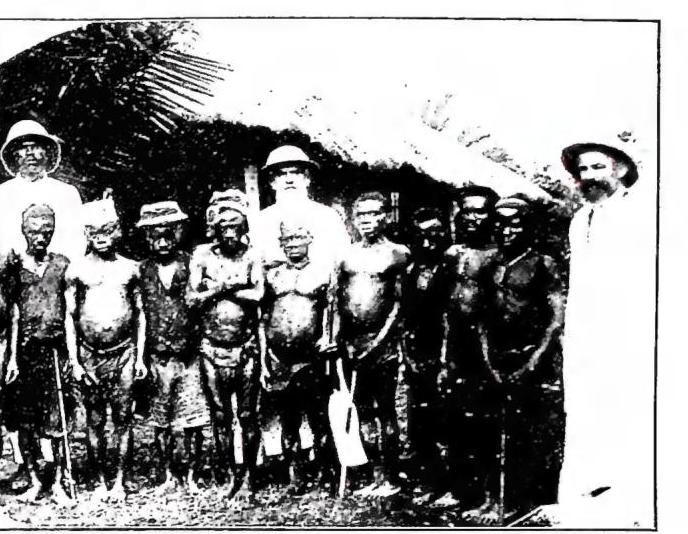
(phot. Fides)
2. Religion of the Asian P. — Certain correspondences found, despite so great a spatial distance, in the religion of the Asian P. cannot fail to strike one, or to appear fortuitous. The theistic conceptions of the Semang are almost equally complex, and vary widely from one tribe to another. The names by which the highest divinity is most frequently designated are Ta Pedn and Karei; the former is sometimes conceived as the son, sometimes as the younger brother, of the latter. Ta Pedn appears to be the original divinity, identified with thunder (which perhaps originally was nothing more than one, the principal one, of his manifestations), creator and preserver of the world, good and compassionate toward men, whom he protects from the more feared Karei, while nevertheless being the giver of nourishment to the Semang. He is believed to dwell in heaven, seated upon a beam, from which he surveys the world. The configuration of Ta Pedn is generally anthropomorphic, that of an old man (here too he is called “little grandfather”); he is the legislator and punisher of individual sins. They ask his forgiveness for these when the fearsome equatorial storms break out, manifestations of his anger. Along with their supplications, the Semang offer him, as a typical expiatory sacrifice, a little of their blood drawn from cuts deliberately made for the occasion.
Very little is known about the religion of the Aeta; but it is known that they believe in a creator God, immortal and invisible, dwelling on high, lord of everything and particularly (like the Tore of the Bambuti) of the animals of the forest, which he protects from the hunters’ arrows. The Negritos turn to him at crucial moments in their lives or when they find themselves in grave danger.
Finally, the religion of the Andamanese is much debated, because the two principal sources on which our knowledge is based, although both authoritative and worthy of credence, present a fundamentally different picture. Ethnological criticism has nevertheless been able to establish the authenticity (among the southernmost and, in all likelihood, purest groups of these islanders) of a monotheistic belief. The Supreme Being, here called Puluga, is predominantly a sky god, dwelling in heaven in a stone house; the lightning bolts are the burning brands that he hurls with his hand, and thunder is his voice. Puluga created everything except evil; he was never born and is immortal; his omniscience, which ceases only when night falls, extends also to human thoughts. He is the punisher of sins: falsehood, murder, adultery, and theft are punished by him, as are violations of his dietary prohibitions (certain food plants are under his direct protection) and the breaking of the “sacred silence,” which the Andamanese must observe when the cicada, his daughter, begins to sing. No worship of prayers or sacrifices is offered to him, but his anger is no less feared and his commandments no less observed for that.
3. Summary considerations
Asian and African P. constitute a sufficiently homogeneous ethnic complex, despite local differences, so that they may be regarded as a unitary entity. The general poverty of material goods and tools, and the simplicity of their economy and sociology, mean that this ethnic complex must be placed among the lowest levels of the civilizations currently existing on earth. These facts, which enabled ethnologists of an evolutionist orientation, even in fairly recent times, to postulate a corresponding crudeness and poverty of spiritual conceptions among the P., in reality do not prevent them from possessing, on the contrary, a rich animological heritage. This finding was one of the most significant achievements and, if one wishes, surprises of modern ethnology. How much of this heritage should be regarded as originating in Pygmy culture? It is not possible, at least for now, and perhaps not even in the future, to give an exhaustive answer. An excellent attempt was made by Fr. Schmidt and his school with regard to the present situation, which may be considered not to have changed substantially over the course of the past few centuries. Having asserted the absence or rarity among the P. of such elements as naturism, animism, manism, and magic (especially “black” magic), or having attributed their possible presence in each case to influences from later cultures currently in contact with the P. (the so-called totemistic culture of the blacks of central-western Africa, and the agricultural-matriarchal culture of Southeast Asia), this scholar concluded (1933) that genuine monotheism had priority and predominance among them (for the general features of the latter in the Urkultur, V. Dio, in Enc. Catt., IV, cols. 1627–29).The more thorough and very recent direct investigations, particularly those of Fr. Schebesta (1950; those of Fr. Schumacher [1950] concern groups of P. that are unquestionably not pure), have brought to light the greater complexity of these problems; and Fr. Schmidt himself took care to reaffirm (1951) the continual revisability of individual conclusions and the character of scientific working hypotheses of the inferences that may legitimately be drawn from them. However future studies may be oriented, the P. remain and will remain living testimony to the richness and often the loftiness that may characterize the spiritual life of the most primitive peoples of today’s world.