
CONGO BELGA. — Formerly, under the name C., were understood present-day French Equatorial Africa, the Portuguese possessions of Angola and C., and those of the Crown of Belgium. Today the name C. B. is given to Belgium’s vast colonial domain in Africa (2.3 million sq km, 80 times the territory of the mother country), extending across the Equator from Lakes Alberto and Tanganica to the Atlantic and encompassing four-fifths of the total area of the basin of the great river that gives it its name.
I. GEOGRAPHY
The basin corresponds to a depressed plateau, hollowed out in its central part like a basin and enclosed along its margins by elevations or highlands, generally ramparted in the form of terraces. The region has an equatorial climate with constant precipitation in the lowlands, and a tropical climate with periodic rains in the highlands; this causes forest to predominate in the former and savanna in the latter. The gigantic river (4,600 km. in length; a basin of 3.7 million sq. km.), although, together with its numerous tributaries, it constitutes an extensive river network suitable for large-scale navigation, is not as important as the Amazon, because its course is interrupted by rapids and waterfalls, which are bypassed by railway lines. C. B. is one of the richest countries in the world, but its development is hindered above all by the obstacles that climate and environment pose to European colonization. Indigenous agriculture, although it permits some surplus beyond internal requirements (maize, peanuts, sesame, castor beans), remains backward; livestock farming (especially goats) is also of little importance, since the widespread scourge of the tsetse fly deprives it of extremely extensive areas. More than the forest, which covers half the territory and provides valuable timber and palm nuts, while supporting an active oil industry; more than the plantations (cotton and coffee, undergoing vigorous development), it is today the immense mineral resources that dominate the economy of C. B.; these have made its south-eastern sector, Katanga, the most active industrial centre on the entire continent (copper, iron, cobalt and tin; elsewhere, and especially in Kasai, diamonds, gold, silver, uranium, coal, etc.). Communications received considerable impetus during the last twenty years (4,662 km. of railways; 94,476 km. of roads; air routes with 167 aerodromes; improved facilities at the ports of Matadi, Banana, Boma and Léopoldville), making penetration into the immense country by now fairly easy, although its development is still limited to relatively restricted sectors.Of the colony’s 10.7 million inhabitants, almost all are represented by Bantu Negroes, with Sudanese peoples to the N. and Pygmies in the forests. The whites number 36,000, of whom 24,000 are Belgians, 2,000 Portuguese and 1,500 Italians, for the most part officials and missionaries. The inhabited centres have an urban character in only a few cases. Léopoldville (or Léo-Kin), the capital, now has approximately 120,000 inhabitants (of whom 7,244 are white); Elisabethville has 69,000; there are also five other settlements, each with more than 10,000 inhabitants.
The indigenous peoples generally incline towards fetishistic cults, and towards the N. there is notable Muslim penetration. Catholics number 2,179,303 (31 Dec. 1946), Protestants 446,805, and Muslims approximately 70,000.
C. B., which had arisen as the “Independent State of C.” in 1882 on the initiative of the King of Belgium, Leopold II, was converted in 1908 into a Belgian colony, administered by a governor-general appointed by the Crown. Contiguous to C. B. is the mandated territory
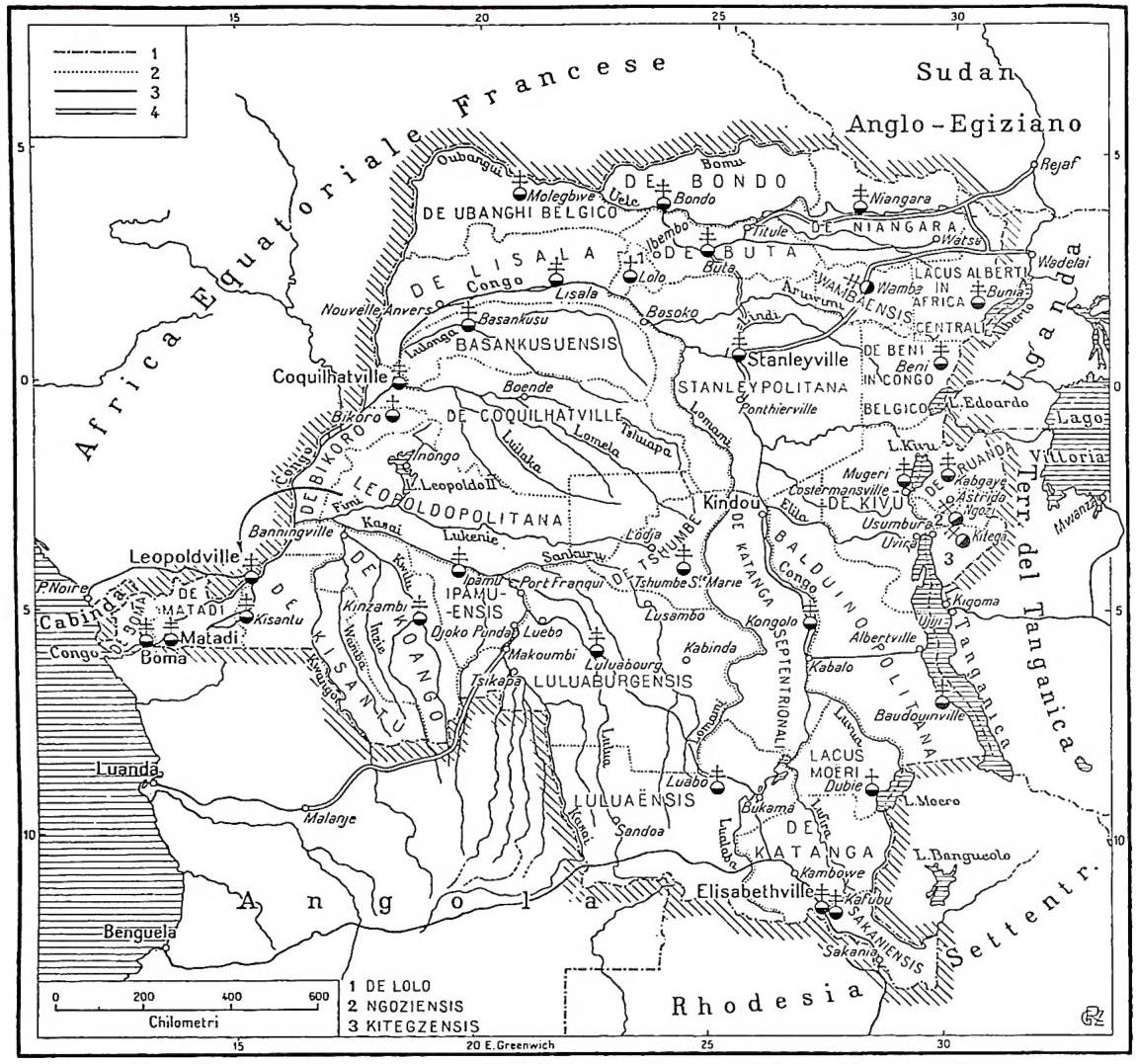
Administrative division of the colony:
| Province | Area in 1,000 sq. km. | Population (1939) in 1,000 inhabitants | Capital (population in 1,000) |
|---|---|---|---|
| Léopoldville | 354 | 2066 | Léopoldville (117) |
| Conquilhatville | 409 | 1566 | Conquilhatville (9) |
| Stanleyville | 510 | 2380 | Stanleyville (14) |
| Costermansville | 226 | 1310 | Costermansville (3) |
| Elisabethville | 484 | 1043 | Elisabethville (69) |
| Lusambo | 353 | 1961 | Lusambo (7) |
| TOTAL | 2336 | 10326 |
Brussels 1938; A. Bollati, Il C. B., Milan 1939; C. Monheim, C. Bibliographie, Antwerp 1942; A. François, C., terre d'héroïsme, Brussels 1943; A. Robert, Le C. physique, Liège 1946; D. Denuit, Le C. d'aujourd'hui, Brussels 1948; L. G. Pugh, The Changing C., London 1948. Giuseppe Caraci
II. HISTORY OF THE EVANGELIZATION OF THE REGION FORMERLY INCLUDED UNDER THE NAME C
1. Ancient mission. — The Congo (Zaire) River having been discovered in 1482 (Padrão at Cabo Agostinho) by Diogo Cão, the evangelization of the kingdom of C. south of the river soon began. It is not yet clear who the first missionaries were: Franciscans, Franciscan Tertiaries, Dominicans, Canons Regular of St. John the Evangelist, known as Lojos.It is more than probable that the first missionary expedition of 1490 was composed of friars from various Orders and « outros clerigos », thus secular clergy. More precise information is available concerning the activity of the Lojos: in their convent in Lisbon those transported there by Cão after the second expedition of 1485–86 were educated and baptized. Three Lojos expeditions, in 1490, 1509, and 1521, are attested. As early as 1491 the king of C. had himself baptized, only to apostatize after a short time. Christianity was able to take root only under his successor Alfonso, a convinced and zealous Christian. In 1513 he sent an embassy to Leo X; he also sent his son Henrique and several sons of chiefs to Portugal, where, after suitable training, they were ordained priests; Henrique, indeed, was consecrated titular bishop of Utica. Their activity in C. is little known. Damião de Goes, in his Chronica do felicissimo Rey Dom Emmanuel (Lisbon 1619), tells us of their zeal in propagating the faith. In the second half of the sixteenth century, Jesuits and Carmelites worked for the spread of the Christian religion in C. After several unsuccessful efforts to obtain a diocese in the country, the diocese of São Salvador do C. was established in 1596. Meanwhile, however, the center of Portuguese colonization had shifted to Angola, where the Jesuits had been working since 1560 and baptized its king in 1584. In 1626 the episcopal see was transferred de facto, if not de iure, to São Paulo de Loanda, where the Jesuits had a college in the seventeenth century. From 1645 the principal missionaries were the Italian Capuchins, sent by Propaganda, to whom the prefecture established in 1640 was entrusted; for approximately two centuries the mission of C. and Angola remained in their hands. In 1653 Fr. Giorgio van Gheel was martyred there. The Capuchins succeeded in extending their activity to the kingdoms of Matamba, whose queen Zinga converted in 1656, and to the kingdom of Loango, where, for a short time as well (1766–76), some French secular priests attempted a mission. In the eighteenth century, however, the Capuchin mission increasingly declined, eventually being reduced to a few stations. In the nineteenth century it fell completely into ruin and was abandoned by them. Only the episcopal see of Loanda remained, together with a few coastal towns where the Portuguese secular clergy exercised parish ministry. In addition, the see of Loanda remained vacant from 1826 to 1852.
2. The modern mission. — The modern mission was begun by the missionaries of the Congregation of the Holy Spirit, or rather of the Congregation of the Sacred Heart of Mary founded by Fr. Libermann, which in 1848 united with that of the Holy Spirit. In 1844 Fr. Giovanni Renato Bessieux (1803–76) founded the first station of St. Mary of Gabon; in 1849 he was appointed apostolic vicar of the Two Guineas. In Gabon, at first, activity was limited to the surroundings of the town of Libreville, founded by the French in 1849. There they established a large agricultural enterprise with attached schools and a hospital, with the aim of bringing the indigenous people to a less savage way of life and founding Christian families. Gabon subsequently became the starting point for the missions of the Congregation of the Holy Spirit in Nigeria and C. In 1865 Propaganda entrusted the ancient prefecture of C. to this Congregation. Opposition from the Portuguese government initially prevented any fruitful activity; only in 1873 were the missionaries able to establish themselves at Landana, an independent territory north of the C. River, visiting the mission field through daring expeditions.
The explorations of Henry Stanley (1841–1904) and Pietro Savorgnan di Brazzà (1852–1905) resulted in the division of the Congolese territory. In 1884–85 the Independent State of C. was founded, and its boundaries were established by treaties with France and Portugal (1885). Consequently, in 1886 a reorganization of missionary activity became necessary. The territory of Landana, assigned to Portugal, constituted the prefecture of Lower C., together with the northern part of the Portuguese possession south of the river. In the French part, alongside the vicariate of the Two Guineas, the vicariate of French C. was established. The Independent State of C. became an autonomous mission, elevated to a vicariate in 1888 under the name Independent C., or B.
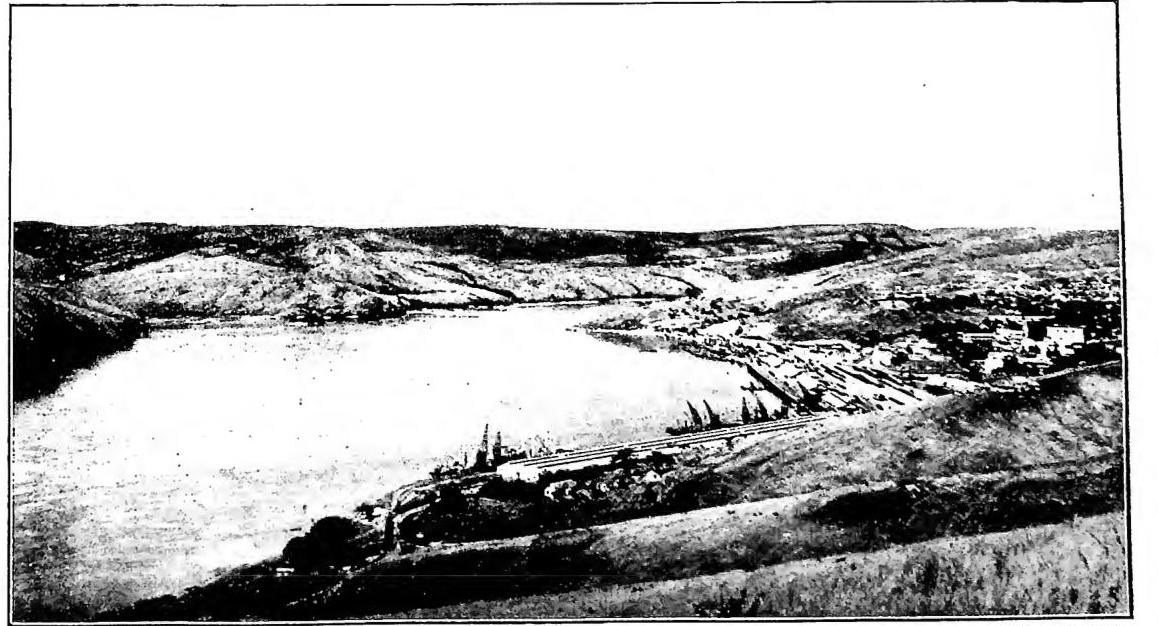
BELGIAN CONGO — Port of Matadi.
(photograph by E. Lebied)
(Int. J. Mulders)
c) Belgian C. — In 1880, by a rescript of the S. Congregation of Propaganda Fide to Cardinal Lavigerie, two mission centers of the White Fathers were authorized, one for the southern Upper C. and the other for the northern Upper C.; they comprised the entire Congolese region east of Stanley Pool and the neighboring regions to the north and south. It was only in 1885 that the first three missionaries of Cardinal Lavigerie founded the first mission station, penetrating inland from the west. As early as 1879, however, the White Fathers had begun their activity in the region of Lake Tanganyika. After the foundation of the Independent State of C., King Leopold II obtained from the Holy See that those missions be reserved for religious institutes from Belgium. Consequently, in 1886 the mission
of the Independent or Belgian C. was created; in 1888 it became an apostolic vicariate, consisting of the territory of that name, except only for the eastern section assigned to the apostolic vicariate of Upper C. for the White Fathers. The new mission of Belgian C. was entrusted to the Fathers of Scheut, who established the center of their activity at Léopoldville. Later, other congregations came from Belgium: in 1891 the Jesuits, in 1894 the Trappists, in 1897 the Priests of the Sacred Heart, in 1898 the Premonstratensians, in 1899 the Redemptorists, in 1905 the Society of Mill Hill, in 1907 the Congregation of the Holy Spirit, in 1910 the Benedictines and Capuchins, in 1911 the Dominicans and Salesians, and, after the war of 1914–18, other institutes. Thus the ecclesiastical circumscriptions of Belgian C. and Upper C., through successive divisions, became increasingly numerous and today are entrusted to 19 missionary institutes. Numerous women’s congregations likewise founded houses there. In 1891 the sisters e de la Charité de Jésus et de Marie and those from Ghent arrived in Belgian C.; many others followed, and by 1935 there were already 52 congregations. In 1888 civil personality was granted to religious, scientific, and charitable associations, and through the convention of 26 May 1906 between the Independent State and the Holy See, close cooperation was established between the Catholic mission and the colonial government. This did not prevent a genuine campaign of attacks and calumnies against the missionaries from being unleashed in subsequent years, even in Belgium itself. The principal defender of the missions was the well-known Jesuit moral theologian Arturo Vermeersch. In return, the mission of Belgian C. became ever more deeply rooted in the hearts of the Catholics of the motherland. As a result, through the cooperation of the Belgian government and people, the missions made great progress, both in the religious sphere, where the number of Catholics rose to 3,247,597 (1948) and that of catechumens to 848,270 (1948), and in the social, economic, and hygienic spheres, especially in the field of education. The ethnological and linguistic works produced by the missionaries are also considerable, given the multiplicity of Congolese tribes. There are 27 apostolic vicariates and 3 apostolic prefectures.
In 1929 an apostolic delegation was created for the missions of Belgian C. and Ruanda-Urund