
COSTA RICA. —
I. GEOGRAPHY
The smallest of the Central American republics facing both oceans: 50,000 sq. km (the relevant figures are not very reliable), with fewer than 800,000 inhabitants (472,000 in the latest census, dating from 1927). Of the population, 90% are creoles, 6% Amerindians and mestizos, and 4% blacks and mulattoes. The country consists of two lowland zones near the sea, separated by a slender internal mountain barrier. The climate is tropical, hot, uniform, and humid, with local differences due to altitude. The national economy is essentially based on plantations, especially coffee (of fine quality) and bananas (exported to the United States), followed by cacao, sugar cane, fruit, etc. Among the minerals are gold and silver. The forests also yield good profits (timber for aircraft construction). Industry is only in its earliest stages.C. R. is a unitary representative republic with a single Chamber. The capital, São José (80,000 inhabitants), is connected by railway to the two ports of Limón on the Caribbean Sea and Puntarenas on the Pacific. Only about 5% of the population professes pagan cults; the religion of the State is Catholicism.
| Provinces | Area in 1,000 sq. km | Population 1945 (in 1,000 inhabitants) | Provincial capital, population (in 1,000 inhabitants) |
|---|---|---|---|
| Alajuela | 9 | 157 | Alajuela (10) |
| Cartago | 3 | 111 | Cartago (13) |
| Guanacaste | 11 | 90 | Liberia (4) |
| Heredia | 3 | 55 | Heredia (11) |
| Limón | 9 | 40 | Limón (10) |
| Puntarenas | 10 | 50 | Puntarenas (9) |
| São José | 4 | 283 | São José (80) |
| Total | 49 | 786 |
II. EVANGELIZATION OF C. R. — Discovered by Columbus on his last voyage in 1502, it was gradually colonized by the Spaniards after 1526. It formed part of the Mexican province (Audiencia) of Guatemala and of the diocese of León of Nicaragua. The Indians, divided into numerous small tribes, among whom the principal ones were the Talamancas and the Guaymis, fiercely resisted colonization and evangelization in the inaccessible mountains of Talamanca. Only through great sacrifices did the Franciscans succeed, in the seventeenth and eighteenth centuries, in establishing a few reductions; their efforts to bring the other Indians into reductions, however, remained fruitless. At the beginning of the nineteenth century, the mission increasingly declined, coming to an end completely in 1829 with the secularization of the Franciscans. In 1850, the diocese of São José of C. R. was erected. The mission was reopened by Mons. Bernardo Augusto Thiel C. M., bishop of San José (1880–1902), among the Indian tribes, which had meanwhile diminished considerably. He visited the Indians of the Talamanca mountains on several occasions, publishing studies
(phot. Alinari)
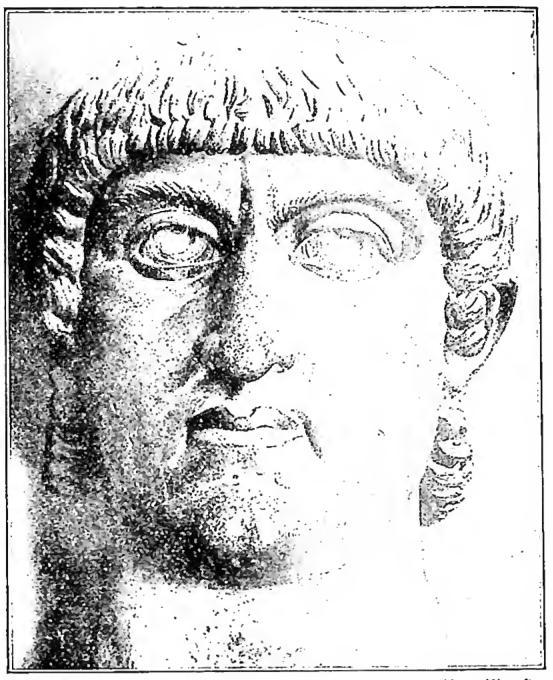
COSTANZO II - Supposed head of C. H. (bronze).
Roma, Museo dei Conservatori.
linguistic studies of great value. In 1894 the German Lazarists assumed responsibility for the mission among the Indians. In 1921 São José was raised to an archdiocese, with the suffragans of Alajuela, a diocese, and Limón, an apostolic vicariate.
III. CONTEMPORARY HISTORY
After the proclamation of Mexican independence, the captaincy general of Guatemala, of which C. R. formed part, likewise declared itself free from Spanish sovereignty on 15 September 1821, and proclaimed its union with Mexico (5 January 1822). Following Iturbide’s fall, a constituent assembly proclaimed the United States of Central America, comprising the five Republics of Guatemala, Honduras, Nicaragua, Salvador, and C. R. Divergences soon arose, however, between the federal authority and that of the State of Guatemala; the result was the dissolution of the confederation, decreed by the federal congress on 14 November 1838. When the former federal president Morazán came to C. R. in 1842 with the intention of reconstituting the United States of Central America and overthrowing R. Carrera, president of Guatemala, C. R. once again endeavored to promote a federal Central American structure; but after Morazán’s defeat and execution, it definitively became an autonomous republic. The presidency of Juan Rafael Mora, which lasted nearly a decade, until 1859, marked a period of significant economic, political, and social progress for C. R. It was then also possible to sign a concordat with the Holy See on 7 October 1852, under which the Catholic religion became the official religion of the State, and the ecclesiastical authorities obtained control over education and full freedom to communicate withRome. Although an strengthening of anti-Catholic currents had taken place in C. R. since the second half of the previous century, relations with the Church have on the whole remained good. The Catholic religion is still regarded as the official religion of the State, and the representative of the Pontiff is held in the highest esteem. During the disturbances of 1948, the able action undertaken by the nuncio, Msgr. L. Centoz, led to a cessation of the conflict and to an agreement between the contenders.