
COREA. —
I. GEOGRAPHY
In Japanese Chōsen (freshness of the morning). A peninsula of eastern Asia extending between Manchuria and the Japanese archipelago, at the latitude of southern Italy. A powerful natural bastion (Chang-paik; 2750 m. at Paikto-san) separates it to the N. from Manchuria, and a long mountain ridge (Taihaku, maximum elevation 2473 m.) runs along its entire length. To a continuous, high and inhospitable coast in the E., there stands opposed to the E. and S. a deeply indented shoreline, fringed with islands, onto which broad plains, irrigated by rivers, open. The climate is relatively little affected by the sea: Keijo (Scoul), at the latitude of Catania, has the same mean annual temperature as Paris. Rainfall increases from N. to S., where it reaches a maximum of 1500 mm. annually.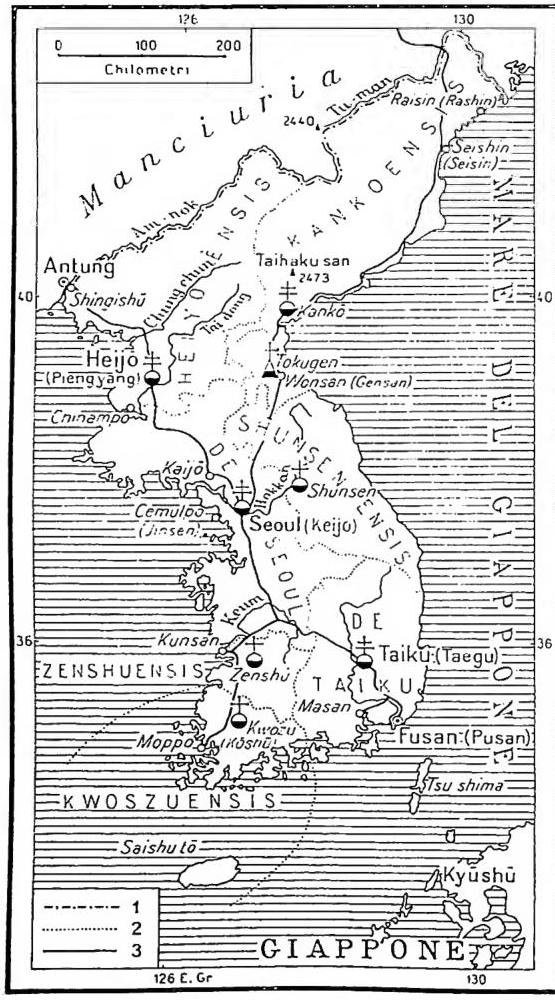
Over an area of 220,788 sq. km. there lived (1940) 24 million inhabitants (density: 110 per sq. km.), of whom approximately half a million were Japanese and 40,000 foreigners. Keijō, the traditional capital, had 1.1 million inhabitants in 1946; Fusan, the most important communications hub with Japan, 400,000; Heijō (Pyeng-yang), the capital of northern C., 286,000; Taikyu, 269,000; Jinsen (Chemulpo), 216,000, etc. The great majority of Koreans profess shamanism (barely one-seventh are Buddhists and perhaps no more than 80,000 are Shintoists). An official estimate of 1 March 1947 gives the number of Christians as 666,000.
A Chinese possession until the Sino-Japanese War (1895), C. was recognized as a Japanese protectorate after 18 November 1905, and annexed to Japan on 22 August 1910. With the Second World War it was supposed to regain its independence. Meanwhile, northern C. (north of the 38th parallel; 124,000 sq. km. with 8.2 million inhabitants) constitutes a Soviet-type people’s republic, as imposed by the Russian occupation; the remainder (96,000 sq. km. with 14.6 million inhabitants) is under United States control.
II. EVANGELIZATION OF C
The missionary history of C. began with the baptism of Pietro Ri Seung-houn-i in Beijing in 1784. During the occu-(from F. M. Trautz, Le Japon, Berlin 1921)
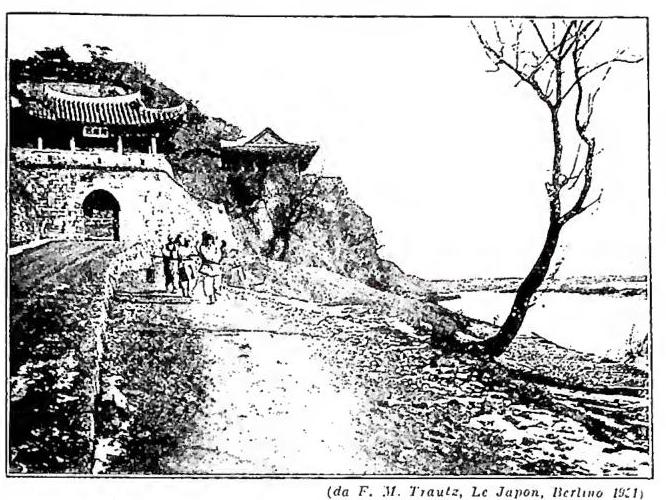
COREA – View over the Daidō River – Pgongyang.
In 1777, several Korean scholars, among them Piek-i, began to study these books. Piek-i commissioned Ri-Seung-houn-i, a member of the 1783 legation, to establish contact with the missionaries. Ri was baptized in Peking by Fr. Jean Joseph de Grammont, an ex-Jesuit, and, on returning to his homeland, baptized Piek-i and Kouen Il-sin-i, zealous propagators of the new faith. It is true that Piek-i apostatized during the persecution that soon broke out, as did Pietro Ri in 1789, after the bishop of Peking, Alessandro de Gouveia (1751-1808), declared the hierarchy introduced by Ri invalid and certain ceremonies resembling those of the Chinese illicit. But the Chinese priest Giacomo Tsiu, who arrived in C. in 1795, found approximately 4,000 Christians, and at his death in 1801 the number had risen to about 10,000. In the persecution of 1801, Tsiu and more than 300 Christians died as martyrs. In 1802 an anti-Christian decree was issued that remained in force until 1882. From 1801 to 1834, the Korean Christian community was again left without priests.
Nevertheless, it persisted and in 1811, and then in 1825, requested priests from Peking and Rome. In 1831 the apostolic vicariate of C. was established, and mons. Barthélemy Bruguière of the Society for the Foreign Missions of Paris (1792-1835), coadjutor of Siam, was appointed apostolic vicar. He never succeeded in entering his vicariate and died in 1835. The Chinese priest Pacifico Ryou, however, was able to enter it in 1834. In 1836 and 1837, the two missionaries Pierre-Philibert Maubant (1803-39) and Jacques-Honoré Chastan (1803-39), together with the new apostolic vicar Laurent-Joseph-Marius Imbert (1796-1839), were secretly able to enter and organize the mission; all three died as martyrs in 1839 (beatified in 1925). Once again the Christian community remained for six years
without priests. In 1845, mons. Jean Joseph Ferréol (1808-53), mons. Imbert’s successor, and the missionary Marie Nicolas Antoine Daveluy (1818-66), assisted by the first Korean priest, Andrea Kim, educated at Macao, succeeded in entering the mission. Kim was martyred in 1846 (beatified in 1925). Fortunately, mons. Ferréol (d. 1853) and his successor, Siméon-Francois Berneux (1814-66), together with coadjutor Daveluy and other missionaries who had arrived there secretly, were able to work until 1866, raising the number of Christians to approximately 23,000. In 1866 the persecution intensified: the two bishops, seven missionaries, and more than 10,000 Christians fell victim to II. The three surviving missionaries were forced to take refuge outside the country. Thus once again the Christian community remained without priests until 1876 and the following years, when missionaries from the seminary of Paris entered the country clandestinely. Mons. Félix Clair Ridel (1830-84) and the missionary Victor Marie Deguette (1848-89) were captured; following the intervention of the French government, they were not killed but expelled.
From 1882, commercial treaties with Japan, the United States, and various European states opened the country to trade. The treaty with France of 1886-87 also secured a certain degree of freedom for the missions. In the following years the number of Christians rose to 77,000 (in 1910), despite continuous difficulties. The annexation of the country to Japan in 1910 placed it under the same conditions as that country. In 1888 the first sisters, Soeurs de St-Paul de Chartres, arrived in C. to educate orphans. The printing press that had already existed in Japan (in 1880 and 1881 it had published a Korean grammar and a dictionary) was transferred to C. A seminary was established in 1892 at Ryang-saun near Seoul and
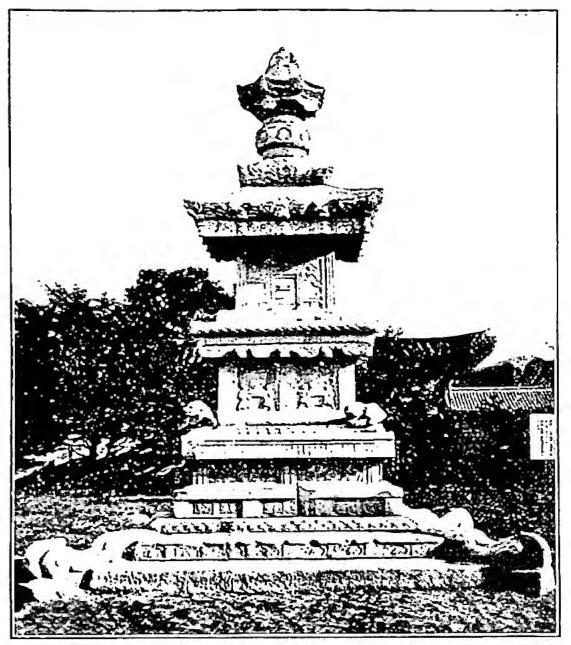
(from A. Eckardt, Geschichte der koreanischen Kunst, Leipzig 1929, pl. 16, fig. 118) COREA - Pagoda of Seoul (A.D. 1085).
Until 1909 the missionaries of the Paris Seminary had been alone in evangelizing Korea. In 1909 the Benedictines of S. Ottilia arrived; they established a teacher-training school and an industrial school at Seoul and, from 1920, also undertook the mission of northern Korea. In 1923 the missionaries of Maryknoll followed, and in 1933 those of S. Colombano.
The apostolic vicariate of Korea was divided in 1911 into 2 vicariates: Seoul and Taiku, both entrusted to the Paris Seminary. Northern Korea was detached from Seoul in 1920 and entrusted to the Benedictines of S. Ottilia as the apostolic vicariate of Wonsan. For the missionaries of Maryknoll, the apostolic prefecture of Hpyang-Yang was detached from Seoul in 1927; from 1929 it bore the name of Peng-Yang, and in 1939 it was raised to the apostolic vicariate of Heijō. In 1937 the missionaries of S. Colombano were entrusted with the apostolic prefecture of Kwonzu or Koanju, detached from the apostolic vicariate of Seoul. In 1940 the apostolic vicariate of Wonsan was divided: the southern part remained with the Benedictines as the abbey nullus of Tokugen or Tokwan; the northern part passed, as the apostolic vicariate of Kanto or Hancheung, into the hands of the Korean clergy, to whom, as early as 1937, part of the apostolic vicariate of Taiku had been entrusted as the apostolic prefecture of Zenshu or Chonju. In 1949 the apostolic delegation was established.
Giovanni Rommerskirchen
III. ART OF C
Tributary to China, C. was for many centuries tied to that artistic tradition, centered essentially on the currents of the T’ang dynasty (7th–10th centuries A.D.). It subsequently became independent and developed original forms that were later transmitted to Japanese art, which derived for the most part from those influences.The most significant constructions of C. were the temples, many of the oldest of which date from around the 7th–8th century. Their characteristic forms are marked by an ornate yet graceful decorativism that distinguishes them from Chinese temples; the pictorial and sculptural decorations of their interiors are also noteworthy. Among the most celebrated frescoes are those of Doujō (Tantjōng), in the temple of Hōryūji near Nara. Korean palaces, on the other hand, repeat the traditional Chinese scheme. Magnificent examples are the Kyŏng-pok-hung and the Chang-tŏk-hung in Sōul.
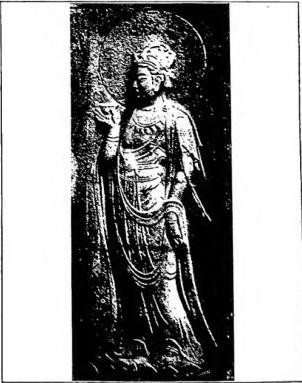
Sculpture is of considerable interest in the decoration of the pagodas, the oldest of which date from the 7th century, in the tombs, and above all in Buddhist statuary, among which the exceptionally rich series in the Temple of the Earth, near Keishū, dating from the 8th century, stands out.
Ceramics were practiced in C. with sobriety and stylistic restraint, and attained a very high level of development, greatly benefiting Japanese ceramics.