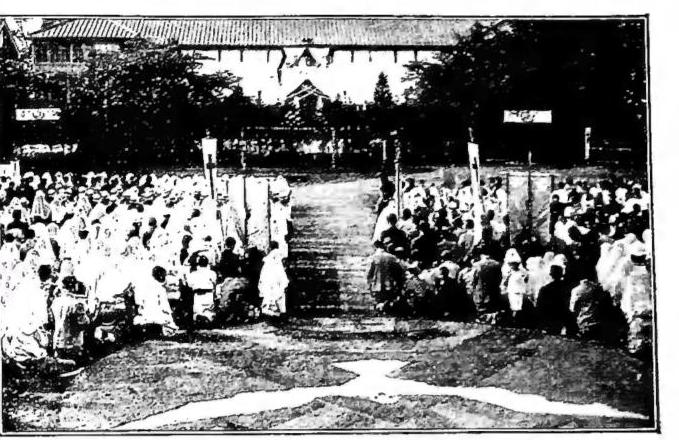
TOK-WON. – Abbazia nullius, situated in the northeastern region of Korea; it covers an area of 3,625 sq km, with a population of approximately 340,000 inhabitants. It is entrusted to the Congregation of the Benedictines of S. Ottilia for Foreign Missions.
In 1909, Mons. Mutel, Apostolic Vicar of Korea, turned to the Benedictines of S. Ottilia of Bavaria, who soon founded a monastery in Seoul, at first a priory and then an abbey in 1913. Father Prior Boniface Sauer was its first abbot. The Benedictines’ aim was to train Christian teachers for the small provincial schools. In addition to this principal work, the Fathers opened a carpentry and painting workshop and a mechanical workshop, the germ of a future industrial school. However, special difficulties arising from Japanese legislation compelled the Benedictines to discontinue the courses of the teacher-training school, while the industrial school continued to prosper until the war of 1914 halted all progress. On 5 August 1920, the Apostolic Vicariate of Wonsan or Kanto (today Ham-Heung) was erected and likewise entrusted to the Benedictines. On 31 August 1927, the seat of the abbey was transferred from Seoul to T.-W. On 12 January 1940, it was established as an abbazia nullius, with the assignment of a small part of the territory of the aforementioned vicariate, including the city of Wonsan. In addition to the workshops, it also possessed a large estate (200 hectares), which, cultivated by the lay brothers using the most modern methods, was held up by the civil authorities, before the Communist domination north of the 38th parallel, as a model and was visited almost every day.
Even before the present conflict, the Communist government of the North had seized all the mission’s personnel and imprisoned them. Abbot Mons. Boniface Sauer is reported to have died in prison in January 1950. There were 4,997 Catholics; 22 priests; 7 indigenous and 9 foreign brothers; 295