
TODI, DIOCESE of. — City and diocese in the province of Perugia.
It has a population of 60,500, of whom 60,000 are Catholics, distributed among 98 parishes served by 80 diocesan priests and 36 religious priests; it has a seminary, 7 male and 19 female religious communities (Ann. Pont. 1953, p. 424). The diocese is immediately subject to the Holy See.
The diocesan territory coincides with that of ancient Tuder, Colonia Fida Julia, formerly a Roman municipium. A boundary agreement with Perugia, Assisi, Bevagna, and Spoleto dates from 757. A copious list of churches, etc., is provided by the Collettorie of the 13th century (Vatican Archive). Wall maps are housed in the episcopal and municipal palaces. The Via Flaminia, with the Statio ad Martis, directly connected T. with Rome; the Via Amerina with Perugia and Amelia; ancient roads led to Orvieto, to Baschi along the Tiber, and to Spoleto across the Monti Martani. Christianity spread there early from Rome. In the 4th century an estate called Angulas, donated, according to the Liber Pontificalis, by Constantine, paid tribute to the Roman basilica of S. Croce in Gerusalemme. After 726 T.
submitted to the Roman Church; in 817 Louis the Pious, and in 962 Otto, reconfirmed its possession to the Pope. Innocent III personally resumed its rule after its occupation by Frederick I and Henry II. During the Avignon period T. became independent. The antipope Nicholas V took refuge there in 1328 together with Louis the Bavarian. In 1392 Boniface IX first granted T. as a prefecture to Malatesta of Rimini and then as a vicariate to Andrea and Pandolfo. In 1433 it passed under Francesco Sforza. Sylvester II held a council at T. (1001); Innocent III dispatched several documents from there (1198); Nicholas V stayed there for several days (1449), Pius II for a month (1459), and Paul II stopped there while traveling from Perugia to Rome (1535). In 1133 the first Italian Premonstratensian convent arose at T., in the former Benedictine monastery of S. Leucio. The martyr pope s. Martino I (649–56) was born in a small village of the diocese on the right bank of the Tiber, now called Piano di S. Martino; several ancient chapels are dedicated to him. Boniface IX spent his youth at T. with his uncle, the bishop, and, among various privileges, granted the Franciscans of T. the Studio minore. s. Filippo Benizzi O.S.M. died and is buried at T.
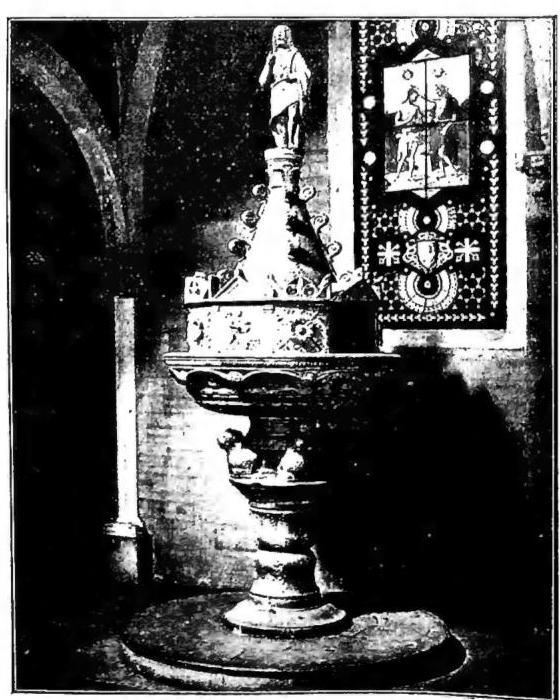
(phot. Alinari)
TODI, DIOCESE of — Baptismal font (15th century) — Todi, Cathedral.
was commissioned by Innocent III to secure peace between Perugia and Orvieto (1209); Bonifacio Colmezzo, consecrated by Honorius III, was ordered to make a pastoral visitation because his «Corpus Christi cum omni honorificentia student custodire»; Ranuccio degli Atti (1326–56); Angelo Cesi (1566–1606) worked for reform and left monumental buildings; Cardinal Marcello Lante founded the Seminary (1608), and Giuseppe Pianetti the Pianettiana Library at Jesi (1709). Also from T. IACOPONE DA TODI (v.), Matteo d'Acquasparta (v.), a supreme theologian, Ranerius Tudertinus O. P., mathematician, etc. Besides important Roman remains, T. has on the Flaminia a small subterranean cemetery, unique in Umbria; in the territory, a group of cemetery churches (S. Terenziano, S. Antimo, S. Illuminata, SS. Fidenzio e Terenzio, S. Felice, S. Faustino, S. Arnaldo); in the city: the Cathedral (11th–12th centuries), Maria S.ma della Consolazione (16th century), S.mo Crocifisso (1591). Numerous documents are preserved in the episcopal, capitular, municipal, and former Congregation of Charity archives. The codices of the former Franciscan Studio, together with a Jacopone collection, are in the municipal library. — Vedi tav. XXI.