
IACOPONE da Todi. – Franciscan mystic and poet, b. at Todi ca. 1230, d. at Collazzone on 25 December 1306. He studied law at Bologna, practised as an attorney in his native city, and toward the end of a reckless youth married Vanna of the counts of Coldimezzo, who, after one year of marriage, died, it is said, during a festival, when a floor collapsed. Struck to the heart, I. abandoned the world, and from 1268 to ’78 lived as a bizozo in excessive, wandering, wild penance. To this decade perhaps belong the laude of the most radical asceticism, of self-hatred carried so far as to invoke every contempt and every evil, including madness. In 1278 he entered the Franciscan Order as a lay brother, meditated on the mysticism of s. Bonaventura, and sang of loving poverty and the ascending degrees of holy nothingness (1278-88). But, an extremist by temperament and intolerant of mitigations of the rule, he plunged into the most ardent group of the dissenters, the followers of Angelo Clareno, protected by Celestino V. In 1294 at Palestrina he joined the Colonnesi against Bonifacio VIII; in 1297 he signed with the rebels their refusal to appear before the Pope, and was excommunicated with them. During this period (1288-97) he hurled violent satires against the relaxed Franciscans, worldly prelates, and Bonifacio VIII, which bear the mark of heretical indiscipline, even though they are not doctrinally heretical. Imprisoned with the others after the capture of Palestrina, I., from prison, joyfully accepted as supreme poverty, addressed repentant verses to Bonifacio VIII asking him to lift the excommunication, but obtained this only from his successor Benedetto XI, at the end of 1303. Perhaps during the final three years the tempestuous mystic, subdued by suffering, sang more exaltedly of the intoxication of the love of God. I. is sometimes given the title of “blessed”; his cult, however, has not been recognized by the Church.
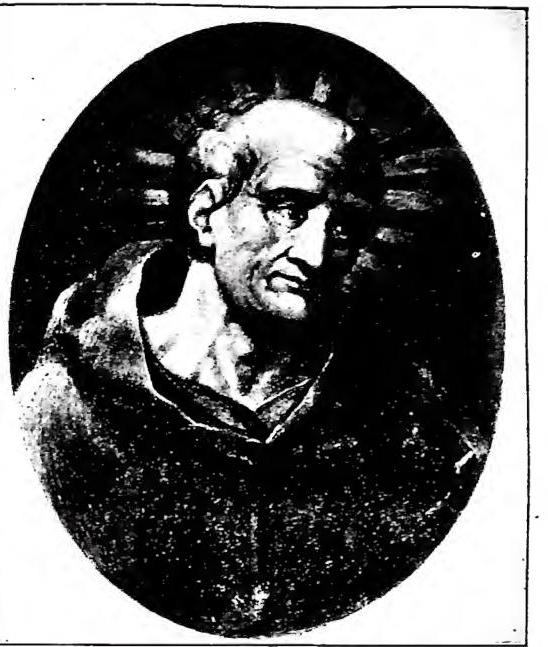
(phot. Crini)
IACOPONE da Todi – Idealized portrait of I. da T. (1506), painted on his tomb – Todi, church of S. Fortunato.
especially where “glorious nothingness” reaches union with God. I. excels in poems to the Madonna. The Stabat interprets liturgically the martyrdom of the Virgin on Calvary; the magnificent lauda Donna del Paradiso interprets it popularly and dramatically, representing in brief the entire Crucifixion. With an originality superior to that of his contemporary versifiers, in other laude he dramatizes the conflict between soul and body, between the living and the dead, between fleeting pleasure and eternal damnation; he arouses the horror of burial and the terror of the Judgment. Ardently realistic in his pessimism concerning mankind, he scourges female vanity with ridicule, as well as the hypocrisies and ambitions of the devout; he satirizes Bonifacio VIII with savage sarcasm. Yet he is the same poet who ineffably sings of the manger. An exceptional penitent, with the temperament and culture of a great lyric poet, I. wrote solely for the glory of God and the salvation of his neighbour, avoiding, out of humility, the pursuit of expression, and abandoned himself to his vein, now crystalline, now turbid and torrential, employing the popular form of the ballad with varied and always musical rhythms. Insofar as he expresses (albeit paradoxically) the soul’s journey to God, I. is not merely the representative of the Middle Ages, but the poet of Christian asceticism and mysticism of every age, the poet who brought into focus the madness of divine love and human ingratitude.
POPULAR CULT. - I. was a religious of exceptional holiness of life, shaped by a rigorous asceticism with strong expressions of lofty and fiery mysticism, most evident in his writings. A saint or "blessed," in the technical sense of the word, he was regarded as such by historians and by the people, who venerated him with acts of devotion, while his name was included in the Martyrologium franciscanum. Buried in the church of the Poor Clares of Montecristo near Todi, in 1433 his bones were transferred to the crypt of S. Fortunato, where in 1596 Bishop Angelo Cesi recomposed them in a more honorable tomb, adorning it with a fine inscription.
However, the cult of I. has not yet been confirmed by the Church, despite attempts made to this end in Todi by the Municipal Council in 1628 and by the Cathedral Chapter in 1676. In 1868 and 1869, the Postulation of the Friars Minor reopened the cause and gathered documents proving this cult rendered ab immemorabili, which has also manifested itself in iconography through some miniatures, with his effigy on the tomb and another near it alongside other saints, and especially with the famous sixteenth-century fresco in the cathedral of Prato. Certain attitudes of I. toward Boniface VIII and the noted poetic intemperances regarding the same Pontiff seem to oppose definitive confirmation.