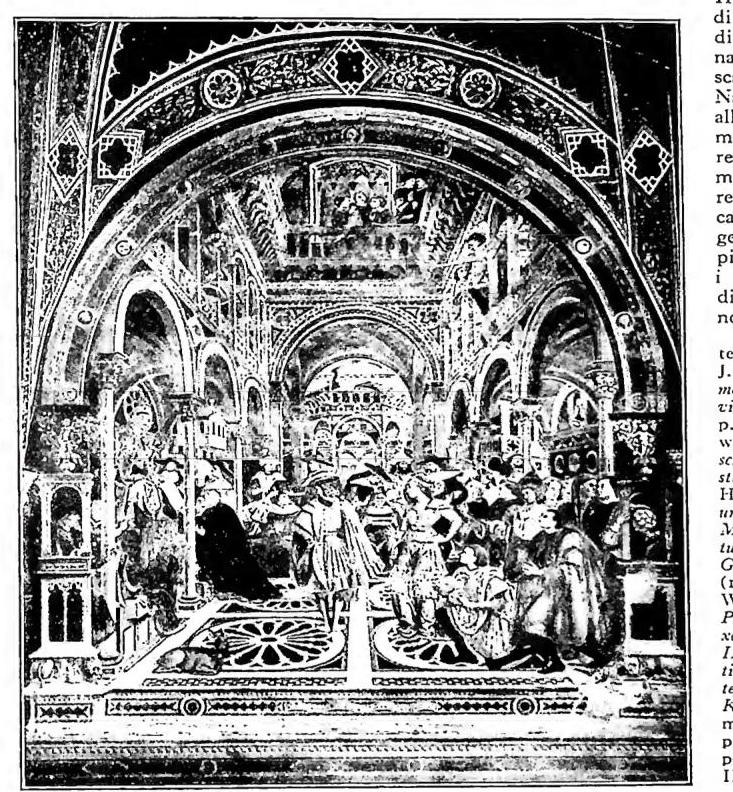
CELESTINE V, pope, saint. — Peter of Morrone, born at Isernia (Campobasso) in 1215, died at the Castle of Fumone (Frosinone) on 19 May 1296. As a young man he entered the Benedictine abbey of Faifoli (diocese of Benevento), of which he later became abbot (1276–79). Throughout his life he showed a clear inclination toward solitude, so he withdrew to Mount Palleno and, after three years, went to Rome where he was ordained priest. His subsequent dwellings were on Mount Morrone and on the Maiella, near Sulmona. On the Maiella he founded the monks later called Celestines (v.).
During the long vacancy of the Holy See following the death of Nicholas IV, he lived in the hermitage of St Onuphrius on Morrone, where he received the news of his elevation to the Supreme Pontificate, which had taken place at Perugia.
The choice of the poor hermit, after a troubled period mainly due to the rivalry between the Colonna and Orsini families, both represented in the Sacred College, was always an enigma to historians. Recent studies have clarified the background: Charles II, King of Naples, with his son Charles Martel, came to Perugia in the spring of 1294 and met with the eleven cardinal electors. From there he went to Sulmona, where he granted privileges to the Celestines and almost certainly also saw the holy hermit, who shortly afterwards wrote a letter to the cardinals urging them finally to give a Shepherd to the Church. Latino Malabranca, cardinal dean, was the first to propose the name of the pious hermit and gave him his vote; the others followed, and the remaining cardinals decided to acquiesce. Other circumstances and spiritual currents (the Angelic Pope) may have influenced the election of the inexperienced hermit. Having accepted the election, he went to L’Aquila, where in the presence of a few cardinals, Charles II, and a great crowd, he was crowned on 29 August 1294.
On 18 September he created twelve cardinals, seven French and five Italian, all pleasing to King Charles, to whom he later entrusted (7 or 9 October) the administration of the archdiocese of Lyon for his young son St Louis of Anjou, who was still a hostage in Spain for his father (Bull. Franc., IV, p. 332). He granted many privileges to the Celestine monks, two of whom were among the twelve cardinals created at L’Aquila. Accompanied by King Charles himself, C. went to Naples, passing through Sulmona and Montecassino, where he ordered the monks to adopt the rule of the Celestines; this command, like many others, was abrogated by his successor Boniface VIII.
At Naples a residence was prepared for him in Castelnuovo, but he soon realised that he was not equal to such a sublime dignity; he was wearied by the intrigues of the curia and longed for the solitude of his cell. At the beginning of Advent he wished to entrust the government of the Church to three cardinals and retire to a secluded cell. When one cardinal opposed him and he was tormented by scruples, he began to consider abdication. He consulted some cardinals, among them Benedict Caetani (the future Boniface VIII), who at first dissuaded him but later declared that it was possible.
C. around 10 December issued a decree stating that a Pope can renounce his high dignity (v. SUPREME PONTIFF), and on 13 December before the cardinals he read the formula of his own free and spontaneous abdication. He had reinstated the strict rule of the Conclave, and from it Boniface VIII was immediately elected (24 December). The latter had his predecessor conducted towards Rome, but C. eluded the vigilance of the papal guards, fled, and hid in Apulia, whence he vainly attempted to cross the Adriatic. Boniface VIII, fearing that ill-intentioned persons might take advantage of C.’s great simplicity, had him sought out and, when found at Vieste, had him taken and guarded in the castle of Fumone near Alatri, where he lived until his death.
It is a calumny that Boniface VIII resorted to machinations to obtain his resignation and hasten his end. St Peter Celestine, whose body was first buried at Ferentino and then transferred in 1327 to Collemaggio (L’Aquila), was canonised by Clement V on 5 May 1313. His feast is celebrated on 19 May.
The unusual resignation of C. immediately provoked a literature on the subject, in which Olivi, Giles of Rome, and John Quidort took part. Famous are the verses of Dante (Inf., III, 59–60), which from the earliest commentators were interpreted as referring to C. — See Plate LXXVI.
Studies: L. Marino, *Vita e miracoli di s. Pietro del Morrone già C. papa V*, Milan 1630 (with many inserted texts); V. SIGNELLI, LUCA, *Vita di s. Pietro del Morrone*, Rome 1664; P. Arnone, *Pietro da Morrone anacoreta e papa*, Cosenza 1681; B. Cantero, *Cenni storici-biografici riguardanti s. Pier C.*, Naples 1892; id., *Nuovi documenti riguardanti s. P. C.*, ibid. 1893; *C. V ed il VI centenario della sua incoronazione*, L’Aquila 1894 (collection of 15 studies); G. Possa, *C. V e i solitari del monte Maiella*, Treviso 1894; G. Celidonio, *Vita di s. Pietro del Morrone*, 4 vols or fascicles, Sulmona 1896 (critical study); id., *La sua autenticità degli Opuscula Caelestina*, ibid. 1896 (identical to the preceding fasc. iv, with a small addition); P. M. Baumgarten, *Il pontificato di C. V*, Chieri 1896 (from *Abruzzo Cattolico*, 4 [1896], pp. 2–14); G. Crociant, *Pel Gran rifiuto di C. V*, Casalbordino 1898 (with a critical survey on the question: from *Bassaegno Abruzzese*, 2 [1898]); F. X. Seppelt, *Studien zum Pontifikat Caelestins V*, (Abhandlungen zur mittleren und neueren Geschichte, 27), Berlin-Leipzig 1911; L. Oliger, *Petri Iohannis Olivi De renuntiatione papae Coelestini V Quaestio et Epistola*, in *Arch. Franc. hist.*, 11 (1918), pp. 309–73; J. Hollnsteiner, *Die Autobiographie Caelestins V*, in *Römische Quartalschrift*, 31 (1923), pp. 29–40; A. Mercati, *Il decreto e la lettera dei cardinali per l’elezione di C. V*, in *Boll. dell’Istituto stor. ital.*, 47 (1931); F. Bockgen, *Beiträge zur Geschichte Caelestins V.*, Halle 1934; P. Barbaini, *C. V anacoreta e papa*, Milan 1936 (popular character); P. Laurelli, *Dante e C. V*, Isernia 1939; J. Leclercq, *La renonciation de C. V et l’opinion théologique en France du vivant de Boniface VIII*, in *Revue d’histoire de l’Église de France*, 25 (1939), pp. 183–92; S. Garcia Palou, *El beato Ramón Llull y la cuestión de la renunciabilidad de la sede romana*, in *Analecta Sacra Tarraconensis*, 17 (1944), pp. 67–96.
