
CONCLAVE.—
In ecclesiastical language, conclave denotes the place where the cardinals gather, after the death of the pope, in a kind of enclosure and seclusion, in order to proceed to the election of the new supreme pontiff. The same word is used to designate the body of cardinals assembled for the election of the pope. This term first appears in the apostolic constitution Ubi periculum of Gregory X, issued in July 1274.
I. HISTORY
In 1059, Niccolò II (bull In Nomine Domini) reserved the election of the pope to the cardinals and bishops alone, and in 1179 Alessandro III (constitution Licet de vitanda) recognized only the S. College of Cardinals as qualified to appoint the popes, establishing the necessary majority as two-thirds of the votes.These wise measures removed many drawbacks from papal elections, but left one rather serious problem unresolved: the lengthiness of the elections and of the vacancies of the S. See, which were always highly damaging to the discipline and life of the Church.
A singular episode in ecclesiastical history gave rise to the creation of the c. As early as 1216, when it was a matter of providing a successor to Innocent III, the citizens of Perugia had compelled the cardinals, by means of enforced seclusion, to proceed promptly to the election; likewise, at the death of Gregorio IX (22 August 1241), the Romans had shut the cardinals in the Septizonium of Septimius Severus on the slopes of the Palatine. But after the death of Clemente IV (29 November 1268), the eighteen cardinals composing the S. College, assembled in the papal palace at Viterbo to proceed with the appointment of his successor, were unable to reach an agreement; it is related that, after the personal interventions of the king of France, Filippo III, and of s. Bonaventura, then in Viterbo as Minister General of the Franciscans, had proved fruitless, eighteen months after the Pope’s death,
(fol. Alinari)
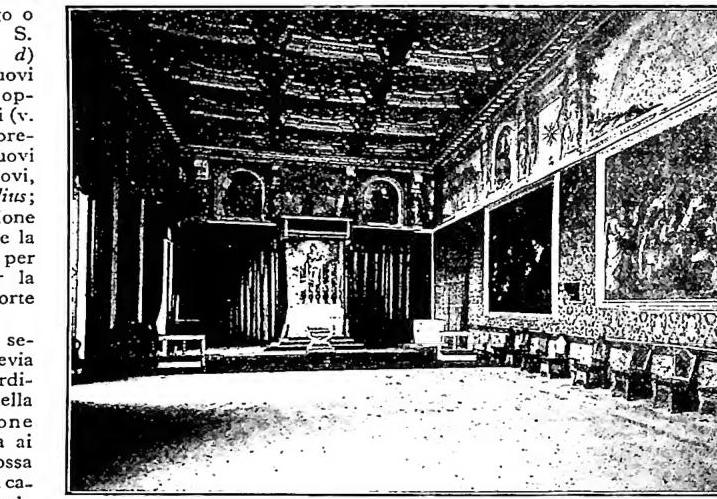
CONCISTORO – Hall of the C., in the papal apartments in the Vatican, decorated by Giovanni Alberti during the pontificate of Clement VIII (1592–1605) – Rome.
Aware of the need to prevent similar harmful vacancies of the Apostolic See in the future, Gregory X, in the fifth session of the Second Council of Lyons, in 1274, promulgated the constitution Ubi periculum, which in some way came to canonize the action of the citizens of Viterbo. Its prescriptions were strict, and many have remained substantially in force down to our own day. The principal ones were as follows: after the death of the pope, the cardinals were to await for ten days the arrival of their colleagues for the c.; then, with only one servant each, layman or priest, they were to assemble, if possible, in the very palace where the pope had died, or in some nearby city, in the episcopal palace or another suitable place, where, in a single room without walls or dividing curtains, they were to live in common, except for free access to a private room. These two chambers were to be so securely closed that no one could enter or leave them without being observed: no one might speak secretly with any cardinal, but, if this was ever necessary, it had to be done with the permission of the S. College and publicly; neither messages nor letters could be admitted or sent; the keys of the c. were to be kept, the inner ones by the cardinal camerlengo and the outer ones by the marshal of the c. This dignity belonged for nearly five centuries to the Savelli family (1274–1712), and upon the death of the last of the Savelli it passed to the Chigi family, which still possesses II. Provisions were to be introduced through a window with a carefully guarded turntable and examined to see whether they contained letters or notes. If, after three days, the cardinals had not reached an election, for the following five days they could have only one dish for lunch and one for dinner; after these five days had also passed, they could have only bread, wine, and water: a severity that was perhaps excessive and was softened by Clement VI (bull Licet in constitution of 6 Dec. 1351).
Like all daring reforms, the laws of Gregory X encountered difficulties in their implementation. The following c., from which Innocent V emerged (21 Jan. 1276), lasted only one day; but, unfortunately, in that same year three elections took place in succession, and both Hadrian V and John XXI abolished the Gregorian laws (licet of 30 Sept. 1276). The consequence was that elections held outside the c. again became lengthy. The election of Nicholas III (25 Nov. 1277) took 7 months and 8 days; that of Martin IV, 10 months and 19 days (22 Feb. 1281); and that of Nicholas IV, 10 months and 12 days (22 Feb. 1288). Even worse occurred after his death, which took place on 4 Apr. 1292: the vacancy lasted 2 years and 3 months.
This experience was sufficiently eloquent, and therefore Celestine V, during the five months of his pontificate before his renunciation, restored the Gregorian laws with three bulls (Quia in futurum of 28 Sept. 1294; Pridem of 27 Oct. 1294; Constitutionem of 10 Dec. 1294). His successor, in fact (Boniface VIII), was elected in c. in a single day: he confirmed the prescriptions of his predecessor and inserted the Gregorian laws into his Liber Sextus (v. CANONICI). From then on, the law of the c. was always observed, even during the Avignon period, though with some non-substantial modifications suggested by changing circumstances of time and place.
Many popes introduced revisions, modifications, and additions to the law. Among these, mention should be made of the bull of Pius IV of 9 Oct. 1562, In eligendi, which regulated in detail the authority of the cardinals and of the Congregations during the vacancy. Other popes dealt with the manner of election, which remained fixed in one of the three still in force: by inspiration, by compromise, or by secret ballot; the accessio soon came into use, whereby a cardinal, in view of the imminent success of a candidate who lacked only a few votes, joined him by changing aloud his original designation, so that two-thirds of the votes might be reached; it will be seen how Pius X replaced this accessio with a second ballot. Pius X also took measures to eliminate any intervention by the civil authority in the c. (v. VETO).
All the c. of the Avignon period (except that from which Martin V was elected, held at Constance on 11 Nov. 1417) down to our own day (with the exception of that in which Pius VII was elected, held in Venice) have been held in Rome. The first two after the schism took place in the Dominican convent of Minerva, and produced Pope Eugene IV (1431) and Nicholas V (1447). All the other c. from the fifteenth to the eighteenth century were held in the Vatican. Some of them were extremely brief: that from which, for example, Julius II (1503) and Paul III (1534) emerged lasted only one day; others were arduous and lengthy, such as the one that gave the Church Benedict XIV (lasting from 19 Feb. to 17 Aug. 1740, that is, six months).
For the needs of the c., the Vatican was isolated by means of walls, and communication with the outside world was possible only through four turntables guarded by prelates (auditors of the S. Rota, protonotaries, bishops, and archbishops assisting at the Throne), and on the outside by detachments of guards.
Upon the death of Pius VII (1823), the Pontifical Palace of the Quirinal was preferred for the c.; being situated higher and more regular in layout, it made it possible to accommodate more suitably the two or three hundred people who composed the c. Leo XII (1823), Pius VIII (1829), Gregory XVI (1831), and Pius IX (1846) were elected there. Upon the death of Pius IX (1878), it was necessary to return to the Vatican; the same was done for the c. from which Pius X (1903), Benedict XV (1914), Pius XI (1922), and Pius XII (1939) emerged.
The turbulent events of the previous century induced Popes Pius VI, Pius VII, and Pius IX to establish rules for the event of attacks upon, or violations of, the freedom of the S. College. Of these extraordinary provisions, the one that remained in force until the recent constitution Vacantis Apostolicae Sedis of Pius XII (v. infra) was that of Leo XIII (apostolic constitution Praedecereores Nostri) of 24 May 1882, drafted during the period of the most acute Italian anticlericalism, when an attack on the Vatican might be feared. These rules (together with those contained in the Instructio appended to the constitution) were reproduced at the end of the CIC (document III), but, after the aforementioned constitution of Pius XII, they were abrogated and are therefore no longer reproduced in recent editions of the CIC. In reality, the c. held after the capture of Rome were entirely free and peaceful; after Pius X they were also enveloped in the deepest secrecy.
II. CURRENT LEGISLATION
The current discipline of the c., governed until now by the constitution of Pius X of 25 Dec. 1904, Vacante Sede Apostolica, reproduced as the first supplementary document appended to the CIC, initially underwent minor modifications through the work of Pius XI, who on 1 March 1922 issued the moto proprio «Cum proxime», also reproduced at the end of the Code (document IX), and finally through the work of Pius XII (const. Vacantis Apostolicae Sedis, 8 Dec. 1945, in AAS, 38 [1946], p. 65 ff.), who essentially retains the law of Pius X, making only minor adjustments to it, apart from one notable change concerning the requirement of one additional ballot beyond the two-thirds of the votes. The minor changes will be noted in their proper place.On the basis of these constitutions, the cardinals may neither enact new laws nor modify them, nor execute favors and provisions issued by the deceased pontiff that have not yet been carried out.
In particular, they must take care in every way not to allow the rights of the Apostolic See to be diminished (no. 2). In urgent cases, the S. College is the arbiter and decides by majority vote (no. 5).
During the vacancy, a general congregation, that is, one of all the cardinals, must take place every day; particular congregations will then take place as often as necessary, composed of the camerlengo and the deans of the three Orders of the S. College, namely the cardinal dean of the bishops, the cardinal dean of the priests, and finally the cardinal dean of the deacons. These deans, however, may belong to the particular congregations only for three days; their places are then taken by the respective vice-deans of the Orders, and after another three days by those next in order of deanery (no. 6). The particular congregation must deal only with matters of lesser importance; any significant or disputed matter must be submitted to the general congregation (no. 7). Voting takes place by written and secret ballots in rebus gravioris momenti. Of particular importance are the preparatory general congregations preceding the c., which determine everything concerning the pontiff’s funeral. In these congregations, Pius XII’s constitution Vacantis Sedis Apostolicae must be read, and the cardinals must take a specific oath in which they promise religiously to observe the said constitution in force, as well as the strictest secrecy, to which the dependent conclavists will also be bound. Two commissions of cardinals must then be appointed, one for the admission of the conclavists and the designation of the various servants and staff assigned to the c., and the other for the construction and closure of the c. and for the distribution of the cells. The Fisherman’s Ring and the lead seal of the Apostolic Chancery are then broken. The cardinals’ cells are ordinarily distributed by lot.
With the pope’s death, the offices of all the cardinals cease, except those of the camerlengo of the Holy Roman Church and of the major penitentiary. The latter and his officials continue to exercise their most important functions, which are described in Pius XI’s const. Quae divinitus of 26 March 1935, no. 12, since they concern matters of conscience and the internal forum, which are always urgent in themselves. With the vacancy of the See, far from losing his office, the camerlengo sees the moment arrive for exercising his most important functions, since “the care and administration of the temporal goods and rights of the Holy See fall to him”; therefore, as soon as he receives from the Master of the Chamber notice of the pontiff’s death, he goes to the Vatican palace to take possession of it and to exercise his office; he also takes possession of the Lateran palace and the villa at Castel Gandolfo (no. 15). It is his responsibility to establish officially the pope’s death and draw up the authentic record thereof, arrange for embalming (respecting the deceased’s wishes), notify the cardinal vicar of the functions to be carried out in the City, etc. (no. 15).
The dean of the S. College will then summon all the cardinals to the Vatican
(no. 16). During the vacancy, neither the office of the cardinal vicar nor that of the papal almoner ceases (nos. 20 and 21). During the vacancy, the S. Congregations and the apostolic tribunals will continue to function within the limits of their ordinary faculties, excluding all matters requiring reference to the pontiff, as well as matters of some importance which, not being urgent, can be postponed until after the pope’s election (nos. 23-25). During the vacancy, all authority over the State of Vatican City belongs to the S. College (no. 23). Provision is then made for the pope’s funeral, called the novendials, of which the final three days are the most solemn (nos. 29-31).
The election of the supreme pontiff is reserved exclusively to the cardinals, including those merely created in consistory and even excommunicated cardinals, provided they have not resigned, or their resignation has not been accepted by the deceased pontiff. A possible council has no right to the election; with the pope’s death, it is suspended ipso facto (no. 33). According to the constitution of Pius X, the cardinals entered the c. ten days after the pope’s death. Pius XI, in order to allow time for those far away, especially those in America, extended this period to fifteen days and permitted the S. College to extend it further, though not beyond a total of eighteen days. Pius XII sanctioned this in the constitution Vacantis (no. 37).
Cardinals who arrive after the c. has begun may enter and participate in the voting, provided the election has not yet taken place. The same would apply to a cardinal who had been required to leave the c. on medical orders and subsequently returned. A cardinal, however, who did not wish to enter the c. or who, having entered, arbitrarily wished to leave it, would forfeit the right to vote (no. 40). Cardinals who, without being prevented by ill health, do not attend the c. are excommunicated (no. 41).
Each cardinal may bring with him two secretaries or servants, whether ecclesiastics or laymen; of these, however, only one, who must be a layman, may accompany him into the c. (no. 49). These “conclavists” must not be prelates, for fear that they might exert influence on the election, nor religious
(Int. Eur. Catl.)
CONCLAVE – Demonstrative print showing the proceedings of the c. at the vacant see of Pope Clement XIV, Rome 1775, ed. G. Bartolomichi.
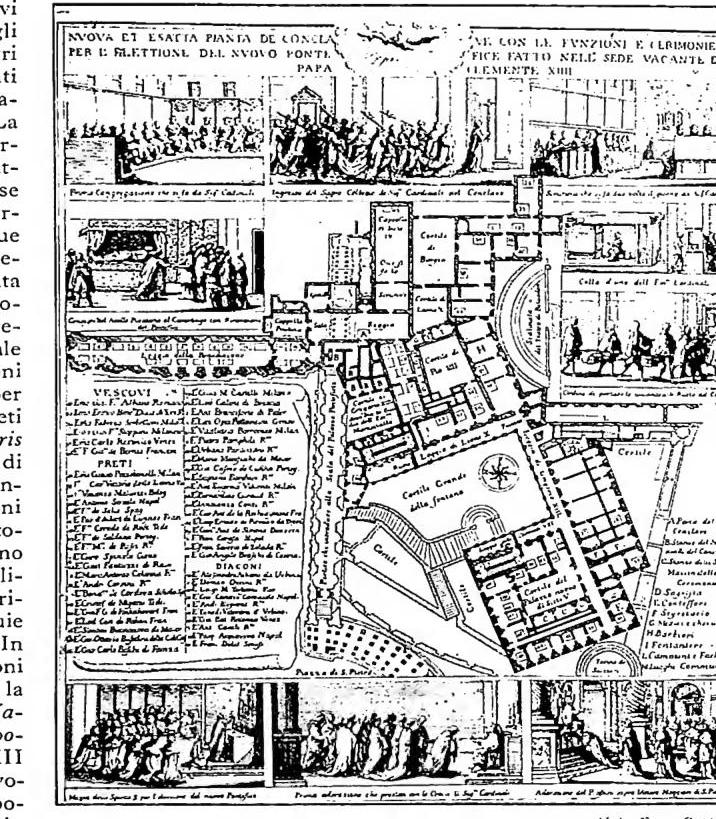
After the pope’s funeral rites have been completed, and while the c. is being prepared, the dean or his delegate celebrates the Mass de Spiritu Sancto, and a prelate or a religious delivers the address de eligendo summo pontifice, exhorting those present to elect the worthiest. After Mass, either in the morning or (more usually) in the evening, they enter the c. in procession behind the papal Cross, carried by the master of ceremonies; when they reach the chapel, the constitution of Pius XII Vacantis is read again and the oath is taken once more, after which the cardinals withdraw to their cells. Meanwhile, the conclavists take an oath before the camerlengo: the master of the Chamber and the marshal of the c. swear separately according to special formulas. Then, after the bell has been rung three times, the c. is closed, and, all the rooms having been inspected to remove any outsider, the conclavists are checked in the chapel (n. 54).
The election of the pope must take place in the c. and after it has been closed; this, however, is not established under penalty of invalidity of the election (invalidity had been established by Gregory XV in the constitution Aeterni Patris of 15 November 1631). Pius X wisely wished the validity of the election to be beyond all dispute, and therefore abolished this sanction, as well as the other one imposed by Julius II (constitution Cum tam divino of 14 January 1505), according to which a simoniacal election would be null (cf. now nn. 57 and 92 of the constitution Vacantis Sedis Apostolicae).
The enclosure of the c. may not be violated: transgressors will be expelled and punished by the new pope (n. 58). Once the c. is closed, no one may speak with the cardinals or the conclavists except in the presence of the prelates guarding the c., and provided that he speaks in a loud and intelligible voice. Should any outsider dare to enter the c., he will thereby forfeit every rank, honor, office, or benefice (n. 59). Letters and printed matter may not enter, and still less leave, the c. before being reviewed by the secretary of the S. College and the assigned prelates. It is absolutely forbidden, under penalty of excommunication, to send newspapers or periodicals out of the c. In Vacantis, Pius XII prohibited the introduction into the c. of telegraphic, telephone, microphone, radio, photographic, cinematographic, and other apparatus (n. 64).
Cardinals and conclavists are bound to the most complete secrecy, so as to disclose nothing that directly or indirectly concerns the election, under penalty of excommunication reserved exclusively to the pope (n. 60). The cardinals may not disclose the outcome of the ballots to their relatives under the same penalty (n. 61). This secrecy must also be observed (though no excommunication is prescribed) after the election has taken place, unless the new pope specially dispenses someone from II.
The election usually takes place in the Sistine Chapel, along whose walls as many small thrones are erected as there are cardinals. One ballot is held in the morning and one in the evening: after an unsuccessful ballot (that is, according to the recent Vacantis [n. 68], every scrutiny in which a candidate fails to receive as many votes as two-thirds of the voters plus one), another is held immediately, so that in practice there are four scrutinies per day. According to the rules issued by Pius X, the ballot paper was designed both to guarantee the strictest secrecy and to make it possible to ascertain whether a cardinal had voted for himself (this verification being made only when exactly two-thirds had been reached for one name). By requiring one vote more than two-thirds, Pius XII rendered this verification unnecessary in every case and consequently simplified the ballots, which now contain only the name of the person elected and no indication of the voter (nn. 72–77). During the elections, cardinals dressed in croccia or in violet mozzetta ordinarily refrained from celebrating Mass, but received Communion in the Sistine Chapel itself; they now, however, have the faculty to celebrate Mass even during the c. (n. 65). Both in the morning and in the evening, every unsuccessful scrutiny is announced to the crowd, which on this occasion gathers densely in St. Peter’s Square, by means of the “smoke signal,” which is dark and smoky (because, in addition to the ballots, paper or damp straw is burned); the scrutiny that has instead produced the pope gives a clear “smoke signal” made from the ballots alone.
Simony, negotiations and agreements concerning the successor while the pope is still alive, and the acceptance and even the direct or indirect communication of the vote of any power or sovereign are forbidden under penalty of excommunication (v. VETO). Under the same penalty, and with nullity attached, any pact or promise, even under oath, by which a cardinal undertakes to vote in a particular way is forbidden. Exchanges of views regarding the election are not, however, forbidden, provided that they take place during the vacancy of the S. See (n. 95). The “capitulations” (v. CAPITOLAZIONE) to which the cardinals might have bound the person to be elected before casting their votes are likewise null (n. 94).
After the canonical election, the dean asks for the consent of the person elected according to a special formula approved by Pius XII (n. 100 of Vacantis). Once this consent has been given, the new pope already acquires full jurisdiction over the entire Church. The dean of the deacons then announces to the people from the window of the loggia: «Annuntio vobis gaudium magnum. Habemus papam dominum cardinalem... qui sibi nomen imposuit...». The cardinals adore the newly elected pope: in the Sistine Chapel, the canopies of all the cardinals except that of the person elected are lowered. The new pope, dressed in white, gives his first blessing to the people from the window of St. Peter’s. The first to give it after 1870 was Pius XI (1922).
coronation (v.) takes place in the following days, performed by the dean of the deacons (n. 108), with the corresponding solemn ceremony in St. Peter’s, together with messages to the whole world, to heads of state, etc.
Conclavists enjoy various privileges: in the past they possessed very extensive faculties and prerogatives, which the new pope promulgated as one of his first acts; in the last c. they were granted only the privilege of a domestic oratory. The establishment of such privileges belongs each time to the new pope, who also takes into account the duration of the c. itself. – Vedi tav. VIII.
Roma papale e medioevale, Rome 1893, cols. 545–52; Lucius Lector (Mons. G. Guthlin), Le conclave, Paris 1894. Further bibliography in A. Molien, s. V. in DDC, III, cols. 1319–42.