
COMMENDATORE DI SANTO SPIRITO. - It is the title of a prelature instituted by Leo X on 15 Dec. 1515 for the rector of S. Spirito, who thereby lost his hospitaller character and assumed that of a prelate, while nevertheless retaining all his previous prerogatives and privileges.
The c. di S. S. is now no more than the Primicerius of the venerable Archconfraternity of S. Spirito in Sassia, but he still retains certain honorary privileges, such as that of being able to affix to the left side of the mantelletta of his prelatial habit a double white cross and of quartering his family coat of arms with this double cross and the image of the Holy Spirit (the radiant Dove with wings outspread).
The prelate c. di S. S. takes his place in the pontifical chapel after the apostolic protonotaries, preceding the Regent of the Chancery, the abbots "nullius" and the general abbots of the Canons Regular.
The distant origins of this prelature go back to the hospice-school founded by the Anglo-Saxon sovereigns as early as the beginning of the 8th century for pilgrims of the Anglo-Saxon nation, whence the designation In Saxia for the locality where the church of S. Maria entrusted to them stood. Like the other scholae that arose in the vicinity of the Vatican basilica, that of the Saxons also underwent a period of decline after the Carolingian period, until Innocent III, in order to meet needs that were becoming more serious, founded on the site a hospital for the sick and for gathering the exposed children who were perishing miserably, and entrusted its care to the order of the Hospitallers of the Holy Spirit, which had arisen at Montpellier. Hence the designation of hospital of S. Spirito in Sassia.
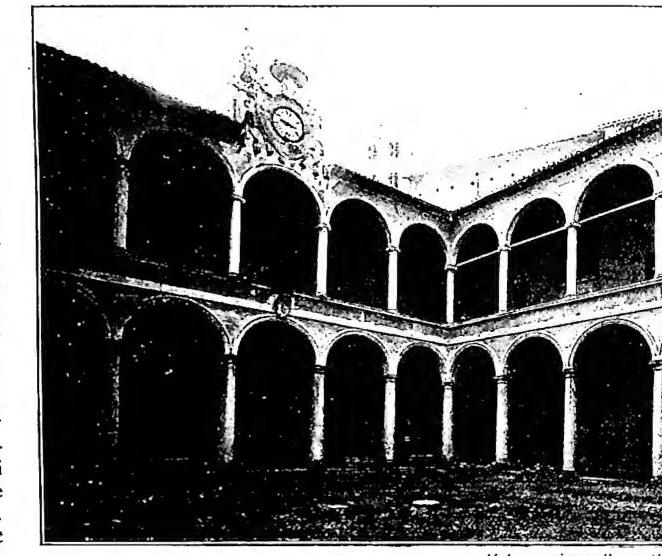
With the constitution Inter opera of 19 June 1204, by which he summoned these Hospitallers to Rome, Innocent III established that the hospital of S. Spirito in Rome should be at the head of those that the said Hospitallers would subsequently erect and that consequently the rector of Rome should be their general head. Then, once the hospitaller nuns of the Holy Spirit had also been instituted, the jurisdiction of this rector extended over them as well. A trace of this preceptory and abbatial dignity is still found in the formula of the ceremonial used by the Holy Father in imposing the mantelletta on the newly elected c.: Esto praecceptor generalis Ordinis S. Spiritus. Like the major offices of other hospitaller orders, that of rector of S. Spirito was also given in commendam, until Leo X made this commendam permanent with the creation of the prelature, which entailed the duty for the prelate of taking care of the hospital. And the popes of the Counter-Reformation took care to confer it on personages who knew how to attend to their duties. The fine palace that Gregory XIII, between 1572 and 1585, had built next to the beautiful church of S. Spirito is proof of the importance that the c. had assumed in the Curia.
This prelature for several centuries retained its supremacy over all the Hospices of the Order, until Benedict XIV with the constitution "Saepe Romanorum" of 5 Apr. 1741, in consideration of the great distance of some of these hospices from Rome, decreed that the jurisdiction of the c. over them was at an end and subjected them to the authority of the Ordinaries.
After the Napoleonic occupation the office of the c. di S. S. was reconstituted, with the appointment as president of the Deputation, instituted by Pius VII on 13 Nov. 1821, to administer and govern the hospitals of Rome. Once this Deputation was dissolved by Pius VIII in 1829, the c. di S. S. continued his office with regard to the hospital in Sassia.
With the capture of Rome, the c. di S. S., deprived of any activity, was reduced to the enjoyment of the privileges inherent in the prelature.
Bibliography3 works
Guglielmo Felici