CANONICI REGOLARI DI SANT'AGOSTINO

CANONICI REGOLARI DI SANT'AGOSTINO. - Sono quei Chierici che vivendo in comune, secondo la cosiddetta regola di s. Agostino, attendono al ministero pastorale con l'obbligo dell'ufficiatura corale.

**CANON REGULARS OF SAINT AUGUSTINE** – These are clerics who live in community according to the so-called Rule of Saint Augustine and attend to pastoral ministry with the obligation of choral office.

Summary:
I. Origin and development.
II. Principal congregations of canons regular.
III. Congregations still in existence:
1. Congregation of the Canons Regular of the Lateran of the Most Holy Savior.
2. Austrian Congregation of the Canons Regular of the Lateran.
3. Hospitaller Congregation of the Canons Regular of the Great Saint Bernard.
4. Swiss Congregation of the Canons Regular of Saint Maurice of Agauno.

I. Origin and development.

This Order, which takes precedence over others (CIC, can. 491) and is composed of autonomous congregations, developed from groupings of clerics living in common or from claustral chapters that arose in various places at the end of antiquity and during the Middle Ages through the efforts of zealous bishops. It is named after Saint Augustine because it was he who, at the earliest origins of the institution, embodied this form of life in an ideal manner, and because from the 12th century onward the so-called Rule of Saint Augustine was adopted by the Order. This Order thus unites and fuses together the proper office of canons—namely, solemn liturgical worship—with the religious life, to which various activities of pastoral ministry are joined, especially the parochial ministry. The Canons Regular of Saint Augustine differ from the Premonstratensian Canons Regular and the Crosiers, which constitute orders with distinctive names, even though they share the common basis of canonical life, and which have their own founder and organization.

The origin of the name "canon" and of the related regular institution has not always had a satisfactory or uniform explanation. The "canon," which in Charisius meant "grammatical rule" and in the Theodosian Code denoted the regulation of in-kind contributions from the various provinces (canon frumentarius), soon came to be used in ecclesiastical language to indicate the prescriptions concerning the discipline of clerics and the faithful. The term "canon," which first appears in Saint Basil and in the decrees of the Council of Laodicea, originally represented a cleric established and living according to the sacred "canons," often to distinguish him from "wandering" clerics or those attached to a private church without a true relationship to the bishop. In this sense, one can understand a canon of the Council of Clermont (535) which prescribes that those priests who are not "canons" either in cities "sacovile" or in rural parishes but who dwell scattered about private oratories must come to the cathedral at least on major feasts. Saint Boniface, the apostle of Germany, in a letter to Pope Zachary, referring to the decline of the clergy in the kingdom of the Franks, declares that he has bound himself to assist only canonical bishops and priests (MGH, Epistulae, III, p. 368).

In time, however, the term "canon" came to be attributed almost by antonomasia to those clerics who lived in monasteries attached to cathedrals or other notable churches, though uncertainty persisted for a long while. Thus, while the "regula canonicorum" of Saint Chrodegang was written precisely for the claustral chapter of Metz, it includes "clerici canonici qui extra claustra in civitate commanent" (c. 21). From the 8th century onward, rules for canons began to appear, whose communal life was patterned, albeit in a more relaxed and flexible manner, on that of monks: one speaks of "abbates canonici," distinct from the "abbates regulares" of monks.

The Canons Regular, so called after the division of canons into secular and reformed ones that occurred in the 11th century, represent, in the first millennium, even before the word "canon" assumed the specific meaning of claustral canon, that part of the clergy which, under the obedience of the bishop, lived in common near a church, observing a form of religious life. Of the existence of these groupings of clerics, who, following the example of monks, adopted such a way of life—though the three religious vows are not distinctly mentioned until the time of the mendicant orders—we have precise testimony. The first comes from Saint Ambrose (Ep. 63: PL 16, 1253-60), according to whom Saint Eusebius, bishop of Vercelli, was the first in the West to introduce among the clergy of his church the common life of monks, which he had learned during his exile in the East. The same is attested of Saint Zeno, bishop of Verona, who lived a monastic life together with the clerics of his cathedral (PL 11, 498).

This exemplary life was not an isolated phenomenon, for other prelates with their clergy imitated II. Among them, those who shared this manner of life with Augustine at Hippo stood out. Although this Augustinian institution declined under the persecution stirred up against the African Church with the invasion of the Vandals, it was not forgotten; many esteemed it as an ideal of holiness and sought to imitate II. Proof of this is the short work *De vita contemplativa* by Julianus Pomerius (PL 59, 415-520), long attributed to Prosper of Aquitaine, and a *Vademecum* for the clergy, steeped in Augustinian doctrine. The author, who presided over a community of clerics in Arles, also reports maxims concerning the common life of the clergy. He reproaches those who, knowing they are in a congregation and possessing goods, claim to be maintained by the church (II, 10). He praises instead the one who leaves his possessions to relatives or to the church, or, having sold everything, distributes the proceeds to the poor to be a voluntary poor man (II, 11). In the second half of the 5th century, therefore, we find in Gaul ecclesiastics living in common without complete detachment from property, while others, certainly fewer in number, as voluntary poor men, followed the Augustinian ideal integrally. Promoters of this in the 6th century were Saint Caesarius of Arles and Saint Gregory the Great. When, shortly after 742, Chrodegang was elected bishop of Metz, he, who had previously professed the monastic life, found the clergy of his cathedral living in a very relaxed manner. The reform of these his closest collaborators, called Canons, was one of his first pastoral concerns. For them he composed

A common life-rule of 34 chapters (W. Schmitz, S. Chrodegangi Metensis Episc. regula Canonicorum, Hannover 1889) which is the first of its kind. In the prologue preceding the chapters he declares that the rule would have been superfluous if pastors and subjects had observed the canons already existing on their duties. This proves that up to that time the Canons had no rule of their own. Hence Chrodegang is to be considered the author of the first canonical rule, which contains norms for common life, daily occupations and the duties of the Canons. Many of its practices are drawn from monastic life and adapted for Canons. Anyone wishing to join the chapter had to donate immovable property to the Church, retaining its usufruct; he remained owner of movable goods and at death half was destined to the Canons and the other half to the poor. It is recalled that the Canons should attain the ideal of perfection (total renunciation), and the bishop is ordered to provide for the necessary maintenance of those who do so. The rule was adopted by other Canons and later expanded into 80 chapters (PL 89, 1057–1098). But as regards the faculty of ownership, the new redaction represents a deterioration, because it allows Canons immovable and movable property. However, Chrodegang’s prescription regarding voluntary poor is maintained. But the improvement in life achieved by the reform of Metz was not long-lasting.

Article illustration

Another attempt to raise the fortunes of the canonical institution was made by Louis the Pious at the imperial synod of Aachen in 816. The collection of statutes destined for the Canons of the Frankish kingdom, called the imperial rule of Aachen (PL 105, 811–34), consists of 145 chapters, of which 118 contain many canons and disciplinary decrees of ancient councils and African synods as well as extracts from the works of the Fathers. The others concern the practices of common life and are drawn from the rule of Metz. In chapter 112 the Canons are reminded of the state of perfection to be attained through total detachment from property; while, a strange anomaly, chapter 115 destroys common life, similar to the monastic and that of St Augustine, by allowing Canons to possess property. The improvement promoted by Louis the Pious was partly achieved, but it was very short-lived. The lack of a vow of poverty and of external equality in house and board led to serious abuses. Private property greatly contributed to relaxing the rule: hence in the course of time many chapters degenerated (G. Hergenröther, Storia universale della Chiesa, trans. it., III, Florence 1905, p. 218).

The institution fared better only when the supreme authority of the Church effectively promoted the regular common life of the Canons. Indeed the Popes and their zealous co-workers, having understood that the main cause of the relaxed life of the Canons was the possession of goods and money, opposed the right of property admitted by the rule of Aachen. This occurred at the Lateran Synod of 1059 under Nicholas II, where, in the presence of 113 bishops, Hildebrand, later Pope Gregory VII, delivered a speech of harsh criticism against such licence (J. Mabillon, Annales Ordinis s. Benedicti, IV, Lucca 1739, p. 689). Even the daily ration of 2 pounds of bread and 5 pounds of wine or beer granted by the rule (chapter 122) was judged excessive and unsuited to ecclesiastical persons. The 4th canon of the Synod ordered the Canons to observe, besides obedience and chastity, common life with total renunciation of property as befits religious clergy (Mansi, XIV, 898).

Another promoter of the reform, St Peter Damian, criticised with even harsher words chapters 115 and 122 of the same rule (Opusc., 24, Contra Clericos Regulares proprietarios: PL 145, 479 ff.). The severity of the reformers’ judgement against the imperial rule was justified by the tenacity of the Canons in defending it to escape reform. Many chapters proved refractory, but the reform achieved notable successes from the outset in Rome and elsewhere. Hildebrand could affirm in the aforementioned speech that some of the clerical order professed common life with the vow of poverty to such an extent that they reserved nothing as their own. Such an example was imitated by the Canons of St Martin in Lucca in the time of Leo IX and Victor II. These, however, did not persevere and opposed any further reform. In compensation there arose in Lucca the celebrated priory of the Regular Canons of St Frediano, who for a long time remained united in fraternal charity with those of St John Lateran.

Through the work of St Peter Damian perfect common life was attained by the canons of the cathedral of Fano (Opusc., 27: PL 195, 204 ff.). Under Alexander II the Canons of Pistoia also accepted II. At the beginning of the 12th century regular common life is found established in the cathedrals of Città di Castello and a little later in those of Perugia and Gubbio. Contemporaneously the efforts of the pontiffs met with success in France and also in Germany, where the reform was strongly opposed. Common life, already embraced by various chapters such as that of Salzburg, was suppressed by the violence of the imperialists and could be resumed only after the death of Henry IV. The success achieved among the canons of the cathedrals was limited; instead the number of those living in common with perfect renunciation of all private property grew noticeably in the new foundations of collegiate churches. With the favour of the Popes and especially after 1080 these multiplied rapidly, especially during the 12th century, which was the period of their greatest development.

Thus deep divisions arose among the Canons: some, refractory to the reform, abandoned even all the practices of common life prescribed by the imperial rule, leading private lives and enjoying a share of the Church’s revenues as a benefice, and were called secular Canons; the reformers, on the other hand, imitating not only monks but also the clergy of Augustine and the renuntiautes of earlier centuries, were called Regular Canons. Between these two classes there remained for some time a group of other Canons, who, little inclined to the reform but still adhering to the imperial rule, nevertheless preserved some semblance of common life. By 1200 they no longer constituted a class.

stable, and they disappeared with the process of division from which arose the two classes mentioned. At the same time, the documents reveal the new designation of "Order" to denote the collectivity of all the reformed chapters, both those of the cathedrals and those newly founded. All, although independent of one another, taken together constituted the Order of the C.r., so called from S. Agostino, since in the course of the 12th century they adopted the so-called Rule of S. Agostino. The great collegiate churches in France and England preferably bore the title of abbey; that of provostship in Germany and that of priory in Italy and England. The collegiate churches of S. Frediano in Lucca, of S. Maria in Porto in Ravenna, and of SS. Vittore e Giovanni in Monte in Bologna were priories. Instead, S. Croce in Mortara was a provostship. These collegiate churches and many others abroad experienced a flourishing development with numerous dependencies of priories and parishes, without, however, altering their original juridical constitution. Only later did some adopt the form of a congregation with a central superior direction and houses juridically equal among themselves.

There is no evidence in the documents that a specific rule was imposed upon the C.r. The reformers demanded from them the practice of common life with total detachment from property; each chapter therefore freely adopted statutes suited to foster such practice. Thus arose various rules, adaptations of statutes or particular usages. Nor were they forbidden to use the norms contained in the two ancient canonical rules not contrary to the spirit of the new life embraced. These norms had not been exhausted in the Roman Synod of 1059. This explains how in the first phase of development of the Order, from 1050 until about 1130, various rules are found, which may be called primitive in relation to another that later replaced them.

The official rule of the Canons, namely that of Aachen, was at first not abandoned but amended and expanded. This is attested by the additions to the rule itself found in the codices of the 11th century: Ottobon. 38 V. Lat. 485 and 1351 of the Vatican Library (C. Egger, *De antiquis regulis Canonici. reg.*, in *Ordo Can.*, I [1946], pp. 44-48), which contain the entire rule of Aachen except for the chapters condemned by the Synod of 1059, and many taken from the Rule of S. Benedetto and of S. Crodengano (A. Werminghoff, *Die Beschlüsse des Aachener Concilis im Jahre 816*, in *Neues Archiv der Gesellschaft für ältere deutsche Geschichtskunde*, 27 [1902], pp. 40-45; C. Egger, *loc. cit.*, p. 48). There would be two parts of a common text from which they were transcribed: they contain the chapters of the imperial rule, with the exception of those contrary to total renunciation of property, which is inculcated with other precepts. This proves that the rule thus amended served the reformed Canons. Another rule certainly used by the C.r. is that which bears the title *Regula de Patrum Augustini, Hieronymi, Gregori, Prosperi (Pomerio) atque Isidori*. The 62 chapters are the very text of the chapters of the rule of Aachen and of the expanded rule of Crodengano: only the text is amended in what concerns perfect renunciation of property. The codex was the *liber capitularis* of the provostship of S. Michele in Càmeri (Pavia) and is now in the civic museum of Pavia (Inv.: martyrology of Usuardo, B. 28, n. 146). There is also the Ottobonian codex 175, which represents a further and freer elaboration of the rule of Aachen, where many sayings of the Holy Fathers on the discipline of the clergy and some chapters of the Rule of S. Benedetto have been inserted. It is interesting that there appears for the first time a passage from the so-called rule of S. Agostino, cited simply as an authority.

Other compilers followed the spirit of the two ancient canonical rules in composing the new text of the rule. This was done by Pietro, called Peccatore, founder and first prior of S. Maria in Porto (Ravenna). The Portuense rule was approved by Pasquale III in 1116. The same method was observed by Mangelodo of Lauterbach, first provost of the collegiate church of Marbach, founded in 1089. This rule was also approved by Callisto II.
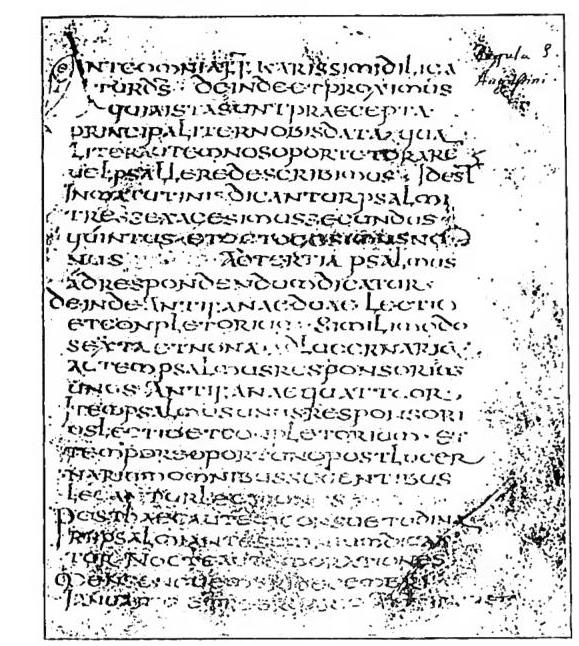
To these various rules adopted by the Order in its first phase of development, must be added the so-called rule of S. Agostino. It has not yet been ascertained where it first appeared, whether in some collegiate church of France, Germany, or elsewhere. The present text of the rule, except for the beginning: *Ante omnia... principaliter nobis data*, is recognized by all as the work of Agostino. It has also been affirmed by historians that the text was written as a rule intended for men. Recent authors, however, believe that it was originally a letter (211) addressed to the holy virgins of Hippo. It would have been transcribed with adaptation for the male sex during the 7th century, probably in Gaul. The codex of Corbie of the 7th century bears witness to this, containing the most ancient manuscript of the "rule adapted for men, which, it seems, served as spiritual reading for monks" (cf. A. Casamassa, *Il più antico codice della regola monastica di s. Agostino*, in *Rendiconti Pont. Acc. rom. arch.*, I [1923], pp. 25-105).

During the 12th century the rule of S. Agostino became the official rule of the Order, although its text was not yet fixed. This is evident from the codices and is clear proof that it was freely chosen by the Canons. In various collegiate churches, such as those of S. Vittore in Paris and those of Marbach, only the genuine text was accepted as the rule. In others, this was preceded by another, now considered by all as spurious, which begins with the already cited words: *Ante omnia*, as found in the Corbie codex from the beginning of the 8th century. Other chapters removed from the spurious text the entire section on the divine office and manual labor and other monastic practices little suited to Canons, so that only the beginning remained. Elsewhere this beginning appears in the title of the rule, and in the genuine text it is recalled as follows: *Haec sunt quae praecipimus observari, ut in canonica habitantes post principalia praecepta Dei et proximi, caritatis vinculum custodatur*. Similar variants are found in the codices up to the entire 15th century. When the text of the rule of S. Agostino was definitively established, the precept of charity, recommended by the opening words of the spurious rule, was preserved in the Augustinian rule, defined as the rule par excellence of charity to be practiced in the common religious life. With the spread of this rule among the C.r., the Order is mentioned in papal bulls as constituted: *secundum Deum et s. Augustini regulam*.

With the observance of perfect common life, divine worship flourished with solemn liturgical functions and diurnal and nocturnal offices. To this principal aim the Canons devoted the greater part of their daily activity.

Many collegiate churches, especially those founded by zealous bishops, initially remained subject to their jurisdiction. Later, the Canons Regular (C. r.) obtained the protection of the Holy See and other privileges, including the right to elect their own priest. Popes and bishops also granted many chapters parochial benefices. Soon, the Canons Regular practiced charity for the poor and pilgrims. Outside the cloister enclosure, there was a room set aside for this purpose, called an *hospitium* or *hospitale*. The care of those housed there was entrusted to a canon known as the *magister hospitii*. This charity, widely practiced from the 11th century to the present day, was notably upheld by the Canons Regular of the Great St Bernard, the Canons Regular of the Holy Sepulchre (which survived until the 19th century), and the Canons Regular of St Anthony and the Holy Spirit, two of whose central houses were in Rome (the hospital of Santo Spirito, which still bears the name).

To remedy the lack of a general direction within the Order and the possible relaxation of regular discipline, the Fourth Lateran Council under Innocent III (1215) prescribed that the Canons Regular and the Benedictines hold triennial provincial chapters. At these meetings, visitors and certain prelates were to be appointed to conduct canonical visitations of the various houses. The need for reform was felt in the following century. Benedict XII ordered it with the Constitution of 25 May 1339 (*Bullarium romanum*, Turin 1857 ff., p. 424). The document contains provisions regarding the acceptance and education of young canons, liturgical duties, offices, food, clothing, administration of property, libraries, and archives. At that time, the Order comprised four provinces in Italy, five

In France and seven in other countries. After a fleeting improvement, regular discipline worsened with the appearance of the schism and the system of commendations; secularization continued, and of the chapters of cathedrals only a few remained regular in name until the 17th century. No further general reform was attempted; however, at various times, reforming currents manifested themselves, infusing new life into the institution. In this way, almost always through the efforts of the canons themselves, Congregations arose. The canonries, until then independent of one another, were united into a single body with a central direction, consisting of a superior general and several counsellors. These Congregations also adopted the practice of holding general chapters, initially annual and later triennial. Some, alongside these innovations, maintained the primitive characteristics of the Order: the perpetuity of the prelatures and the stability of individuals, sometimes uniting in such a way as to form a Congregation on the model of the monastic ones.

A distinctive feature of the Order is its spiritual schools:

1. The School of St Victor: its principal representatives, Hugh, Richard, Adam, Accardus, and Thomas Gallus, were of a rather speculative disposition and under the influence of Pseudo-Dionysius. All creation, historical events, and especially Sacred Scripture, contain a “divine nucleus” that is known through intuitive meditation. From this one ascends to contemplation, which is an affective consideration of divine truth, free from the “smoke of passions.”

2. The School of Windesheim: better known under the name of the “Devotio moderna.” It represents precisely a new spiritual current, which, through the Augustinian Canons Regular of Windesheim and the Brethren of the Common Life, spread through the Netherlands, Germany, Austria, Italy, France, and Spain.

3. The Lateran School: the Lateran Congregation, in the fervour of the reform, produced a rich literature of an ascetical nature, often inspired by the “Devotio moderna”; without complex schemes, it insists on renunciation of the world and of one’s own will, places less emphasis on austerities than on filial and intimate prayer and frequent reception of the Sacraments. Among the authors, who also deserve credit for having usually employed the vernacular, are to be numbered: Paolo Maffei, Serafino da Fermo, Pietro da Lucca, Serafino da Bologna, Alessandro Torre, and Nicola Bambacari.

In the missionary field, the Augustinian Canons Regular rendered meritorious service in the 12th and 13th centuries in the evangelization of some Slavic tribes of northern Germany and the Baltic peoples. The regular canon St Vicelinus preached the Gospel to the Wagrians, and St Meinhard crowned his missionary activity in the Baltic with martyrdom. The Portuguese Congregation of St John the Evangelist later brought the good news to the kingdom of the Congo, Abyssinia, and India; Spanish Augustinian Canons collaborated around 1500 in the conversion of the Indians of America.

The contribution of the Order to culture and civilization is considerable. Let us first note the theological school of St Victor in Paris with Hugh, Richard, Godfrey, Walter, Robert of Flamborough, Peter of Poitiers, and the biblical scholars Andrew and Peter Comestor. The college of Augustinian Canons Regular of Val des Écoliers was part of the faculty of theology at the University of Paris. In the theological field, we may also mention Gerhoh of Reichersberg, Martin of Aspilcueta (called Navarrus), Giovanni Crisostomo Trombelli, and Eusebius Amort, the last two of whom, together with Gabriele Pennotto, were also distinguished historians of the Order. Throughout the Middle Ages, St Ivo of Chartres and Stephen of Tournai were renowned as canonists. For Oriental and biblical studies, limiting ourselves, as above, to a few representative figures, we may name Ambrose Teseo, Agostino Steuco, Sebastian Schertlin, and Giovanni Crisostomo Mitterndorfer. For medieval Latin poetry, Andrew of St Victor is celebrated; for humanistic poetry, Girolamo Vida, Basilio Zanchi, and Giovanni Battista Santeul (Santolius). Alessandro Marino may be called the founder of the Accademia di S. Cecilia in Rome.

II. PRINCIPAL EXTINCT CONGREGATIONS

To list all the Congregations of the Augustinian Canons Regular would mean naming a large part of the cathedrals and collegiate churches of Europe; it will suffice to indicate only some of the principal ones that became extinct over the centuries before mentioning those that still exist.

1. The Congregation of the Most Holy Saviour, also called the Rhenish

It was so named from the church of the Saviour in Bologna, near which, in the mid-14th century, the Augustinian Canons Regular of S. Maria di Reno transferred. This renowned collegiate church had arisen at the beginning of the 12th century near the Reno stream in the Bolognese territory; but the beginning of the Congregation was the work of Stefano Agazzari, prior of the recently founded Augustinian Canons Regular in S. Ambrogio in Gubbio. He obtained from Martin V in 1418 the union of S. Ambrogio with S. Salvatore, and the following year the Congregation was founded. Other canonries joined them, and by the end of the following century they numbered forty, including the Roman ones of S. Pietro in Vincoli, S. Lorenzo fuori le Mura, and S. Agnese. The Congregation had many distinguished men for virtue and learning, among whom were the Blessed Arcangelo Canetoli, Agostino Steuco, Cardinal Andrea Galli, and Archbishop Vincenzo Gorofali. Suppressed in 1810, it was restored in the years 1814–19 and united with the Lateran Congregation in 1823.

2. The Congregation of S. Giorgio in Alga-Venice. — S. Giorgio was an ancient Augustinian Canons Regular priory, reduced in 1404 to the single prior with two lay brothers in simple profession. The priory was suppressed, and at S. Giorgio a collegiate church of secular canons of common life, very observant, was established. It was approved by Gregory XIII in 1407. Among the first canons were the Pope’s nephews, Antonio Correr and Gabriele Condulmer, later Eugenius IV, and St Lawrence Giustiniani. They had several houses in Italy, including S. Salvatore in Lauro in Rome. They became regular when Pius V in 1570 imposed solemn vows upon them. Clement IX suppressed them in 1668, and their property passed to the Republic for the war against the Turks.

3. The Congregation of Windesheim

It was founded in 1386 at Windesheim near Zwolle by Florentius Radewyns and six Brethren of the Common Life and was approved by Boniface IX and Martin V. It spread rapidly

Article illustration

in the Netherlands and in Germany. Especially in the 15th century it rendered great service to the reform of canonical life. It disappeared with the Napoleonic suppression. At the beginning of that century various houses of C.r. were aggregated to it, with the principal house of Groenendael built by the Blessed John Ruysbroeck. In 1432 twelve other canonries, with the principal one of Neuss in the diocese of Cologne, joined II. The prepositura of Marbach, devastated and ruined by the Armagnacs, revived in 1464 with its incorporation into the Congregation. At its greatest extent it numbered as many as 120 houses, many of which perished in the Reformation. In the 17th century there was also an attempt to unite it with the Lateran Congregation. It disappeared definitively with the Napoleonic suppression.

4. The Congregation of St Victor and St Geneviève of Paris

The abbey of St Victor, founded by William of Champeaux, was approved by Paschal II in 1114. It soon became a renowned centre of learning. Among its illustrious canons were Hugh, Richard and Adam. As dependencies it had many priories and parishes. After years of splendour, it was struck by the revolutionary storm. At the end of the 15th century an attempt to unite it with the Congregation of Windesheim failed. In 1515 it associated itself with the new Congrégation réformée de France, which was styled that of St Victor. But in 1544 the Victorines returned to independence. The series of commendatory abbots began. The government of the abbey was entrusted a priori to vicars until 1641; these then became triennial priors. In 1634 from another reform, promoted by the prior Charles Faure of the abbey of St Geneviève and by Cardinal de la Rochefoucauld, arose the Congregation of St Geneviève. It included numerous abbeys and priories in France and some in the Netherlands, but it too was swept away by the revolutionary storm. Among the last canons of these Parisian abbeys who died martyrs were the Blessed Charles Mary Bernard, librarian of St Victor, the Blessed John Francis Bonnet de Pradal and Claudius Ponce of St Geneviève.

5. The Congregation of the Most Holy Saviour

It was founded by St Peter Fourier, a canon regular of the abbey of Chaumont and parish priest of Mattaincourt in Lorraine. The saint had already given life to the Congregation of Canonesses of Our Lady when (in 1623) he set about reforming canonical life in the abbeys of his region. In 1628 the reform had been accepted by eight houses, which Urban VIII, by a bull of 28 August of the same year, united into a Congregation. At the same time he granted that the superior general be elected for life. It spread especially in Lorraine and Savoy and rendered notable service in sacred ministry and in the instruction and education of male youth.

6. The Congregation of the Holy Cross of Coimbra in Portugal

It was so called from the central house erected in 1132 by Tello, archdeacon of the cathedral. The canons adopted the customs of those of St Rufus of Valence. At Coimbra St Anthony of Padua lived among them before entering the Franciscan Order. From a reform promoted by King John II there arose in 1527 the Congregation with various houses scattered throughout the Portuguese kingdom.

Article illustration
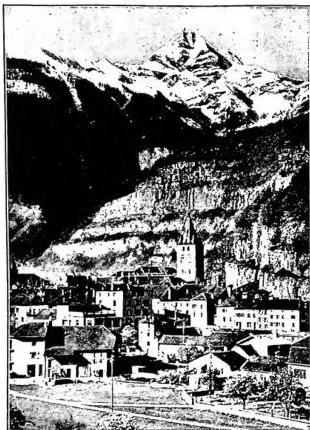
(ret courtesy of the Canons of St. Maurice) Canon Regulars of St. Augustine – Abbey of St. Maurice d’Agauno with the Dente du Midi in the background, alt. m. 3260. Switzerland.

1. **Congregation of the Augustinian Canons Regular of Lateran.** – The origins of this congregation date back to the 11th century, when the first prepositures of Canons Regular of St. Augustine were established in various parts of Europe. Among the most ancient are those of Rottenbuch in Upper Bavaria (1077), St. Florian in Upper Austria (1071), St. Pölten in Lower Austria (1108), Novacella or Neustift in the diocese of Brixen (1142), Reichersberg in the diocese of Linz (1084), and Vorau in the diocese of Seckau (1163). Some of these prepositures became true centers of culture, with rich collections of artworks, manuscripts, and incunabula (the library of St. Florian preserves 800 of these). During the 16th and 17th centuries, a charitable union and the sharing of privileges were established between these monasteries and the Congregation of the Lateran Canons Regular; from that time, these Canons Regular have been called Lateran Canons Regular, and their provosts have been styled Lateran abbots.

According to the ancient custom of the Order, each prepositure has a certain number of parishes incorporated into it (a total of 110 parishes throughout the Congregation), where pastoral activity is carried out. In the prepositures, the Canons Regular devote themselves to choral office, study, and teaching. Klosterneuburg is renowned for its “liturgical apostolate” (Volksliturgisches Apostolat), a movement aimed at fostering active participation in the sacred liturgy among the faithful. The celebrated Gerhoh of Reichersberg belonged to this branch of Canons Regular.

In the General Chapter, the abbot general is elected, who presides over the Congregation for six years, and the co-visitor, who conducts the canonical visitation in the prepositure of the abbot general. The Congregation today comprises 6 houses with 349 canons.

Bibl.: B. Gernik, *Die Schriftsteller der Augustiner-Chorherren Österreichs*, Vienna 1905; W. Pauker, *Führer durch die Sehenswürdigkeiten des Stiftes Klosterneuburg*, ibid. n.d.; M. Schrutt, *Guida storico-descrittiva della Propositura dei Canonici Regolari di Novacella*, published on the occasion of the eighth centenary of the Abbey 1141-1941, Florence 1942. Carlo Egger

2. **Hospitaller Congregation of the Canons Regular of the Great St. Bernard.** – Its origins date back to the second half of the 11th century. Its original purpose was to oversee the functioning of the hospice founded by St. Bernard, archdeacon of Aosta (q.v.), on Mont Joux, in place of the Carolingian hospice of Bourg-St-Pierre, which had been destroyed. It is governed by a provost (praepositus), appointed for life by the General Chapter; he receives the abbatial blessing and is invested with all the prerogatives of abbots of monasteries *sui iuris* as well as other special privileges, by virtue of the bull that Clement XIII addressed to Provost Claude Filibert Thévenot on 9 August 1762.

Today, in addition to caring for the hospices of the Great St. Bernard and the Simplon, the Canons exercise a stable ministry in nine parishes of the diocese of Sion and one in the diocese of Aosta. Furthermore, since 1933 they have undertaken a mission on the borders of Burma, Tibet, and China (Canon Maurice Tornay, martyred in September 1949, was the first victim of the mission). The Constitutions promulgated by Cardinal Giovanni Cervantes on 15 May 1438 are still in use (the original manuscript is preserved and described by L. Quaglia in *Archives héraldiques suisses*, 63 [1949], pp. 26-29); these have been adapted and supplemented by various General Chapters and are now aligned with the prescriptions of the *Codex Iuris Canonici*. The Congregation today numbers 86 members.

Bibl.: *Regula S. Patris Augustini pro Canonicis Regularibus una cum Constitutiones pro iurisdictione Congregationis Con. Reg. Montis et Columnae Iovis*, Lucerne

1723. In addition to the works cited in the bibliography of BERNARD OF AOSTA, see: Fred

Th. Dubois, *Les armoiries de l’hospice du Grand-St-Bernard*, in *Archives héraldiques suisses*, 28 (1914), pp. 150-53; id., *Armorial des Prieurs du St-Bernard*, ibid., 33 (1939), pp. 8-13, 46-53, 72-76, 176-32; L. Quaglia-D.-L. Galbreath, *Sigillographie du Grand-St-Bernard*, ibid., 61 (1944), pp. 10-14, 70-75; L. Quaglia, *L’habit des chanoines du Grand-St-Bernard*, in *Revue d’hist. eccl.*, 38 (1944), pp. 34-46; P. Croidys, *Du Grand-St-Bernard au Thibet*, Paris [1949]; Chr. Simonnet, *Thibet. Voyage au bout de la chrétienté*, ibid. [1949]. A. Pietro Frutaz

3. **Swiss Congregation of the Canons Regular of St. Maurice of Agauno.** – It appears that the monks of Agauno adopted the Rule of St. Benedict in the 7th or 8th century, but around 824 they were replaced by Canons who likely followed the prescriptions of St. Chrodegang, bishop of Metz. From the mid-8th to the mid-11th century, the abbots were simultaneously bishops of Sion; subsequently, the officials of the last Carolingians, then the kings of the second kingdom of Burgundy, and finally the first counts of the House of Savoy reserved for themselves the supremacy over this abbey, sometimes holding the title of abbot or provost themselves, or granting these titles to their relatives, such as the archbishops of Lyon or the bishops of Aosta. At the suggestion of St. Hugh, bishop of Grenoble, Count Amadeus III of Savoy renounced commendatory appointments, and the Canons of the abbey adopted the Rule of St. Augustine in 1128, with the approval of Pope Honorius II.
From the beginning of the 14th to the mid-17th century, the abbey had become a collegiate church with several prebends, and the abbot was the temporal lord of many localities. At the initiative of the apostolic nuncio Girolamo Farnese, Abbot Pietro Maurizio Odet began in 1642 the restoration of regular life, and Nuncio Domenico Passionei approved the new Constitutions in 1722; these were later revised in 1820, 1870, and 1931. King Victor Amadeus III of Sardinia created the abbot a count in 1782, and Pope Gregory XVI elevated him to the dignity of bishop in 1840, with the title of Bishop of Bethlehem and the abbatial church as his cathedral.

By privilege of Pope Eugenius III, the Canons wear, according to tradition, the red mozzetta; moreover, Nuncio Odoardo Cibo, in 1675, granted the Canons of the cathedrals of Savoy a violet habit, and Pope Gregory XVI, in 1840, granted them the red cappa. Since the Middle Ages, the Abbey of St. Maurice has had several parishes, and Pius XI, in 1933, determined which are of *nullius iuris* and which are fully incorporated into the abbey by the diocese of Sion. In the Middle Ages, the Abbey of Agauno participated in the founding of the abbeys of Abondance and Filly in the diocese of Geneva and governed several priories, such as Vetroz (Valais), Aigle (Vaud), Semur and Senlis (France), and Ripaille (Savoie), the latter founded by

From St. Louis IX, king of France, and from Duke Amadeus VIII; it still governed several hospices, such as St. James near Agaunum and another in Villeneuve (Vaud). Over time, the abbey of St. Maurice concluded various pacts or spiritual alliances with the abbeys of the C. r. of Abondance and of Filly, with the Benedictines of Einsiedeln, with the provostship of the C. r. of the Great St. Bernard, the Congregations of C. r. of the Lateran and those of St. Peter Fourier in Lorraine.

Today, the abbey is an intellectual and spiritual center of Catholic Switzerland. The Canons devote themselves to teaching and to all forms of priestly and missionary ministry. Within the abbey precincts, about 600 students attend courses in the attached gymnasium-lyceum, recognized by the government of the Valais canton. The Canons of St. Maurice also teach at the college of St. Charles in Porrentruy (Berne) and at the commercial schools of Sierre and Bagnes (Valais). They also exercise the sacred ministry in the apostolic prefecture of Sikkim (India), which has been entrusted to them since 1937. As of December 31, 1948, the Congregation numbered 128 members.

Bibl.: L. Dupont Lachand, *Les Abbés de St-Maurice d'Agaune*, in *Les Echos de St-Maurice*, 31 (1932), pp. 239-77. Leone Dupont Lachenal

CANONIC—1. For the origin of the term and the history of the institutions in the first millennium, V. CANONICI REGOLARI DI SANT'AGOSTINO. AGOSTINO.

In 1059 Nicholas II sought to reduce canons to a common life and to restore the community of goods in the Church, but it was a difficult task that did not succeed everywhere, hence the distinction between regular and secular canons. In the 13th century, the canons of the cathedral church formed a separate category within the clergy of the episcopal city.

2. Here we consider secular canons. Canons and dignitaries constitute the essential element of a Chapter. The CIC mentions above all two kinds of canons: canons simpliciter or titular canons and canons ad honorem or honorary canons (can. 406, § 3).

3. Titular canons are members of the Chapter and enjoy a true benefice that grants them the right to suitable resources, so much so that a special concession from the Holy See is required to establish canonries without attached emoluments (can. 393, § 3).

The number of canons must be sufficient to ensure the dignified celebration of divine worship and the dignity of the church (can. 394, § 3). The number is fixed once and for all in the so-called numbered or fixed-number Chapters: in such Chapters there are as many prebendaries as there are prebends (can. 394, § 1), whereas in non-numbered Chapters the number is not fixed and it is for the bishop, after consulting the Chapter, to determine how many members the benefice revenues can support decently (can. 394, § 1).

4. In the 18th century, the practice was introduced in France of appointing honorary canons to ecclesiastics to whom bishops wished to show particular consideration. They have no obligation to attend choir or to reside, nor can they claim any canonical prebend or exercise voting rights (active or passive) in Chapter assemblies. In effect, they are not members of the Chapter. The right to appoint honorary canons, whether diocesan or extra-diocesan, belongs solely to the bishop: he must consult the Chapter and exercise this right rarely and with circumspection (can. 406, § 1).

For the appointment of an extra-diocesan priest as honorary canon, the bishop must not only consult his Chapter but also obtain, under pain of nullity, the consent of the Ordinary of the priest himself, and inform that Ordinary of what insignia and privileges the new canon may use (can. 406, § 2). The number of honorary canons residing outside the diocese cannot exceed two-thirds of the number of titular canons (can. 406, § 3).

Honorary canons of a basilica or collegiate church in Rome may use their insignia and privileges only within that church and its dependencies. Honorary canons of all other churches outside Rome may use their insignia within the bounds of their diocese and exceptionally outside it, as titular canons do. In addition to honorary rights, honorary canons have the right to a stall in the choir (can. 407, §§ 1, 2).

5. The term supernumerary canons designates those canons who exceed the fixed number and consequently lack a prebend, in the so-called closed or numbered Chapters. Supernumerary canons are true canons, with the right to a stall in the choir, a voice in Chapter, and daily distributions, and with the obligation to attend divine service.

Article illustration

Those who hold a prebend in a capitular church may obtain from the Holy See—and from it alone—an indult of merit, called an indult of jubilation, after forty years of laudable service in the choir, either in the same church or in distinct churches of the same city or at least of the same diocese (can. 422, § 1). Jubilated canons, even if they do not reside at the place of their benefice, receive the revenues of their prebend and also the daily distributions, though they are dispensed from altar service (can. 422, § 2); but they do not enjoy the right of option where it exists (can. 422, § 3).

We may note in passing coadjutor canons, whom the Pope assigns to those canons who, due to age or infirmity, are unable to perform their office. Generally, they possess the spiritual and temporal powers of the canons they assist, but they have no right to the prebend, nor any obligation of residence or attendance at divine service.

6. It is the bishop’s prerogative to confer all canonries, after hearing the Chapter’s opinion, unless their collation is reserved to the Holy See or the foundation charter assigns this right to others. The bishop shall confer this title only on priests distinguished by learning and integrity of life (can. 404, § 1); other things being equal, he shall take into account the degree of doctor in theology or canon law or the merits acquired in ministry or teaching.

Canons must take possession of their benefice in accordance with cann. 1443–45 and make the profession of faith prescribed by cann. 1406–1408. After taking possession, they may use their insignia and privileges, occupy a stall in choir, and receive the fruits of their benefice (can. 405, §§ 1, 2).

7. Chief among the duties of canons are choir service and residence. All who hold a choral benefice are bound to recite the Divine Office daily in choir. A turn-based service (servitium per turnum) is nevertheless lawful if authorized by the Chapter’s foundation law or by the Holy See (can. 414). Canonical office comprises: the chanting of the canonical hours, the conventual Mass, and any other Masses to be celebrated in conformity with the rubrics of the missal or by virtue of pious foundations (can. 413, §§ 2, 3).

Chapter members are bound to reside at the place of their benefice and may enjoy only a limited period of vacation; for canons bound to choir, this may not exceed three months in any one year, whether continuous or divided (can. 418, § 1). A legitimate cause and special permission from the bishop are required if canons wish to be absent during Lent or Advent or on the more solemn feasts of the year (can. 418, § 3). During vacations they receive only the revenues of their prebend.

8. Canons have the right to wear a distinctive habit and insignia, which may include the rochet, the mozzetta, the cappa magna, a ring, and sometimes a pectoral cross. The canonical habit must be worn in choir and may be worn throughout the diocese; outside the diocese it may be worn only by those accompanying the bishop or representing the Chapter at councils or other solemnities (can. 409, §§ 1, 2).

Bibl.: Wernz-Vidal, II, 3rd ed., Rome 1943, no. 653 ff. (with extensive bibliography).

CANONICO PENITENZIERE — In every cathedral church there should, if possible, be the office of penitentiary canon; it may also be established in collegiate churches, especially notable ones. The office of penitentiary canon is therefore obligatory for cathedral churches, subject to the reservation introduced by the Council of Trent: “ubi id fieri potest” (cf. now can. 398).

The penitentiary canon must possess the same qualifications as the theological canon (v.), with this difference: other things being equal, not only a degree in theology but also one in canon law should give him preference over others. It is advisable that the penitentiary canon be at least thirty years of age (can. 399, § 1).

The penitentiary canon may not simultaneously receive or exercise any office involving jurisdiction in the external forum. On this point the Code is declaratory of the law binding all cathedral churches, which cannot be separated from the jurisdiction of the external forum; by virtue of this law the penitentiary canon may not at the same time hold the office of vicar general, capitular vicar, official, promoter of justice, or defender of the bond (can. 399, § 3).

Before conferring this office, the bishop must assure himself that the candidate’s life, morals, and doctrine are blameless. The appointment is by right reserved to the bishop, unless the prebend is to be granted by competitive examination, in which case the mode of collation must be followed (can. 399, § 2).

The penitentiary canon is bound to be available for confessions in the confessional reserved to him in the chapter church during such hours as the bishop deems most convenient for the faithful, even during the time of choral office (can. 401, § 2).

For the entire period during which he fulfills his office, the penitentiary canon is regarded as present at choir and thus entitled to the fruits of the prebend and to daily distributions (can. 420, § 1, n. 3). In accordance with can. 416 he is also dispensed from serving at the altar as deacon or subdeacon, unless the ceremony is celebrated solemnly by the bishop.

The penitentiary canon may be regarded, in the sacramental forum, as the bishop’s vicar general and in this regard possesses the same powers as the Ordinary. Nevertheless, the general norm contained in can. 199, § 1 does not authorize him to delegate his faculties to others. Like the bishop and the parish priest, he has in the internal forum a power that is both territorial and personal, namely that within the limits of his diocese he may absolve even strangers, while outside the diocese he lacks jurisdiction over all. His powers extend also to offenses and censures reserved to the bishop (can. 401, § 1).

If the penitentiary canon is found negligent in the exercise of his duty, he shall first receive a warning from his bishop; if this proves ineffective, canonical penalties shall be imposed and a portion of his prebend shall be withheld and assigned to substitutes. Should the negligence persist for a full year, the offender shall incur suspension from the benefice, and after a further six months deprivation of the benefice itself (can. 2384).

Bibl.: V. CANONICO.

ROMUALDO SOUARN

CANONICO TEOLOGO — In every cathedral church there must be the office of theological canon; it may likewise be established in collegiate churches, especially notable ones (can. 398, § 1). If no suitable incumbent can be found, the office must at least be instituted.

I. The office of theological canon originated under the pontificate of Innocent III in a decree of the Fourth Lateran Council (1215) worded as follows: “In every metropolitan church a theologian shall be designated, charged with interpreting Sacred Scripture and instructing the faithful in matters pertaining to pastoral ministry” (L. Thomassin, Antiqua et nova disciplina Ecclesiae circa beneficia, Lucca 1728, I, cap. 1; II, cap. 10, n. 1). This decree, extended to cathedral churches by the Council of Basel, was solemnly promulgated by the Council of Trent (sess. V, c. 1). The person chosen for this office should, in view of local circumstances, be best suited to perform these functions; other things being equal, a doctor—and preferably a doctor in theology—shall be designated (can. 399, §§ 1–2). Following the motu proprio “Bibliorum scientiam” of Pius XI, dated 27 April 1924, the theological canon, entrusted with explaining Sacred Scripture to the faithful, must have obtained academic degrees from the Biblical Commission or at least the title of bachelor from the Biblical Institute in Rome (AAS, 16 [1924], pp. 180–82).

2. The cathedral preacher, on the days and at the hours fixed by the bishop after consulting the Chapter, must publicly expound Holy Scripture in the cathedral or collegiate church. If he deems it expedient, the bishop may entrust the teaching of other branches of Catholic doctrine to the incumbent, such as dogma and moral theology. It should be added that for a grave reason the cathedral preacher may be called upon to teach sciences in the seminary rather than deliver those lectures in church; such a grave reason exists when the bishop cannot find another competent professor for the purpose. In this case, the cathedral preacher who obeys his bishop is still considered to be exercising the functions of his office and does not forfeit any of his canonical rights (can. 420, § 1, n. 2).

3. The cathedral preacher, like all canons, is appointed by the bishop, unless in some chapter churches the choice is subject to a competitive examination, a system which, where it exists, is to be preserved (can. 399, § 2).

4. The cathedral preacher shall personally discharge his duties; if, however, he is prevented from doing so for a period exceeding six months, he is bound to provide a substitute at his own expense, the substitute to be designated by the bishop (can. 400, § 2).

The canonical penalties are the same as those for the canon penitentiary (v. can. 2384).

Bibl.: V. CANONICO. Romualdo Souarn
CANONI ECCLESIASTICI: V. COSTITUZIONI APOSTOLICHE.

CANONIZATION. — Canonization is a definitive act or sentence by which the Supreme Pontiff decrees that a servant of God, already enrolled among the blessed, be inscribed in the catalogue of saints and be venerated throughout the universal Church with the cult due to all canonized saints.

I. CANONIZATION IN THE PRACTICE OF PRESENT-DAY CANON LAW

From the definition it is immediately apparent what difference exists between beatification (v.) and canonization. In the former, cult is limited to a city, diocese, region, or religious family, and is merely permissive; in the latter, it is extended to the entire Catholic world and is obligatory. But the true difference, as Benedict XIV writes, lies in that final and definitive sentence of sanctity which imposes the cult due to saints throughout the universal Church: a sentence which the Supreme Pontiff pronounces in canonization, and never in beatification. One of the characteristic notes of the Church is indeed its holiness: it is holy because its Founder is holy, its doctrine is holy, its purpose is holy, and it is holy because it has the power to generate in every age legions of saints who, through their lives, their virtues, their apostolate, and the miracles wrought through their intercession, serve to confirm the very holiness of the Church. The guardian and judge of this holiness is none other than the Vicar of Christ; and to him alone, who presides over the entire Church and has the right to propose what is to be believed and done in matters concerning religion, it belongs to judge who is to be regarded and honored as a saint. And in this judgment the Pope cannot err. Benedict XIV, the incomparable master in this matter, teaches that he would consider «not only heretical, but certainly temerarious, scandalous to the whole Church, injurious to the saints, suspect of heresy, and an advocate of an erroneous proposition, anyone who should dare to affirm that the Pope in this or that canonization has erred, and that this or that saint canonized by him ought not to be honored with the cult of dulia», that is, by reason of his dignity in the supernatural order.

Moreover, the definitive sentence by which the Pope proclaims the sanctity of God’s servants finds its first and highest justification in the special assistance of the Holy Spirit which enlightens him, and is solidly supported by a whole complex of investigations, studies, and facts which demonstrate with what discrimination and prudence the Church proceeds in causes of canonization, which are numbered among the greatest and most serious within its competence. Indeed, the normal and ordinary path is not to initiate a cause of canonization unless it is first established that the servant of God has already been recognized as blessed. And if for a moment we recall what was said under the heading of beatification, we shall see what long and rigorous inquiry is employed before a servant of God obtains the title and honors of blessed. Despite this array of research and verification, two further miracles are required to have occurred after beatification; these are subjected to the scrutiny of several physicians and surgeons appointed ex officio, and are discussed and evaluated first by a medical commission and then by two prelates, consultors, and cardinals in three or more Congregations, the last of which is presided over by the Pope.

Once the miracles are approved and the decree is promulgated establishing that it is safe to proceed to canonization, a further series of acts unfolds in three Consistoriums; for the Holy See desires that in an affair of such gravity the consultative judgment of the Sacred Congregation of Rites be supplemented by the equally consultative judgment of the Sacred College of Cardinals. The process begins with the secret Consistory, where, in addition to the cardinals of the Sacred Congregation of Rites, all cardinals residing in Rome assemble. After hearing the report of the Cardinal Prefect of the same Congregation on the life, miracles, and acts up to that point, and being questioned by the Supreme Pontiff whether it pleases them that solemn canonization should proceed, they respond with placet or non placet. Next, a public Consistory is held, where one of the consistorial advocates delivers an elegant Latin oration on the life and miracles of the blessed whose canonization is sought. Upon the conclusion of the advocate’s address, the Secretary of Latin Letters, speaking on behalf of the Pope, replies that His Holiness exhorts all to invoke divine light through fasting and prayer before the sacred College of Cardinals and the episcopate declare their intention. To this end, a semi-public Consistory is convoked, to which, in addition to all the cardinals, the patriarchs, archbishops, bishops, and abbots nullius residing in Rome are invited, so that, after taking cognizance of a compendium of the blessed’s life together with the relevant acts, prepared under the care of the Secretary of Rites, they may cast their vote. This final Consistory opens and closes with a brief allocution by the Pope, who announces the day on which, in the basilica of St. Peter with solemn apparatus and ceremonies, he will perform the act of canonization. On the appointed day, the Pope pronounces before the Catholic world the definitive sentence by which the name of the blessed is inscribed in the catalogue of saints, and ordains that his memory be honored annually by the universal Church.

What has been set forth thus far concerns formal canonization. There is also an equivalent canonization, reserved for those servants of God who, already in possession of a cult prior to the decrees of Urban VIII, were beatified by equivalent beatification through a papal decree attesting to an immemorial cult and the heroicity of their virtues or martyrdom. For the procedure in these exceptional cases V. BEATIFICATION. Yet to pass from equivalent beatification to equivalent canonization, three miracles are required to have occurred after the servant of God was beatified. There are also cases, now extremely rare, in which the Pope proceeds to equivalent canonization without the aid of miracles; this occurs when the person in question is of such

Canonization — Pius II canonizes St. Catherine of Siena (29 June 1461). Fresco by Pinturicchio in the Piccolomini Library (1505–1507) — Siena.

sanctity of life or whose glorious martyrdom is demonstrated by processes with such breadth and certainty of proof as to exclude any doubt.

Bibl.: F. Contelori, Tractatus et praxss de Canonizutione sanctorum, Lyon 1634; Benedetto XIV, De Servorum Dei Beatificatione et de Beatorum Canonizutione, Prato 1839; Codex Postulatorum, Rome 1934; Norme da seguirsi nella compilazione delle Posizioni riguardanti le Cause dei Servi di Dio e Regolamento annesso, ibid. 1943 (collects the various norms issued by the Sacred Congregation of Rites in recent times). Carlo Salotti

II. CANONIZATION IN HISTORY

Summary:

I. Origins of canonization; the cult of the martyrs

II. The beginning of the cult of the “non-martyrs.” —

III. Episcopal canonization

IV. Papal or universal canonization

V. List of canonizations handled by the Sacred Congregation of Rites from Clement VIII (1594) to Pius XII

VI. Equipollent canonization

VII. Canonization and the Church.

I. Origins of canonization; the cult of the martyrs. The early Church regarded martyrdom as the highest expression of faith and charity, hence of Christian perfection; therefore it venerated martyrs as the closest friends of God and the most powerful intercessors for us.

This veneration rested on the public fact of martyrdom and was tied to a twofold element: local and temporal. The cult was indeed bound to the place of martyrdom or the martyr’s burial, and to the date of the martyrdom itself. The memory of a martyr, unlike that of an ordinary deceased person, was not celebrated only by relatives and kin but by the Christian community as a whole, and the anniversary was entered in the relevant calendars. Moreover, whereas in the piety shown toward the dead the prevailing idea was that of our intercession with God for their salvation, the celebration of a martyr was festive in character, and his intercession was implored on behalf of the living. The first historically documented example of an anniversary feast for a martyr is that of the Church of Smyrna for St. Polycarp, who died in 156 (Martyrium Polycarpi, 18; ed. R. Knopf–G. Krüger, Ausgewählte Märtyrerakten, 2nd ed., Tübingen 1929).

The fact of martyrdom was a matter of public knowledge; the Christian community itself had witnessed II. Ordinarily, therefore, no specific act of recognition by ecclesiastical authority was required. Only in certain special cases, when sects also claimed to have martyrs—especially in Africa—did a certain vigilance on the part of ecclesiastical authority seem advisable (v. MARTIROLOGIO).

As has been said, the Christian communities kept a kind of list of their own martyrs, recording the name, the date of martyrdom, and the place of burial. St. Cyprian attests this when he reminds his clergy: “Dies eorum quibus excedunt, adnotate, ut commemorationem eorum inter memorias martyrum celebrare possimus” (Epistolae, 12, 2, ed. J. M. J. Hartel: CSEL, III, 303). Hence arose the origin of martyrologies and calendars. An example of such lists is found in the Depositio martyrum of the Roman Church, inserted in the Chronography of 354 (v. cronografo). But the names of martyrs also passed more directly into worship, namely, they were inserted in local diptychs, read during the holy sacrifice (v. DITICO). The constant contact among the various churches gave occasion for an initial spread of a martyr’s cult beyond his place of origin; his name began to migrate into the calendars and martyrologies of other churches, and certain famous martyrs were even received into the diptychs of those churches.

The golden age of the cult of the martyrs was the first centuries after the Peace of Constantine: suffice it to mention the splendid decoration of their tombs, the erection of memorials, churches, and basilicas—often grand—over their graves or in their honor; the pilgrimages, the solemn liturgical celebrations of their feasts, the panegyrics delivered in their honor. The Oriental custom of the translation and division of their relics then spread to the West as well, and the centers of martyr-cults multiplied. St. Stephen the Protomartyr, once his relics were discovered (415), St. John the Baptist, or St. Lawrence the Roman deacon, and many others, received a cult that rapidly extended to the whole Church. Popes of Oriental origin introduced many martyr-cults into Rome; with the migrations of entire populations caused by the barbarian invasions, there sometimes followed the migration of relics and the cult of a martyr (e.g., St. Quirinus from Siscia to Rome, St. Severinus from Noricum to Naples); all this developed in an organic and natural way, without prior intervention by bishops. Only from time to time was it necessary to moderate a zeal that was too ardent and less cautious on the part of the people (v. MARTIROLOGIO).

At this period one cannot yet speak, strictly speaking, of canonization in the modern canonical sense. The solemn liturgical cult of the martyrs was the fruit of a spontaneous and logical evolution grounded, on the one hand, in the historical notoriety of the fact of martyrdom, which rendered the deceased directly like Christ, and, on the other, in the two fundamental elements for the origin of the cult: date and place of martyrdom.

II. The beginning of the cult of the “non-martyrs.” — The period of persecutions had not yet ended when another group of the deceased began to attract special veneration from the Christian communities, namely the “confessors” (v.), that is, Christians arraigned before the civil authority for their faith but who, for various reasons, had either not undergone martyrdom or had survived II. Testimonies to the special veneration accorded these confessors (in the primitive sense of the word) are very numerous; and upon a confessor’s death he could easily become the object of a veneration similar to that paid to a true martyr. Among the best-known examples it suffices to recall: Dionysius of Milan (359); Eusebius of Vercelli (370); Athanasius (373); Meletius of Antioch (381); John

Chrysostom (407). Yet it is easily observed that some of these figures distinguished themselves not only by what they suffered for the faith, but also by their strenuous defence of it in the political and doctrinal arena and by their life and activity, so that, immediately after their death, a reputation akin to that enjoyed by martyrs was created around them. There are then other figures who, without having been confessors of the faith in the primitive sense, excelled so greatly in doctrine, exemplary life, and manifold activity—political-ecclesiastical or social—that, after their death, they too were soon surrounded by honours analogous to those rendered to martyrs. It suffices to mention Gregory Thaumaturgus (270), Ephrem the Syrian (373), Basil the Great (379), Ambrose of Milan, Martin of Tours (397), Jerome (420), and Augustine (430), to say nothing of so many others.

But there is more: in the same period, and on a very broad scale, the practice of asceticism and monasticism had been developing. The East soon resounded with the fame of hermits and cenobites, and the West too came to know some of its great figures (e.g., Athanasius, the great exile). Anthony the Abbot (356) was known throughout the Christian world through the celebrated biography written by St. Athanasius, where all could read that Anthony was to be equated with the ancient martyrs, not by the shedding of blood, but by a no less authentic and real martyrdom—that is, the arduous and continual conquest of perfection (Vita, ch. 47: PG 26, 912). Similar veneration was accorded to other great ascetics and monks, such as Hilarion (372), Paul of Thebes (381), and Simeon the Stylite (450). Even the anniversary of their death was celebrated liturgically; at their tombs there often arose shrines of extraordinary renown, destinations of renowned pilgrimages; their relics were venerated and sought after, and churches in their honour multiplied. The first “non-martyrs” to enter the liturgical cult of the Church of Rome appear to have been Pope Sylvester and Martin of Tours. During the 6th–9th centuries, many other saintly “non-martyrs” were admitted into the Roman calendars; in Rome they had their oratories, monasteries, and churches, and from there they spread beyond the Alps, and vice versa. This movement of cult was largely fostered by popes of non-Roman origin, by the many monks who emigrated to the West, or by the exchange of relics and the diffusion of legends and passions, etc.

Article illustration

Another element that must not be underestimated, and which operated very deeply and widely, is the literary work of the Fathers and ecclesiastical writers, who systematically developed and spread the theory of “inherent martyrdom,” represented precisely by penitential, ascetic, and monastic life, or in any case by the life of Christian perfection. This theory became the common doctrine throughout the Middle Ages and still exerts influence today. A few brief examples will suffice, while for the rest reference may be made to the bibliography noted below. Paulinus of Nola urges for St. Felix, a Nola-born priest, the glory of martyrdom: “Martyrium sine caede placet, si prompta ferendi mensque fidesque Deo calent; passura voluntas sufficit, et summa est meriti testatio voti” (S. Paulini carmina [ed. J. M. J. Hartel: CSEL, XXIX], carm. 14, vv. 10–12, p. 46). St. Jerome does not hesitate to write to Eustochium: “Mater tua longo martyrio coronata est. Non solum effusio sanguinis in confessione reputatur, sed devotae quoque mentis servitus cotidianum martyrium est” (Epistolae [ed. I. Hilberg], CSEL LV, ep. 108, n. 31, p. 349). Of Martin of Tours, Sulpicius Severus says: “Implevit tamen sine cruore martyrium”; in his feast, elements proper to the liturgy of martyrs, such as psalmody, are still found.

BIBL.: H. Delehaye, Sanctus, essai sur le culte des saints dans l'antiquité, Bruxelles 1927, pp. 109–21, 162–89; D. Gougaud, Dévotions et pratiques ascétiques du moyen âge, Maredsous 1929, pp. 200–19; H. Delehaye, Les origines du culte des martyrs, 2nd ed., Bruxelles 1933, p. 50 sqq.; M. Viller–K. Rahner, Askese und Mystik in der Väterzeit, Freiburg in Br. 1939, pp. 29–59; H. Leclercq, Saint, in DACL, XV (1949), cols. 373–462.

III. Episcopal cults

Between the 6th and 10th centuries, while the East was increasingly separating itself from the West, the dissolution of the Roman Empire and the immigration of barbarian peoples, with the consequent need to convert them to the Catholic faith, placed the Church before new and arduous tasks. It was the age of the great bishops, missionary monks, converted kings who ended up even in the cloister, queens and princesses who founded monasteries and churches and then became themselves abbesses or nuns, hermits and pilgrims—a world in ferment and motion, with deep contrasts between violence and holiness, amid young peoples of strong imagination, enthusiastic about the new faith, admirers of the heroes of charity and evangelical liberty. In this period, alongside a flourishing of the cult of saintly martyrs, new cults of saints arose everywhere: often the mere reputation of a penitential life, the founding of a monastery with its beneficial consequences, great charity toward the poor, sometimes a violent death, even if not always for strictly religious motives, and above all the reputation of miracles, sufficed to give rise to a new cult. Popular esteem for holy life and belief in miracles were the two starting points for these cults of the early Middle Ages. Great churches customarily regarded their founders and first bishops as saints; the same applied to the figures of great abbots. In all cases, their memories were collected, their legends written, without much concern for criticism; the calendars and martyrologies of those centuries were enriched with ever new names, altars multiplied in churches, and the number of feasts rapidly increased. From time to time, it was necessary to repress easy abuses. Charlemagne, for example, had to take measures against abusive cults (MGH, *Capitularia*, II, 56: “Ut falsa nomina martyrum et intercentesanctorum memoriae non venerentur”); the Council of Frankfurt [794]: “Ut nulli novi sancti colantur aut invocentur nec memoriae eorum per vias erigantur, sed ii soli in ecclesia venerandi sint, qui ex auctoritate passionem aut vitae merito electi sunt” (MGH, *Capitularia*, II, 170); the Council of Mainz [813]: “Deinceps corporant sanctorum de loco ad locum nullus praesumat transferre sine consilio principis vel episcoporum et sanctae synodis licentia” (Mansi, XIV, 75).

From the various and manifold accounts on this matter, it emerges that in these centuries a more or less uniform practice was being formed, through which a new cult was authorized. The starting point remained always the public reputation, the *vox populi*, which immediately after the death of the servant of God rushed to the tomb, invoked his intercession, and proclaimed his miraculous efficacy. The competent bishop was then informed; in his presence, indeed often on the occasion of a diocesan or provincial synod, a life of the deceased was read, above all the history of miracles (the very first nucleus of future processes), and following the approval granted, the exhumation of the body was carried out to give it a more honourable burial: the *elevatio*. But often there followed immediately or later another step: the *translatio*, that is, the new deposition of the holy body before or beside an altar or even beneath or above it, which took its name from the saint thus venerated; indeed, sometimes the very church was enlarged or rebuilt and precisely dedicated to the saint who had been elevated or translated. From the *elevatio* or *translatio* onward, the liturgical feast was regularly celebrated, often with great solemnity, not only in the city where the altar or church stood, but throughout the diocese, region, province, or the entire religious family.

The principal elements of this procedure, which had taken shape in the Merovingian era and had gained a certain consistency in the Carolingian period, are therefore: public reputation for holiness and miracles (or martyrdom), presentation to the diocesan bishop or to the synod (diocesan, provincial) of a life composed for the occasion, with particular emphasis on the miracles attributed to the “saint,” official approval or consent to the cult, which was inaugurated with the *elevatio* or *translatio*. In other words, a fixed point of cult was created: the altar proper to the new saint.

or the Church, where the liturgical feast is regularly celebrated. The cult may remain limited or may spread more or less rapidly and widely; this is a secondary element, the essential being the official intervention of the competent ecclesiastical authority, that is, in that age, of the ordinary bishop, by virtue of his own authority, often rendered more evident by the concurrence of neighboring bishops or of a synod. In this way, we are faced with an ordinary and normal ecclesiastical discipline, universally recognized, therefore legitimate and valid in all respects: that is, episcopal or local, or particular, as some prefer to call it, the only and exclusive form from the 6th to the 12th century and sometimes continued until the 14th. A very late example, to cite one, we still have in 1215, in the cult of St. Peter of Trevi, celebrated *prout poterat* by the bishop of Anagni, Peter, in the presence of neighboring prelates. St. Peter Damian (d. 1072) was well acquainted with this practice and speaks of it as an ordinary matter (cf. *Opusculum* VI, cap. 19: PL 145, 142).

To conclude: for more than five or six centuries (6th–12th) the episcopal cult was the normal and sole cult in use in the Latin Church. Beside it, as will be seen immediately, the papal cult grew very slowly, and much time and doctrinal and canonical labor were required before it succeeded in supplanting the ordinary medieval cult accomplished by bishops. It should be noted above all that the episcopal cult gave rise to a true cult of the saint, that is, to the celebration of the liturgical feast, the erection or dedication of altars and churches, the use of the name in Baptism, and so forth, without any limit. The more or less extensive geographical spread of these cults is a secondary and purely accessory element. One must avoid applying modern juridical concepts to those times; moreover, even the formal papal cult, although it obliges the whole Church to venerate a saint, does not in any way imply the imposition of his feast upon the whole Church.

**

BIBL.:** Besides the works of Fr. H. Delehaye cited above, cf. St. Beissel, *Die Verehrung der Heiligen und ihrer Reliquien in Deutschland*, 2 vols., Freiburg in Br. 1890, 1892; E. Marignon, *Études sur la civilisation française. II: Le culte des saints sous les Mérovingiens*, Paris 1899.

IV. The Papal or Universal Cult

The transition from the practice of episcopal cult to that of papal cult is almost imperceptible at its beginning. At first, the latter appears rather casual and was certainly not intended as a supreme act valid for the universal Church. But it is clear that a cult authorized by the pope had greater authority; and for this reason, in a second phase, requests for papal authorization of cults grew ever more frequent. Yet the procedure remained the same as in episcopal cult, and in the majority of cases the pope merely gave his consent, while on the spot the usual solemn elevation and inauguration of the cult proceeded as before. The travels of the popes in the 11th and 12th centuries gave the pontiffs occasion to perform such elevations in person. Insensibly, the papal cult gained greater consistency and canonical value; a stricter procedure took shape, and finally it became the exclusive and uniquely legitimate form of cult.

One may therefore distinguish three periods in the development of the papal cult:

a) Until the decretal *Audivimus* (1170) of Alexander III was inserted into the Decretals of Gregory IX (1234);
b) Until Sixtus V, who entrusted the Sacred Congregation of Rites with the task of preparing the papal cult;
c) The period of papal cult according to the practice of the said Congregation.

### a) First Period: Until the Time of Gregory IX

It should be noted that the dates in parentheses following the names of individual saints are those of their deaths.

The first pope to intervene in the authorization of a cult outside Rome would have been Innocent I (401–17), to whom the acts of the martyrdom of St. Vigilius of Trent (June 26, 403) were said to have been transmitted “so that they might be inserted into the sacred memorials of the martyrs”; but the authenticity of the acts, or at least of this notice, is disputed. More certain, however, is the definitive translation of the body of St. Severinus (d. 482 in Noricum and transported by his disciples to Monte Feltre, thence to Castellum Lucullanum [Pizzofalcone] near Naples), which was carried out “then by the authority of the Roman see of St. Gelasius” (*Vita Severini* [ed. P. Knöll: CSEL, IX] 65).

The following notices are more or less uncertain: Boniface IV (608–15), according to a forgery, would have approved “by his own authority” the life of St. Maurus, abbot (January 15, 584); Leo III, at the request of Charlemagne, on the occasion of his visit to Verdun, would have elevated the body of St. Suitbert (March 1, 713). To Pope Zachary (741–52) is attributed the permission for the elevation of the martyrs Kilian, Coloman, and Totnan (June 8, 689) at Würzburg; Adrian I (772–95) would have approved the cult of St. Alban, protomartyr of Britain (under Diocletian), at the request of King Offa. John VIII (872–82) would have personally elevated the bodies of Sts. Agricola, Sylvester, and Desiderius, bishops of Chalon-sur-Saône of the 4th century. More certain is the notice that Bishop Hugh of Würzburg proceeded, on October 14, 983, to the elevation of the body of St. Burchard (February 2, 754) “by permission of Pope Benedict” (Benedict VII [974–83]). Finally, John XV (985–96) would have authorized the elevation of the body of St. Ladoald (687 or 688), celebrated at Ghent on March 19, 982 (though the chronology is erroneous).

Leaving aside other similar notices, difficult to verify, we come to the first secure papal cult for which a papal document still exists, that of St. Ulrich, bishop of Augsburg (July 4, 973), carried out by John XV on January 31, 993, during the synod held at the Lateran. Among the prelates present was also the bishop of Augsburg, who asked and obtained permission to read before the assembly the life and miracles of Ulrich, and received general applause. The pope, on the same date, drew up an act, recounting what had occurred and declaring Ulrich worthy of veneration. All of this fits perfectly into

Canonization – Apparatus of St Peter’s Basilica for the canonization of the Blessed Isidore the Farmer, Ignatius of Loyola, Francis Xavier, Teresa of Avila and Philip Neri, carried out by Gregory XV (12 March 1622).

Article illustration
Within the general framework of the procedure then in use, only the Pope acted as judge. In any case, this act is usually regarded as the first papal canonization in the present sense of the word.

To Gregory V is attributed the canonization of St Adalbert, bishop of Prague and martyr (23 April 997), carried out in the same year; it is certain that he erected and dedicated to him, who had been his friend, a church on the Tiber island (later S. Bartolomeo).

Benedict VIII permitted, at the request of Count Boniface, the construction of a church in honour of St Simeon, a monk at Polirone near Mantua (26 October 1016). The Pope replied: “Tractate eum ut sanctum.” This would be the swiftest canonization, occurring one or two months after the death of the servant of God.

John XIX permitted, around 1024, the elevation of St Adelard, abbot of Corbie (2 January 826) and two years later that of St Bononius, abbot of Lucedio (30 August 1026).

Benedict IX granted, around 1032, the elevation of St Romuald (16 June 1027). Much more important is his other intervention which, in every respect, constitutes historically the true first and perfect act of papal canonization, namely the canonization of St Simeon, recluse at Trier (1 June 1035). In the letter to the German people the Pope explains how he had repeatedly received accounts of the life and miracles of the Saint, and how Poppo, bishop of Trier, had directly asked him “ut quod nobis visum fulset de celebratione eiusdem sanctissimi viri, salubri definitione nostræ apostolicae auctoritatis statueremus atque decerneremus.” At a solemn assembly of “fraternitatis romani nostri cleri,” on the occasion of Christmas (1041), the Pope, by common consent, decreed: “eundem virum Simeonem... ab omnibus populis, tribubus et linguis sanctum procul dubio esse nominandum,” establishing that his feast be celebrated annually and that his name be inserted in the martyrology. It is evident how much this act differs from the simple papal permissions for elevations previously granted, above all for the express intention of a definition of universal scope and binding on the whole Church. Yet the times were not yet ripe for such decisions, and the canonization of St Simeon in fact did not exceed the limits of the usual episcopal canonizations.

Noteworthy also is the case of St Wiborada, recluse at St Gall (2 May 926). Abbot Hitto had solemn vigils celebrated and himself celebrated Mass over her tomb on the day of deposition; later, as Ekkehard relates, “in sanctam eam levari iam bis nostris temporibus per duos papas decretatum est, et sub Norberto tandem impletum.” Abbot Norbert, indeed, supported by Emperor Henry III, obtained in 1047 (5 January) from Clement II “ut canonizaret et pro sancta haberi præciperet et anniversarium diem ipsius solemnizandum institueret.” As can be seen, two previous papal concessions were not followed up, and only a third succeeded; from this one may deduce the real value of papal concessions of elevation.

Important instead for the history of papal canonization is the pontificate of St Leo IX, to whom his frequent journeys gave occasion to celebrate personally various solemn elevations. At the beginning of 1049, on the occasion of the customary Lateran Synod, after the reading of the life, he permitted in the usual way the elevation of St Deodatus, bishop of Nevers (19 June 679). In the summer of the same year, at the Synod held at Mainz, he likewise permitted the cult of St Gervasius, bishop of Liège. On 3 December following, Archbishop Hugh of Besançon, by special mandate of the Pope, solemnly carried out the elevation of the bodies of the abbots St Romaric of Luxeuil (c. 635) and Amatus of Remiremont (c. 625), as well as of Adelfus,

Bishop of Metz, dedicating to them the rebuilt church of Remiremont. Very interesting is the case of St. Gerard, Bishop of Toul, predecessor of the Pope in that see (23 Apr. 994). The same Pope took the initiative; at the Lateran Synod, 2 May 1050, he presented the case to the assembly, spoke of the life and miracles of the Saint, and, to general applause, decreed: “that henceforth he be held as a saint... throughout the world, as are the other saints,” announcing that he himself would perform the elevation; which he actually did on 21 Oct. of the same year at Toul. Here we are again faced with a formal papal canonization in the sense of full papal authority; indeed, the Pope addressed a letter “to all the sons of the Catholic Church,” signed by all the members of the Roman synod. Thus begins to emerge a distinction between the papal definition and the act of elevation, which until then, especially in episcopal canonizations, had been considered the fundamental act. At Toul the Pope also performed the elevation of a Bishop Roman of Toul, whose name, however, is not found in the authentic lists of that see.

During his great journey through Germany, in the presence of Emperor Henry III, the Pope personally celebrated at Ratisbon (8 Oct. 1052) the elevation of the Bishops St. Henry (8th century) and St. Wolfgang (31 Oct. 994). Benedict XIV, in his well-known great work on canonization, accepted as credible the report of the elevation, made by Leo IX at Padua in 1053, of Sts. Bellinus, Fidelis, and Maximus, or, as others claim, Julian, Maximus, Felicity, and three innocents; but the matter is very uncertain, like some other reports of this kind, easily explained by the notable activity of St. Leo IX in the field of canonization.

Article illustration

Alexander II, while passing through Milan in 1067, is said to have celebrated the elevation of St. Ariald, martyr (27 June 1066), but the report is not entirely certain. In 1070 he permitted the elevation of St. Theobald, hermit at Salanigo (30 June 1066), and granted the Bishop of Burgos the faculty to proceed to the solemn elevation of the Abbot Iñigo of Oña (1 June 1057).

Gregory VII permitted (1073) the solemn elevation of the relics of St. Paschasius Radbertus, Abbot of Corbie (26 Apr. 860), by Bishop Wito; in 1083, at the request of King Ladislaus, he granted the solemn elevation of St. Gerard Sagredo, Bishop of Csanád, apostle of the Hungarians (24 Sept. 1046), Stephen, first King of Hungary (15 Aug. 1038), and his son Emeric (2 Sept. 1031).

Urban II permitted the elevation of St. Godeleva, martyr at Ghistelles (6 June 1070); while passing through Milan in 1095 he is said to have personally performed the elevation of St. Erlembald, martyr (10 Apr. 1076). At the Roman Synod of 1098 the life of the pilgrim St. Nicholas of Trani (2 June 1094) was read, and the Archbishop Bisantius of that city requested the insertion of his name in the catalogue of saints; the Pope entrusted Bisantius himself with carrying out the decision upon his return to Trani. The Roman Martyrology also includes St. Attilanus, Bishop of Zamora (5 Oct. 1009), as canonized by Urban II himself.

Paschal II canonized St. Angilbert, Abbot of St-Riquier (18 Mar. 1141) in 1100, authorizing his elevation. He also authorized the elevation of the body of St. Canute, King of Denmark (10 July 1086), which took place on 19 Apr. 1101. On 4 June 1109, at Segni, after the usual reading of the life, he permitted the bishops of the region to venerate as a saint Peter, Bishop of Anagni (4 Aug. 1105).

Callistus II, elected at Cluny on 2 Feb. 1119, on the Epiphany of 1120 proceeded to the elevation of St. Hugh, Abbot of Cluny (28 Apr. 1109), whom he had known. In the same year he entrusted the Cardinal of Palestrina, his legate at the Synod of Beauvais, with proceeding to the elevation of St. Arnulf, Bishop of Soissons (14 Aug. 1087). As for the alleged canonization of St. Conrad, Bishop of Constance (26 Nov. 976), the Pope is said to have declined it, referring the matter to a general council. Notable is the case of St. Gerard, Bishop of Potenza (30 Oct. 1119). His successor Manfred, who reports the fact, went to Rome with a delegation from the people to request his canonization. The case was brought before the consistory, where Callistus read the life of the deceased and pronounced the canonization viva voce, without further documentation; but to attest its authenticity he ordered the bishops present—Peter of Acerenza, Guido of Gravina, Leo of Marsico, and together with the Cardinal of Palestrina, William—to go to Potenza to proclaim the canonization and grant an indulgence of 40 days. All this must have occurred between the early months of 1123 or 1124. The granting of an indulgence on the occasion of canonizations became customary only about a century later.

Innocent II, present at the Plenary Council of Reims on 29 Oct. 1131, after the usual reading of the life and miracles, permitted the Church of Hildesheim to venerate its own Bishop St. Godehard (4 May 1038). On 22 Apr. 1134, after the preparations for the Council of Pistoia, the Pope, following the reading of the life and miracles, authorized the veneration of St. Hugh, Abbot of Chaise-Dieu, Bishop of Grenoble (1 Apr. 1132). The same procedure was followed at the Lateran Council of 1139, 19 Apr., for St. Sturm, Abbot of Fulda (17 Dec. 779).

Eugenius III, in a solemn assembly of the clergy in Trastevere on 4 Mar. 1146, proceeded to the canonization of St. Henry, Emperor (13 July 1024). In his letter the Pope recalls having given instructions to two cardinal legates in Germany to gather information at Bamberg, where he was buried in the cathedral of that see, which he had founded.

It is commonly attributed to Alexander III the reservation of the exclusive right of canonization to the Supreme Pontiff alone. The matter, however, is quite different. On 6 July 1170 Alexander addressed to Canute I, King of Sweden, to the bishops, clergy, and people of Sweden the lengthy letter *Aeterna et incommutabilis* (Jaffé-Wattenbach, II, 13546: PL, 200, cols. 1259-61); towards the end of this letter the Pope comes to speak of a particular case: “finally we have heard...,” namely of a man who, killed in a state of drunkenness, had been venerated by some as a holy martyr. On this point the Pope teaches that: “even if many signs and miracles were worked through him, it would not be lawful for you to venerate him publicly as a saint without the authority of the Roman Church.” It was thus a particular case for which the Pope gave a directive, as the Supreme Pontiffs were wont to do in many other instances. But barely a decade later, certainly after 1179, an English canonist, diligent collector of papal decisions, inserted in his collection, known as the “Cottoniana prima,” also the “Audivimus” from the letter *Aeterna et incommutabilis*, with some adjustments in the text. Through some other collections of this kind, but always of a private nature, the text ended around 1206 in the private collection of Master Alan, an Englishman, professor of law at Bologna. Finally, St. Raymond of Peñafort, entrusted by Gregory IX with the official edition of the Decretals, also inserted the “Audivimus” of Alexander III, so that this text, by virtue of that insertion (5 Sept. 1234), became universal law. The final and definitive fortune of the “Audivimus” came in the subsequent interpretations of the great canonists, especially Sinibaldo Fieschi (Innocent IV) and Henry of Susa, known as the “Cardinal Hostiensis,” who in his *Summa Aurea* (1253) and in his *Commentaria* (after 1268) interpreted the “Audivimus” as the fundamental law of the papal right of canonization. This most important point in the history of canonization has only recently been properly highlighted thanks to S. Kutner, *La réserve papale du droit de canonisation*, in *Revue historique du droit français et étranger* (new series, 17 [1938], pp. 172-228; offprint, Paris 1938).

The canonizations of Alexander III do not differ, moreover, in any way from the preceding ones; only half a century later did papal canonizations acquire such splendor and universal resonance that the canonistic elaborations could graft onto the text of the “Audivimus,” itself very meager, the idea of a universal law reserving the right of canonization to the Supreme Pontiff alone.

The first canonization of Alexander III was that of St. Edward the Confessor, King of England (4 Jan. 1066), performed at Anagni (7 Feb. 1161), where, in the presence of his court, after examining the *liber miraculorum* and seeing the letters of his predecessor Innocent on the matter, he proceeded to the proclamation.

Article illustration
(1st. Enc. Catt.)
Canonization. – Decree under Pope Clement X for the canonization of the martyrs of Gorkum (9 Oct. 1674) – Vatican City, Archive of the Sacred Congregation of Rites.

A request for canonization was made; the letter was addressed to all of England on 7 Nov. 1161.
Two similar canonizations follow: at Tours on 9 June 1163 the Pope entrusted to Thomas, archbishop of Canterbury (the future martyr), after the reading of the life and miracles in a special council, with the canonization of St Anselm of Canterbury (21 Apr. 1109). From Sens, where he was residing, in 1164 the Pope gave a similar mandate for the elevation of St Helena of Skövde, a Swedish martyr (c. 1160). By way of an aside, it is worth noting the canonization in Dec. 1165 of Charlemagne (d. 28 Jan. 814) carried out by Paschal III, the antipope whom Emperor Frederick Barbarossa had set up against Alexander III. Paschal entrusted Rinaldo di Dassel, archbishop of Cologne, the noted imperial chancellor, with the solemn elevation of Charles. This is the only case of a canonization performed by an antipope that does not fall outside the scope of “local” canonizations. In 1169, at Benevento (8 Nov.), the canonization of St Canute (Knud Lavard), a Danish martyr (7 Jan. 1131), followed. Of far greater importance, however, was the canonization of St Thomas Becket, archbishop of Canterbury (29 Dec. 1170). The fact of his martyrdom produced an enormous impression throughout Europe; the Pope, in 1173, issued from Segni two letters of identical tenor, one of which was directed to all the prelates of the Church. He states that he had known Thomas personally and wished to await the report of two of his cardinal legates, especially regarding the miracles. Finally, “in capite ieiunii” (21 Feb. 1173), in the presence of very many ecclesiastics and laypeople, “we solemnly canonized the aforementioned archbishop.” This is the first time that this precise term appears in a papal document. Equally important is the canonization of St Bernard of Clairvaux (20 Aug. 1153). After repeated petitions from the Cistercians, on the feast of the Chair of St Peter (18 Jan. 1174), at Anagni, in the presence of a large assembly of prelates, after the life of Bernard had been read, the Pope decreed: “relying on the merits of the blessed Apostles Peter and Paul, we have decreed that he be inscribed in the catalogue of saints.” This is the first time that we become aware of a formula referring to apostolic authority being used in this act.

Lucius II, in 1181, in the usual form, granted the elevation of St Bruno, bishop of Segni (18 July 1123).
Clement III canonized, on 21 March 1189, St Stephen of Thiers, a hermit and founder of the Congregation of Grammont (8 Nov. 1124). Of great interest is the canonization of Otto, bishop of Bamberg, apostle of the Pomeranians (30 July 1139). In two apostolic letters, dated 29 Apr. and 1 May 1189, addressed to particular German prelates, the Pope declared that he had entrusted two bishops, of Merseburg and of Eichstätt, two abbots and a canon to diligently investigate the life and miracles, and then, with apostolic authority, to solemnly and publicly announce that he had been canonized: “you shall solemnly and publicly announce that he has been canonized, relying on apostolic authority.” This is an authentic canonization by papal delegation. Similar was the canonization of St Malachy O’Morgair, archbishop of Armagh (d. at Clairvaux, 2 Nov. 1148), carried out on 6 May 1190 on the basis of the life written by St Bernard and other manifold information.

Celestine III, on 4 March 1192, at the repeated requests of the bishop of Gubbio and after many reports on the matter “by the common counsel of the brethren” and “by the authority of the blessed Apostles Peter and Paul,” canonized St Ubald, bishop of Gubbio (14 May 1136), ordering that his feast be celebrated “among you.” Of similar tenor is the apostolic letter for the canonization of St Bernard (Bernhard), bishop of Hildesheim (26 Oct. 1025), carried out in Rome at St Peter’s on 8 Jan. 1192. Identical was the canonization of St John Gualbert (13 July 1073) on 24 Oct. 1193. On 27 Apr. 1197 the canonization of St Gerald, abbot of Sauve-Majeur near Bordeaux (5 Apr. 1105), took place. To the same Celestine is also ascribed the canonization of St Bernard degli Uberti, cardinal bishop of Parma, a Vallumbrosan (4 Dec. 1133), but Clement XI in 1714 refused to extend his feast to the universal Church because it was not possible to prove historically that a formal canonization had taken place. More certain appears the canonization of St Rudesind, bishop of Dumnium in Galicia (10 March 977), which probably took place in 1196.

Innocent III, on 12 Jan. 1199, canonized St Homobonus of Cremona (13 Nov. 1197), and in his letter the Pope for the first time in an official document provided a brief summary of the life of the saint and of the miracles, attesting that it had been composed on the basis of sworn testimony. On 3 Apr. 1200 he canonized St Cunigunde, empress and wife of St Henry (3 March 1040).

The canonization of St Gilbert, abbot of Sempringham (4 Feb. 1189), took place in 1202. Of great interest is the case of St William, hermit of Malavalle near Grosseto (10 Feb. 1157). Already Alexander II had ordered, at the request of the bishop of Grosseto, that in his diocese the solemn office for the said saint be celebrated *ad interim*, without proceeding to the act of explicit canonization. Innocent (1202, 8 May) renewed the permission to continue celebrating the feast after repeated petitions. Benedict XIV denies that this act had the character of a canonization; nonetheless we believe it still to be a local canonization. On 14 May 1203, at Ferentino, he canonized St Wulfstan, bishop of Worcester (19 Jan. 1095). The Pope had entrusted a commission of two bishops and two abbots to go to Worcester, to proclaim a three-day fast and then to examine the miracles. Account was taken of a life written a hundred years earlier in Old English, authenticated and sealed. All of this was brought to Rome for examination. On this basis the Pope celebrated the canonization and also published the oration of the new saint. On 2 July 1204 the elevation of the body of St Procopius, abbot of Sázava, was carried out by Cardinal Guido of S. Maria in Trastevere, in accordance with the Pope’s order “that the body of the blessed man be solemnly canonized.”

Honorius III, on 17 May 1218, at St Peter’s in the Vatican, canonized St William, archbishop of Bourges, later a Cistercian monk and abbot (10 Jan. 1209). On 18 Feb. 1220, from Viterbo, he announced to all Christendom the canonization of St Hugh, a Carthusian and bishop of Lincoln (17 Nov. 1200), after the now customary “commissio inquisitionis.”

On 8 January 1222, the Cistercian monks of Molesme were granted permission to venerate their abbot, St. Robert (14 April 1111), "as though he were a saint." On 21 January 1224, at the Lateran, the canonization of St. William, a Cistercian abbot of Roskilde in Denmark (6 April 1203), took place. A case of particular interest is the canonization of St. Laurence O'Toole, archbishop of Dublin (14 November 1181), celebrated at Rieti on 11 December 1225. At his tomb in Rouen, many miracles had occurred; therefore, the Pope ordered the archbishop of that city to conduct the usual inquiry along with other ecclesiastics, who gathered the necessary testimonies. However, regarding the life of the saint, the commissioners forwarded their findings to the archbishop of Du-

blin, who, detained at the English court, delegated other dignitaries. These officials conducted the inquiry in Dublin, sealed it, and sent it to Rouen, from where all the material was forwarded to Rome for verification and decision. This case represents the first instance of what is now called a "rogatorial process."

On 18 March 1226, at the Lateran Council, the canonization of St. William Fitzherbert, archbishop of York (8 June 1154), took place after the usual petitions and inquiries. Honorius III is also credited with the canonization of Hugh, Cistercian abbot of Bonnevaux (1 April 1191), and of John the Hermit, prior of Santa Maria di Gualdo. The necessary inquiries were conducted for the former on 2 December 1221 and for the latter on 3 June of the same year, but no documents remain attesting to the actual canonization. Another similar case is that of John Cacciafronte, Benedictine abbot of Vicenza, who was killed on 16 March 1183. Honorius initiated the "commissio inquisitionis" and even held a process in Cremona, where he was born, but no further progress was made.

Gregory IX. The canonization of St. Francis of Assisi (4 October 1226) aroused universal acclaim; the Pope proclaimed it at Perugia and announced it with two letters, one to the clergy and another to the universal people (16 July 1228 and 21 February 1229). The related ceremony was conducted by the Pope in Assisi in early July 1228. In the square before the church, he delivered a sermon, and after the body was brought into the church, during the singing of the *Te Deum*, he celebrated the Mass of the new saint. The formula of this canonization is preserved and is certainly the oldest known. The feast of the saint was imposed on the entire Church and immediately accepted universally. Although the Pope had been a friend of Francis, he nonetheless decreed that the usual inquiry process into his life and miracles should be conducted (the first fully preserved and published canonization process) and that everything should proceed according to the customs of the time.

Another notable canonization, famous throughout the world, is that of St. Elizabeth of Thuringia (19 November 1231), which took place in the church of the Dominicans in Perugia on 27 May 1235. The papal letter is dated 1 June of the same year, and once again the feast was extended to the universal Church "distrutte principiando," though without real effect. Under Gregory IX, a process was also initiated for Blessed Odon of Novara, Carthusian abbot (14 January 1230). The "commissio inquisitionis" is known to date from 10 December 1240, along with the related process; however, everything came to a halt, perhaps due to the Pope's death.

Finally, the case of St. Hildegard, Benedictine abbess (17 September 1179), must not go unmentioned, as it is both instructive and significant. Her fame during her lifetime was already widespread, and after her death, a great number of miracles were attributed to her intercession. Gregory IX appointed a commission and, on 16 December 1233, ordered the process, which was sent sealed to Rome. Finding the depositions insufficient, a new examination of witnesses was ordered, though no record of it has survived. Innocent IV then renewed the commission in 1243, but without practical effect. After renewed petitions, John XXII, in 1317, issued new letters of commission, but the matter had become increasingly difficult due to the lack of oral testimonies and the ever-growing demands of the processes. Thus, the famous saint was never formally canonized.

A similar case is that of St. Bruno, bishop of Würzburg (27 May 1045). Gregory IX issued the usual commission for him on 1 May 1238, but the process sent to Rome was deemed unsatisfactory. Innocent IV therefore ordered a new inquiry (Lyon, 5 November 1245), yet a formal canonization never took place.

Undoubtedly, Gregory IX, an eminent canonist, gave new importance to papal canonization.

BIBL.: Canonizatio sanctarum Pii V str., Rome 1728, p. 881; V. CATALOGO DEI SANTI; V. CANONIZZAZIONE.

After the very brief pontificate of Celestine IV, the great figure of Sinibaldo Fieschi, Innocent IV (1243–54), ascended to the papal throne. Already a professor of law at Bologna, as Pope he wrote the *Apparatus super V libros decretalium*, a commentary that immediately enjoyed wide diffusion and renown, though he expressly declared that he had written it as a private individual. Fieschi’s observations and definitions regarding canonization thus became the foundation for all subsequent canonists. He definitively established Alexander III’s *Audivimus* as the fundamental law of papal canonization, providing its first precise definition, which became classic among canonists. It consists in “canonice et regulariter statuere quod aliquis sanctus honoretur pro sancto,” that is, with all the prerogatives of public and universal cult. In this universality, Innocent IV recognized the root of the papal reservation of canonization: “Solus Papa potest canonizare sanctos,” since only the Pope exercises universal jurisdiction over the entire Church. Yet to achieve canonization, juridical proofs are required “de fide et excellentia vitae et miraculis.” He himself canonized, on 16 December 1246 in Lyon, the archbishop of Canterbury, St. Edmund Rich, originally from Abington (16 November 1240), and at Easter 1247, again in Lyon, St. William Pinchon, bishop of St-Brieuc (29 July in an uncertain year between 1234 and 1241). More grandiose was the canonization of St. Peter Martyr (6 April 1252), whose ceremony was celebrated in Perugia in the square before the church of the Dominicans at Easter 1253. The Pope issued two letters of general tenor, one from Perugia on 24 March 1253, the other from Anagni on 8 August 1254. Important is the Pope’s assertion that he had proceeded to canonization “post inquietissimum solertem, studiosum examinationem, discussionem sollemnem... auctoritate beatorum Petri et Pauli Apostolorum ac nostra.” On 8 September 1253 in Assisi, the canonization of St. Stanislaus, bishop of Cracow and martyr (8 May 1279), followed. The entire solemn celebration took place completely within the great basilica of St. Francis. From this point onward, canonization would unfold entirely as a liturgical rite. Subsequently, following a commission given by Innocent IV, processes were constructed between 1251 and 1254 for Giovanni Buono (23 October 1249), a hermit, but, for reasons unknown to us, the canonization never took place.

Alexander IV celebrated another famous canonization, that of St. Clare of Assisi, whom he had assisted at her death (12 August 1253). The solemnity took place at Anagni on the second anniversary of her death, 12 August 1255.

Article illustration

Urban IV canonized at Viterbo on 22 January 1262 St. Richard de Wych, bishop of Chichester (3 April 1253). As the Pope states in the letter concerning the cause, the inquest had been ordered by Innocent IV and “diligenti examine discussa” first by the cardinal bishop of Frascati, Otto of Châteauroux, and finally “per nos et per fratres,” that is, by the cardinals. One sees how the procedure was becoming ever more rigorous.

Clement IV proceeded to the canonization of St. Hedwig, grand duchess of Silesia (15 October 1243), performed at Viterbo on 26 March 1267.

This period closes with the great figure of the cardinal of Ostia, of whom we have already spoken. His *Summa aurea* and especially his *Commentarium* constitute the culmination of a centuries-long development. From the mid-13th century, one may date the second period in the history of canonization, de facto and de iure now reserved to the Holy See. Yet with this reservation, the emergence of new local liturgical cults did not cease, though they never reached canonization.

As we have seen, from the early, sporadic interventions of some popes—more casual than anything else—one arrived insensibly at attributing a higher and exclusive value to papal canonization. While at the outset it was chiefly a matter of papal permissions or commissions to proceed with the elevation of a saint, this element, hitherto of capital importance, receded into the background; what came to prevail was the simple and formal papal declaration of canonization. Thus the procedure, initially quite rudimentary, acquired true juridical substance, incorporating the various elements of canonical procedure developed for the various curial processes.

At the beginning, it sufficed to read a life and the miracles before the Pope and a synod or some other solemn assembly of the clergy to obtain, by common consent of those present, the papal permission for elevation. But in the respective papal letters, one soon discerns the tendency to give greater emphasis to the papal act, conferring upon it universal value. The examination of miracles, in some way pertaining to a definition of divine intervention, led to the idea that canonizations were a “negotium maius Ecclesiae,” belonging to the Pope and his Curia. The mere reading of a simple life was no longer enough; the Holy See took the initiative and itself requested more extensive information. In 1146, concerning Eugenius III and St. Henry, we know for the first time that the Pope made use of his legates for this purpose. In 1189, under Clement III, the term “commissio” appears for the first time, that is, the explicit mandate given by the Pope to certain persons to conduct the inquest into the life and miracles.

Under Innocent III (for St. Homobonus), we are informed for the first time that the inquest was based on sworn testimony. Rapidly, all the juridical safeguards then in use for other processes—exemplified, for instance, masterfully by William Durand, bishop of Mende, in his *Speculum iuris* (published in 1272 and 1287)—were introduced into the preparatory procedure for canonization. In the canonization process, too, appeared the oath known as “de calumnia,” the “interrogatoria,” the “articuli,” prepared ex officio by the papal Curia and transmitted, together with the “commissio,” to the commissioners. The sealing of the acts after each session dates from this same period. Likewise, as with other processes, those for canonization were entrusted to the clerics of the Curia, generally the papal chaplains, for review and rubrication; this was followed by a preliminary examination by a cardinal and, finally, presentation in consistory.

The liturgical celebration of canonization also underwent substantial evolution in this period. At the outset, it was a simple juridical act, a papal sentence pronounced in synod, without further liturgical celebration. These latter—that is, the solemn elevation with Mass, etc.—took place at the site where the saint’s relics rested. Only in 1131, under Innocent II (canonization of St. Godehard), do we learn that the proclamation of canonization concluded with the singing of the *Te Deum laudamus*. In 1192 (with the canonization of St. Ubald), we have the first record that Celestine III, following the canonization, also celebrated Mass in honor of the new saint. From various hints contained in the papal letters concerning canonizations, one may infer that a certain ritual formula had developed for the proclamation of a saint; the names of the Apostles Peter and Paul were inserted (first hint in 1174, under Alexander III, for St. Bernard); in 1228 (for St. Francis), the complete formula is preserved: “Ad laudem et gloriam omnipotentis Dei, Patris et Filii et Spiritus Sancti, et gloriosae Virginis Mariae, et beatorum Apostolorum Petri et Pauli, et ad honorem Ecclesiae Romanae.” Under Honorius III (1218), the first concessions of indulgences on the occasion of canonization appear, forty days (for St. William of Bourges). Gregory IX granted, in 1228 for St. Anthony, the first instance of a year-long indulgence. For St. Elizabeth (1235), the

The duration of indulgence rose to one year and forty days. From 1288 (St. Francis) it became the rule that the Pope should deliver a sermon to the people, then read or have read the miracles, and finally pronounce the formula of canonisation, concluding the celebration with Mass. Moreover, it is known that in that period the singing of the *Veni, Sancte Spiritus* was already customary to implore divine aid, so that “God may not permit the Pope himself to err in this matter,” as the Ostiensis notes.

b) Second Period: up to Sixtus V. — Gregory X ordered an inquisition for the process of St. Margaret of Hungary (18 January 1270) to three Hungarian prelates. In 1271 the process was closed, but judged insufficient in Rome (the record has been lost); Innocent V therefore commissioned two Italian experts of the Curia to conduct a second process (1276) with the *interrogatoria* sent from Rome. The process survives, but was never followed up. Only recently (1943) Margaret was canonised *aequipollenter* by Pius XII (see below under *canonisation aequipollens*).

Before his death (3 April 1287) in the convent of Santa Sabina in Rome, Honorius IV, having received news of the death of Ambrogio Sansedoni, a Sienese Dominican (20 March 1287), and surrounded by a reputation for holiness and extraordinary miracles, immediately ordered four Dominicans to go to Siena to begin the necessary inquiries. The commissioners, after the Pope’s death, continued their work without formal process to gather material on the case. But that was as far as it went. When in 1442 (1443) Eugenius IV was urged to proceed with the canonisation, he promised to do so in Rome. Meanwhile, on 16 April 1443, he granted the Roman province of the Dominicans permission to celebrate the feast of Ambrogio “as if he had been canonised.” Yet no formal canonisation ever took place.

Boniface VIII, on 11 July 1297 at Orvieto, canonised St. Louis IX, King of France (25 August 1270). This canonisation had a certain political flavour, being carried out by the Pope following his reconciliation with Philip IV, King of France.

Clement V, on 5 May 1313 in Avignon, canonised St. Peter of Morrone, Pope Celestine V (19 May 1296).

John XXII, on 7 April 1317, canonised St. Louis, Bishop of Toulouse (19 August 1297); on 17 April 1320, St. Thomas Cantelupe, Bishop of Hereford (3 October 1282); and on 18 July 1323, St. Thomas Aquinas (7 March 1274), all in Avignon.

Clement VI, still in Avignon, on 26 June 1347 canonised St. Ivo Hélory (19 May 1303), and on 19 September 1351, St. Robert de Turlande, Abbot of Chaise-Dieu (17 April 1057).

Urban V, on 15 April 1369 in Avignon, canonised St. Elzéar de Sabran, Count of Ariano (27 September 1323). The bull of canonisation was published by Gregory XI on 15 January 1371. It was the last canonisation outside Rome.

Under Gregory XI the case of Charles of Blois, Count of Brittany, who fell at the battle of Auray on 29 September 1364, is noteworthy. A regular process of canonisation was constructed at Angers in 1374 and sent to Avignon. According to the report of the Venetian ambassador, the Pope, already on the point of departing for Rome, decided to perform the solemn canonisation at Marseille on the day before his departure, which actually took place on 2 October 1376; but no source attests that the canonisation was in fact carried out.

The canonisation of St. Catherine, daughter of St. Bridget, placed by various authors in 1378 under Urban VI, lacks any historical foundation; her feast, permitted by Sixtus IV, was fixed by Leo X on 21 March 1512 to 25 June “until such time as her canonisation is achieved.” At the same period the reputation of the thaumaturge Peter, Count of Luxembourg (2 August 1387), was alive in France. The antipope Clement VII (Robert of Geneva), who had created him cardinal-bishop of Metz, commissioned three cardinals to conduct a preliminary inquiry, and in the Consistory of 16 June 1389 Peter d’Ailly, acting on behalf of Charles VI, promoted the cause. A new commission of cardinals was appointed in 1390, and a process was constructed based on no fewer than 280 articles, but in the turbulent times nothing further came of II. In 1433 Eugenius IV took up the cause again, and the Council of Basel in 1435 set up a new commission, but once more without result. Finally, Pope Clement VII, on 7 April 1527, after repeated petitions, issued a bull permitting the aforesaid Peter and Louis Aleman to be venerated as “Blessed… until such time as canonisation is achieved.” But the canonisation was never carried out.

Boniface IX, on 7 October 1391, canonised St. Bridget (23 July 1373) in the chapel of the Vatican Palace, and the following Sunday celebrated a solemn Mass in her honour.

Martin V canonised, on 26 March 1425, St. Sebald, hermit (19 August, 7th or 8th century). He also ordered an inquisition into Hedwig, Queen of Poland (17 July 1399); in 1426 Albert Jastrzębiec, Archbishop of Gniezno, as apostolic visitor to the Kingdom of Poland, appointed a sub-commission to collect testimony about the queen; in 1450 the royal chancellor Jan Długosz noted resignedly that there was no longer any hope for the cause.

Eugenius IV celebrated, on 1 February 1477, the canonisation of St. Nicholas of Tolentino (10 September 1306), and since the new saint belonged to the Order of Hermit Augustinians, after the function in St. Peter’s the Pope proceeded in grand procession to the church of St. Augustine to celebrate Mass there.

Nicholas V, on 24 May 1450, canonised St. Bernardine of Siena (20 May 1444).

Callistus III, on 1 January 1456, canonised St. Osmund, Bishop of Salisbury (4 December 1099); on 29 June 1456, St. Vincent Ferrer (5 April 1419). The bull was published under Pius II on 1 October 1458. On 15 October 1457 he canonised St. Albert of Trapani, Carmelite (7 August 1307); the bull was published by Sixtus IV on 31 May 1476.

Pius II, on 29 June 1461, canonised St. Catherine of Siena (29 April 1380).

Paul II in 1466 ordered the process for St. Emma of Gurk (29 July 1045). In a letter to Emperor Frederick III (1467) he stated his intention to proceed with the canonisation, but only in 1938 was the cult approved with the title of “saint.” Paul II also intervened in the cause of St. Andrew Corsini (6 January 1373), a case of great interest for the history of canonisation. Andrew was immediately venerated in Florence, and in the war of Florence against Milan in 1440 he was credited with saving the city. On the anniversary of the deliverance his body was solemnly exposed. The Pope visited his tomb and readily consented to all the regular manifestations of veneration. Finally, at the instance of Florence, Paul II formed the commission of three cardinals then necessary to begin the process of canonisation. The cause was resumed under Clement VIII and Paul V, but only under Urban VIII in 1629 was formal canonisation possible. It will be seen how Urban VIII put an end once and for all to certain claims of cult that appeared not entirely free from inconvenience.

Sixtus IV. — A special case is that of the proto-martyrs of the Franciscan Order in Morocco: Berard, Peter, Otho, Accursius and Adjutus (16 January 1220). The Pope had granted *vivae vocis oraculo* permission to celebrate their feast in the churches of the Franciscan Order; but when objections arose, the Pope issued a brief on 7 August 1481 declaring expressly that the Friars Minor “everywhere and solemnly and publicly” might celebrate this feast. This concession therefore falls perfectly within the papal grants of limited cult, but with all the prerogatives of a canonised saint’s cult: a “minor” canonisation, if one will, but still a canonisation. On 14 May 1482 Sixtus IV canonised St. Bonaventure (14 July 1274).

Innocent VIII solemnly canonised, on 6 January 1485, St. Leopold III, Duke of Austria, of the House of Babenberg (15 November 1136).

To Julius II (1508) is ascribed a case similar to that

di Sisto IV, for the Camaldolese martyrs Benedetto, Giovanni, Matteo, Isacco and Cristiano (8 Nov. 1003, near Poznań). However, this notice is an invention of the 17th century. On 12 Dec. 1512 he approved the centuries-old cult paid to Notker of St Gall, called Balbulus (6 Apr. 912) for the monastery of St Gall and for the diocese of Constance, with the clause however “quod... propterea canonizatus aut alias approbatus non censeatur,” thus explicitly excluding the effect of a formal canonization, unlike similar previous concessions already mentioned. The formal canonization had become so deeply rooted as the supreme act of the Pope that it was necessary to prevent possible misunderstandings arising from lesser concessions.

Leo X, on 1 May 1519, canonized St Francis of Paola (2 Apr. 1527) and, in 1521, St Casimir, son of Casimir IV the Great, king of Poland (4 Mar. 1484).

Boniface VIII, cardinal in 1295, d. in 1341, left an account of the canonization of St Celestine V and of St Thomas Canteloup, in prose; a second in verse on St Celestine, and a third on St Louis of Toulouse, inscribed in the Ordo Romanus XIV (chaps. III and 115). In the canonical procedure a novelty appears which, however, was not maintained subsequently, namely an entire series of consistories for the study of the process, and the choice of 7 or 8 prelates of the Curia charged with expounding, on the day of the canonization, the content of the process in the form of a sermon to the people. Of interest is the notice that the Pope, in the final consistory, appointed two cardinals, generally religious, with the task of preparing the liturgical texts, one the lessons, the other the antiphons.

Article illustration
(From the Art of Sacred Music)

Canonization — Pontifical of Pius XII for the canonization of Catherine Labouré (27 July 1947) — Chant of the Latin Gospel.

Adrian VI, on 31 May 1523, canonized, in a unique case of this kind, two saints together in a single canonization: St Antoninus, archbishop of Florence (2 May 1459) and St Bennon, bishop of Meissen (16 June 1105 and 1107); the bull, however, was promulgated by Clement VII on 26 Nov. 1523.

Paul III in 1537 commissioned the nuncio of Sicily to construct the process of canonization of Guglielmo Cuffinella, hermit at Scicli (4 Apr. 1411). Having examined it, on 26 Feb. 1538 the Pope permitted for the moment the existing cult, but with the clause: “quod dictus Guglielmus, propter praemissa, canonizatus non censeatur”; the formal canonization never took place. These and similar cases are the first indications of what was later to become beatification (v.).

Sixtus V canonized, on 2 July 1588, St Diego of Alcalá (13 Nov. 1463) and this is the last canonization according to the ancient style. The Congregation of Rites, instituted only a few months earlier, was in fact unable to intervene in any way.

During the second period of papal canonizations, one immediately notes a decisive and complete affirmation of such canonizations as the only legitimate form for the establishment of universal cult. Yet even if in the papal bulls the feast of the new saint is generally prescribed in categorical terms, in reality few of those feasts entered into general use in the Church; the cults remained, de facto, confined to more or less limited territories. Sometimes, however, even in the same papal bulls such limitation is expressly established, without thereby derogating from the quality of “saints” of those canonized. Sometimes, though, papal intervention occurred with the express exclusion of the full effect of the canonization; these are the first indications of the future formal beatification distinct from canonization.

The procedure and rite of canonization in this period is known to us above all through some precise descriptions. G. Gaetani Stefaneschi, nephew of