
VALENZA (VALENCIA), ARCIDIOCESI of - City, capital of the homonymous province in Spain. The archdiocese covers an area of 10,755 sq. km., with a Catholic population of 1,700,000 inhabitants, distributed across 434 parishes served by 796 diocesan priests and 324 regular clergy; it has two seminaries, 47 male religious communities and 275 female ones (Ann. Pont. 1953, p. 441).
The city is situated on a plain on the banks of the Turia or Gualaviar River, 4 km from the sea, where the port known as Grao is located. An ancient Greek colony, then Carthaginian, later Roman: Pompey defeated Sertorius near the Turia. It was under Gothic rule from 413 to 714, then under Moorish rule until 1094, when it was conquered by El Cid, from whom it took the name "City of the Cid." After being retaken by the Moors a few years later, it became an independent kingdom. It was reconquered in 1238 by James I the Conqueror, King of Aragon. In 1808 Valencia rose against the French and was governed by Fr. Rico. It capitulated in 1812, and the French remained until 5 June 1813. It was then affected by the revolutionary movements of 1868, 1869, and 1873; from 1932 to 1936 it suffered the destruction of churches and monasteries and was also the seat of the revolutionary government during the civil war until 28 March 1939.
The Christian origins of Valencia are very obscure, and the first certain bishop is Justinian (531-46), praised by St. Isidore; then St. Eutropius from 596 to 608. After the Arab occupation, the first bishop was Ferrer de Pallarés (1240-43), followed by Andrea de Albalate (1248-76), who began the construction of the Cathedral; later Alfonso Borgia (1429-55), who became pope as Callistus III. Valencia was first a suffragan of Toledo, then of Tarragona. In 1458 it was elevated to a metropolitan see with Segorbe and Majorca as suffragans; in 1564 Orihuela was added, in 1782 Ibiza, and in 1795 Minorca.
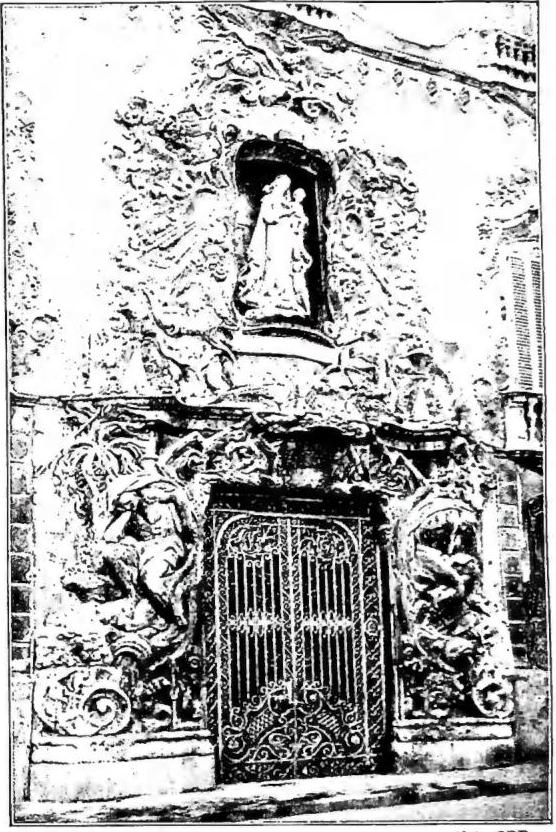
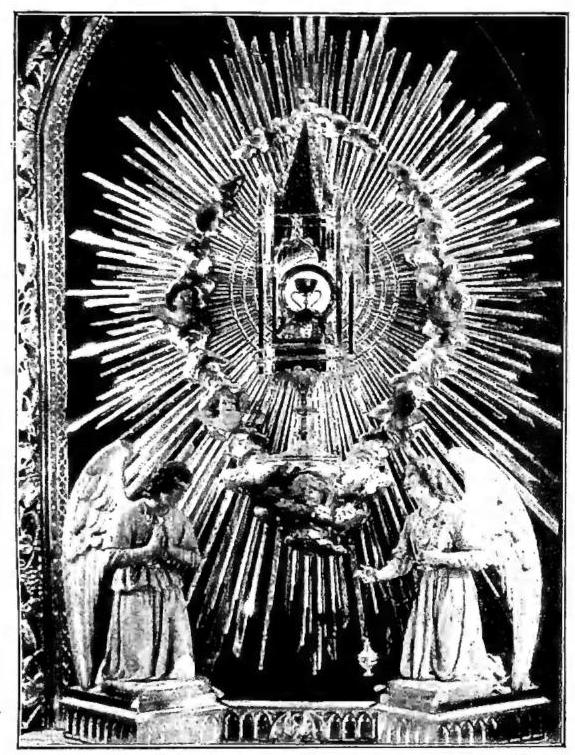
The Cathedral, known as "la Seo," is dedicated to the Blessed Virgin; it stands on the site of the ancient Roman temple of Diana, then a Gothic church (San Salvador), and later a mosque transformed by El Cid in 1095 into a church dedicated to St. Peter, which James I the Conqueror reconsecrated to the Blessed Virgin in 1238. Reconstruction began in 1262 and was completed at the end of the 14th century. The Gothic interior was transformed between 1674 and 1774. The great Baroque south portal was erected in 1703 by C. Rudolf, with statues by Vergara the Elder (1713). Through the 13th-century Romanesque portal with multiple arches and six columns, known as the Palau or Almoyna portal, one enters the right transept; the left transept is accessed via the Gothic "de los Apostoles" portal of 1354, restored in the 15th century. Above it is a large rose window. In the crossing stands an octagonal ciborium with two tiers of Gothic windows closed by alabaster panes (late 14th century). In the central nave, at the choir screen, is an alabaster bas-relief by Giuliano da Firenze (1417-24) depicting biblical scenes. In the "Capilla mayor," the high altar of 1498 was remade in 1682; the statue of the Madonna and Child is by Vergari and comes from the Charterhouse of Porta Caeli. In the left nave is the "Sala Capitular antigua" of 1388, which has housed since 1428 a chalice carved from an oriental emerald-green agate, a gift from Alfonso V of Aragon. The base of the chalice is certainly not very recent, while the cup seems very ancient. Popular devotion calls it "the Holy Chalice" and identifies it with the one used at the Last Supper. In the "Capilla mayor" is the tomb of Archbishop Martín d’Ayala (1496). In the sacristy is the modern chapter hall and the Treasury, which preserves a chasuble of Alexander VI. Outside, the octagonal tower is 60 m high (1381-1429); it is called Miguelete or el Micalet from the great bell placed there on the feast of St. Michael in 1418. Next to the Cathedral is the Archbishop’s Palace.
Outside the walls of Valencia, Vincent (v.) of Saragossa suffered martyrdom. From Valencia came St. Louis Bertrand, Pedro Bautista (known as Baylon), and Vincent Ferrer; it is the burial place of St. Michaelina of the Most Holy Sacrament, foundress of the Adorers of the Most Holy Sacrament.
In 1410 a Studium Generale was established in Valencia, elevated to a university in 1492. Recently, a new archdiocesan seminary has been built. The Provincial Museum of Fine Arts or of St. Pius V is housed in a former convent; it contains over 2,000 paintings by Spanish and Italian artists, statues, mosaics, sarcophagi, ancient inscriptions, architectural fragments of Arab art, and works from the 14th-16th centuries. The Municipal Historical Museum is in a building known as Casa Enseñanza (a former normal school) from 1758-63, with a façade from 1915. It contains paintings, illuminated manuscripts from the 13th-15th centuries, historical banners, and a modern library. Near Valencia is the ancient Sagunto, with notable Roman remains, including a Roman theater and circus.
Folklore. — Typical are the festivals of V. from 17 to 19 March in celebration of the solemnity of St Joseph; hundreds of large monuments made of wood and cardboard, called “fallas,” are constructed, alluding to current or local events; the “fallas” are set on fire during the night of 19 March to the accompaniment of music and the explosions of “tracas” (firecrackers). On the second Sunday in May and the following week, the spring festivals in honour of the “Virgen de los Desamparados” are celebrated. During the week of Corpus Christi, religious dramas, “autos sacramentales,” are performed, daily processions are held, and monumental representations of religious symbols or allegorical groups, called “rocas,” are paraded through the streets. Also characteristic is the “feria,” held from 24 July to 1 August.