
STEFANO, saint. -
I. LIFE
Protomartyr (Gr. Στέφανος “crown”), one of the first seven deacons chosen by the apostolic community of Jerusalem at the decision of the Twelve to attend to the distribution of food and assistance to needy believers (Acts 6:1-4). In the list he is placed first, and he is the only one whose name is accompanied by an encomium: “a man full of faith and the Holy Spirit.” The Greek name of St and the other six may indicate their Hellenistic origin, but Greek names among Jews of the Christian era were very common. Acts 6–7 presents in rich detail the preaching, work, and martyrdom of St.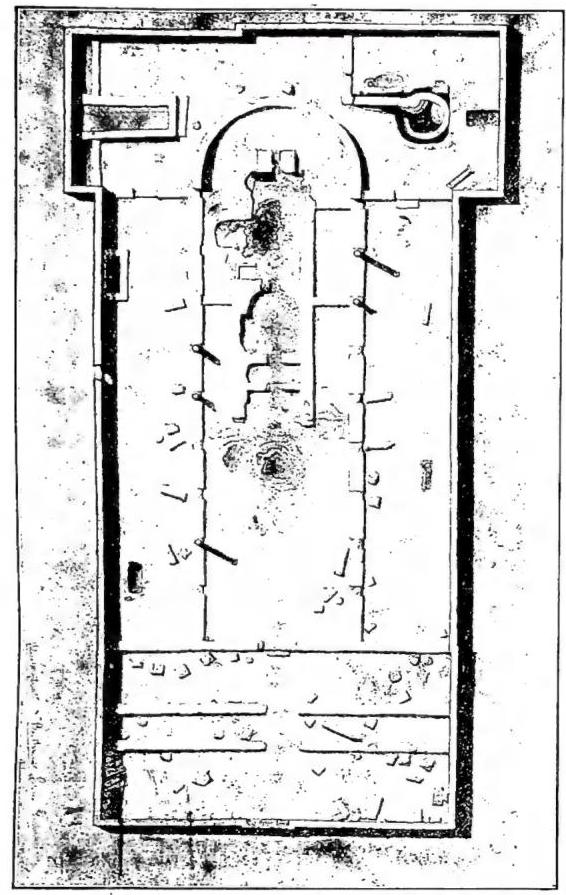
The perfect harmony between the figure of the man and the words in which the ideas fermenting at that moment in the Christian community find expression leaves no doubt about the authenticity of the speech, which formally may have been elaborated by St Luke according to the pattern of Christian-Hellenistic writings, predominantly apologetic, which was followed from the earliest times in Christian preaching.
Immediately after the speech, in a mob fury St is dragged outside the city, stripped (and the keeper of the garments is Saul), and stoned, while he implores forgiveness for his killers. He was the first Christian martyr. The year of his death is probably 35 or 36 (Lagrange), near the feast of Pentecost or of Tabernacles, because his adversaries were especially fanatical foreigners.
II. CULTO
1. Discovery of the body of St. Stephen in 415. - After his glorious death, the first μάρτυς of the Lord (St. Paul in Acts 22:20), received a worthy burial from “men of more” (Acts 8:2), but there is no mention of any cultic manifestations in his honor. Only in the 4th century, when the cult of the martyrs took extraordinary development, do the first accounts of the cult paid to St. Stephen appear. This cult was affirmed and spread rapidly throughout the Church after the discovery of his relics together with those of Gamaliel, Nicodemus, and Abibas, which took place on December 18 or 19, 415, at Kaphar Gamala, through the efforts of the monk Migetius and the local priest Lucian, who had been warned in a dream on December 3, 10, and 17 by Gamaliel (q.v.). The details of the discovery, which moved the entire Church and against which no doubt was raised, are known through the interest of the priest Avitus of Braga, who translated into Latin the account given to him in Greek by the priest Lucian (Epist. Luciani ad omnem Ecclesiam de revelatione corporis Stephani martyris primi et aliorum: PL 41, 807-18 [in the second column, an interpolated recension is reproduced]). This relation, or rather Revelatio, in its Greek, Latin, and Syriac versions and in Armenian, Georgian, etc., translations, soon enjoyed considerable diffusion. In the West, it was brought by Paul Orosius (q.v.; cf. the letter of Avitus to Pulconius, bishop of Braga: PL 41, 805-808). The Decretum Gelasii lists among the apocrypha a Revelatio quae appellatur Stephani, apocrypha (ed. E. V. Dobschütz, in DACL. Gelasius Décret. VI, 1, 744), but it is not known whether this refers to Lucian’s letter.2. Sanctuaries and churches in honor of St. Stephen. - The principal part of the relics, brought to Jerusalem and deposited by Bishop John in the church of Sion, was transferred in 439 by Patriarch Juvenal from the church of the stoning of St. Stephen, which was later replaced by the great basilica built by Empress Eudoxia and dedicated on June 15, 460. The portion that remained at Kaphar Gamala (the ruins of the 5th-century sanctuary are still visible) was generously distributed by the priest Lucian to all who requested II. In the West, certain churches that obtained relics became true sanctuaries to which the saint’s thaumaturgic power drew numerous devotees; these privileged centers were the island of Minorca (cf. the letter of Bishop Severus [q.v.]: PL 41, 821-32), and in Africa, Uzalis (cf. De miraculis s. Stephani, lib. duo: PL 41, 833-54), Calama, and Hippo (a memoria dedicated in 425). St. Augustine became the herald of devotion to the Protomartyr, and it was through his initiative that the faithful were asked to draw up for the bishop a libellus, i.e., an account of the miracle, intended to be read to the people (cf. De Civitate Dei, XXII, VIII, 20-21: PL 41, 768-69). Well known is the libellus of Paul of Caesarea, who was miraculously healed at the memoria of St. Stephen in Hippo (cf. Serm. 322: PL 38, 1443-45; De Civitate Dei, XXII, VIII, 22: PL 41, 469-71).
In Italy, at Ancona, even before the discovery of the body of St. Stephen, there was already a church dedicated to the Protomartyr, in which a stone believed to have been used in his stoning was preserved (cf. Augustine, Serm. 323,2: PL 38, 1445-1446). In Constantinople, around 380, Aurelian, consul in 400 (cf. Theodore the Reader, Hist. eccl. fragmenta: PG 86,221), and the Novatian bishop Sisinnus (d. 407; cf. Sozomen, Hist. eccl., VIII, 24), erected two churches in honor of St. Stephen, and Empress Pulcheria (d. 453) built the famous St. Stephen’s in the Palace. In Rome, the virgin Demetriade (q.v.) built, under the pontificate of St. Leo the Great, the basilica of St. Stephen on the Via Latina (cf. Lib. Pont., I, pp. 238, 531); Pope Simplicius dedicated to him the centrally planned church, known as St. Stephen’s Rotondo, on the Caelian Hill, and another near St. Lawrence outside the Walls (cf. Lib. Pont., I, p. 249). Slightly later must be the oratory of St. Stephen in the monastery of St. Mary Major, near St. Peter’s, now known as St. Stephen’s of the Abyssinians. At Ravenna, Archbishop Maximian dedicated to St. Stephen on December 11, 550, a great basilica, now lost, which stood on the site of a 5th-century memoria sacred to the Protomartyr (cf. Agnellus, ed. A. Testi Rasponi, Bologna 1924, pp. 190-92). At Naples, toward the end of the 5th century, Bishop Victor erected a church to St. Stephen in front of the cemetery basilica of St. Januarius (cf. D. Mallardo, Il Calendario Marmoreo di Napoli, Rome 1924, pp. 121-22).
3. Feste liturgiche
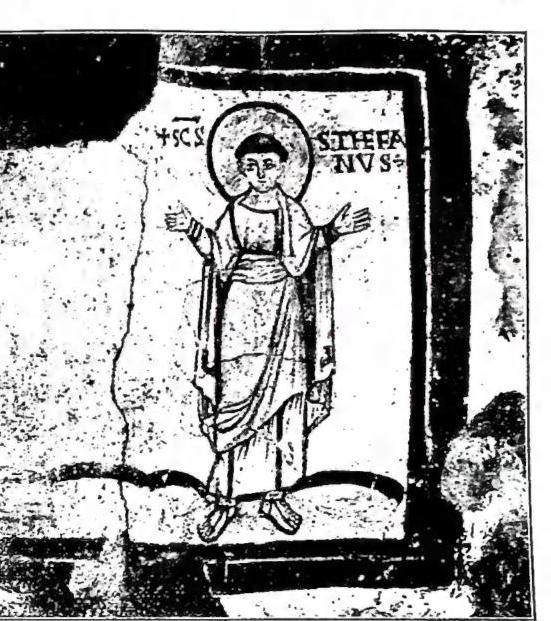
Il nome di S. figura sin dal sec. v nel canone della Messa romana e ambrosiana (lista del Nobis quoque). Nella chiesa latina le feste in onore di S. ricorrono il 2 ag. e il 26 dic.; nella greca il 2 ag. e il 27 dic.; nella nestoriana il 4° venerdì dopo l'Epifania; nella caldea, copta e sira l'8 genn. (altre date in N. Nilles, Kalendarium manuale utriunque Eccl. Orient. et Occid., 2 voll., 2ª ed., Innsbruck 1896-97, V. indice). Il giorno della morte di s. S. essendo rimasto sconosciuto, il suo dies natalis è stato assegnato al 26 dic. perché sin dal sec. IV la sua qualità di protomartire della Chiesa nascente lo fece porre a capo del gruppo di personaggi biblici che, in Oriente, vennero venerati subito dopo il Natale di Cristo per i peculiari rapporti che ebbero con la sua persona; si veda al riguardo l'interessante paragrafo 23 della demonstratio XXI di Afraate, scritta nel 344-45 (ed. J. Parisot, in R. Graffin, Patrol. Syriaca, I, Parigi 1894, p. 937). La festa del 26 dic. è attestata da s. Gregorio Nisseno nel 379 (In laudem fratris Basilii: PG 46, 789); da Asterio di Amasea, all'inizio del sec. V (Hom. XII in laudem S. Stephani: PG 40, 340), dal Martirologio striaco del 411-12 (ed. H. Lietzmann, Bonn 1911, p. 7); dai Calendari di Silvio Polemio del 448 (ed. Th. Mommsen, in CIL, I, 2ª ed., Berlino 1893, p. 279), di Cartagine, dell'inizio del sec. VI (ed. Lietzmann, cit., p. 6), di Carmona in Spagna del sec. VI (ed. J. Vives, Inscripciones cristianas de la España romana y visigoda, Barcellona 1942, p. 113); dal Martirologio geronimiano; dal cosiddetto Sacramentario leoniano (ed. Ch. L. Feltoe, Cambridge 1896, pp. 85-98, il libellus missarum di S., posto al 2 ag. sotto l'indicazione di Stefano papa, comprende 9 messe di cui 8 per il dies natalis del 26 dic., come si rivela dal prefazio della messa VII [p. 89] che accenna al Natale di Cristo); dal Sacramentario gelasiano antico (ed. H. A. Wilson, Oxford 1894, pp. 6-7) e in seguito da tutti i libri liturgici occidentali. Nelle Chiese orientali, ove vigeva e vige tuttora l'uso di ricordare al 26 dic. i Parenti di Cristo, la festa di S. fu spostata al 27 dic. Questa data è attestata all'inizio del sec. VII da Sofronio di Gerusalemme (Orat. VIII in a. apost. Petrum et Paulum: PG 87, 3361), dal Menologio siro giacobita del sec. VII (ed. F. Nau, in Patr. Orientalis, X [1915], p. 31), dai Sinassari greci. ecc. Il 2 ag. la Chiesa greca commemora la traslazione di reliquie di S. a Costantinopoli, sotto Teodosio II, nota per mezzo di un racconto anacronistico (BHL, 7857-58; BHG, 1649-51). Il 3 dello stesso mese la Chiesa latina celebra invece la festa dell'invenzione delle reliquie del Santo, avvenuta, con'è noto, il 18 o 19 dic. 415. Questa festa pur ricordata dal Martirologio geronimiano il 2 e il 3 ag., non entrò nei Sacramentari e Messali prima del sec. IX-X (cf. A. Ebner, Missale Romanum im Mittelalter. Iter Italicum, Friburgo in Br. 1896, pp. 81, 215; V. JALABERT, LOUIS, Les sacramentaires et missels mss. des bibl. pub. de France, I, Parigi 1924, pp. 42, 46, 72 [V. indice, III, pp. 415-16]; A. Baumstark, Missale Romanum, Eindhoven 1929, p. 224); Stefano vescovo di Liegi (903-20) ne compose l'Ufficio, testo e melodia, che ebbe una larga diffusione (cf. A. Auda, L'école musicale de Liège au Xe siècle. Etienne de Liège, Bruxelles 1923, pp. 42-66). In origine, la festa del 2 o 3 ag. doveva ricordare la dedicazione di una chiesa; il p. Delehaye propone di vedervi la dedica del santuario di Ancona; ma non è improbabile che a Roma si volesse ricordare in tal giorno la dedicazione di una delle Basiliche sopra ricordate, poiché nel cosiddetto Sacramentario leoniano la IX messa del libellus missarum di S. inserito al 2 ag. è stata composta per la dedicazione di una basilica al Santo, come si rileva espressamente dal Prefazio (ed. cit., p. 90).(do O. Marucchi, in Nuovo Bulletin di arch. crist., II [1911], tav. 3) STEFANO, santo - Affresco nel cimitero di Commodilla (sec. VII). Roma.
in DACL, V, II (1922), coll. 624-71; H. Vincent - F. - M. Abel, Jérusalem. rech. de topogr., d'archéol. et d'hist., II, IV, Parigi 1926, pp. 743-804; F.-M. Abel, La légende apocryphe de st Etienne. A propos de quelques textes géorgiens (pro manuscripto), Gerusalemme 1931; H. Delehaye, Quelques dates du martyrol. Hiéronym., in Anal. Boll., 49 (1932), pp. 23-30; id., Les orig. du culte des Martyrs, 2ª ed., Bruxelles 1933, pp. 80-82, 122-31, passim (completare con F. Halkin, Inscript. grecques relatives à l'hagiogr., in Anal. Boll., 67 [1949], p. 503, indice. s. v.; ibid., 69 [1951], p. 462, indice. s. v.); R. Krautheimer, S. S. Rotondo a Roma e la chiesa del S. Sepolcro in Gerusalemme, in Riv. arch. crist., 12 (1935), pp. 51-102; F. Antonelli, in Verbali Soc. dei cultori di Arch. Crist. Adun. 15 apr. 1934, ibid., pp. 173-75; G. Segui Vidal, La carta-enciclica del obispo Severo estudio critico de su autenticidad e integridad con un bosquejo historico del cristianismo Balear anterior al siglo VIII, Palma di Maiorca 1937, pp. 39-49 (Orosio e le reliquie di s. S.), 149-83 (ed. critica); V. L. Kennedy, The saints of the Canon of the Mass, Città del Vaticano 1938, pp. 145-148; P. Peeters, Le tréfonds orient. de l'hagiogr. byz., Bruxelles 1950, pp. 53-58; J. M. Gosol, Scoperta di una bas. paleocristiana con battistero a Minorca, in Riv. Arch. crist., 28 (1952), pp. 184-186 (può darsi che si tratti delle rovine della chiesa dedicata a s. S.).
A. Pietro Frutaz
III. ICONOGRAPHY
St. Stephen is depicted as a young man dressed in the sacred diaconal vestments, and his representations are often characterized by the stones that allude to his martyrdom by stoning. He is not infrequently shown together with the second patron of the diaconal Order, namely St. Lawrence. Various representations of St. Stephen survive from the early Middle Ages: among them the most notable are the mosaic in the triumphal arch of the basilica of St. Lawrence outside the Walls in Rome, a work datable between 578 and 590 (cf. pl. cvi of vol. VII), and the frescoes in the cemetery of Commodilla (7th century) and in Sta. Maria Antiqua in the Roman Forum (8th century). The scene depicting the stoning of the Saint, already reproduced in the Menologion of Basil (late 10th–early 11th century), becomes more frequent in the 12th century, especially in Spanish art.The figure of St. Stephen appears among the Apostles and other saints seated beside Christ in the Last Judgment frescoed by Pietro Cavallini around 1290 in Sta. Cecilia in Trastevere, Rome. Giotto also portrays him in a panel now in the Museo Horne in Florence, providing an excellent iconographic model of the Saint. A superb bronze statue of St. Stephen adorns the tabernacle of the Wool Guild in Orsanmichele, Florence; it is the work of Lorenzo Ghiberti, dated 1426. Also notable is the marble figure that adorns the altar of the basilica of St. Agnes at Via Nomentana in Rome, a work by Andrea Bregno dated 1490.
The entire cycle of the Stories of St. Stephen, together with those of St. Lawrence, was frescoed around 1450 by the Blessed Angelico on the walls of the Niccoline Chapel in the Vatican Palace. It consists of six scenes: 1) the deacon’s consecration of St. Stephen; 2) the distribution of alms; 3) his preaching to the people; 4) St. Stephen before the Jewish priest; 5) his being led to martyrdom; 6) his stoning.
Another notable cycle of the Stories of St. Stephen was painted by Vittore Carpaccio between 1511 and 1515 for the scuola of S. Stefano in Venice. Four scenes from this cycle, now dispersed, survive: one, with the consecration of the Saint, in the Kaiser Friedrich Museum in Berlin; another, with the disputation, in the Brera Gallery in Milan; a third, with the Saint’s preaching, in the Louvre; and a fourth, with the stoning, in the Stuttgart Gallery.
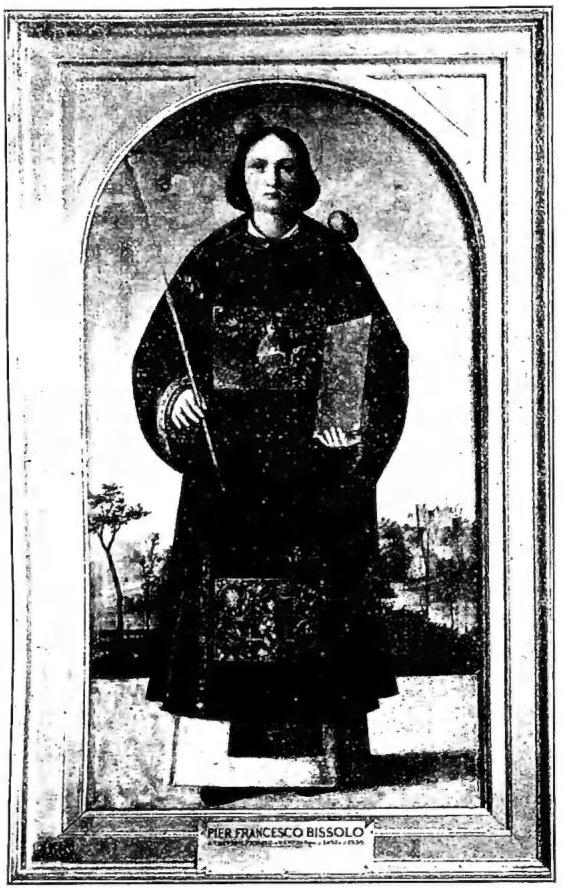
Early 16th-century painting produced some very fine and highly characteristic individual representations of the Saint. Among these one may cite first the panel by Francia in the Borghese Gallery in Rome, where St. Stephen is shown kneeling, his bleeding head in an attitude of prayer during his martyrdom (cf. pl. xciv of vol. IV), and the triptych by Pier Francesco Bissolo in the Brera, Milan, whose central panel depicts the Saint in a dalmatic, with stones, as it were miraculously suspended, above his head and right arm.
Raphael included St. Stephen among the figures of the celestial choir in the Disputation of the Holy Sacrament in the Stanza della Segnatura in the Vatican. The Vatican Pinacoteca possesses a painting of the Stoning of St. Stephen by Giorgio Vasari, dated about 1560.
Among the most notable paintings of the 19th century were the frescoes of the Stories of St. Stephen and those of St. Lawrence on the main nave of the basilica of St. Lawrence outside the Walls, executed by Cesare Fracassini and others at the time of the restoration of the basilica under the pontificate of Pius IX; these frescoes were almost entirely destroyed by the bombing of the basilica on 19 July 1943. — See pl. XCI.
After P. von Winterfeld (1902), O. Bardenhewer proposed its identification with the original Greek (written in 415, translated into Latin by Avitus of Braga) of the Epist. Luciani ad amnem Ecclesiam de revelatione corporis Stephani martyris primi et aliorum, preserved in a double Latin recension (PL 41, 805-18), which in the codex Floriacensis begins with others: Revelatio s. Stephani; but the hypothesis, though attractive, remains doubtful. Likewise unproven is the identification with the legendary Revelatio o Martyrium Stephani of the pseudo-Clementine cycle whose original Greek is lost, but which survives in a Georgian version (Cod. of Mount Athos, 10th cent., ed. du Marr: PO 19, 689-99) and in a Slavonic version published by Ivan Franko in Ukrainian, later in a German version from the two manuscripts of Lwow and Zamosti. Some have supposed that the lost apocryphon recounted the mysteries revealed to the Protomartyr when «he saw the heavens opened and Jesus standing at the right hand of God» (Acts 7:55), and Sixtus of Siena (Bibliotheca Sancta, ed. Naples 1742, p. 193) asserts that this Apocalypse of St. Stephen was held in honor among the Manicheans.