
ORATORIO (LITURGY). – It is a sacred building or place intended, rather than for the use of all the faithful, for that of a college, a community, a family, or a private individual (can. 1188).
I. GENERAL NOTIONS
The distinction between a church and an o. began to emerge when, after the cessation of the persecutions and the spread of Christianity, spacious buildings devoted exclusively to prayer and the celebration of sacred rites were added to the generally cramped places in which acts of worship had taken place during the first centuries. This distinction must, however, be limited to the substantive sense, since both the name ecclesia and that of oratorium were commonly used, although the latter term corresponds more closely to the Christian concept, since Christ himself called the place intended for divine worship domum orationis. With the Church’s revival, the term oratorium, and not merely its substantive concept, acquired a meaning opposed to that of basilica and ecclesia, in consideration of the very size of the buildings; decisive in this comparison, and in the restriction imposed on o., was the celebration of Mass and the administration of the Sacraments. Two particular types of sacred places, included under the name o., had already become established as early as the sixth century: the private chapel of the supreme pontiffs and bishops, and those of princes.II. DISTINCTIONS
Oratories are distinguished as private, semipublic, and public.1. Private oratories. — By the decree De observandis et evitandis in celebratione Missae of the twenty-second session of the Council of Trent, on 17 September 1562, the bishops’ power to permit the celebration of Mass in private oratories of private houses was revoked; whereas that power remained unchanged for private oratories in non-private houses, that is, for those commonly called semipublic or semiprivate oratories. The Apostolic See alone is competent to grant this concession, and the indult is the form by which the privilege is conferred: it contains a certain number of clauses concerning: 1) the intervention of the bishop (before the bishop grants the license, he must visit the oratory either personally or through others, in order to ascertain whether it meets all the conditions required by the indult, and then approve it); 2) the location of the oratory, which must be decently arranged, enclosed by walls on at least three sides, equipped with all the furnishings necessary for the Divine Sacrifice, and free from any profane or domestic use; 3) the Mass and the celebrating priest (only one Mass is permitted; but if, by an extraordinary indult, permission is granted to celebrate on the day of the Nativity of the Lord, then as many as three Masses may also be celebrated in the oratory [S. Congr. del Concilio, 13 January 1725]); 4) the
(Int. Anderson)
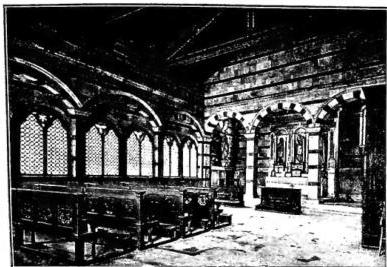
ORATORIO - O. of S. Maria della Spina, formerly o. of S. Maria di Pontenuovo
(enlarged in 1323, restored in 1871) - Pisa.
The pontifical constitutions subsequent to the Tridentine decree are the letter of the S. Congr. of the Council of 25 Oct. 1615, and Clement XI’s decree Quoniam sancta of 15 Dec. 1703, in which the principle was reaffirmed that bishops, even when invested with cardinalitial dignity, did not have the power to celebrate or have Mass celebrated outside their residence, in the homes of laypeople.
Benedict XIV, with the encyclical Magno cum animi of 2 June 1751, decisively reaffirmed the position of the Council of Trent and of his predecessors, namely, the necessity of authorization by the Apostolic See for the celebration of Mass in private o.
Canons 1188–90 and 1194–96 of the CIC concerning private o. are merely a compendium of the preceding norms. In fact, the aforementioned canons examine three categories of private o.: 1) those intended for the benefit of private persons (can. 1188 § 2, n. 3). Their establishment ordinarily requires the granting of a pontifical indult (can. 1195 § 1). The bishop, moreover, may permit the celebration of only one Mass per modum actus, in casu aliquo extra ordinario, iusta et rationabili causa. 2) As regards the category of private o. belonging to cardinals and bishops (can. 1189), a distinction must be made between the o. of titular cardinals and bishops and those of residential cardinals and bishops. The former are private o. that nevertheless enjoy the privileges and rights proper to semi-public o.; the latter, that is, the o. located in the palace of the diocesan bishop, are doubtfully to be called private, despite their enumeration in the CIC, whereas they ought to fall within the category of semi-public o., that is, private o. belonging to non-private houses. 3) The small o. erected in cemeteries by families or private persons for their own burial.
The recent instruction of the S. Congr. of the Sacraments of 1 Oct. 1949 has further restricted the possibility of granting the privilege of a private o. This concession is granted only to those qui ceterum morum probitate opertaque religionis professione excellent and who have been dispensed, on account of illness or distance from the church, from hearing Mass on days of precept. The faculty of fulfilling the Sunday precept in the o. is limited to blood relatives or relatives by marriage in the same line and degree in which consanguinity or affinity constitutes a diriment impediment to marriage (cann. 1076 §§ 1 and 2; 1077 § 1), to cohabitants, and to persons employed in the service; whereas the granting of this faculty per omnes aditantes is excluded, unless the case is extremely grave and extraordinary. The principle is also confirmed and reaffirmed—moreover, it has been scrupulously observed in the constant practice of the Apostolic See—that the faculty to reserve the Eucharist in domestic chapels is not to be granted except in extraordinary cases, for grave reasons, and with the appropriate safeguards.
2. Semi-public o. — Semi-public or semi-private o. began to assume a juridical character of their own at the time of the Council of Trent. Leo XIII, in the decree A sacra of 23 Jan. 1899, establishes that semi-public o. are those which, although erected in a private place and in any event not absolutely public, nevertheless do not serve an individual or a family, but a community of persons. It is evident from the text of the decree that the auctoritas of the Ordinary is a necessary condition for the erection of a semi-public o., whereas, in the case of a private o., the bishop is merely the executor of the pontifical indult, provided that all the requirements of the indult itself are present.
The Council of Trent introduced no innovation concerning the power of diocesan Ordinaries in relation to semi-public o.; it clearly distinguished them from private o., with which they had previously often been confused.
Common doctrine recognizes various kinds of these o., namely, those of episcopal and cardinalitial palaces; those of religious places, that is, places erected with the consent and authority of the bishop for a pious purpose; and those of public places, that is, places not reserved for the residence of a private family but, by virtue of a foundation, intended for the common benefit, such as colleges intended for the education of the young and prisons.
For a semi-public o. to perform its functions, it must be subject to the designatio and the visitatio, functions that generally belong to the diocesan Ordinary; it may also be dedicated, but this is not necessary. In a semi-public o. all and only sacerdotal functions may be exercised, and the Sunday precept is fulfilled not only by those for whose benefit the o. was erected, but also by those who wish to attend.
In regulating semi-public o., the CIC merely recalls the principles set forth above (can. 1188 § 2, n. 2). Canon 1192 § 1 prohibits the erection of semi-public o. without the consent of the Ordinary; § 2 notes that approval must be conditional upon a visitation by the bishop himself or by a priest delegated by him, for the verification of the required conditions; § 3 deals with the impossibility of converting a semi-public o. into a profane place without the bishop’s authorization. These o. may be consecrated by constitutive blessing, in which case, according to the prevailing doctrine, they are exempt from civil authority and enjoy immunity; generally, however, an invocative blessing is sufficient (can. 1196 § 2).
3. Public o. — The two necessary and irreplaceable requirements are: 1) the public entrance of the o., which implicitly presupposes its free use by the public.
of the faithful. The sole exception, which in any case disappeared from the beginning of the seventeenth century, is found in those oratories that are privately owned and have no public door or entrance, but are constituted in titulum beneficii; an example is provided by the chapel of the Palazzo Altemps in Rome, where, in addition to the bell, a sign of publicity, there are ministers permanently dedicated to worship and a grand display in the celebration of feast days; 2) the autoritas of the bishop for its construction. Requirements that are likewise indispensable are, as indeed for the building of a church, the consent of the diocesan authority and the establishment of an endowment (which, according to the doctrine, is made only for consecrated oratories and not for those that are merely blessed). Moreover, the oratory to be erected must not, by its erection, cause harm to other churches already existing, and particularly to parishes; in view of this, only priestly functions may be celebrated in oratories, such as solemn private Masses, the blessing and distribution of candles, ashes, and palms; the functions of Holy Week, the exposition of the Forty Hours, etc., whereas proper parish functions are excluded, such as the blessing of the baptismal font, the sprinkling of houses, processions within the parish boundaries, and the Mass of Holy Thursday. As regards the administration of the Sacraments, Baptism, Penance, and the Eucharist may be administered extraordinarily in a public oratory, and Matrimony may be celebrated; the celebration of a member of the faithful’s funeral rites belongs exclusively to the parish. Other signs distinguishing the public oratory from the private are the bell for summoning the faithful to sacred functions; the fixed and immovable altar, given its perpetual dedication to worship; and the existence of a titular saint whose feast is celebrated each year. These requirements are not necessary, but serve only, in cases of doubt, to demonstrate the public character of an oratory.
Upon examining the CIC, one may observe, following the common doctrine as well, that no essential difference can be established between a church and a public oratory: the sole distinction is that a church is principally, and by virtue of its nature, intended for all the faithful, whereas a public oratory is principally intended for particular physical or moral persons. On the basis of can. 1188 § 2 n. 1, a twofold category of public oratories may be inferred: namely, those erected for the benefit of some private person, and those established for the benefit of some college, confraternity, etc. The faithful have the right of free access to oratories of both categories. A question not yet resolved in the doctrine concerns the juridical nature of the public oratory: indeed, the intention of the CIC with regard to can. 1191 § 1 is uncertain: oratoria publica eodem iure quo ecclesiae reguntur, since an extensive or restrictive interpretation determines whether or not a juridical person exists in the public oratory.
III. THE ORATORIES IN THE ITALIAN LEGAL SYSTEM
In this context, only public oratories are of interest, since, obviously, private oratories cannot be considered. Public oratories nevertheless remain privately owned and, as has been observed, “are therefore distinguished from churches intended for public worship, belonging to what is known as the ecclesiastical public domain.” However, from a strictly civil-law point of view, oratories in this category are designated by the generic term churches or chapels open to public worship; but “while the church is objectively and subjectively public, the public character of oratories is of an entirely special nature, insofar as it arises from the existence of the faithful’s right to enter them freely, at least during services” (Olivero). This right of access is an essential element of the public character of the oratory and, consequently, once this purpose has been established, the owner may not alter it on his own initiative, and the episcopal authority or the parish priest, within the scope of their respective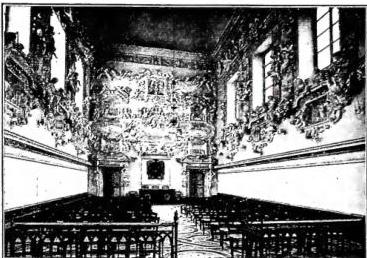
According to the authors, moreover, since public oratories are buildings open for worship, the relevant articles of the Concordat must necessarily be considered applicable to them; consequently, these places are exempt from requisition or occupation, which may, in entirely exceptional circumstances, be permitted following agreement with the Ordinary (art. 9); nor is the demolition of such places permitted except with the agreement of the competent ecclesiastical authority (art. 10).
IV. ART
As an architectural structure, the oratory does not differ essentially from churches, but is smaller in size: generally it consists of a simple square or rectangular hall, with a single altar.It may be a free-standing building, as, to cite the oldest examples, those of SS. Celso and Nazaro (the so-called mausoleum of Galla Placidia, distinguished by its Greek-cross plan) and of S. Maria in oleo (formerly the baptistery of the Arians), both in Ravenna; and that of S. Giovanni in oleo in Rome (remade externally by Bramante and internally by Borromini). More often, however, it is joined to larger places of worship, as in the case of that of the SS. Quaranta Martiri near S. Maria Antiqua in Rome (eighth century), or it is on a lower level than the church (S. Maria della Fontana beneath the church of the same name in Milan; S. Michele Berteldi beneath that of S. Gaetano in Florence), or above it (the oratory of the Stigmata attached to the church of the same name in Rome).
Oratories with direct access to the outside, and therefore with their own façade, are also common: typical are those dedicated to s. Bernardino, adjoining or at least close to Franciscan churches, erected mostly during the second half of the fifteenth century; notable examples are that of Assisi, that of Siena, consisting of two superimposed rooms, and that of Perugia, famous for its elegant façade by Agostino di Duccio. In the seventeenth century, the Rule of s. Filippo Neri, which prescribed the oratory as distinct from the church, spread this type of construction; the principal examples are in Florence (S. Firenze, no longer used for worship), Bologna, Turin, and Rome (the latter a particularly notable work by Borromini). During the Counter-Reformation, other Orders and Confraternities also erected oratories, sometimes noteworthy
for their architecture (S. Maria in Trivio, the oratory of the Crocifisso in Rome; the oratory of the Dottrina cristiana in Florence), for their paintings (S. Lucia del Gonfalone in Rome), or for their decoration (the oratory of the cathedral of Vicenza). In Palermo, it is inside the oratories that the decorative exuberance of Sicilian Baroque is most fully manifested, above all through the work of the Serpotta family, who covered their walls and vaults with stucco (Rosario di S. Domenico, Rosario di S. Zita, S. Lorenzo, S. Caterina). Interesting less for their architecture than for their works of art and historical associations are the oratories of hospital congregations (Misericordia in Florence; S. Maria della Scala in Siena); and especially those of the companies that assisted the condemned (S. Giovanni Decollato in Rome and Orvieto; S. Maria succurre miseri in Naples; oratory of the Morte in Genoa, etc.). Oratories are rarer in the eighteenth century, whether in Baroque forms (S. Maria dei Guarini in Bologna) or already distinctly marked by Neoclassicism (the oratory of the B. Enrico in Treviso), following the general tendencies of religious architecture in the various regions.