
MOMMSEN, THEODOR. — Historian, jurist, philologist, born at Garding in Schleswig on 30 November 1817, died at Charlottenburg on 1 November 1903.
He completed his studies at the University of Kiel and received his doctorate in law there in 1843. Appointed professor of civil law at Leipzig in 1848, he was removed from his chair for political reasons (1850) and moved to Switzerland, where he obtained a chair of Roman law at Zurich (1852). In 1854 he was called to teach the same subject by the University of Breslau, where he remained until 1858, when he moved to Berlin to devote himself, at the Royal Academy of Sciences (of which he was secretary from 1873 to 1895), to the publication of the Corpus inscriptionum Latinarum. In 1861 he began teaching Roman history in Berlin, from the chair that the University had established for him. In 1902 he was awarded the Nobel Prize for Literature. His activity, both as an author and as an editor of texts, as well as an organizer and director of major scholarly enterprises (Corpus nummorum; Vocabularium iurisprudentiae Romanae; Prosopographia imperii Romani), was immense: the works he published numbered approximately one thousand.
He was, as Vittorio Scialoja stated, the “uncontested sovereign” of epigraphy. In 1845, during his first journey to Italy, he visited B. Borghesi, who advised him to study the epigraphy of southern Italy: the fruit of M.’s research during this period was the Inscriptiones regni Neapolitani (Leipzig 1852) and, published shortly earlier, a fundamental study of the southern dialects, Die unteritalischen Dialekte (ibid. 1850). As a result, he was placed in charge of the work of collecting and publishing all existing Latin inscriptions, a task that constitutes one of the greatest merits that the Berlin Academy of Sciences can claim in relation to world scholarship. While engaged in preparing the Corpus inscriptionum, M. published the three volumes of the Römische Geschichte, Leipzig 1854–56 (Italian translation by L. di S. Giusto, 3 vols., in 5 tomes, Turin 1925); in 1858, the Römische Chronologie bis auf Caesar, Berlin 1858 (2nd ed., ibid. 1859); and, shortly thereafter, the definitive edition of the Geschichte des röm. Münzwesens (ibid. 1860).
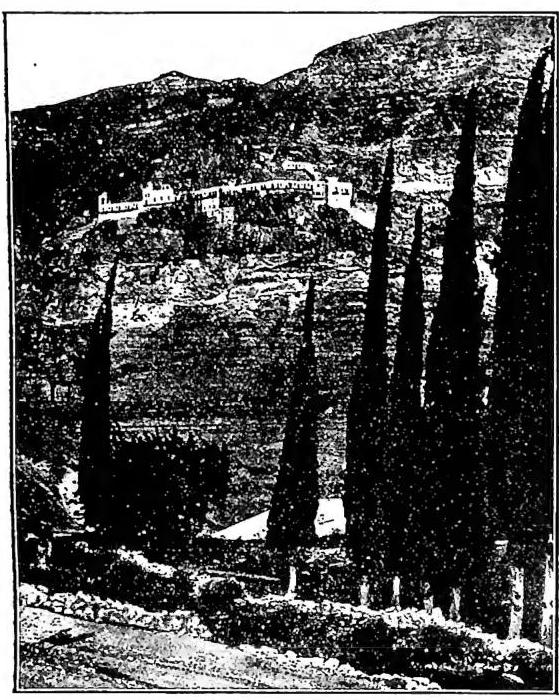
MONACHISM — Laura del Monte della Quarantena — Gebel Qaranjal.
Rome 1904). Toward the end of his life M. published Das römische Strafrecht (Leipzig 1899), a complete exposition of Roman criminal law and its procedure through the ages.
To this enormous activity must be added his work as an editor of texts and documents. Without mentioning more than the most important works, M., together with P. Krüger, produced the best edition of Justinian’s Digesta (1868–1870); his collaboration with Krüger and G. Studemund resulted in the Collectio librorum iuris anteiustiniani (1890); to him, together with P. M. Meyer, we owe the critical edition of the Codex Theodosianus (v.), published after his death on the basis of the corrected proofs that he had left. He also edited the works of Solinus (Collectanea rerum memorabilium, 1864, 2nd ed., 1895), Iordanes (Romana et Getica, 1882), and Cassiodorus (Variae, 1894), as well as the first volume of the Liber Pontificalis (1898). For the Corpus inscriptionum Latinarum he edited vols. I (1862; 2nd ed. 1893), III (1873, with two supplements, 1902), V (1872 and 1877), IX and X (1883), while contributing extensively to others. His articles scattered through journals, some of considerable importance for the history of Christianity, were collected in the Gesammelte Schriften (8 vols., Berlin 1905–13).
A deputy in the Prussian Chamber from 1873 to 1882 and in the German Reichstag from 1881 to 1884, he was liberal in sentiment and a tenacious opponent of O. Bismark. Given the situation in Germany, the political action he undertook produced practically no results; and M. must have suffered greatly on account of this, since in a codicil to his will, recently published and dated to the end of 1899 (four years before his death), he expressed his dissatisfaction—which is certainly surprising—with the scientific activity he had carried out, and added: “I wished to be a citizen. This is not possible in our nation, in which the individual, even if he is the best, does not rise above service in the ranks and political fetishism.” These words perhaps also contain the explanation of those aspects of his character that seemed less commendable; they may justify the alternation in him of a tendency toward a brilliant and even boisterous life with moments of depression, which were noticed by those closest to him; as well as certain of his extremely harsh attitudes on the occasion of scholarly controversies. They demonstrate how deeply and humanly M. had felt the separation—already taking place in Germany in his day—between the world of culture and that of action.