
CASSIODORUS (Flavius Magnus Aurelius Cassiodorus senator). — Born c. 485 at Scyllacium, in Bruttium (modern Squillace), into a family of powerful officials of Syrian origin. Thanks to the high standing of his family (since his father, a praefectus praetorio, soon appointed him as consiliarius) and to his own rhetorical talents, displayed in a panegyric to King Theodoric, Cassiodorus rapidly rose to fortune. By the age of twenty, he had become quaestor and royal secretary, and he eventually reached the summit of the cursus honorum: ordinary consul in 514, then magister officiorum, praefectus praetorio in 533, and finally patricius. Four Gothic kings—Theodoric, Athalaric, Theodahad, and Witigis—employed him as their minister. Throughout his long political career, Cassiodorus, the leading representative of those Romans who collaborated with the barbarian regime, maintained his ideal of political rapprochement between Romans and barbarians, which coincided for a long time with the cornerstone of Theodoric’s domestic policy. When the dominant issue became relations with the Eastern Empire, the Roman minister continued to advocate agreement and peace.
In 540, under King Witigis, Cassiodorus redirected the course of his long life, abandoning the court and founding in his Calabrian estates (which formed his patrimony) the monastery and hermitage of Vivarium. Contributing to this decision were the substantial failure of his political ideals, which was becoming evident with the intervention and triumph of the Empire in Italy, and the spectacle of the tragic events that filled those years. The monastery became his refuge and workplace in the twilight of his life; he served as its abbot. The rule he imposed on the monks, who soon flocked there in large numbers, anticipated the Benedictine rule by requiring, among other things, the application of study to sacred and profane letters and the transcription of texts. He died in the monastery, probably in 583. His Variae are the principal source for his biography.
Cassiodorus was born to affirm his civic and religious ideals both through action and through writing; thus his works, like his life, may be divided into two classes, corresponding to the two aspirations of his spirit—earthly and heavenly glory.
The first class includes the speeches delivered at the court of the Gothic kings, of which only a memory and a few fragments remain. The Chronica, which has come down to us, was written in 519 and spans the period from Adam to the author’s own time. For the Roman era, it draws on Eusebius, then Livy, Aufidius Bassus, Victor of Aquitaine, and Italian chroniclers, especially for the list of consuls, to which a few scattered notices are appended. In the background is the theme of praise for the Goths. This theme is openly developed in the De origine actibusque Getarum, composed in twelve books under Athalaric, of which only Jordanes’ meagre epitome survives (v.). Cassiodorus sought to identify the Goths with the Getes and thus with the Scythians, attributing to them all the deeds and legends of those peoples. In this way, he clothed barbarian history not only in the majesty of the Roman tongue but also in the enchantment of its ancient origins and legends.
The Variae, which have been transmitted to us, comprise a collection of 468 letters divided into twelve books, compiled in 537. These are the letters he wrote as a statesman; however, the sixth and seventh books appear to be mere formularies. Toward the end, the collection takes on the aspect of an encyclopedia, with digressions on morality, law, politics, art, and natural history. In the Variae, the author’s attention is at times focused primarily on style, which is ample and bombastic, reflecting a characteristic of the age; the title refers to style as much as to content. The work was not intended by the author to have historical value, but it does for us.
The Ordo generis Cassiodorum, of which part remains, is a genealogical memoir of the Cassiodorus family.
Shortly after the Variae, Cassiodorus wrote the brief treatise De anima in twelve chapters, which already marks a shift in the author’s spirit toward different concerns. Drawing on St Augustine, Tertullian, and Claudianus Mamertus, he first distinguishes the various meanings of the word “soul”; then he defines it as created by God, spiritual and of a special substance, the vivifier of the body, rational and immortal, capable of turning toward good or evil. It is made of light, as God is light, and is formless and incorporeal. Its four cardinal virtues are complemented by other moral virtues: contemplatio, iudicialis (to distinguish good from evil), and memoria; it also possesses five natural virtues for the governance of the body. Created by God, as faith teaches, it resides in the head but extends throughout the body, a wondrous and harmonious temple created for II. The treatise then discusses the particular signs by which the good and the bad are recognized, and it concludes with a prayer.
The meditations on the soul form the bridge from his secular works to the four principal works of his monastic period. These are consistent with the ideals of cultural industry that Cassiodorus impressed upon the life he founded.
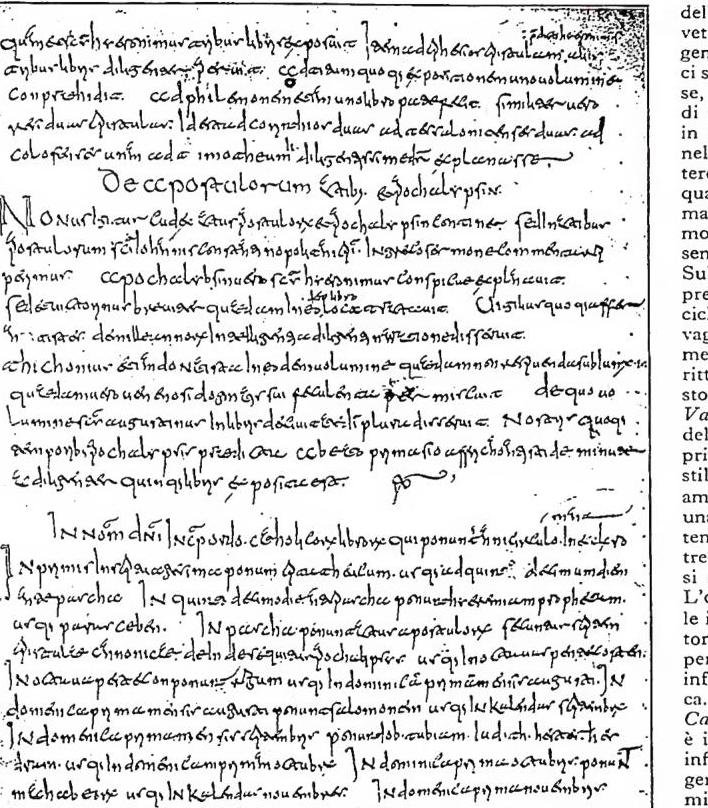
CASSIODORUS - De institutione diuinarum litterarum, chaps. 8 and 9.
Semi-cursive codex of northern Italy (8th century).
Vercelli, Capitular Library, ms. no. 183, f. 104.
For himself and his monks: they are religious action, just as his earlier writings had been political action. Yet they do not represent an ascetic withdrawal from the world, for the voice of the world is still present through the attention given to human culture of antiquity; only now this culture is no longer an end in itself or a ladder to worldly honours, but is subordinated to God and made an instrument for interpreting His word.
The Complexiones in psalmos are inspired above all by the Enarrationes in psalmos of St Augustine—“a rivulet drawn from the sea,” as the author himself says with profound admiration for the master’s work. Preceding it is a rich preface in seventeen chapters on the nature of the Psalter and its interpretation. Here Cassiodorus proceeds with a certain schematism, but he gives clear preference to allegorical exposition. Every psalm is referred by him either to the life of Christ or to the Church. Very similar are the Complexiones in Epistolas et Acta Apostolorum et Apocalypsin: not a continuous commentary but exegetical notes that “sum up in a few words the various points they propose to touch upon.”
Yet the principal work of Cassiodorus the monk is the Institutiones diuinarum et saecularium litterarum. This too arose from a practical purpose. Since the stormy century had prevented the projected foundation, with the help of Pope Agapetus (535–56), of a theological school in Rome for the study of Holy Scripture, he wished to supply this need with his Institutiones, an introduction to the study of theological science and especially of Sacred Scripture (c. 544). The first book acquaints us with the Latin or Greek authors translated into Latin and preserved in the monastery library, which can aid the study of individual sacred books; it treats textual criticism, gives brief notes on biblical cosmography, and recommends manual labour as a diversion from study—especially the copying of manuscripts. The second book, in seven chapters, sets forth the elements of the seven liberal arts. The De orthographia is likewise a manual compiled at the request of his monks, composed from extracts taken from the writings of eight ancient orthographers. The Historia ecclesiastica tripertita was compiled from extracts of the histories of Socrates, Sozomen, and Theodoret, which the monk Epiphanius had expressly translated from Greek for him. As such, the work has for us only the value of a translation, often not even a successful one; yet for Cassiodorus’ successors, who knew none of the originals, it represented a precious handbook of ancient church history.
Edition of the Institutiones by R. A. B. Mynors, Oxford 1937. Studies: A. Thorbecke, C. Senator, ein Beitrag zur Geschichte der Völkerwanderungen, Heidelberg 1867; A. Franz, M. A. C. Senator, Breslau 1872; I. Ciampi, I Cassiodori nel V e nel VI sec., Imola 1876; G. Mansi, M. A. C., Naples 1895; C. Pujia, M. Aurelius C. in Calabria, Rome 1909; P. Lehmann, Cassiodorstudien, in Philologus, 71 (1912), pp. 278-99; 72 (1913), pp. 503-517; 73 (1914), pp. 253-73; Schanz-Krüger, IV, II, pp. 92-109; G. A. Punzi, L’Italia del VI sec. nelle Variae di C., Aquila 1927; A. Van der Vyver, C. et son œuvre, in Speculum, 6 (1931), pp. 244-92; id., Les Institutiones de C. et sa fondation à Vivarium, in Rev. bénéd., 53 (1941), p. 59 ff.; Bardenhever, V, pp. 264-78; Moricea, III, II, pp. 1308-61; P. Courcelle, Le site du monastère de C., in Mélanges d’archéol. et d’histoire, 55 (1938), p. 259 ff.; id., Les lettres grecques en Occident, Paris 1943, pp. 313-88; G. Bardy, C. et la fin du monde ancien, in Année théologique, 6 (1945), pp. 383-425; L. W. Jones, C. Senator, New York 1946; L. W. Laistner, The Value and Influence of C. Ecclesiastical History, in Harvard Theol. Rev., 41 (1948), p. 51 ff.; P. Courcelle, Histoire littéraire des grandes invasions germaniques, Paris 1948, p. 171 ff.
Marcello Aurigemma
C. AND MEDICINE. — In the field of medicine, C. was of considerable importance for many reasons.
Thanks to his wise work as advisor and assistant to King Theodoric, medicine owed the restoration of its dignity. He reinstated the office of the archiaters and instituted the position of Comes archiatrorum, the supreme authority in medical legislation of the time, a kind of unappealable judge who could decide all questions that might arise among physicians. He was also the author of the investiture formula for the Comes archiatrorum, in which medicine was defined as “the first among the most useful arts that contribute to sustaining the indigence of human frailty.” All this was highly significant in view of the excessively humble condition of the physician and of medicine in Gothic legislation. Finally, even in his retreat at Squillace, he devoted much attention, with his monks, to medicine and to the care of the sick, both practically and through his care for medical codices.