Machine translation of the 1948–1954 Italian original. The original text is authoritative.
TEODORETO, vescovo di CIRO. - N. verso il 393 ad Antiochia, da famiglia facoltosa, ed educato in scuole monastiche, m. nel 458. Dopo essere stato lettore della chiesa, distribuì tutto il suo avere e si fece monaco. Nel 423 divenne vescovo della piccola città di Ciro (a oriente di Antiochia) e combatté ariani e marcioniti.
Amico personale di Nestorio e rappre-
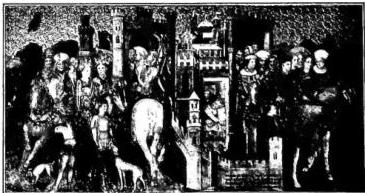
(fot. Alinari) TEODOLINDA - Stories of Queen T. Detail of the fresco by the Zavattari (1444) - Monza, Cathedral....sentative of Antiochene theology, attacked the Patriarch of Alessandria in his refutation of Cirillo's 12 anathemas. This (lost) work was followed by a more extensive work against Cirillo and the Council of Efeso. He subscribed to the Formula of Union in 434. At the Robber Council of Efeso (449) he was deposed as an adherent of Nestorio. T. appealed against this sentence to Pope Leone I. At the Council of Calcedonia (451) he was admitted among the orthodox doctors, after an explicit declaration against Nestorio, but the Fifth Ecumenical Council (553) condemned anew his writings against Cirillo and the Council of Efeso and some of his letters and sermons. His dogmatic stance did not seem clear to the partisans of the two contending factions.
WORKS: a) Dogmatic writings: the two writings against Cirillo, already mentioned. Also by T. is the work, wrongly attributed to Cirillo d'Alessandria, on theology and the divine incarnation (PG 75, 1147-90, 1419-78). Then the Eranistes (= the Monophysite beggar) seu Polymorphos. Also attributed to T. are the two works of Pseudo Giustino: Expositio rectae fidei and Quaestiones et responsiones ad orthodoxos. b) Apologetic works: the most famous is the Graecarum affectionum curatio (v. the ed. by Raeder in the Biblioth. Teubneriana, Lipsia 1904), which makes extensive use of Clemente Alessandrino and Eusebio. The sermons on Providence are lectures (not homilies) for the educated public of Antiochia. A work against the Magi in Persia has been lost. c) Exegetical works on many texts of the Octateuch (Quaestiones) and commentaries on the Psalms, Cantico Canticorum, and Prophets (the commentary on Isaiah published by A. Mohle, Berlino 1942) and on the Pauline Epistles. As an exegete T. is not of great originality, but represents the average ideas of the Antiochene school (on T. and Teodoro di Mopsuestia V. R. Devreese, Essai sur Théodore de Mopsuestia [Studi e testi, 141], Città del Vaticano 1948). d) Historical works: Historia religiosa (PG 82, 1283-1496), a history of the ascetic movement. A Refutatio haereticorum, in 5 books (PG 83, 335-556), for the earliest part based on earlier anti-heretical writings, and an Ecclesiastical History (ed. by Parmentier [CB 19], Lipsia 1911) for the period from 325 to 428. T. often coincides with Socrate and Sozomeno. e) Sermons and letters. Of the sermons only fragments exist; of the correspondence a great deal has been preserved (209 letters in Greek and 27 in Latin).
BIBL.: the ed. by Schultze and Noesselt, reprinted in PG 80-84, does not meet present-day requirements; in particular, the collection of his letters has grown. On the letters V. WAGNER, PETER, A chapter of byzantine epistolography. The letters of T., in Dumbarton Oaks Papers, 4 (1948), pp. 119-81. On T. V. Schwartz, Zur Schriftstellerei Th., in Sitzungsber. bayr. Akad., 1922, fasc. 1; G. Bardy, Théodoret, in DThC, XV, coll. 299-321; C. da Mazzarino, La dottrina di T. sull'unione fantastica delle due nature di Cristo, Roma 1941; J. Montalverne, Theodoreti Cyrensis doctrina antiquior de Verbo «inhumanato» (Studia Antoniana, 1), Roma 1948. Articles on T.: J. Lebon, Restitutions à T., in Rev. d'hist. eccl., 26 (1930), p. 523 ff.; R. Devreese, Quaestiones in Octat., in Rev. bibl., 44 (1935), p. 167 ff.; M. Richard, T. et les moines d'Orient, in Mélang. de science relig., 1946, p. 147 ff.; M. Brook, Touchant la date du commentaire sur le psautier de T., in Revue d'hist. eccl., 44 (1949), p. 552 ff.; M. F. A. Brack, The date of T.'s Expositio rectae fidei, in Journ. Theol. Stud., 1951, p. 178 ff.; P. Nantin, La valeur des femmes dans l'Eranistes de T., in Rev. d'hist. eccl., 46 (1951), p. 681 ff. Erik Peterson
Cite this article
“TEODORETO, VESCOVO DI CIRO.” Enciclopedia Cattolica, vol. XI (1953), p. 1161. Azione Romana digital edition, https://azioneromana.com/article/teodoreto-vescovo-di-ciro.