
ISAIA (Hebrew Jēša-jāh[ā] «salvation [is] Jahweh», Septuagint Hozīz). — The greatest of the writing prophets of the Old Testament (8th century B.C.).
I. THE PROPHET
Isaiah’s activity is closely connected with the history of the kings of whom he was a contemporary, according to the indications of individual biblical passages and the general statement in Is. 1:1: “In the days of Uzziah, Jotham, Ahaz, and Hezekiah, kings of Judah.” Their reigns together cover the late eighth century, for about seventy years: a period difficult from the political standpoint and one of religious-moral decline, yet flourishing in terms of Israelite society, which enjoyed the benefits of civilization due to frequent exchanges with neighboring countries, especially Aramean lands (to the north), Assyria, and Egypt.Jerusalem at this time was a fine city, with advanced public services (Is. 7:3; 22:8–11; etc.), grand palaces, and heavy traffic, always a matter of concern to the kings for its defense (Is. 22:8; etc.). The kings of Isaiah’s time, judged by the prophets from the moral and religious standpoint, were either mediocre or far removed from embodying the theocratic ideal. Uzziah (or Azariah, ca. 769–737), who died in the very year the prophet began his ministry, had a long reign during which Israel enjoyed a certain prosperity: essentially a good king, whose policy may have been somewhat narrow compared to that of his northern counterpart Jeroboam II, yet fruitful especially for the future because of his peaceful and popular character. His successor Jotham reigned only a couple of years, or a little more (737–34). Ahaz (734–720), on the other hand, was the type of “secular” king, insofar as such an expression can be applied to a Semite of that era: a shrewd, calculating politician who exploited situations to his advantage. According to the summary judgment of the author of Kings, he was one of the kings of Judah who “did what was displeasing to the Lord,” an “impious” man and as such punished (2 Kings 16:2–20). A far better king was the great Hezekiah (721–693), even though grave errors marred his life, especially in his policy toward Assyria. During the time of Ahaz, the Syro-Ephraimite war had taken place (736–735); moreover, the first attempts at Assyrian penetration into Palestine under Tiglath-pileser III (745–727) and especially under Shalmaneser V (727–722) had occurred. But Hezekiah had to withstand Sargon (721–705) and Sennacherib (705–681) and endure the disastrous invasion of his territories. In compensation, he was more fortunate in his diplomatic relations with distant lands—Babylon, Ethiopia, other small Syrian and Arabian states—and in skirmishes with the Philistines and other neighboring peoples.
In the Jerusalem of Isaiah’s day, the usual courtly forms predominated: ambition and corruption, cynical or hypocritical depending on the case, in which women participated through luxury, vanity, and flirtatiousness. Religious life, or rather ritual life, was extremely intense. This world of officials, courtiers, merchants, women, and Levites talked much about public affairs and “politics”: trying times were at hand, and everyone felt the need to declare themselves for Egypt or Assyria, to say nothing of the stances taken for or against Samaria, Damascus, and so on.
It was in such an environment that Isaiah was born and lived, the most personal writer of the Old Testament and one of the profoundest spokesmen of God in the entire religious history of humanity. Son of Amoz (not to be confused with the prophet of the same name), he was most probably born in Jerusalem, which was the stage of his activity (Is. 7:3ff.; 8:2; 22:15ff.; 37:2ff.). The data of the book do not confirm the Talmudic tradition that Isaiah was of royal lineage, but they do show him as an aristocrat who was familiar with the court (cf. especially chaps. 7 and 36–39), well-informed about the backstage of politics (a symptomatic case: ibid. 29:15ff.). His date of birth would fall around 767 B.C. if we suppose that at the time of his “call” in 737 he was about thirty years old. By that date Isaiah was already married (cf. ibid. 7:3) to a woman whose name is unknown, who is called a “prophetess” (ibid. 8:3) because of the religious vision Isaiah had of their marriage, not expressed as explicitly as in Hosea (q.v.), but still evident in the symbolic names of their sons (cf. ibid. 7:3 and 8:3).
Slightly earlier than Isaiah had been Amos. Hosea was in full activity (ca. 745–735) when Isaiah would have been about twenty; Micah (q.v.) was his contemporary, who in turn both influenced and was influenced by Isaiah, though to a lesser degree.
Like other prophets before and after him, Isaiah felt himself invested with a sovereign mission in a sudden divine manifestation, the “call,” which he himself described (ibid. 6), occurring ca. 737 B.C. Isaiah was in the Temple, probably alone, at prayer, when in a vision of grand solemnity he was able to contemplate Yahweh seated upon a “lofty” throne, while seraphim hovering in the air in two alternating choirs cried out the invocation “Holy, holy, holy!” Isaiah watched, accompanied by a profound sense of awe at the consciousness of his own unworthiness to witness such a spectacle, beyond the memory of the moral wretchedness of his sinful people, with which he felt himself complicit. But then one of the seraphim took from the altar a burning coal and with it touched the prophet’s lips, purifying them. Then Yahweh himself communicated to him his mission: the task of hastening, through his word, the action of God’s judgment already underway against the rebellious people, until it became like a tree-stump from which a new “shoot” was to spring—the messianic people (ibid. 6:13). The mystery of that enthralling hour was indelibly impressed upon the memory of the man who had become a prophet. The seer’s soul felt itself absorbed forever in the mission that God, proclaimed thrice “Holy,” had willed to give him. Conscious of his belonging to Yahweh, from then on he lived and acted as the envoy of the “Holy One of Israel” (as Isaiah so often calls God) to his people and even to the pagans. With intrepid courage, for more than three decades he fulfilled the mission of restoring to religion its monotheistic and moral purity, inculcating justice in human relationships, especially among the rich toward the poor, and rekindling in public life a sense of Israel’s election and its belonging to God. These are the three main lines of Isaiah’s message.
Political and commercial relations with Arameans, Assyrians, and Egyptians favored the infiltration into Israel of pagan ideas and practices as well; thus to the ancient transgressions against religion were added new ones: astral cults, magic, divination, all characterized by the refinement of foreign fashions. Of the traditional religious forms, only the external manifestations remained—grand sacrifices, lavish ceremonies—empty of sincere piety and divorced from morality. For both attitudes—immoral paganism and empty ritualism—the prophet has the harshest words of blame, derision, and contempt, which spare not even the most venerable places of worship and often allude to the priestly class or prominent citizens responsible for bad example.
Isaiah also fought for social morality. From Amos (q.v.) and from Isaiah come the most striking depictions of transgressions against justice: the rich man who commits extortion against the poor and grows rich at their expense (Is. 5:8, 14–15; etc.); unjust verdicts in cases brought before magistrates; oppression
Isaiah’s denunciations extend to the most repulsive moral vices and complete the rejection of external religiosity, which is often associated with them in glaring contrast to the urgent demands of divine holiness.
A distinctive feature of Isaiah’s thought was the subordination of public activity and even politics to the principles of the faith and morality of Yahwist religion. Israel is the people of God: it has a law, and God demands of it a way of life; therefore its public life, like its private life, cannot be that of any of the gentile peoples. Its kings cannot follow the current that drags all sovereigns and peoples into a policy of sheer utilitarianism. Moreover, as the possession of Yahweh, Israel must preserve its spiritual heritage from every pagan corruption; hence it cannot, even for occasional reasons, ally itself with idolatrous peoples. Hence the stern opposition which Isaiah, more than any other prophet, showed toward political and military alliances with pagan peoples. In the struggle for hegemony being waged among the neighboring powers—Samaria, Syria, and Assyria to the north, Egypt to the south—Israel must not take
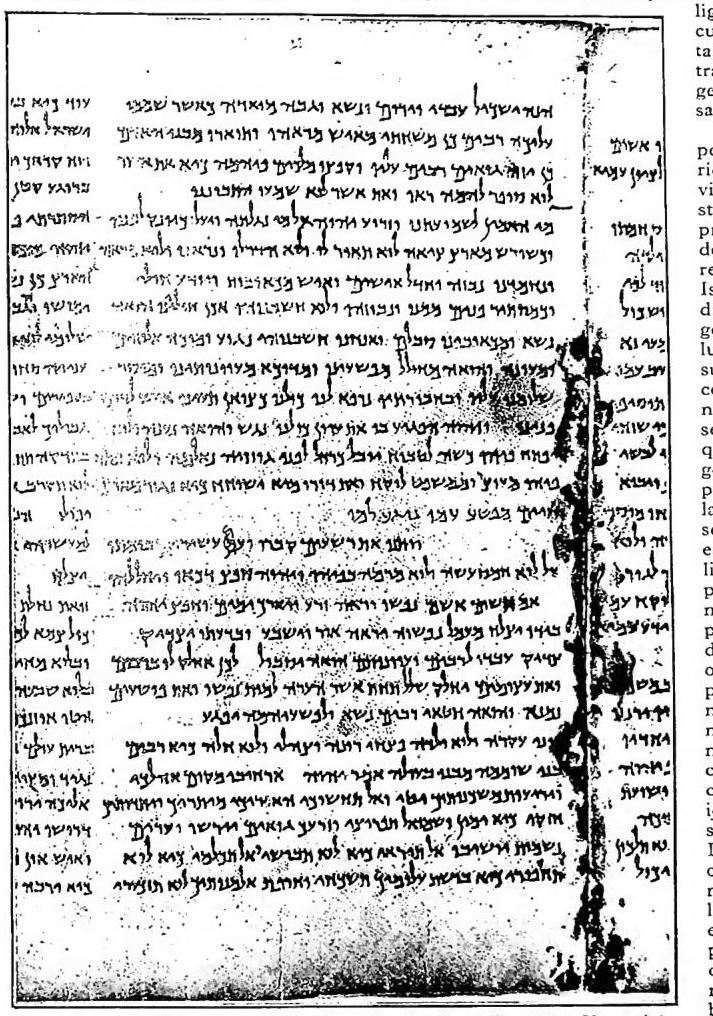
ISAIA - Is. 52, 13-54, 4: prophecy of the Passion (last of the Servant of Jahweh songs). Scroll of I. found at 'Ajn Feshah (Dead Sea).
ISAIAH - Is. 52, 13-54, 4: prophecy of the Passion (last of the Servant of Jahweh songs). Scroll of Isaiah found at 'Ayn Feshah (Dead Sea).
In the midst of the stormy sea of events, Isaiah pointed to the unshakable rock of trust in the Lord, to which the king and the people were to cling. Because of trust in the Lord of Isaiah, Jerusalem was saved.
As a result, like all men of God, Isaiah encountered opposition. His words were not always received with deference and respect: interests that were wounded, vices that were denounced, sought revenge in calumny, hatred, and scorn (Is. 28, 9.10), in contempt for his word (ibid. 30, 12). At times he enjoyed favorable influence, at others he was unpopular and fell into disfavor at court. A tradition of uncertain reliability, transmitted in late Jewish sources, connects Isaiah’s end—on which the biblical text is silent—and claims that the prophet died a martyr.
According to the Ascension of Isaiah (5, 1 sgg.), the prophet was indeed put to death by being sawn in two with a wooden saw (cf. Hebr. 11, 37) on the order of the wicked Manasseh (cf. 2 Kings 21, 16), whom he had reproached for idolatry.
II. THE BOOK OF ISAIAH
The book clearly presents a division into two parts, which is identically accepted by all scholars.1. First part (chapters 1–35) and historical appendix (chapters 36–39)
The first part contains content that reflects the characteristic prophetic mentality of the 8th–7th centuries B.C., as known from other similar writings of that age, in this case accompanied by powerful thought and expressive perfection. The prophetic theme is essentially a grand divine judgment upon contemporary life and history: not only the pagans and not only the schismatic northern kingdom, but also Judah (Jerusalem) for its religious infidelities and moral corruption will be subjected to “judgment”; the instrument of punishment will be Assyria, moved by Yahweh. The people will be overwhelmed along with the ruling dynasty; from the disaster only a small “remnant” will be saved, which will be the seed of the messianic people. From the Davidic stock a shoot will sprout: the Emmanuel (q.v.), the Messiah, who will reign eternally and universally in Zion.Special considerations of content lead to a further distinction of smaller collections of Isaianic oracles (1st collection: chapters 1–12; 2nd: chapters 13–27; 3rd: chapters 28–35, in which sometimes even finer stratifications can be discerned), which may for a time have existed independently, only later to be incorporated into the present work. Because of this gradual formation, perhaps through successive accretions, the book is not arranged according to a single principle. Among the “minor” collections, two concern Babylon (chapters 13–14 and the first part of chapter 21) and one is a singular composition known as the “Apocalypse of Isaiah” (chapters 24–27), whose authenticity is seriously questioned for reasons (set forth, e.g., by the Catholic J. Fischer [q.V. bibliography], I, pp. 110, 148) of historical setting (the Neo-Babylonian power asserts itself at least a century after Isaiah) and of form.
The historical appendix (chapters 36–39) has a common origin with the passage 2 Kings 18:17–20:19, of which it is essentially a duplicate. There are reasons to believe it may be the work of Isaiah (cf. 2 Chronicles 32:32), used by the author of the Book of Kings, or else the work of the author of that book, from which it was extracted and inserted into Isaiah because of the important role the prophet played in the events narrated.
2. Second part (chapters 40–66)
Notable differences in content and form have, since the end of the 18th century (Döderlein, 1775; Eichhorn, 1824), raised strong doubts about the authenticity of the second part, whose author, without prejudice to the critical question and provisionally, given the seriousness of the problem, is almost universally designated by the name “Deutero-Isaiah.”Some scholars then accept a further division of this part, proposed by Duhm (1892), into two collections by different authors, called “Deutero-Isaiah” (chapters 40–55), from which the poems on the “Servant of Yahweh” are distinguished, inserted at four points (in chapters 42, 49–50, 52–53), and “Trito-Isaiah” (chapters 56–66). Other, more minute and daring divisions, devised by isolated “critics,” are not worthy of consideration.
The author, with the mentality, aspirations, and concerns of a Jew living at the end of the Babylonian exile, speaks mostly of the imminent liberation of Israel, its return to the Holy Land, and the inauguration of the “kingdom of God.” Formally, one finds poems, genuine literary compositions, some of them lengthy, employing advanced and sometimes refined techniques. This brief note suffices to indicate the distant origin of the hypothesis that this “second part” should not be attributed to Isaiah, but to an anonymous writer of the 6th century B.C., possibly a student of Isaiah, and should be considered a separate biblical book. One must affirm the eminently historical-critical character of the question, despite its rationalistic origins.
For Catholics, the (religious) value of the messianic prophecies contained in Isaiah II would remain intact even if they were attributed not to Isaiah of the 8th century B.C. but to an author of the 6th century B.C. (cf. H. Höpfl – A. Miller – A. Metzinger, Introductio in Vet. Test., Rome 1946, p. 418), i.e., they would still be genuine prophecies; the same can be said of the prophecies concerning Israel’s liberation from exile. Already a well-known response of the Pontifical Biblical Commission of June 28, 1908 (Ench. Bibl., nn. 287–91), without taking a decisive stance, limits the doctrinal-theological aspect of the question by affirming (and in this all Catholics concur) the character of true prophecy possessed by the oracles of the second part of Isaiah (Resp. I–III), while regarding the question of authenticity, on the critical level, it merely states that the arguments advanced up to that time to deny Isaianic authorship are not sufficient to abandon the attribution peacefully accepted by the entire Jewish and Christian tradition (Resp. IV–V). Catholics have not ceased, with the consent of ecclesiastical authority, to consider the possibility that the “Deutero-Isaiah” may indeed not date back beyond the 6th century, and to study the arguments for and against this opinion, which even nearly half a century after the response cannot be said to have been demonstrated, though it has gained some adherents. A useful orientation on the most advanced position in Catholic thought is found in J. Coppens, Histoire critique des livres de l’Ancien Testament, Louvain 1942, pp. 182–83, 187–88. On the other hand, it is not without interest to note that even very recent non-Catholic scholars have spoken against the “Deutero-Isaiah” hypothesis and in favor of the unity of the book (see the list in H. Höpfl – A. Miller – A. Metzinger, op. cit., p. 415, note 6).
Arguments in favor of the traditional unity are, in particular, that the author of the second part of the book did not live in Babylon, to which there are only scant references, interpretable also as not from direct observation, but in Palestine, whose civil conditions are also well depicted (Isaiah 56 ff.); the fact that this would be the only example of an anonymous prophetic book, a remarkable and strange fact, certainly not in keeping with Israelite religious-literary mentality; the Jewish and Christian tradition; and other considerations of thought and form. In opposition, the following are adduced: the description of the exile as a present situation, not future (Cyrus is a figure assumed to be known and even designated by name); many peculiarities of language and even of general theological conceptions (divine majesty; wisdom; omnipotence; transcendence) characteristic of this book; the literary character of the whole, the work of a poet rather than a nabi’.
3. The oracles of Isaiah
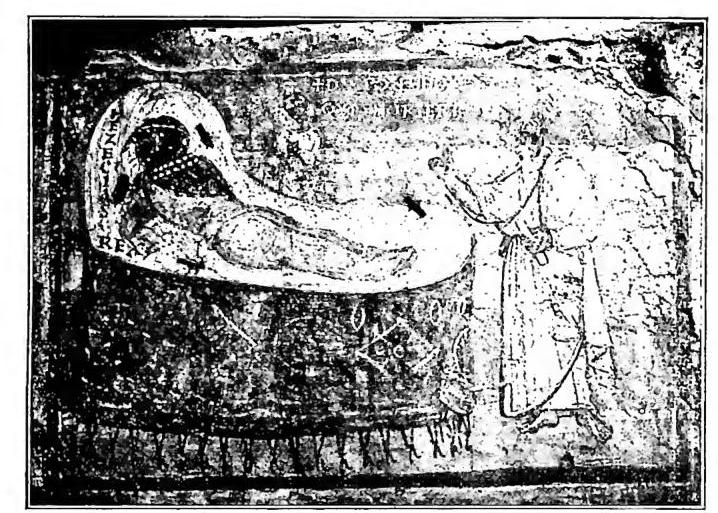
Among Isaiah’s oracles of particular importance are: a) chapter 1, used as a general introduction to the book but perhaps composed after the Syrian war of 732: a vivid and moving representation, in beautiful imagery, of the painful conditions of that moment, from the religious, moral, and economic points of view. — b) The introductory vision of chapter 6, which contains at least in embryo all the characteristic themes of the prophet’s teaching. — c) The prophecy of the Emmanuel (q.v.) in chapter 7, with developments in a long series of subsequent oracles (“Book of Emmanuel,” chapters 7–12). — d) The poems of the “Servant of Yahweh” (42:1–7; 49:1–9; 50:4–11; 52:13–53:12), with prophecies of messianic passion and redemption. — e) The description of the new messianic Jerusalem (chapters 60–62).(photo Alinari) ISAIAH — The prophet Isaiah announces to Hezekiah his impending death (Isaiah 38:1). 8th-century fresco in Santa Maria Antiqua, Rome.
Ma la sublime potenza dello scrittore e il suo valore religioso e profetico potrebbero conoscersi solo nella lettura diretta dei suoi vaticini. Le « forme » che egli usa (parte 1°) sono quelle fissate dalla tradizione profetica: oracoli di minaccia e promessa in relazione al futuro, e di rimprovero riguardo al presente. La sua teologia altissima, la passione violenta che l'investe a tratti, il calore patetico dei suoi appelli alla fede e all'abbandono in Dio, la potenza plastica dell'espressione continuamente avvivata da immagini, alcune delle quali sembrerebbero oggi perfino troppo audaci, o scagliate con un vigore spiegato solo dalla profondità di concezione e dall'immediatezza creatrice ne fanno il più grande poeta ebraico e uno dei sommi geni dell'antica civiltà semitica.
Commenti patriatici: Origene (PG 13); s. Basilio (PG 30); s. Cirillo Alessandrino (PG 70); s. Girolamo (PL 24).
Commenti cattolici: B. Neteler, Münster 1876; A. Condamin, Parigi 1905; S. Minocchi, Bologna 1907; J. Knabenbauer-F. Zorell, 2 voll., Parigi 1922-23; F. Feldmann, 2 voll., Münster 1925-26; J. Fischer, 2 voll., Bonn 1937-39; G. Girotti, Torino 1942.
Non cattolici: S. D. Luzzatto, Padova 1855-67; B. Duhm, Gottinga 1892 (4ª ed., ivi 1922); K. Marti, Tubinga 1900; H. W. Hertzberg, 2 voll., Lipsia 1936-39. Giovanni Rinaldi
III.
I. ISAIAH SCROLLS
A scroll of the entire Book of Isaiah was discovered in the autumn of 1947 in a cave 2 km. west of the Dead Sea, 4 km. from the springs of 'Ajn el-Feshah; it was purchased by the Syro-Jacobite metropolitan of St. Mark’s in Jerusalem. It is 7.24 m. long, 26 cm. high, composed of 17 leather sheets (25 to 63 cm. wide) sewn together with linen thread. The sacred text is arranged in 54 columns (averaging 29 lines each); it was carefully written in the 2nd or 1st century B.C. (J. Trever dates it: 125–100 B.C.). In mid-February 1948 it was photographed by John C. Trever (E. L. Sukenik then copied and published chs. 42–43, Jerusalem 1948), and in 1950 the American School of Oriental Research issued its phototypic edition (in 61 double plates), edited by Millar Burrows.The text is substantially in accord with the Masoretic recension, but contains many strange, redundant spellings (scriptio plena); it belongs to the type of “popular” transmission, distinct from the “official” text fixed by the
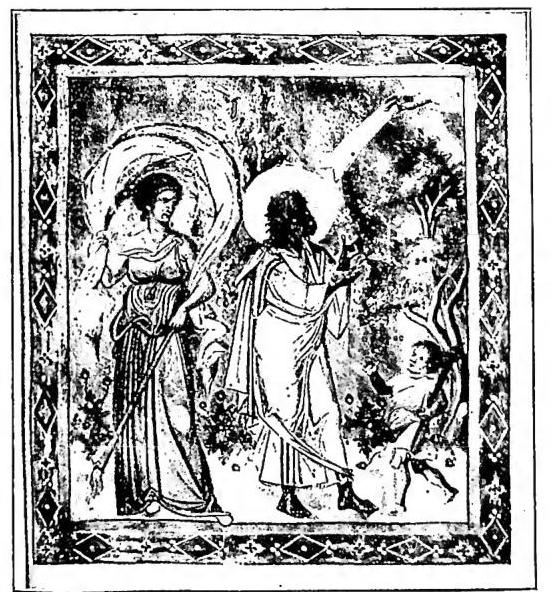
ISAIA - I. in preghiera. Miniatura del sec. X - Parigi, Biblioteca nazionale, cod. gr. 139, f. 435.
sōphērîm, i quali eliminavano verso l'inizio dell'èra cristiana i testi « popolari » gettandoli nella gēnlzāh. È interessante l'ortografia dei nomi propri (J. T. Milik [V. BIBLICA.], p. 217 sg.); nei nomi teoforici la finale -jāhō è quasi regolarmente sostituita con -jāh. Dal cap. 34 i pronomi maschili e femminili di 3ª persona singolare assumono una forma allungata (huvā, hā') e altre forme (kāh, mī', -hāh) si prolungano con una mater lectionis. Un testo indipendente dalla tradizione codificata dai sōphērîm si osserva in 19, 18; 49, 5. 24-25; ecc.
L'Università ebraica di Gerusalemme possiede un altro rotolo di I. (acquistato da E. L. Sukenik) allo stato frammentario. Racchiude parti dei capp. 17, 22 e 23, e l'ultimo terzo del libro (capp. 44-66), tutto in pessimo stato. Si sta facendo rivivere questo testo con la fotografia ai raggi infrarossi. È fedelissimo alla recensione « ufficiale »; Sukenik lo ritiene del sec. III o II a. C.
IV. ICONOGRAPHY
A fresco in the catacomb of Priscilla depicts the Madonna holding the Child to her breast; to the left a figure in tunic and pallium holds a book in his left hand and with his right points to the star painted (now faded) above the Madonna’s head. G. B. De Rossi, who first published the fresco, identified the figure as Isaiah, who wrote: “Ecce Virgo concipiet et pariet Filium” (Is. 7, 14); in the star De Rossi saw the true light, symbol of Christ, foretold by the same prophet: “Surge illuminare Ierusalem, quia venit lumen tuum et gloria Domini super te orta est” (ibid. 60, 1-6). Garrucci instead proposed to identify the figure as the prophet Balaam, who foretold the star: “Orietur stella ex Iacob” (Num. 24, 17). Wilpert upheld De Rossi’s opinion and provided a very important colored reproduction of the image since the star is no longer recognizable (Pitture, tav. 22); the same author mistakenly believed to identify another similar scene in a badly damaged fresco in the Domitilla catacomb (ibid., p. 175, fig. 14). Recently Fr. E. Kirschbaum revived Garrucci’s thesis, while L. De Bruyne emphasized Isaiah’s allusions to light (Conferenze della Società dei cultori di archeologia cristiana, in Riv. di arch. crist., 21 [1945], p. 243).It should be noted that Justin attributes to Isaiah (Apol., I, 32: PG 6, 380) what instead belongs to Balaam.
In the Christian topography of Cosmas Indicopleustes a miniature represents Isaiah’s vision; at the center is the Redeemer enthroned between two seraphim acclaiming “Agios, agios!” while in the right corner the prophet is approached by an angel who purifies his lips with a burning coal (a similar scene also appears at the beginning of the Book of Isaiah in the Bible of Charles the Bald in the Bibliothèque nationale de Paris). In the Greek Psalter no. 139 of the Bibliothèque nationale de Paris a miniature depicts another vision of Isaiah; from the divine hand above a ray emanates and strikes the nimbed head of the prophet standing between personified Dawn and Night.
A fresco in Santa Maria Antiqua depicts the prophet Isaiah foretelling to Hezekiah his imminent death (Is. 38, 1). In the chapel of al-Baqawāt in Egypt the martyrdom of the prophet was represented. A miniature with Isaiah’s vision is in fol. 67 of the manuscript containing the Sermons of St. Gregory Nazianzen in the Bibliothèque nationale de Paris (Cod. Parisius 510).
V. ASCENSIONE DI I
Apocrifo del Vecchio Testamento a carattere narrativo e profetico, avente per protagonista il profeta I. È unanimemente riconosciuto il carattere composito dell'opera. Sull'identificazione delle fonti, o scritti indipendenti anteriori, e delle aggiunte redazionali o posteriori, gli studiosi avanzano varie ipotesi, che si accordano sostanzialmente nel riconoscere un Martirio d'I. (capp. 1-3, o 2-3 fino al V. 12, e prima metà del cap. 5); uno scritto apocalittico detto da Charles Testamento di Ezechia (cap. 3 dal V. 13 e cap. 4); una Visione d'I. (dal cap. 6 al cap. 10 e parte del cap. 11).Il primo documento narra che I. sotto accusa di essersi fatto superiore a Mosè, per aver detto « Vidi il Signore » (Is. 6, 1), viene dall'empio re Manasse fatto tagliare con una sega di legno : questo scritto, noto già a Origene (In Is. hom. 1,5), e secondo alcuni anche a Hebr. 11, 37, che tra i generi di martirio ricorda l'« essere tagliato » (ma potrebbe attingere solo da tradizioni parallele), è giudaico e della fine, o metà, del sec. I a. C.
Il secondo documento narra dei risentimenti provocati in un avversario del profeta dalle grandi profezie messianiche di lui : Incarnazione, Passione e Morte del Cristo, elezione degli Apostoli, ecc. È di origine cristiana, forse del sec. II d. C.
Il terzo documento narra un viaggio d'I. per i sette cieli, ove conosce i misteri più riposti, anch'essi a carattere cristiano : forse anche questo del sec. II d. C.
La compilazione finale è della fine del sec. II d. C., o inizio del III. Il testo originale era greco, solo parzialmente conservato (2,4 - 4,4); si hanno la versione etiopica intera (sec. V) e frammenti di tre versioni latine, di una slava e una copta.
La narrazione della morte d'I. ebbe una certa fortuna presso i Padri (E. Tisserant [V. BIBLICA.], pp. 62-74) e gli scritti giudaici; il libro era apprezzato presso alcune sette gnostiche. - Vedi tav. XVI.
Studi : V. Burch, The literary unity of the book of the Ascension of I., in Journ. of theol. studies, 20 (1918-19), pp. 17-23; J. Felten, Storia dei tempi del Nuovo Testamento, II, Torino 1932, p. 350 sgg. Giovanni Rinaldi
ISAIA. - Ascetic writer, not to be confused with the 4th-century Egyptian monk Isaiah mentioned by Rufinus (Hist. monach., 10: PL 21, 428 sg.; cf. E. Preuschen, Palladius und Rufinus, Giessen 1897, p. 63 sg.) and Palladius (Hist. Lausiaca, ch. 14; ed. Butler, II, p. 37 sg.). Isaiah was a Monophysite ascetic who came from Egypt to Palestine, living in the hermitage of Eleutheropoli and near Gaza, where he died on 11 Aug. 488; he was also, according to Zacharias Rhetor (Vita Isaiae, ed. E. W. Brooks, Corpus script. christ. orient., Script. Syri, 3rd ser., XXV, Paris 1907, Latin trans., pp. 1-10), the author of ascetical writings.
His relations as a Monophysite with Peter the Iberian, bishop of Maiuma, and Theodore of Antinoe are well attested, but his true stance regarding the question of Cyril’s anathemas is confirmed.
In fact, he later subscribed to Zeno’s Henoticon.