
SENNACHERIB. — Assyrian king (Assyrian Šin-ahhē-eriba, “Sin has given me a substitute for my [deceased] little brothers”; Heb. Sanhērībh), who ruled the Neo-Assyrian Empire from 705 to 681, at the time of its greatest cultural splendour. He appears in a dramatic episode narrated three times in the Bible (II Reg. 16:13–19, 36; Is. 36–37; II Par. 32:1–23) and in many cuneiform inscriptions, which delineate his character.
A great statesman, S. had passions that might seem modern: a lively interest in technical inventions, architecture, literature—especially Sumerian—and the philology of the various dialects of his Empire (cf. Is. 36–37), as well as in mountaineering, which he added to hunting, so greatly favoured by all the Neo-Assyrian kings. His passion, however, for his favourite queen Naqi'a (probably an Aramaic name, from the region of Lahiru south of Babylon; Assyrian Zabāitu, “the pure one”), a woman of considerable political ability, caused disturbances that ended with S.'s assassination. He, Sargon II (v.) had governed the lands of Nairi and the more difficult province of Babylonia, always showed moderation in foreign policy. He even consented to reductions in his vast territory if its defence proved difficult. But he revealed himself to be an energetic commander when revolts threatened commerce or the honour of the Empire required II. He aspired more to the internal advancement of his kingdom, and to making it surpass the splendour of Babylonian civilisation, than to military conquests. Having succeeded his father in 705, he spent the first two years doubling Nineveh (v.), where he built the “palace without equal,” two larger belts of walls, various temples, roads and extremely broad squares; in the surrounding area he had a network of canals constructed, especially the magnificent aqueduct of Jerwan, described by T. Jacobsen and S. Lloyd. He introduced cotton to Nineveh, creating a new industry for its large population, as well as myrrh. A botanical and zoological garden was added to the Palace: the park contained every species of herb, fruit tree and wild tree that grew between Amanus and the Persian Gulf, as well as a pond surrounded by groves, tall reeds and cypresses, in which igirru birds, wild boars and deer lived.
Thus, during the first two years of his reign, he neglected to go to Babylon to lead the statue of Bäl in procession at New Year, a rite required in order to be regarded as the legitimate king upon the throne of Marduk. A division consequently arose among the Babylonians: some remained loyal to Assyria, considering S. the legitimate king even though he had not ritually begun his reign at Babylon; others, angered, took the adventurer Marduk-zākir-šum and installed him as king with the sacred rite. While S. was still far away, Merodach-Baladan (v.),
deposing the usurper, established themselves once
more in Babylon; but in the campaign
of 703, owing to a strategic error by Merodach-Baladan, they lost the double battle
of Kutha and Kis. S. entered Babylon in
triumph, received as a friend, and his valiant soldiers plundered only the Palace
of Merodach-Baladan. S. conquered (703–
702) the strongholds of the Chaldean tribes, while
Merodach-Baladan hid in the marshes
at the mouths of the Euphrates and the Tigris. When S. had returned to his homeland, Bël-ibnî, a servant of the Palace appointed by S. as king of Babylon, proved unequal to the delicate task, and another Chaldean leader, Marduk-ušēzib, lorded it over the
surroundings of Babylon. S. therefore hurried there
again in 700 (probably after the campaign in Judea) and defeated and deported many
of the Bît-Jakîn, but the two Chaldean leaders
fled by ship to Nagîtu-Raqqē, beyond
the Gulf, in Elamite territory. S. then made
his son Aššur-nādin-šumī king of Babylon, taking the incapable Bël-ibnî with him to the
Palace at Nineveh. There could be no hope of
peace until the Chaldean exiles, led
by Merodach-Baladan and his sons
from the Syro-Phoenician coast, and shipyards were opened at Nineveh
for a fleet capable of transporting a large army;
a level road was also built between Opis and the Euphrates in order
to transport those ships overland. The advance, begun in 694, was highly successful at first, although the
Chaldeans flooded the land by cutting the dams; but
after the great army had crossed to the delta, Ḥallušū, king of Elam,
invaded Babylonia, seized Sippar and Babylon, aided by “fifth columns,”
took Aššur-nādin-šumī prisoner,
carried him to Elam and killed him. Then the anti-Assyrian
party engaged in great purgatory massacres;
it made Nergal-ušēzib king, but he was able to hold out only in the cities of Babylon, Sippar and Borsippa. S.'s army, although cut off
from its homeland and without supplies, won the battle near
Nippur, and captured Nergal-ušēzib alive; he was killed at Nineveh.
But another prince of the Chaldeans, Mušēzib-Marduk,
made himself king of Babylon; hated by S. more than anyone else, and called by the Assyrians Šuzub (“fugitive”), he immediately allied himself with
Umanu-Menanu of Elam. In the extremely bloody battle
of Ḥalūlē (693), of which S. gave the finest description
of a battle in the ancient East, Šuzub did not succumb.
But when, later, Umanu-Menanu was struck by nervous paralysis, he was left alone to face S., who, following
in his father’s footsteps, had even mobilised the Arab tribes.
The Assyrian invasion followed in 690, ending with the capture,
sack and destruction of the marvellous city of Babylon;
water contributed more than fire: after
the soldiers had blocked the canals, especially the Araḫtu,
it flooded the city and made it marshy and uninhabitable. The gods themselves
had to emigrate to Nineveh, where Šuzub was executed. Only eleven years later Queen Naqī'a, governor Asarhaddon (v.), began to drain and then rebuild that
metropolis of the nations.
In the vast semicircle extending from Elam to Cilicia, Sargon II (v.) in Urartu
(which was already beginning to recover), there was calm during S.'s reign. Apart from expeditions that were rather mountaineering ventures,
for example that to the Judhī Dāgh, the celebrated mountain Nīpur
of the Assyrians, where, according to ancient traditions, the ark of Utnapištīm had come to rest amid the waters of the Flood, mention should be made
of the expedition of 702 to the land of Elippi, south of
Kirmanšāh, where S. rectified the frontier in his favour
against Elam, founding his own town, Kar-sīnahḫa-ribā (“fortress of S.”). At the Cilician gates, S.'s generals in 796–95 clashed with Kirun of Illubru,
probably a Greek who, taken prisoner to Nineveh,
was flayed as punishment; the pirates
belonging to that people were also punished. Farther north was conquered
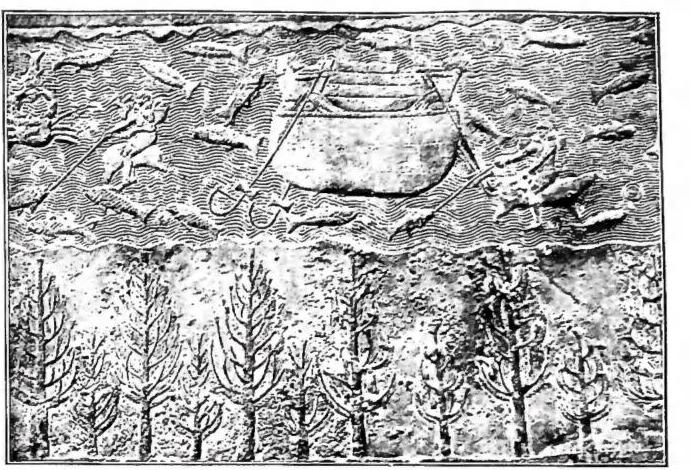
(from H. Schäfer–W. Andrae, Die Kunst des Alten Orients. Berlin 1925, para. 23)
SENNACHERIB – Navigation and fishing on the Tigris. Alabaster relief from the Palace
of S. at Nineveh.
Til-Garimmu, but a large part of Commagene
and Melitene was lost.
Of greater interest is the third expedition (701–
700) of S., against a coalition led in the north
by Luli, king of Sidon, and in the south by Hezekiah (v.), king of
Judah. Three biblical accounts of it have survived,
differing in literary genre and in numerous details, and,
if we select the most reliable, two complete records in cuneiform inscriptions (the Taylor prism and
that of the Oriental Institute of Chicago). These
five accounts reflect the genre and particular intentions
of each. The three biblical accounts, with H. Haag,
may be reduced to a single source preserved in purer form
in II Chron. 32:1–23.
The pericope II Kings 18:13–19:36 intends
to highlight the piety of Hezekiah and the prophetic gift of Isaiah;
it combines within itself different versions of the events, as is shown
by the addition in 18:14–16: Hezekiah’s formal submission
to S. and the imposition and payment of the burdensome tribute,
which is not mentioned in Is. 36–37, where a
magnificent drama is unfolded in several episodes, intended
to exalt the man of God who saved Israel; the two embassies from
the Great King, the speeches in Hebrew of the Rabshakeh (v.), which
the second time reads a proclamation of S., the fear and prayer
of Hezekiah, the message he receives from Isaiah, his triumphant song
with which little Judah, protected by Yahweh, defies Assyria at its apogee,
the intervention of the Angel, and the hasty flight
of the Assyrians. As for the cuneiform records, their authority
must be acknowledged, with H. Haag (against G. Ricciotti, who,
proceeding with little historical sense, presents the
Assyrians according to a cliché of a proud, deceitful, and
above all cruel people). But these documents do not closely follow
chronological order; they summarize several
distinct operations in a record concerning the same city.
From these sources the third expedition of S. can thus be reconstructed. He first conquered the cities belonging
to the Sidonians and to the people of Tyre, as well as mainland Tyre.
Luli fled to Cyprus, where S.’s loyal vassals killed him.
The coast as far as Acco had by then fallen into the hands of S.,
who placed his vassal Ethbaal on the throne of Sidon. Since
the provinces of Dūru and Samerina remained loyal to S.,
Ammon, Moab, and Edom also submitted to S.; only the Philistine
coast and Hezekiah resisted S. In the south Hezekiah, allied
with Pharaoh Šabaḫa, dominated the coalition: at that time, in fact,
he conquered the Philistine city of Gaza, and when
the anti-Assyrian subjects of Ekron deposed their
Assyrianophile king Padi, they handed him over in chains
to Hezekiah in Jerusalem. And the coalition held firm: when
S. arrived, only Mitinti, king of Ashdod, submitted; the other cities of the
plain and of the šēphēldh: Bethdagon, Joppe, Banai-Barqa Azuru, Themna, Elthece, as well as the fortresses of Judah, e.g., Lachish (reliefs of its capture in Nineveh!) or Libnah, had to be conquered one by one. S. sent troops against Jerusalem. As the Pharaoh’s arrival drew near, they fortified themselves with ramparts near the city gates. But S.’s main army continued the sieges and captures of the cities of the plain. When the Pharaoh arrived, it seems (H. Haag) that S. was compelled to move his headquarters from Lachish, already captured, to Libnah. The decisive battle was fought near Elthece, where the Pharaoh was defeated, but S. no longer had the strength to invade Egypt, having certainly suffered considerable losses. In these circumstances the drama of Jerusalem unfolded, where Isaiah prevented total capitulation; there, through the prayers of the King and the prophet and through the means of human prudence employed by the King, a compromise accepted by S. was reached. Thus the Kingdom of Judah avoided being reduced to an Assyrian province, a matter of the utmost importance for maintaining the recently reformed Yahwistic religion. It is entirely true, as the Chronicler relates, that Hezekiah had to write letters of apology as one defeated and had to submit to very harsh peace terms, such as reductions of the national territory to the advantage of Padi and other neighbors, and especially the extremely burdensome tribute, which forced the pious King even to melt down the roof and ornaments of the Temple of Jerusalem. Yet, for a king who was the leader of a rebellion, it was a moral miracle that S. had come to terms, probably for various reasons: his own losses, illnesses in the army, bad news from Babylon, where Bēl-ibnī was proving incapable, concern at having to prolong the siege of Jerusalem for years, S.’s rather moderate imperialism, and finally the power of God, who moves the hearts of kings. For another good century the little Kingdom of Judah had preserved the right to live according to its own laws, until Nabuchodonosor arrived (v.).
No differently from what David did with his son Solomon, younger but born to his favorite consort, S. designated Asarhaddon, son of Naqi'a, as his successor. For this reason S. was assassinated, apparently by discontented Babylonians joined by his sidelined elder sons, probably during a religious service in the temple of Nisroch (Ninurta?) at Nineveh, in šēbet (January) 681. Yet for his son Asarhaddon and the energetic Naqi'a it was not difficult to suppress the revolt, which had already been extinguished by March. S., originator of splendid Nineveh, murdered for love of a queen of incomparable qualities; the reconstructive builder of Babylon, wonder of the world—this was a theme that must have impressed the imagination of the peoples. Hildegard Lewy’s reconstruction of the reports transmitted by Ctesias through Diodorus Siculus therefore has some probability: Ctesias’s Ninos and Semiramis would be none other than S. and Naqi'a; both would have been fused with memories of other historical figures: Ninos with Samši-Adad V (824–812); Naqi'a with Samuramat, likewise an energetic and highly capable woman, who for four years (811–808) governed Assyria for her underage son Adad-nīrārī III. Herodotus, however, speaks of two queens of great intelligence: Semiramis and Nitocris, wife of Nabuchodonosor; in his account, the features of Naqi'a would be concealed beneath those of Nitocris.
v. J
C., Louvain 1938, pp. 69–76; H. von Zeisel, Ag. Forschungen, XIV, Glückstadt 1944, pp. 17–34; A. L. Oppenheim, in Ancient near eastern texts relating to the Old Testament, Princeton 1950, p. 287 ff.; H. Haag, La campagne de S. contre Jérusalem en 701, in Rev. bibl., 58 (1951), pp. 247–50; H. Lewy, Nitobris-Naqi'a, in Journ. of near eastern studies, 11 (1952), pp. 264–86. Pietro Nober#### SENOFANE: V. ELEATISMO.