Machine translation of the 1948–1954 Italian original. The original text is authoritative.
ASARHADDON (Assur-ahu-iddin, “the god Assur gave a brother”). — King of Assyria from 681 to 669 B.C. He was the son, perhaps the third, Sennacherib (v.) who chose him as his successor (II Reg. 19:37 = Is.
37:38). His elder brothers, unable to tolerate this preference, murdered their father and made war on A., whom he defeated in a month and a half. During his twelve-year reign, A. waged continuous defensive and offensive wars. He rebuilt Babel, destroyed by his father, together with the Esagil temple and the Etemenanki tower.
He held back the Cimmerians at the northern frontiers, subjugated the Arameans, and allied himself with the Elamites. In 677 he conquered and destroyed Sidon, whose king 'Abd-Melqart (Abdimelkutti), having fled to the court of the Cilician king Sanduari, was taken prisoner and beheaded the following year along with Sanduari. The southern part of the territory of Sidon was given to Ba'al, king of Tyre. By 673 A. had conquered most of Phoenicia, Palestine, and Cyprus. In addition to Ba'al, king of Tyre, Manasse (v.), king of Judah, and the princes of Ashkelon, Ekron, Aradus, Azotus, Byblos, Ammon, and Moab accepted A.’s supremacy. The ten
princes of the Greek cities of Cyprus (Idalion, Paphos, Salamis, Clytron, etc.) also sent embassies to A., declaring themselves his vassals. In July 671 he routed the Egyptian army, and the capture of Memphis redeemed the setback inflicted on A. two years earlier by the Pharaoh Taharqa. On his way to a third expedition against Egypt, which had risen in revolt, he died on 10 marbešwan (November) 669. He settled colonists from the eastern provinces in Samaria (Estd. 4:2).
BIBL.: B. Meissner, Könige Babylonens und Assyriens, Leipzig 1926, pp. 211–28; A. Pohl, Historia populi Israel, Rome 1933, pp. 136–38. Giustino Boson
ASBURGO (HABSBURG). – Swiss castle on the Aar. The dynasty that took its name from it originated in Alsace, and the first securely attested figure is a WERNER, bishop of Strasbourg at the beginning of the 11th century; his nephew WERNER was count in Aargau after 1082; but the family acquired power rather more
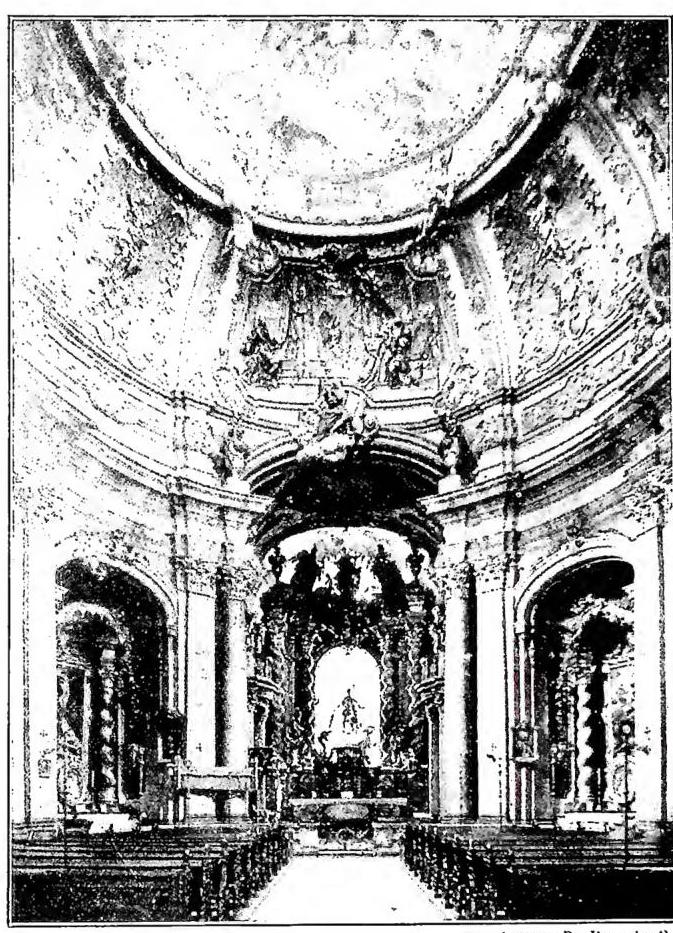
ASAM – Interior of the Klosterkirche at Weltenburg.
(propr. B. Urgenhart)slowly in the lands of present-day Switzerland and the surrounding areas, so that by the time of the Emperor FREDERICK II it could at last emerge from obscurity. Its greatest fortunes, however, began with the appointment of RUDOLF (born 13 May 1218) as king of Germany, which took place at Frankfurt in September 1273 and brought to an end the long interregnum that had in fact lasted since 1254. The new sovereign was concerned only in words with effectively asserting his rights in Italy or with receiving the imperial crown (cf. Dante, Purg., VI, 103; VII, 94 ff.); instead, he directed his policy toward extending his dominion in southeastern Germany, overthrowing the power of Ottokar II of Bohemia, his principal adversary (d. 26 August 1278), and conquering Austria, Styria, Carniola, and the Windic March; somewhat later (1335), Carinthia also became part of the Habsburg possessions. After Rudolf’s death in 1291, his son ALBERT obtained the royal crown only in 1298 and held it until 1 May 1308, when he was killed and succeeded by Louis of Luxembourg; his son FREDERICK (1214) attempted to recover it, but found himself opposed by Louis of Bavaria and was defeated in the ensuing war (d. 13 January 1330). In the face of the house of Luxembourg, which later regained the kingdom and the empire and also occupied Bohemia, the house of A. passed into second place; it nevertheless retained its original possessions and the lands acquired at the end of the 13th century, adding Tyrol to them. Another FREDERICK appears at Constance during the Council, but without succeeding in prevailing against Sigismund’s actions; only after the latter’s death (1437) did ALBERT II of A., of the Albertine branch, become king of Germany. At his death shortly afterward (24 October 1439), FREDERICK III (of the Leopoldine branch of Styria) held the German Empire until 1493. In addition to his claims to Hungary and Bohemia, which he never ceased to assert, he succeeded in securing Burgundy (which at that time included the Netherlands) for his house through the marriage of his son MAXIMILIAN, later King of the Romans. In turn, PHILIP, the son of Maximilian, married Joanna the Mad, daughter of Alfonso, king of Aragon, and Isabella, queen of Castile; thus, at the death of these two sovereigns, Philip and then his son CHARLES found themselves heirs to the Spanish kingdoms. Since Philip had already died, at the death of his grandfather Maximilian (1519) CHARLES (I of Spain and V of Germany) united the kingdom of Germany with Burgundy to the Spanish kingdoms, in addition to the kingdom of Naples, conquered by the Aragonese in 1501, and the rights to the Duchy of Milan, contested by the king of France. To all this must be added possession of the East Indies, which were being discovered after 1492. Against this immeasurable power, which threatened to absorb all Europe, rose Francis, king of France, who sought the help of England and of anyone who might be an enemy of Charles, including the Turk, and especially the rebellious German princes and supporters—above all for political reasons—of the new Protestant doctrines. Charles thought it advisable to divide this group of kingdoms with his brother FERDINAND, to whom he entrusted Germany with Hungary, which had been left without a king in 1526, and with Bohemia, while retaining all the rest for himself. Upon his abdication (1556), his son PHILIP II remained king of Spain, the Netherlands, Naples, and the other territories, and perpetuated the dynasty until CHARLES II, who died in 1706, when the French Bourbons took possession of the throne, though losing the Netherlands. Ferdinand I received the imperial crown, which he transmitted to his son MAXIMILIAN II and then to his grandsons RUDOLF II and MATTHIAS.
At the death of Matthias in 1619, the crown went to FERDINAND II, son of Charles of Styria, the second son of Ferdinand I, one of the most convinced supporters of Catholicism and its rights in Germany; and this direct branch became extinct in 1740 with the death of CHARLES VI. It was then that CHARLES ALBERT of Bavaria, son of a sister of Charles VI, claimed the throne of Germany; but the latter, by virtue of a “pragmatic sanction” that he had issued, had established that his heir should be his daughter Maria Theresa, who since 1736 had been the wife of Francis I, duke of Lorraine.
The German Empire thus passed to the A.-Lorraine branch, which acquired the Grand Duchy of Tuscany upon the death of Gian Gastone, the last of the Medici (d. 1737), and then also the Duchy of Modena upon the death of the last Este. Tuscany went in fact to PIER LEOPOLD and then to his son FERDINAND III and his descendants; Modena went to the son of Pier Leopold’s brother and to his son.
The Napoleonic wars led in 1804 to the suppression of the Holy Roman Empire and the kingdom of Germany; other kingdoms had meanwhile been formed: those of Prussia, Bavaria, Hanover, and Württemberg. FRANCIS II instead assumed the title of emperor of Austria, king of Hungary and Bohemia; for his own advantage, he constituted the Kingdom of Lombardy-Venetia by joining the former Duchy of Milan to the Italian territories of the suppressed Republic of Venice; and since Tuscany and Modena were in the hands of his relatives, he was able to exercise decisive preponderance over the Italian princes. The reconquest of Hungary during the 18th century led the house of A. to extend its European and Christian influence along the entire course of the Danube and throughout all the surrounding lands; but against the dynastic absolutism of its policy, which nevertheless ensured order and good administration, new tendencies were emerging. While the German nation shifted its center of action from Vienna to Berlin, the other nations—Italy, Bohemia, Hungary, and later the southern Slavs—aimed at complete independence. The house of A. understood too late that, as the times advanced, maintaining its ancient positions was becoming a hopeless undertaking, even though these had generally been far from disastrous; and in the world war of 1914–18 it was swept away together with that of the Prussian Hohenzollerns, who had made every effort to supplant it in directing European policy.
The last members of the A. dynasty to reign were: FERDINAND I, son of Emperor FRANCIS, who, because of the uprisings of 1848, had renounced the throne in favor of FRANCIS JOSEPH, the son of his brother. After the latter’s death, following a very long reign, during the war, in 1916 he was succeeded by CHARLES FRANCIS JOSEPH, his great-grandson, who ceased to reign two years later and died in exile in Madeira, a prisoner of the Allies, losing also a large part of the family’s patrimonial fortune.
BIBL.: It is extremely abundant, both with regard to the general history of the family and with regard to the various periods and individual persons and events. Cf. Ed. von Lichnowsky, Geschichte des Hauses Habsburg, Vienna 1836–44; W. Merz, Die Habsburg, Aarau 1896; A. Dudan, La monarchia degli Asburgo, Rome 1915; L. Léger, Histoire de l'Autriche-Hongrie, Paris 1920; C. Capasso, s. V. in Enc. Ital., IV, p. 771 ff. Pio Paschini
Cite this article
“ASARHADDON (ASSUR-AHU-IDDIN « IL DIO ASSUR DIEDE UN FRATELLO »).” Enciclopedia Cattolica, vol. II (1949), p. 71. Azione Romana digital edition, https://azioneromana.com/article/asarhaddon-assur-ahu-iddin-il-dio-assur-diede-un-fratello.