
BABYLONIANS.
- Peoples who, from the dawn of history, inhabited the "land between the two rivers" (Mesopotamia), the Tigris and Euphrates, stretching from present-day Baghdad to the Persian Gulf, called Babylonia or Babylon (v.) after the city (Babel) that from 1830 B.C. was its capital.
By the 4th millennium B.C., we find Sumerians in the south and Akkadians in the north. The origin of the Sumerians, who were non-Semitic, remains problematic. The Akkadians were Semites; they took their name from Akkad, the capital of their first empire. Strengthened by the continuous arrival of kindred tribes, they gradually gained the upper hand, occupying the entire country. In ancient times, the city almost bordering the sea was Eridu, already close to the sea marshes. The upper Mesopotamian plain, with its abundant artificial canals, created by the wisdom of its rulers, was a rich and fertile land, a small Egypt.
SUMMARY:
I. History
II. Babylonian-Assyrian Literature and the Bible
III. Religion.I. HISTORY.
1. Sumerians-Akkadians. - The history of the Babylonians, which extends until the advent of Cyrus (538 B.C.), encompasses two great periods: the Sumerian, from the beginnings to 1830, and the Akkadian or Babylonian.In the first period, the Sumerians, bearers of an advanced civilization and a culture that influenced the ancient Orient for centuries, as well as of writing (the cuneiform script) which remained in use almost until our era, held predominance. They consisted of many small city-states, often in conflict with one another, among which were: Ur (v.), the homeland of Abraham (Gen. 15:17); Lagash (Telloh); Kish (el-Oheimir); Umma (Gōbah); Adab (Bismajyah); Isin; Mari; Uruk (Warka), the Erech of Gen. 10:10; Larsa (Senkereh), the Ellasar of Gen. 10:10. Only at times did one dominate the entire country; thus Lagash under the kings Entemena and Urukagina (early 3rd millennium); Umma, under Lugalzaggisi (second half of the 3rd millennium). Akkad, founded by Sargon (Šarru-kin) I,
whose empire reached the Mediterranean, was the capital of the first Semitic empire: the Akkadian (2360-2180). The Third Dynasty of Ur (2067-1960), after the occupation by the Guteans, was the last manifestation of Sumerian power.
2. The First Babylonian Dynasty. - The second period begins with the advent (1830) of the First Babylonian Dynasty (the Amorite), named after Babel, chosen as its capital (1830-1531). The Semitic Akkadians had prepared the ground for the rise of these rulers of Semitic stock.
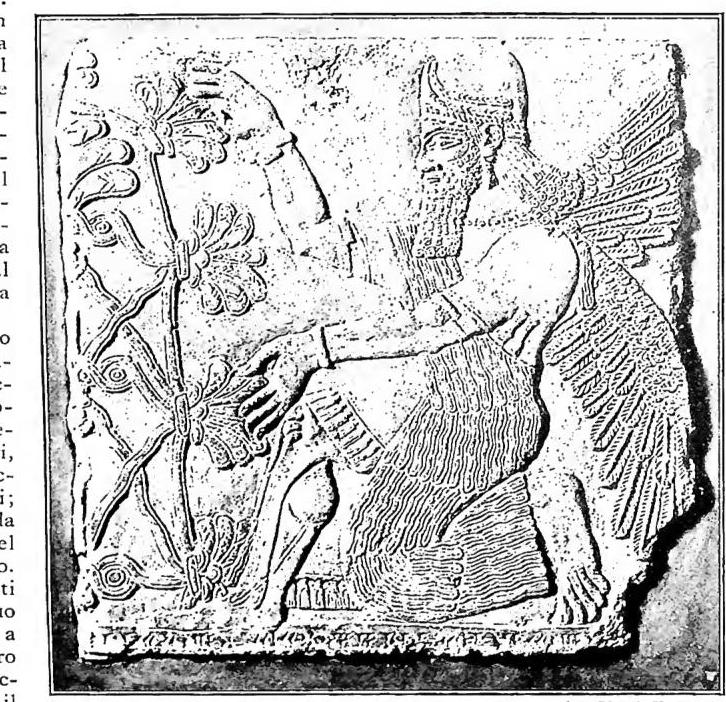
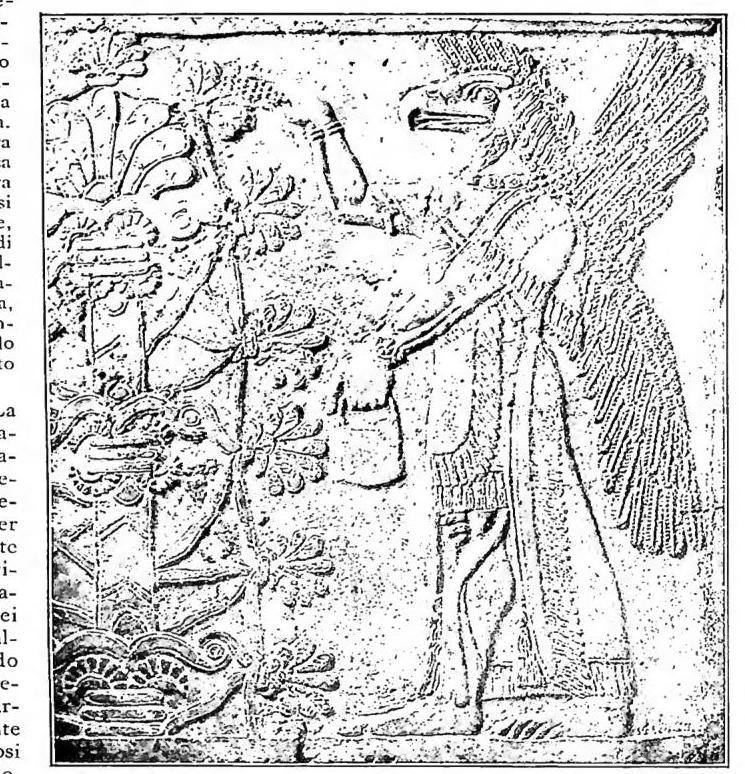
The winged genius kneeling before the tree of life. Below, a cuneiform inscription with the royal titles of Assurnasirpal II (9th century B.C.) - Vatican Museums, Assyrian reliefs staircase.
Bel. Samsuditana (ca. 1582-50), the last king of this first Babylonian dynasty, saw his country devastated by an invasion of Hittites from Cappadocia and Anatolia, who, however, did not remain long in the Mesopotamian region. Already under Hammurapi’s immediate successor, Samsuluna, a new dynasty of the "Sea Land" (southeastern part of Babylonia) arose. An insignificant dynasty representing a rebellion of mixed elements, Sumerian and Akkadian, against the Babylonian Semitic victory.
3. Kassite Dynasty (ca. 1550-1150 B.C.) - The Hittite invasion, though short-lived, caused a severe weakening of Babylonia. It was also accompanied by several other migrations of peoples, among them that of the Kassites, who, having settled in Babel as rulers, reigned there for over four centuries.
The Kassites, who are supposed to have been Aryans, related to the Mitanni and Hittites, inhabited, at the beginning of the third millennium, the shores of the Caspian Sea (the name derived from Kassu, with p being the plural ending in Caucasian languages). The Kassite period is poor in documents. The civilization of the invaders was inferior to that of the conquered inhabitants; they adapted to the culture and customs of the land.
From a religious standpoint, the newcomers vied with the local element in honoring the deity of the subject people. Under these Kassite kings, the kudurru (boundary stones) are particularly interesting, on which many emblems of the deity are depicted (v. MAŞŞENHÂH).
Politically, the new dynasties, from Gandaš, the conqueror of Babel, to Ellil-nâdin-ahhê (a Semitic name), the last ruler, as far as is known, contented themselves with maintaining independence in their small state. By defeating the king of the neighboring "Sea Land" near the Persian Gulf, they brought under their dominion all the Mesopotamian land as far as the Lower Zab.
4. The Assyro-Babylonians (between 1149 and 625 B.C.). - The politics of the two cities (Babylon and Assur) became so intertwined that it is necessary to recount their history simultaneously. In this period, phases of mutual war alternate with phases of peace and friendly relations.
In 1149, a new dynasty seized power in Babylon and counted eleven kings over a span of 131 and a half years, from 1170 to 1039 B.C. The founder of the dynasty can, from a fragment of a kudurru in the Yale collection, be identified with Marduk-šâpik-zêri. The third king of this dynasty is Nebuchadnezzar (Nabû-kudur-uşur) I, who freed Babylon from the damage of the Elamite invasion. In a kudurru of this king, which is a charter of privileges for Ritti-Marduk (the chariot commander), reference is made to a campaign of this king in Elam "to avenge" Akkad, devastated by previous Elamite incursions. The Babylonian troops gathered at Der, a land near the Elamite border, in summer and suffered from the heat; but Ritti-Marduk inspired courage in the troops, who reached the Eulaeus, where they defeated the confederated Elamite forces. It seems that the victor was clement with the vanquished, as another kudurru informs us that some Elamites took refuge in Babylon, bringing with them the statue of their god Ria, under the protection of Nebuchadnezzar I, which they requested. This monarch is said to be the conqueror of the land of the Lullubi (south of Lake Van) and of Amurru.
Assur (v.) the list of kings is complete, though the details available refer only to Aššur-riš-iši I (1130-1113), a contemporary of Nebuchadnezzar I. The latter is also said to be the conqueror of the Ahlâmu, the Lullubi, and the Gutians. Perhaps he encountered the Babylonian army during the conquest of the Lullubi, inflicting or suffering some affront. Indeed, Nebuchadnezzar I of Babylon reacted to the provocation made by the Assyrian king, who had penetrated into Babylonian territory, pursued him, and besieged him in the fortress of Zanku; but Aššur-riš-iši forced him to lift the siege. Nebuchadnezzar returned to the attack and suffered a new defeat, losing the fortified camp of Kara-
stu and the commander-in-chief of the army, who was taken prisoner and led into Assyria.
The policy of conquest and war of King Aššur-riš-iši took on considerable proportions with his son and successor, Tiglath-Pileser (Theglathphalasar) I (1112-1074 B.C.), who was the greatest conqueror of the ancient Assyrian empire. The inscription on a cylinder, which recounts his campaigns and victories, comprises eight columns of over a hundred lines each. A fierce and cruel victor, he traversed, sowing destruction and death, almost all the land between the Tigris and Lake Urmia and Armenia, indicated under the name of Nairi, also penetrating northwest as far as Subartu and Commagene and into the land of the
Muski. In a subsequent campaign, he ventured into the territory of the Hatti in Cappadocia on the border of the land of the Moschi. Melitene and the surrounding region had to submit to the Assyrian yoke; to the west, Carchemish and the Aramean tribes were devastated and subjugated. All these conquests took place in the first five years of his reign. His expeditions against the Arameans in northern Syria took place toward the last years of his reign, during which he also undertook an expedition against Elam, which he devastated.
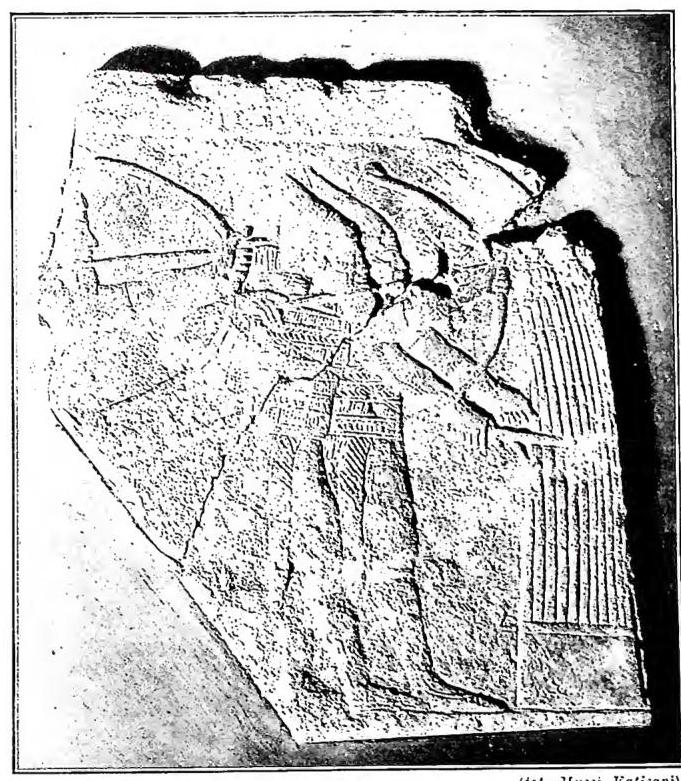
BABILONESI - Siege scene. Archers fighting behind a trench - Age of Sennacherib (early 7th century B.C.) - Vatican Museums, Assyrian reliefs gallery.
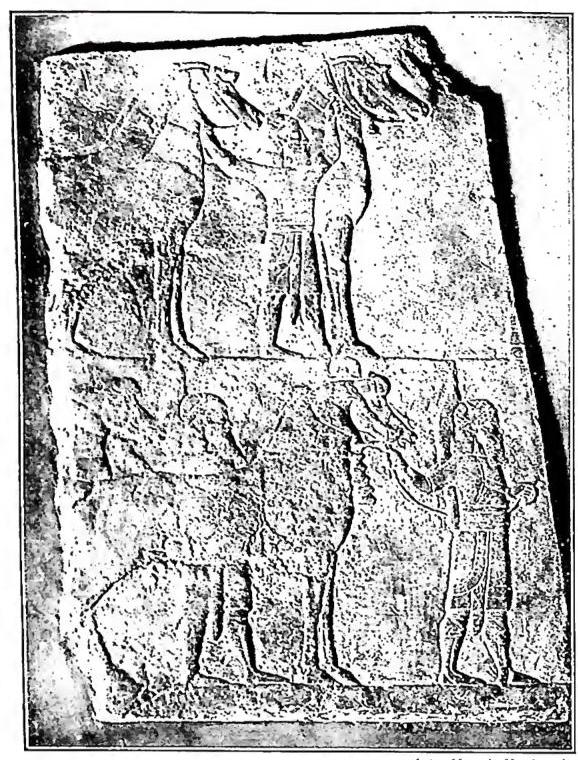
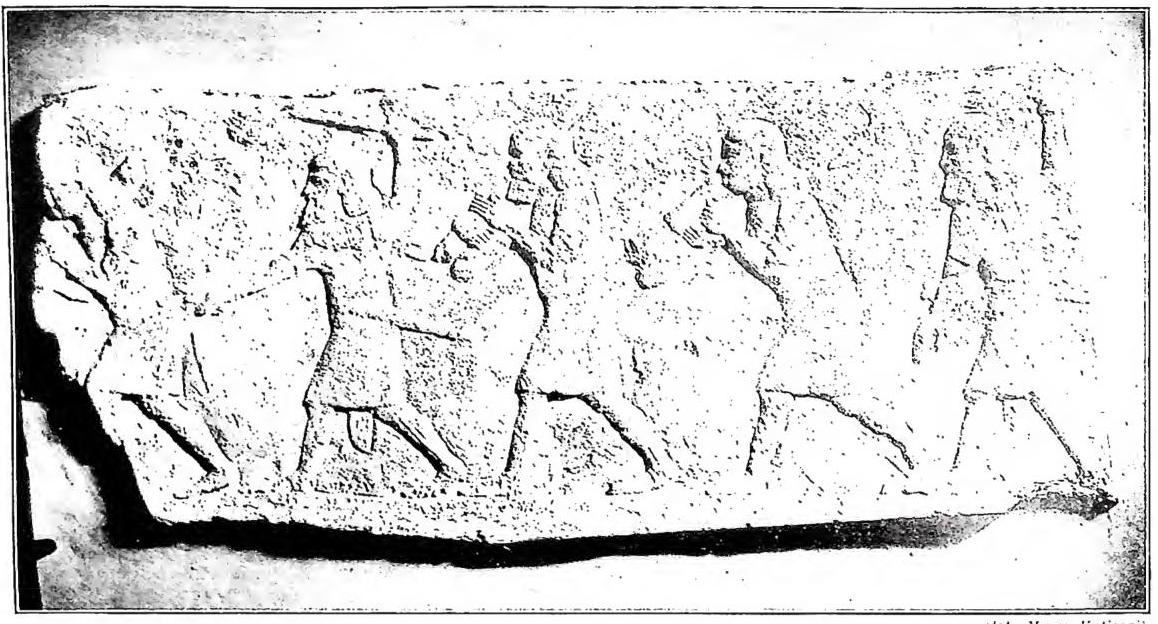
BABILONESI - Above, a groom with two draft horses. Below, two groomsmen with two saddle horses - Age of Assurbanipal (7th century B.C.) - Vatican Museums, Assyrian relief staircase.
Aššur-bēl-kala, grandson and successor of Theglathphalasar, was bound by friendship with Marduk-šāpik-zēr-mati, king of Babylon: but when the latter was deposed by Adad-aplu-iddina, an Aramean, son of Itti-Marduk-balātu, he allied himself with the usurper and married his daughter.
After the reign of Aššur-bēl-kala, the history of Assyria is almost unknown to us for a period of approximately 130 years; only from later inscriptions do we know that under the reign of Aššur-rābi II (1010-970) Assyria lost the Aramean provinces along the course of the Euphrates, already conquered by Theglathphalasar, and that a later king, Salmanassar III (858-824), would recover them. Another king, Aššur-riš-iši II, placed his statue in the mountains of northern Assyria; near Mount Amanus, which demonstrates that he continued the Mediterranean expeditions of Theglathphalasar I.
Around 950, Theglathphalasar II ascended the throne of Assyria; he was succeeded by his son Aššur-dān II and his grandson Adad-nirāri II. During this period, Babylon was in decline: the nomads of the desert, the Satū, raided Babylonian cities, plundering and devastating them. Ephemeral dynasties succeeded one another on the throne of Babylon, until with the advent of the VIII dynasty (dynasty H), around 1000, a more stable government began. Babylon and Assyria were once again in conflict. Adad-nirāri II inflicted a severe defeat on Šamaš-mudammiq, fourth and fifth king of the new dynasty, and won a second victory over Nabū-šum-ukān I, the murderer and successor of Šamaš-mudammiq, conquering several Babylonian cities. Then friendly relations were established between the two countries, and each of the two kings married the daughter of the other.
In the 9th century, a revival of the Assyrian kingdom occurred with the advent of Tukulti-ninurta II (888-884 B.C.). He conquered as far as Lake Urmia, while in the northwest he penetrated as far as Commagene. His son Assurnasirpal III (885-860) completed these military successes, penetrating even further into the regions of the lakes of Van and Urmia, defeating and temporarily subjugating the Kirhi, the Kirruri, and the Nummi, who occupied the regions between the two lakes to the west and north. These regions, called the "Land of Nairi," mountainous and difficult to access, a safe refuge for the continuous waves of hordes seeking to penetrate the south, the new Assyrian empire never managed to subdue completely.
Assurnasirpal, with his campaigns, had to oppose the movements of raiders coming from the desert toward the south and west of the Euphrates. The bedouin Sutū, Aramean nomads from the deserts of Arabia, were repelled and dispersed; several small cities along the Chabur tributary were forced to recognize the supremacy of Assur, whose armies reoccupied the Hittite and Moschi countries to the northwest.
But Babylon bore this Assyrian expansion with ill will, especially due to the interruption of trade routes along the Euphrates; its king Nabū-apal-iddin allied himself with the king of Suhi, a small state located along the Euphrates at the mouth of the Chabur. But Assurnasirpal prevailed over the united forces, capturing the brother of the Babylonian king along with the commander of his army. After this battle, friendly relations followed between the two countries, which continued until the reign of Salmanassar III.
The enormous booty and heavy tributes imposed on the conquered peoples, while ensuring the prosperity of the conquerors, diminished the resistance of the countries subjected to Assyrian hegemony. The ferocious manner of waging war established by Assurnasirpal was imitated by his successors; conquered cities were plundered, destroyed, and burned; peoples who resisted were put to the sword; on the walls of conquered cities were displayed the severed heads or the skins of enemies flayed alive. But this cruelty and oppressive Assyrian yoke only succeeded in alienating the spirit of the momentarily subjugated populations and fostered rebellions that the Assyrian governors, placed by the king in the conquered regions, were unable to suppress.
Salmanassar III (858-824) personally directed his military campaigns for an uninterrupted period of 26 years; he extended his conquests as far west as Lake Urmia and also defeated Parsua and Namri. In Armenia (Urartu), north of Lake Van, where a powerful kingdom had arisen, he waged war against the kings Arimi and Sarduri I. In Cilicia, he extended his campaigns as far as Tarsus and in the north to the land of Tabal and Musri (west of Melitene), emerging victorious everywhere. In Babylon, where two brothers were disputing power, he was called to the aid of one of them and defeated the adversary; but his son, Aššur-dān-apla, conspired against him. Šamši-adad V (823-810) managed to rid himself of his brother and secured his right to the throne. He spent the 12 years of his reign consolidating his father's conquests. To this end, he traversed almost the same countries. He also fought and defeated the king of Babylon, Marduk-balātu-iqbi, who had gathered mercenary troops from Elam, Urartu (Chaldea), and other districts. The reign of Adad-nirāri III (809-782), son of Sammuramat (the Semiramis of Greek legend), was even more splendid. He subdued part of Babylon, reconquered the land of Nairi:
in Media he reached the "great sea of the rising sun" (the Caspian Sea): he victoriously traversed the lands of Hatti, Amurru, Tyre, Sidon; he subjected the "land of Omri" (Palestine) to tribute as far as the "great sea of the setting sun" (Mediterranean); Damascus was besieged and sacked; a considerable booty of gold, silver, copper, iron, fabrics, ivory objects, was transported to Assyria. However, to the north and northwest, several provinces were wrested from him by a kingdom that had newly arisen there. Menuas, king of Urartu (Armenia), had taken from his southern neighbors the provinces of Melitene and the land of Dajaini.
Under the reign of Adad-nirāri's successors, the power of Urartu consolidated at the expense of Assyria, as Argistis and Sarduris II (760-730) extended their dominion over the entire land of Nairi, north of the Tigris, from Lake Urmia to Melitene. For the treatment of the subsequent history of Assyria, V. THEGLATHPHALASAR III (745-727), SALMANASSAR V (726-722) son of Theglathphalasar III; SARGON (722-705), SENNACHERIB (704-681), ASSURBANIPAL (669-626).
5. Neo-Babylonian Empire
Following the victories obtained, the Medes occupied Assyria, and Nabopolassar (625-605) became absolute lord of Mesopotamia. Babylon, finally free from Assyrian oppression, rose to new life and great splendor.To oppose the advances of the Egyptian army, Nabopolassar sent an army under the command of his son Nabuchodonosor. The decisive battle between Egypt and Babylon was fought at Carchemish (604) and marked the defeat of the pharaoh.
After the death of his father, Nabuchodonosor II (604-561) ascended to the throne of Babylon. One of his first expeditions was directed against Jerusalem, which he conquered and destroyed in 586. The population was deported to Babylon along with King Zedekiah, who was blinded. Jerusalem was destroyed, and all precious objects, including the sacred vessels of the temple, were carried off to Babylon as war booty. In 568, Nabuchodonosor began another war against Egypt, though its outcome is unknown. The long reign of this king is justly celebrated also for the magnificent constructions that enriched Babylon with splendid walls, palaces, temples, and gardens. Under his rule, the canals deriving from the Tigris River were restored, even connecting this river with the Euphrates. His successors were rather weak kings: Amēl-Marduk (Evil-Merodach in II Reg. 25:27 ff.; Ier. 52:31), Neriglissar (Nergalšar-ušur), and Labāši-Marduk reigned for only a few years, from 561 to 556. In 555 B.C., the priestly party succeeded in placing Nabonidus on the throne, renowned as a restorer of temples but lacking military aptitude.
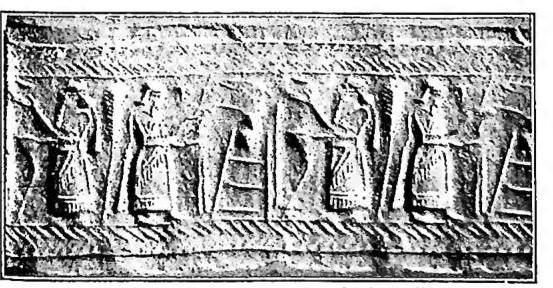
(Propr. Prof. D. E. Van Buren)
BABILONESI - Assyrian seal. Age of Assurnasirpal II (9th century B.C.).
Vatican Library, Museo Profano.
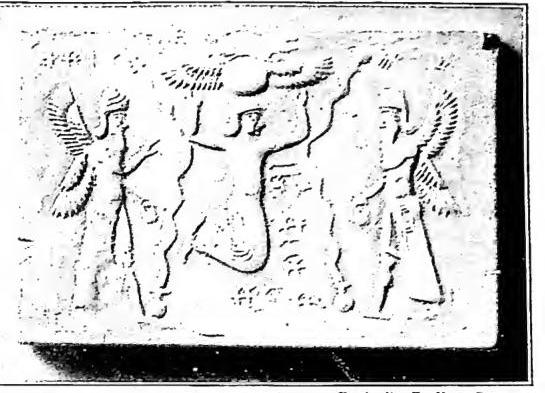
(Prof. D. E. Van Buren) BABILONESI - Assyrian cylinder with astronomical symbols (c. 7th century B.C.).
II. BABYLONIAN-ASSYRIAN LITERATURE AND THE BIBLE
A vast recent literature argues that the Bible, particularly the Pentateuch, derives from Assyro-Babylonian sources.The earlier Babylonian sources from which the author of the Tōrāh is said to have drawn are: 1) the Enūma elīš (v.), that is, the poem of creation (cf. H. Gressmann, A. O. Texte, II, pp. 108-38); 2) The account of the Flood (v.), on which cf. A. Deimel in Orientalia, 20 [1926], pp. 69-79; 3) The catalogues of legendary Babylonian kings (cf. A. Deimel in Orientalia, 17 [1925], pp. 33-47); 4) The legislation of the Sumerian code and especially HAMMURABI (HAMMURAPI) (v.), which contains many articles resembling those of the Pentateuch’s author (translated and published by P. Scheil, IV Délégation en Perse, Paris 1904).
Anyone who compares even superficially the first three Babylonian sources with the data of the Pentateuch observes some distant resemblance in form, combined with great diversity in substance.
Referring to Enūma elīš (v.) and Gilgameš (v.), it is sufficient to note the legendary character of the ten primitive Babylonian kings, who, according to Berosus, reigned 430,000 years; according to two cuneiform documents discovered in this century (Wald-Blundell edition by St. Langdon: Historical Inscriptions..., Oxford 1923), reigned either 241,200 years (1st doc.) or 456,000 years (2nd doc.). Any comparison between these Patriarchs (v.) of Gen. 5, therefore, lacks foundation.
In literature, some resemblance between the Babylonian and the biblical cannot be denied. And this is natural. The Assyro-Babylonian and the Hebrew are both Semitic peoples. The seer, even if inspired, if he wished to have
Assyro-Babylonian history offers some very interesting synchronisms for the history of the kings of Samaria and Judea; by citing their names and fixing their dates, it lends support to the biblical account (v. ASSIRI).
It could be supposed that the two Semitic branches, Babylonian-Assyrian and Hebrew, which shared a common mother tongue, also had, in remote times, a commonality of religious and moral ideas. The Hebrew branch, guided by Jahweh and the Patriarchs, kept the primitive morality and religion pure from corruption.
The Babylonian-Assyrian branch, in contact with other polytheistic peoples and not sustained by the calls of spiritual guides, thus deviating in some religious and moral aspects, nevertheless preserved, thanks to that common origin, a religious and moral idea not devoid of a certain nobility.
v. J
C., I: Histoire, Paris 1922, pp. 7-35; II: La littérature, ibid. 1923, pp. 2-114, 205-315; III: Les idées religieuses et morales, ibid. 1936, pp. 37-262, 333-402, 417-29; J. Plessis, Babylone, in DBs, I, coll. 713-849; G. Furlani, Babilonia, in Enc. Ital., V, pp. 734-73; B. Bonkamp, Die Bibel im Lichte der Keilschriftforschung, Recklinghausen 1939. - History and culture: F. Thureau-Dangin, La chronologie des dynasties de Sumer et Arcad, Paris 1918; B. Meissner (and E. Weidner), Babylonien und Assyrien, 2 vols., Heidelberg 1920-25; id., Könige Babylonien und Assyrien, Leipzig 1926; G. Contenau, La civilisation assyro-babylonienne, Paris 1922; P. Dhorme, L'aurore de l'histoire babylonienne, in Rev. Biblique, 33 (1924), pp. 534-56; 35 (1926), pp. 62-82, 233-39, 534-47; E. Meyer, Die ältere Chronologie Babyloniens, Assyriens und Aegyptens, Stuttgart 1925; A. Deimel, Die bibl. Paradieserzählung und ihre babylon. Parallelen, in Orientalia, 19 (1925), pp. 90-100; id., Der bibl. Sintflutbericht und die Keilinschriften, ibid., 20 (1926), pp. 69-79; id., Enāma eliš und Hexaëmeron, Roma 1934; F. Hommel, Historia de antiguo Oriente (Spanish trans.), Barcelona 1927-28; E. Ebeling, Geschichte des alten Morgenlandes (Sammlung Göschen), Berlin 1929; G. Castellino, Le lamentazioni individuali e gli inni in Babilonia e in Israele, Torino 1940; A. Bea, Die Texte von Mari und das A. T., in Biblica, 21 (1940), pp. 188-90; A. Heidel, The Babylonian Genesis, the Story of the Creation, Chicago 1942; A. Vincent, L'aube de la civilisation: Les Sumériens, in La Revue, Paris 1948.Giustino Boson
### III. RELIGION.
The principal gods of the Sumerians, who are also found in the Babylonian pantheon, are Anu, god of the sky and king of the gods; Enlil, patron of Nippur and god of the earth; Enki, patron of Eridu and god of the waters, called Ea by the Semites; Enzu, god of the moon and patron of Urim, later called Uru by the Babylonians; Udu or Babbar, god of the sun and patron of Larsa; Ninni, goddess of the planet Venus, identified by the Semites with Ištar, lady of Uruk; Dumuzi-abzu, "son of the apsū," that is, of the abyss, meaning Enki. The Babylonians made Tammūz out of Dumuzi.
6. The Gods
According to the Babylonians and Assyrians, the vast throngs of deities they worshipped formed a complex of various divine families, each headed by a married couple who had a great number of ministers at their service. The gods were the personification, in human form, of various forces of nature, such as water and fire, or of cosmic beings, such as the sky, the moon, and the stars, or of moral concepts, such as justice and law. Already in origin, the divine figures of the Babylonians and Assyrians mostly had an astral character, but over time they became increasingly astralized, and in the Neo-Babylonian or Chaldean period, astralization reached its peak. At that time, all the most prominent gods had either a star, a planet, or a constellation as their manifestation, and alongside the ancient planetary gods, stellar deities of the same nature were also worshipped.The Babylonians and Assyrians distinguished among their gods primarily some triads, whose worship exerted a certain influence on religious ceremonies. The cosmic triad was composed of Anu, god of the sky; Enlil, god of the earth; and Ea, god of the waters—thus identical to that of the Sumerians. The astral triad included Sin, the moon god; Šamaš, the sun god; and Ištar, the goddess of the planet Venus, the goddess of war (especially among the Assyrians) and of love and pleasure. In the ceremonies of the bāri, the divining priest, another triad played a significant role, consisting of Šamaš, Adad (god of rain, lightning, and storms), and Marduk. All three of these deities, especially the first two, revealed the future to humans through lightning and rain. The cultic or sacrificial triad comprised Ea, Šamaš, and Marduk.
The Marduk (v.), whereas Assur (v.).
The god of rain, storms, and lightning, Adad, was worshipped more in Assyria than in Babylonia and was identified with Amurrū, the national god of the West. It was said of Adad that he proclaimed his will in lightning and thunder. In thunder, one heard the bellowing of the god’s bull. Adad brings the hurricane, the evil wind, the storm, the earthquake, and famine. Yet he is also the god of beneficial rain, the one who makes crops grow and causes the flood that brings silt to the plain.
Nābū, son of Marduk, was greatly venerated in Babylonia, but in the last centuries of Assyria, he also gained great fame in that country. The name Nābū is of Semitic origin and means "the announcer" or "the prophet." He was the local god of the city of Borsippa, south of Babylon. He was the god of arts and crafts, of writing and wisdom, the minister of the gods and their secretary, and he carried the tablets of the gods' destinies.
The god of the underworld and death, of war and pestilence, was Nērgal, husband of Ereškigal, mistress of the underworld. He was a malevolent god but also had some traits of a benevolent deity. He was seen as a great warrior, a destructive god who commanded an innumerable host of nefarious and horrible demons—true executioners who punished sinful and rebellious humans with diseases and other misfortunes, and ultimately with death. It was Nērgal who filled the underworld with the dead. In Babylonia, he was especially worshipped in the city of Kūtū. His star was the planet Mars.
The sun god was called Šamaš in Semitic, meaning "sun." His character did not differ at all from that of the corresponding—or rather, identical—Sumerian god Udu or Babbar. He was regarded as the god of justice and law, and it was from him that the Babylonian king Hammurapi received the laws of the land. Alongside Adad, he was a mantic god.
Of greater importance than him was the moon god, Sin, identical to the Sumerian god Nanna. The name Sin was formed by the Semites of the Valley of the Two Rivers from two Sumerian words meaning "lord of wisdom."
Tamūz was the ancient Sumerian agrarian god Dumuzi, worshipped by both Babylonians and Assyrians, akin to the Egyptian Osiris, the Western Semitic Adonis, the Phrygian Attis, and other similar divine figures. He was the god of livestock, animal births, vegetation, and shepherds. He was also a physician and healer. Tamūz died every year when vegetation disappeared at the beginning of winter and was resurrected in spring with the rebirth of nature, brought back to earth from the arallā (v.) by his mother, wife, or sister.
An ancient chthonic god was Dagan, who was also a god of vegetation. The ancient Mesopotamians had several deities of fire and light: Nusku, Gibil, and Išum. The seven Pleiades were simply called "the Seven."
The preeminent goddess of Babylonia and Assyria was Ištar (v.). Ištar was almost identical to the Sumerian goddess Ninni or Innini, a goddess of both war and love. Her position among the goddesses was so prominent in Assyria that her name came to mean "goddess" in general. The Mesopotamians had a great number of other female deities,
almost all goddesses of procreation or medicine, but their figures merged almost entirely with that of Ištar.
The number of deities was truly overwhelming, but the most worshipped were the great gods, the illāni rabūti, essentially identical to the seven planetary gods: the Moon, the Sun, Venus, Jupiter, Mercury, Mars, and Saturn. A distinction was made between the gods of the sky, the Igigi, and those of the earth, the Anunnaki.
In the hierarchy of the universe’s beings, below the gods stand the demons, mostly evil, enemies of humans, and executors of the gods, whom the latter unleash when they wish to punish a sinner or rebel. Demons inflict all kinds of pain and misfortune on humans, penetrate their bodies, nest within them, and are thus the cause of the many diseases that afflict them. Finally, they kill mortals if the latter cannot somehow appease them or divert their attention from the afflicted person. Humans seek to defend themselves from demons also through amulets, which are incantations written on tablets. Babylonian and Assyrian demonology, mostly of Sumerian origin, was highly developed. Everywhere, Mesopotamians saw demons and evil spirits. Their lives were thus a continuous struggle against demonic attacks. If religion was the service rendered to the gods, they spent much more time defending themselves from demons.
7. Mythology
Around their principal deities, the Mesopotamians developed a rich mythology. The Babylonians had a myth of Marduk, largely drawn from earlier Sumerian myths, to which a poet gave the form of an epic. Since the Enūma eliš (v.)—this is the title given to it by the Babylonians, meaning "When on high"—aims to explain how Marduk became the national god of the land, this epic should be called the "Exaltation of Marduk."Among the other myths, particular mention should be made of that of Ištar’s descent into the underworld and that which speaks of Nērgal and Ereškigal to explain how the god of death became the king of hell. Other mythical poems describe the myth of Etana and the eagle, with the hero’s flight to heaven and his fall, the creation of man by various deities, Adapa (v.), son of Ea, and how he failed to obtain eternal life, as well as other episodes from the lives of various gods and goddesses of Mesopotamia. The vast majority of these myths derive from Sumerian originals, some of which have come down to us.
In addition to the Enūma eliš, the ancient Mesopotamians had an epic whose central figure was an ancient king of the city of Uruk, Gilgameš (v.), alongside whom stands the equally heroic figure of his close friend Enkidu. This mythical epic is a patchwork of the Sumerian epic of Gilgameš and Enkidu.
8. Magic
The religious life of Babylon and Assyria is characterized by the great importance given to exorcistic, magical, and incantatory practices, to the art of divination—that is, the prediction of the future from a vast number of circumstances and through the oracles of the gods—and to the rites and ceremonies performed in the grandiose and numerous temples of the cities, officiated by large groups of priests and attendants.Exorcisms and incantations had as their patron the god of water, since water was the quintessential magical and enchanting element. The exorcist priest āšīpu (v.) thus invoked the god Ea, whose rites and ceremonies he performed using water (mū ellū), consecrated precisely by this god. The most elaborate exorcisms consisted of a description of the demon, illness, or spell afflicting the sick person; a declaration that Marduk sees the demon or spell but, not knowing what means to adopt to banish or break it, asks his father Ea for advice and help; a dialogue between the two deities; and a commission from Ea to employ the indicated exorcistic means. A good part of the exorcisms is dedicated to the exorcism of the sick person, beset by demons, to drive them away by throwing them some morsel of pork or lamb. The Babylonian and Assyrian texts containing descriptions of exorcisms and incantations are extremely numerous and belong to all periods. Related to exorcisms were magical acts, through which one usually sought to cause someone’s death. For this purpose, for example, clay or other material statuettes were made, which were then destroyed in order to provoke, through their destruction, the destruction or death of the person represented. Alternatively, a magical formula was recited while plucking a plant or breaking a stick, always with the aim of bringing about the death of the person symbolically represented, based on the concept that the symbol is in reality the object symbolized.
9. Cult
Religious life manifested itself particularly in the numerous religious ceremonies, most of which were performed in temples. The rituals, several of which survive in texts from the late period of Babylonia, describe in great detail all the religious acts of which they consisted, the processions with the statues of the deities, the exorcisms that interrupted them from time to time, the hymns accompanied by sacred instruments, primarily drums and timpani, the processions with the participation of all the gods of the city, and many other incidents of a very different nature. Each important god had an annual great celebration that could last even two weeks: the most renowned was that of Marduk in Babylon, held in the first fortnight of the first month of the year, during which the gods, under the presidency of the national god, fixed the destinies for the year about to begin.Sacrifice was offered to the gods daily, and more abundantly on feast days. It was usually offered in the temple cells and, when it concerned astral deities, on the terrace of the building. The alimentary character of the sacrifice offered to the gods was quite marked.
The priestly class was numerous and included many ranks and types of priests and temple attendants. The diviner priest, bārū, had the task of foretelling the future through the art of divination. He practiced primarily hepatoscopy, that is, the inspection of the liver, especially of lambs, to determine from its shapes, colors, and peculiarities what would happen. The Babylonian and Assyrian, before undertaking anything, consulted the god through divinatory practices. These practices of ancient Mesopotamia spread through literary writings to all other nations of the ancient Near East and also penetrated into the West. The exorcist and conjurer bore the name of maṣmaṣ or āšipu.
Another type of priest was that of the kalū, whose main task was to sing exorcisms and hymns to the gods during ceremonies, accompanied by sacred instruments. The šangā had more administrative than truly religious functions and occupied the highest position in the priesthood.
According to the beliefs of the ancient Mesopotamians, man does not die entirely but enters a particular state in which he retains his body and passes into the underworld, the arallā, where, however, he leads a very wretched and dull life. The Babylonians and Assyrians buried the bodies of the dead. They placed beside the deceased the tools and objects he had used during his life and brought food and drink to the tomb so that he would not risk suffering hunger and thirst. Thus, the condition of those who had no relatives ready to provide for them in the afterlife was sad.
(fot. Alinari)
BABILONESI - Winged genius with the head of an eagle before the sacred tree. Bas-relief found at Nimrūd, palace of King Assurnasirpal, 9th century B.C. Paris, Louvre Museum.
Sacrifice was offered to the gods daily, and more abundantly on feast days. It was usually offered in the temple cells and, when dealing with astral deities, on the terrace of the building. The alimentary character of the sacrifice offered to the gods was quite marked.
The priestly class was numerous and comprised many ranks and types of priests and temple attendants. The divining priest, bārū, had the task of foretelling the future through mantic science. He practiced primarily hepatoscopy, that is, the inspection of the liver, particularly of lambs, to
continue during his life, and they brought food and drink to the tomb so that he would not risk suffering hunger and thirst. Thus, the condition of those who had no relatives ready to provide sustenance for the afterlife was sad.
to visit Marduk; and on the 10th of Nisan (March-April), at the passage of Marduk and the other gods, emerging from the grand temple Esagila, to which the famous tower Etemenanki was attached, visible from a great distance, for the solemn procession that concluded the New Year's festival. This "holy gate," always closed and walled up, inspired Ex. 44,3. The name of the district was extended to the entire city.
Sargon I (ca. 2340 B.C.) presents himself as the founder of Babel; but this is much older; Sargon merely rescued this Sumerian village or small town from oblivion, situated in a privileged geographical position on the route between the Persian Gulf, Syria, and the Mediterranean. Babel was first a capital under Sar-kali-šarri (dynasty of Akkad); the importance of this religious city gradually grew under the Third Dynasty of Ur (ca. 2067-1960).
After the first Akkadian empire, with Sargon, Babel became the capital again with the first Amorite dynasty (1830-1530 B.C.); the Assyrians (v. ASSIRI) subdued it, Sennacherib destroyed it (690 B.C.), his successors rebuilt II. It reached its greatest splendor under Nebuchadnezzar (605-562 B.C.), who made it the greatest and most famous capital of antiquity, so much so that it was elevated to a symbol of prosperity and magnificence.
From 538 onward, the beginning of Persian domination, the decline foretold by the prophets (Is. 13 and 21; Ier. 50 and 51) began, which was completed by the Parthians in 126 B.C.
For the captivity of the Jews in Babylon V. ESILIO BABILONESE.
From 1899 onward, systematic excavations were conducted by R. Koldewey near the present-day village of Hillah; the ruins of the great metropolis extend mainly on the left bank of the Euphrates, around the current el-Merkez; further north, the village of Babil has preserved the ancient name. - See Pl. XXXIX.
20 (1936), p. 201; F. Wetzel and F. H. Weissbach, Das Hauptheiligtum des Marduk in Babylon, Esagila und Etemenanki, Leipzig 1938; M. Rutten, Babylone, Paris 1948; provides an overview of the city, its districts, public buildings, temples, and excavations.