
HAMMURABI (HAMMURAPI). – Sixth king of the first Babylonian dynasty, son of Sin-muballi; he reigned for 43 years.
I. LIFE
Babylon, under the first dynasty, of Amorite origin, represented the outpost of the Amorite invasion, which came from the West and advanced through a series of marches established across all the lands along the Euphrates. With H., it became the heir of the entire Sumero-Akkadian civilization, more than a thousand years old, itself in turn heir to the great prehistoric civilizations (Gemdet Nasr, Uruk, Obejd, and, still more anciently, Halaf in the north and Eridu in the south). The Amorites received this inheritance from the past, directly or indirectly, reshaped it, and left their imprint upon it so powerfully and enduringly that Babylon became the great spiritual metropolis, whose radiance imposed itself even upon its enemies and traversed the centuries.H.’s work in foreign policy was to establish the power of Babylon and make it the center of an empire.
The conqueror knew how to administer, reconcile, and make justice prevail. His entire correspondence, especially that with the provincial governor Sin-idinnam, with Šamaš-þašir, manager of an estate, and with other high officials such as Balmunambe, is highly revealing. Personally or through Lú (Awil)-Ninurta, who served as prime minister, H. supervised all important affairs. This correspondence, now supplemented by that of the court of Mari (the Assyrian period and the national period) and of Assyria (Šamsi-Addu and Išme-Dagan), makes it possible to understand the life of the Mesopotamian states in one of the most brilliant periods of their history. Numerous hypotheses have been advanced concerning H.’s exact period, and the extreme conclusions range from the twenty-second to the eighteenth century B.C. The recent discoveries at Mari have forced a revision of certain synchronisms that had seemed established. The new excavations and newly discovered texts, together with the advances made by Oriental studies in recent years throughout the Middle East, compel a re-examination of the chronological problem as a whole, as well as of the particular absolute and relative chronologies. Some scholars are inclined to place H. later, in the eighteenth or even the seventeenth century. This tendency is gaining increasing favor among experts. Taken as a whole, this view, which entails numerous variations, is highly probable: many even consider it proven; nevertheless, some scholars currently prefer to retain the traditional dates and place H. in the twentieth or nineteenth century.
II. THE CODE OF H
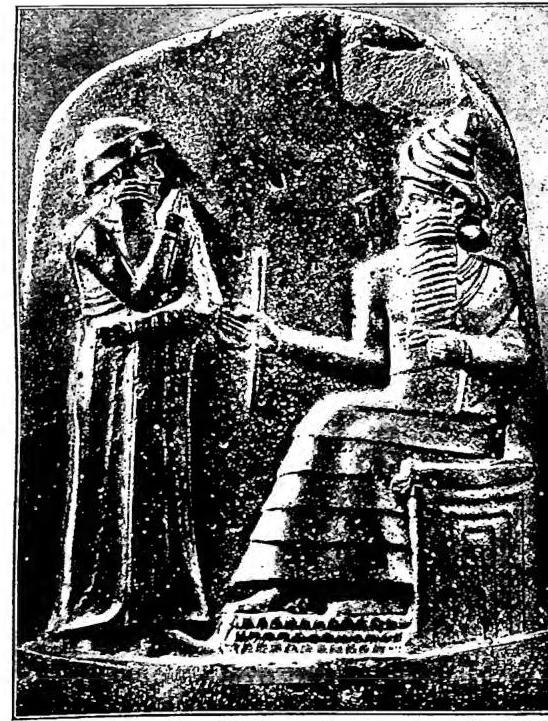
The most important monument of H.’s legislative activity is his code. The principal exemplar is a block 2.25 m high,found broken into three pieces at Susa by the French mission called Délégation en Perse and directed by M. de Morgan, in December 1901–January 1902. This exemplar seems originally to have been erected in the temple of Šamaš at Sippar, and thus placed before the legislating god himself (this is the opinion of V. MERSCH, EMILE), or else in the temple of Marduk at Babylon (according to others). In any case, it was removed by the Elamite invaders and transported to Susa as war booty. Some paragraphs were even erased by the victors, perhaps to make room for an inscription. The text was copied at different periods and in different countries; these copies have made it possible to reconstruct, approximately, the damaged portions and have supplied variants, sometimes interesting, for the preserved parts. The Susa code was transported to Paris, to the Louvre Museum. It was deciphered by V. MERSCH, EMILE (v.).
It is not a code in the modern sense of a systematization of laws, but in the sense of a collection made to be seen by everyone and to which everyone can refer; it stands opposed to collections made chiefly for specialists, such as the collection of Assyrian laws.
It is not a code in the modern sense of a systematization of laws, but in the sense of a collection made to be seen by everyone and to which everyone can refer; it stands opposed to collections made chiefly for specialists, such as the collection of Assyrian laws.
The code has a prologue and an epilogue, composed in dialect and poetic style, and a body of laws (divided by modern scholars into 282 paragraphs), written in the dialect and style of the royal chancery, clear and precise, without technical terminology. The legislative section can be divided into three major sections: property law, family law, and social law (criminal and civil). This division is not entirely adequate according to modern concepts, but it is convenient.
For a long time H.’s code was regarded as an almost unique document, and there was a tendency to see in it a kind of miracle, attributing to H. an originality that he does not possess. The discoveries in recent years (1945–47) of the code of Ešnunna (or the code of Bilalama) and the code of Lipit-Ištar—the first in Akkadian, the second in Sumerian, earlier than H.’s by approximately two centuries and a century and a half respectively, and originating, one from the northeast and the other from the south of Babylonia—make it necessary to revise this judgment. H.’s code belongs to the great Sumero-Akkadian, or Mesopotamian, juridical tradition. All the great Sumerian or Akkadian sovereigns had declared themselves legislators, and their juridical activity is demonstrated by acts and legal provisions, such as those of Urukagina (at the end of the dynasty of Lagaš). H.’s originality consisted in being the legislator of an Empire and in entering into the juridical tradition by completing it, harmonizing the

It is impossible here even to sketch a comparison with the other legislations: the collection of Assyrian laws, the Hittite code, the customs of Nuzi. These partake of Mesopotamian law, modified, however, by the usages and particular rights of the civilizations that produced them.
Nor is it possible to establish a detailed comparison with Israelite law. It is enough to observe that Mesopotamian law is that of a commercial country, which lives by production, exchange, and transit in every sphere. Its concern is to guarantee justice and security within a civilization that is at once stable and «open». Israelite law is certainly influenced by Mesopotamian law, but also by the usages of nomads and semi-nomads (in this it would approach the customary law of Nuzi); it is the law of a small people threatened by the great Empires, seeking to preserve its faith, traditions, and integrity, and therefore it might almost be called a «protectionist» and «closed» law. Moreover, Israelite law possesses a very distinctive character of theocratic monotheism. Leaving aside what is revelation and monotheism in Israel, one may say that H. sought, while maintaining the religious spirit, to establish a distinction between everything belonging to sacerdotal or clerical authority and what fell within the competence of civil authority. The king, religious head, is sovereign of both orders, since religion is their foundation, but the functions must be distinct. There is likewise an abyss between Jewish monotheism and the religious unification attempted by H.
The age of H. is also that of Abraham (even if one does not accept the extremely doubtful identification of Amraphel [v.] with H.; and even if Abraham and H. were not exactly contemporaries). This was the age of the first classical Babylonian civilization, in which Mesopotamian culture, rich in an exceedingly long past, reached one of its highest expressions: a classical age, not only for the ancient East, but for humanity as a whole.
Other figures bearing the name H. have been revealed by the letters of Mari.