Elam (v.).
The very ancient Sūšan ("lily" or "whiteness"), situated at the southern foot of the mountain range of present-day Luristān, is known from the time of the Second Dynasty of Ur. By the end of the Third Dynasty of Ur (21st century B.C.) it already had several kings. It became the capital of the glorious Elamite Empire (cf. Gen. 10:22; 14:1) and later of the Neo-Elamite Kingdom.
The Assyrian Ashurbanipal sacked S. (640-639 B.C.), burned the sacred groves, invaded and destroyed the sanctuaries and the great ziggurat with its glazed bricks, carried off about 32 statues of gold and silver of deities and kings, violated their tombs and scattered their bones. Among the Samaritans who wrote to Artaxerxes against the Jews, there were also those deported from S. (Ezra 4:9), probably by Ashurbanipal (the Aramaic Anappar), who scattered the inhabitants of S. and all Elam throughout his empire and sent various colonists to S.
With the Persians, S. returned to its former splendor. Darius I settled there, and his successors gladly spent the spring in Persepolis (v.), the summer in Ecbatana, and the winter in S. Darius I (c. 500) began the construction of the great Dioscurion (more than 100 steps) of the royal palace (cf. Esth. 1:5); he dwelt there for the last three years of his life and died there in 486. In the time of Artaxerxes I (445-442), a great fire destroyed the Apadana, the great hall supported by numerous columns which served for government assemblies (cf. ibid. 1:3); it was restored by Artaxerxes II (404-359), who made many other alterations elsewhere. The events of the Book of Esther take place in S.
Excavations, after the discovery by L. Loftus in 1851 (v. BIBLICA) near the present-day village of Sūš, were begun by M. Dieulafoy (1884-1886) and continued by J. Morgan (1889) and the Mission archéologique en Perse, initially directed by the latter. The entire ruin complex consists of four mounds or tells. The artisans' city or lower city, a kind of suburb, is of little interest; it lies to the northeast of the other three tells. These form a very compact group, surrounded by walls: this is the city proper. Within it, two well-distinguished parts: to the left of the river (the ancient Coaspe, the modern Kerkha), the acropolis or citadel, occupied by the royal palace; to the right (east), the immense tell of the inhabited city of the people. Esth. 3:15; 9:6, etc., distinguishes the two parts with different names: in Hebrew, respectively, brāḥ (Aramaic "fortress," and by extension "acropolis") and 'pr. In the citadel (Neh. 1:1) Nehemiah received sad news from a relative, arrived from Jerusalem, about the failure to rebuild the walls of the city.
Between the two tells of the acropolis and the Apadana (citadel), a vast quadrilateral raised above the plain, there is a depression which formed a large square (parade ground and bazaar), the heart of the city. In the so-called imperial quarter, it has been possible to trace the period from the Muslim era back to the Sassanian and native periods, with rich finds. Of the palace of Darius I, it has been possible to identify the site of the internal and external walls, which have completely disappeared.
SUSA, DIOCESE OF
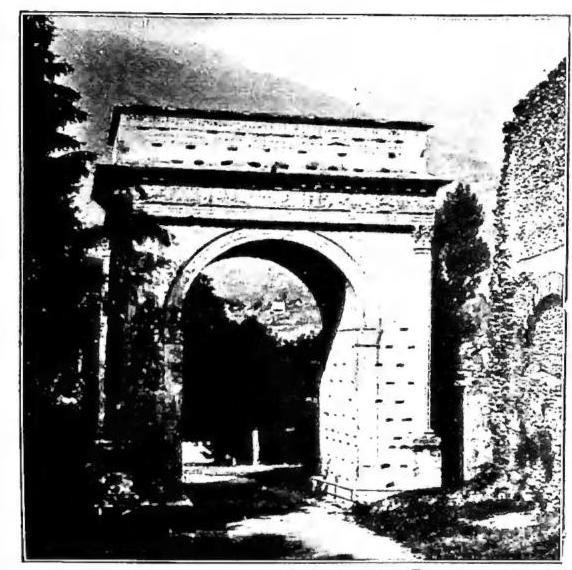
An arch erected by King Cozio I in honor of Augustus, in the year 9 B.C. — Susa.